Choosing High Output Bubble Machines for Large Events: Key Factors
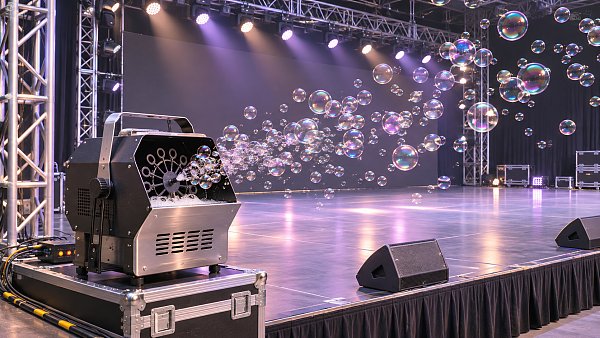
For project managers planning a large event, bubbles may seem like a small production detail—until the effect fades halfway through a headline moment or fluid runs out during a crowded program. Choosing high output bubble machines involves more than finding the largest advertised output. Coverage, operating duration, power availability, fluid management, placement, and safety all shape whether the effect works when the audience is watching.
The best choice is the machine—or combination of machines—that fits the show plan and can be operated reliably by the crew. Before comparing products, define where the bubbles need to appear, for how long, and under what venue conditions.
Start with the effect, not the output claim
“High output” is useful as a category, but it is not a consistent measurement on its own. Suppliers may describe performance in bubbles per minute, fluid consumption, fan capacity, or an estimated coverage area. These figures are difficult to compare unless the test conditions are similar. Bubble size, fluid formulation, airflow, and the method used to estimate output can all affect the result.
Translate the creative brief into an operational requirement. Is the aim to create a dense burst around a stage entrance, maintain a gentle atmosphere over a reception area, or fill a large outdoor space during a finale? Each calls for a different balance of volume, direction, and duration.
- Coverage: Identify the audience or performance zone where bubbles should be visible, rather than using the venue’s total floor area alone.
- Timing: List the cues, their duration, and the intervals between them. A machine used for brief bursts has different demands from one running throughout a reception.
- Placement: Mark viable positions, access routes, power points, and areas where equipment must remain out of sight.
- Operating conditions: Note whether the event is indoors, outdoors, or in a partially enclosed space, and whether ventilation or wind will influence the effect.
A short written specification gives suppliers a common basis for their recommendations. It also gives the production team a way to judge whether a proposed machine is actually suitable, rather than simply impressive on a sales sheet.
Coverage depends on airflow as much as bubble volume
A machine can generate a large number of bubbles without distributing them where they are wanted. Fan direction, mounting height, room ventilation, and nearby obstructions all affect the visible result. In an indoor venue, air-conditioning currents may carry bubbles away from the stage or concentrate them near a doorway. Outdoors, changing wind can make a carefully planned effect drift off course.
Ask suppliers how their equipment is intended to project bubbles and whether the airflow or output direction can be adjusted. Request a demonstration using the intended fluid where possible. A video can be helpful for an initial review, but a site test or a comparable venue test provides a better basis for assessing coverage.
For wide or irregular spaces, multiple strategically placed machines may deliver more even coverage than one large unit. That approach also introduces more cabling, refill points, and control requirements. Compare the complete installation, not just the number of units. If a single machine fails, will the effect disappear entirely? If several machines are used, can the crew operate them together without missed cues?
Indoor and outdoor decisions are not interchangeable
Indoor events offer more control over weather, but surfaces, ventilation, fire-safety arrangements, and audience movement may constrain placement. A venue may also have restrictions on fluids or effects near sensitive finishes and equipment.
Outdoor events need a plan for wind, rain, and changing site conditions. Do not assume that a machine is suitable for wet environments because it is used outdoors; verify its environmental protection and follow the manufacturer’s operating limits. Where weather exposure is possible, agree on a protected position and a cancellation or relocation procedure with the production team.
Calculate runtime from the actual cue schedule
Tank capacity matters, but it is not a runtime figure by itself. The useful estimate is based on both the available fluid and the machine’s consumption at the selected output setting:
Estimated runtime = usable fluid capacity ÷ fluid consumption per hour.
For example, if a machine has 5 liters of usable fluid and consumes 1 liter per hour at the required setting, the theoretical runtime is five hours. Real operating time may differ, so confirm consumption with the supplier and test it under the planned conditions. Do not treat the full tank volume as usable unless the manufacturer confirms it.
For intermittent effects, add the duration of all scheduled cues rather than using the full event length. Then account for rehearsals, testing, unexpected extensions, and fluid needed to restart or maintain the system. A reserve is sensible, but its size should reflect the consequences of running out and the practical opportunity to refill.
Refilling deserves as much attention as the calculation. A large tank is of limited value if the crew must cross a public area or interrupt a performance to reach it. Check whether the reservoir is removable, whether the machine must be switched off before filling, and how spills will be contained. If an external reservoir or continuous-feed option is proposed, verify compatibility and secure the fluid lines so they do not create access hazards.
Compare machines as complete event systems
Procurement decisions often focus on the machine body, while the operational costs and constraints sit around it. Use the following comparison when requesting quotes or reviewing rental proposals.
Control deserves particular attention for programmed events. A simple local switch may be adequate for an attendant running a continuous effect. For a show with precise transitions, confirm whether the machine supports the production team’s control method, how it behaves after a power interruption, and whether an operator can stop it quickly. Do not assume that a remote-control feature is compatible with an existing show-control system.
Build safety and venue approval into the selection
Bubble effects introduce liquid into an occupied space. Depending on the fluid, surface, and amount used, residue may create a slip concern or require cleaning. Discuss the proposed effect with the venue before committing to equipment, especially around stairs, polished floors, entrances, stage edges, and accessibility routes.
Request the fluid’s safety documentation and review the manufacturer’s instructions for both fluid and machine. Confirm that the selected fluid is approved for the equipment; an unsuitable formulation can affect performance or cause maintenance problems. Consider audience exposure, performers’ needs, nearby food service, and any venue-specific restrictions. The venue and event safety team should determine appropriate controls for the actual setting.
Electrical distribution requires the same discipline as any other temporary installation. Confirm supply compatibility and load with a competent person, route and protect cables, and keep electrical connections away from likely spills. For overhead or elevated placement, use only approved mounting provisions and follow the venue’s rigging requirements. A machine should never be placed where it obstructs an exit or compromises emergency access.
Include cleanup in the event plan rather than treating it as an afterthought. Agree who will inspect affected areas, what cleaning methods are suitable for the surfaces, and when cleanup can take place without disrupting guests or the next activity.
What to ask suppliers before approving a quote
A useful supplier conversation should produce evidence for the specific event, not just a list of features. Share the venue layout, cue schedule, desired coverage, installation constraints, and expected operating environment. Then ask for a written response covering:
- Performance assumptions: Under what conditions were output and coverage claims assessed? Can the proposed setup be demonstrated at a comparable distance and height?
- Fluid and runtime: Which fluids are approved, what consumption should be expected at the planned setting, and how should refills be handled?
- Controls and power: What connections, operators, and power arrangements are required for the intended cues?
- Documentation: Can the supplier provide operating instructions, electrical specifications, applicable compliance documentation, and fluid safety information relevant to the destination market?
- Support: What spare parts, replacement equipment, technical assistance, and lead times are available if a unit fails?
When sourcing across borders, check who is responsible for shipping, import requirements, local power compatibility, and post-delivery support. A lower equipment quote may not remain attractive once freight, compatible fluid, consumables, cleaning, and crew time are included. Global Commercial Trade’s sourcing perspective is useful here: the decision should account for the supplier’s ability to support the project as well as the specifications of the machine.
Make the final decision around the weakest link
Before approval, walk through the event as a sequence: delivery, installation, testing, operation, refilling, shutdown, and cleanup. Identify the point most likely to interrupt the effect. It may be limited access to a reservoir, uncertain wind exposure, a control interface the crew has not tested, or the absence of a replacement unit.
Choose high output bubble machines only after those dependencies are understood. For a one-off event, rental may be practical if it includes tested equipment and responsive support. For repeated productions, ownership may make sense when storage, maintenance, consumables, and utilization are accounted for. In either case, a documented site test and a clear operator plan are often more valuable than selecting the highest advertised output.
Search News
Hot Articles
Popular Tags
Need ExpertConsultation?
Connect with our specialized leisureengineering team for procurementstrategies.
Recommended News
 Nov 19, 2026Choosing High Output Bubble Machines for Large Events: Key FactorsChoosing high output bubble machines for a large event? Compare coverage, runtime, fluid needs and safety to deliver a reliable, crowd-pleasing effect.● Pro Audio Engineer
 Oct 19, 2026What Event Technology Stack Suits a 500-Person Corporate Event?Discover what event technology stack fits a 500-person corporate event. Compare registration, check-in, AV, and connectivity to reduce queues, control costs, and engage attendees.● Pro Audio Engineer
 Jul 13, 2026Stage Riser Platforms Explained: Types, Load Ratings, and Best-Fit Event UsesStage riser platforms explained clearly: compare types, load ratings, safety factors, and best-fit event uses to choose smarter, safer solutions for conferences, schools, hotels, and live shows.● Pro Audio Engineer
 Jul 09, 2026SASO Fast Track Cuts Stage Lighting Export Lead TimeSASO Fast Track cuts stage lighting export lead time from 45 days to 12 working days. Learn how Saudi certification changes affect truss suppliers, OEMs, buyers, and shipment planning.● Pro Audio Engineer
 Jul 08, 2026SASO Updates Stage Lighting Label Rules for LED Moving HeadsSASO updates stage lighting label rules for LED moving heads, requiring three-level energy efficiency values and bilingual labels. See what exporters and buyers must do before October 2026.● Pro Audio Engineer
 Jul 07, 2026SASO Adds Energy Label Rules for Stage Lighting ImportsSASO Adds Energy Label Rules for Stage Lighting Imports: learn which stage lighting products now need Arabic energy labels and SASO-recognized test reports before Sept. 1, 2026.● Pro Audio Engineer
 Jul 06, 2026Saudi SASO Sets A+ Rule for Stage LED LightingSaudi SASO sets A+ rule for stage LED lighting from Oct 1, 2026. Learn how the new SASO label and IEC 62722-2-1:2026 standard impact compliance, shipping, and market access.● Pro Audio Engineer
 Jul 04, 2026SASO Tightens RF Test Rules for Wireless Stage ControlsSASO tightens RF test rules for wireless stage controls in Saudi Arabia. Learn how the new IEC 62368-3 requirement impacts stage lighting exports, compliance, and delivery.● Pro Audio Engineer
 Jul 03, 2026Saudi SASO Adds RF Approval Rule for Stage LightingSaudi SASO adds RF approval rule for stage lighting. Learn how the new SASO RoHS+RF certification affects wireless lighting, truss control exports, retail access, and project delivery in Saudi Arabia.● Pro Audio Engineer
 Jul 02, 2026SASO Starts EMC Pilot for Smart Stage Lighting in SaudiSASO starts an EMC pilot for smart stage lighting in Saudi Arabia, impacting dimming controllers, cloud access, and project compliance. See what suppliers and integrators must do now.● Pro Audio Engineer
 Jul 01, 2026Saudi SASO Tightens UV-C Limits for Stage LightingSaudi SASO tightens UV-C limits for stage lighting and truss products. Learn the 2026 SASO IEC 62471 update, retesting deadline, customs risks, and how to protect Saudi shipments.● Pro Audio Engineer
 Jun 30, 2026EN 62471:2026 Adds UV-C Limit for Stage LightingEN 62471:2026 adds a UV-C limit for stage lighting, impacting LED moving heads, laser fixtures, and truss lighting. Learn what changes before Dec 1, 2026.● Pro Audio Engineer
 Jun 29, 2026TUV Adds Wi-Fi 7 EMC Test for Stage LightingTUV Adds Wi-Fi 7 EMC Test for Stage Lighting sold into the EU. Learn the Oct 1, 2026 deadline, retesting rules, and how EN 55032:2024 impacts certificates, shipments, and compliance planning.● Pro Audio Engineer
 Jun 25, 2026LED PAR Cans Wholesale: What to Compare in Wattage, Beam Angle, and DMX ControlLED par cans wholesale buyers should compare wattage, beam angle, and DMX control before requesting quotes. Learn how to avoid costly mismatches and choose fixtures that fit each venue.● Pro Audio Engineer
 Jun 16, 2026Stage Lighting Equipment List for Small Venues: What You Need and How to Plan ItStage lighting equipment for small venues: discover a practical equipment list, planning tips, and smart setup ideas to improve performance, flexibility, and long-term value.● Pro Audio Engineer
 Jun 12, 2026Vietnam Tightens EMC Rules for Stage Lighting LEDsVietnam Tightens EMC Rules for Stage Lighting LEDs: learn how QCVN 139:2026 impacts imports, testing, sourcing, and delivery planning for stage lighting businesses.● Pro Audio Engineer
 Jun 11, 2026LPGA Shanghai Debut Lifts Stage Lighting OrdersStage lighting and truss demand is rising as LPGA Shanghai debuts in 2026. Learn how tighter delivery windows, compliance, and project execution are reshaping global orders.● Pro Audio Engineer
 Jun 04, 2026UK EPR Rules Expand to Stage Lighting and TrussUK EPR rules for stage lighting and truss expand in Q3 2026. Learn how UKCA-linked registration, reporting, recycling fees, and material documentation will affect compliance and market access.● Pro Audio Engineer
 Jun 03, 2026UK EPR Fee Hits Stage Truss Textiles in Q3 2026UK EPR Fee for stage truss textiles starts in Q3 2026. Learn what new recycling charges and UKCA-Flame rules mean for lighting and truss suppliers.● Pro Audio Engineer
 Jun 02, 2026UK EPR Fee Hits Stage Lighting & TrussUK EPR Fee Hits Stage Lighting & Truss products with textile components in 2026. Learn compliance risks, BOM updates, and cost impacts for UK exporters.● Pro Audio Engineer
 May 25, 2026China's Carbon Fiber Truss Strength Up 32% at 2026 Sports ExpoCarbon fiber truss strength up 32% at 2026 Sports Expo—UL 1598 certified, CE+UL ready. Discover how China’s stage infrastructure is winning European music festivals & global tenders.● Pro Audio Engineer
 May 23, 2026Vietnam Mandates Bilingual MSDS for Stage Lighting & Truss ImportsVietnam mandates bilingual MSDS (Vietnamese & Chinese) for stage lighting and truss imports — ensure compliance by July 1, 2026 to avoid shipment rejection.● Pro Audio Engineer
 May 20, 20263 Chinese Stage Lighting Firms Join LA28 Olympic Supplier List3 Chinese stage lighting firms join LA28 Olympic supplier list — showcasing ISO 20121 & UL 1574 compliance, sustainability leadership, and global credibility in live-event infrastructure.● Pro Audio Engineer
 May 20, 2026What matters most when choosing lighting stands crank up?Lighting stands crank up: learn what really matters beyond height—load capacity, crank safety, stability, compatibility, and serviceability—to choose the right stand with confidence.● Pro Audio Engineer