Choosing an Ultrasonic Jewelry Cleaner Manufacturer: What Buyers Should Check
Choosing an Ultrasonic Jewelry Cleaner Manufacturer: What Buyers Should Check
Choosing the right ultrasonic jewelry cleaner manufacturer involves more than comparing unit prices. For procurement teams, cleaning performance, product safety, production capacity, quality control, and after-sales support can all affect the total cost and reliability of a purchase. Whether sourcing equipment for jewelry retailers, workshops, or private-label distribution, buyers need a clear way to assess supplier capabilities and identify risks. This guide outlines the key checks to make before selecting a manufacturing partner.
Start with the jewelry and the working environment
A cleaner that suits a repair workshop may not suit a retail counter. Workshop staff may process multiple pieces, remove polishing compounds, and use specialized cleaning solutions. A retailer may need a quieter, compact machine for occasional cleaning in view of customers. A distributor selling under its own brand needs to consider user instructions, packaging, warranty claims, and replacement parts as well as the machine itself.
Before requesting quotations, define the intended workload: the types and sizes of items, the contamination to be removed, the expected number of cleaning cycles, and whether operators have professional training. Specify the available counter space, electrical supply, drainage arrangements, and any restrictions on noise or heat. These details help suppliers propose comparable equipment rather than simply offering whatever model is already in their catalog.
Jewelry compatibility deserves particular care. Ultrasonic cleaning is not suitable for every gemstone, treatment, setting, or assembled piece. Porous or fractured stones, some treated gems, glued components, and loose settings can be vulnerable. Ask the supplier what guidance accompanies the machine, but do not treat a blanket claim that a cleaner is “safe for all jewelry” as reliable. The jewelry manufacturer’s instructions and an experienced jeweler’s assessment should take precedence for individual items.
Compare cleaning performance under realistic conditions
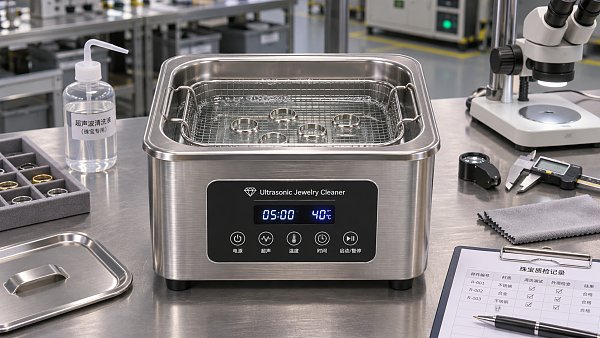
Ultrasonic cleaners use high-frequency sound waves to create cavitation in a liquid. The resulting action can dislodge contamination from surfaces and recesses that are difficult to reach manually. Performance, however, depends on the whole cleaning process: the machine, basket, liquid, temperature, cycle time, item placement, and type of soil.
Ask suppliers to identify the operating frequency, tank capacity, usable liquid volume, ultrasonic power, and heating capability, where applicable. These figures are useful only when defined consistently. For example, establish whether a quoted power value refers to electrical input, ultrasonic output, a nominal rating, or a peak figure. A larger number on a sales sheet does not necessarily mean better cleaning, and nominal tank volume is not the same as usable capacity with a basket installed.
Frequency also involves a trade-off. Lower frequencies can produce more vigorous cavitation, while higher frequencies are often considered for finer or more delicate work. Neither characteristic makes a particular piece of jewelry automatically safe to clean. The right choice depends on the items and the complete process, not on frequency alone.
A practical sample test is more informative than a demonstration on a single easy-to-clean ring. Give shortlisted suppliers the same representative items or test coupons and describe the contamination. Agree on the cleaning solution, dilution, liquid level, temperature, cycle time, and loading pattern. Inspect results in recessed areas as well as on visible surfaces, and check for loosened components or surface changes. Use items that can be safely tested, not irreplaceable customer jewelry.
Repeat the test across several positions in the basket and, where practical, across more than one unit. Uneven results can point to a process or equipment issue worth investigating. A sample test will not prove long-term durability, but it can reveal a poor fit before a larger order is placed.
Look beyond the catalog to establish who makes the equipment
Some suppliers design and assemble machines in-house; others outsource significant stages or act primarily as trading companies. Either arrangement can work, provided responsibilities are clear. Problems arise when the buyer assumes direct manufacturing control that the supplier does not actually have.
Ask which operations are performed at the stated facility and which are subcontracted. Relevant activities may include tank fabrication, transducer bonding, electronics assembly, final assembly, testing, and packaging. Request the name and address of the production site, then use a site visit, remote audit, or independent inspection where the order value justifies it.
Production capacity should be discussed in terms of a specific model and order schedule, not just a factory-wide monthly figure. Ask about current lead time, key component availability, peak-season constraints, and how the supplier handles a failed batch or a change in component supplier. For repeat purchases, confirm whether the same specification can be maintained and how substitutions will be approved.
For private-label projects, separate cosmetic customization from engineering changes. Adding a logo or changing a carton is different from modifying a control board, tank, heating system, or enclosure. The latter may require new tooling, additional testing, revised documentation, and a longer approval cycle. Agree on ownership of custom tooling and design files before paying for development.
Review safety evidence for the actual model and market
An ultrasonic cleaner combines liquid, electricity, and sometimes heat. Buyers should examine electrical insulation, grounding where applicable, temperature controls, enclosure design, markings, and instructions for safe filling and cleaning. The required assessment depends on the product configuration and the destination market.
Do not accept a certificate image as the entire compliance review. Request the relevant test reports and declarations, identify the issuing or testing organization, and check that the model, electrical rating, factory, and product configuration correspond to the unit being purchased. If the machine is modified or rebranded, establish whether existing evidence remains applicable and who is responsible for any additional assessment.
Also confirm local requirements for plugs, voltage, labeling, language, and disposal or substance restrictions where applicable. Importers and brand owners may have obligations that cannot simply be transferred to the factory. When the market or product classification is uncertain, seek advice from a qualified compliance specialist before committing to tooling or packaging.
Examine the quality system at the points that affect reliability
A clean sample does not guarantee consistent production. Ask for a quality-control plan covering incoming components, assembly checks, finished-unit tests, and records. For this product category, the useful questions are specific: How are transducer attachment and tank integrity checked? Are units operated with liquid during functional testing? How are heating, timers, controls, and electrical safety verified? What happens to a unit that fails?
Traceability matters when a fault appears after shipment. A serial number or batch identifier should allow the supplier to link finished units to production records and, where feasible, relevant components. Ask how long records are retained and whether the buyer will receive inspection summaries or only a general pass statement.
Agree on inspection criteria before production, including visible defects, functional checks, packaging condition, and how nonconforming units will be handled. A pre-shipment inspection can reduce surprises, but it is not a substitute for a manufacturing process that prevents recurring defects. For a new supplier or customized model, a small pilot order can be a sensible intermediate step.
Calculate the landed and operating cost, not just the quote
A low ex-factory price can become expensive once freight, import charges, inspection, spare parts, and warranty work are added. Request a quotation that states the delivery term, currency, payment schedule, minimum order quantity, production lead time, and what is included in the unit price. Compare offers on the same basis; a price that includes retail packaging and accessories is not directly equivalent to a bare machine.
Include the cost of baskets, lids, power cords, manuals, cleaning solutions if supplied, and any custom tooling. For an operating site, consider consumables, energy use, cleaning-solution replacement, routine maintenance, and staff time. For distribution, add expected costs for customer support, returns, replacement units, and local fulfillment. These are planning assumptions rather than guaranteed outcomes, so test how the decision changes if freight rates or warranty claims are higher than expected.
Clarify payment milestones and the conditions for accepting production. A deposit may secure materials, but the buyer should understand what happens if the approved sample, delivery date, or inspection results are not met. Put remedies and any limits on liability in the purchase agreement rather than relying on informal promises.
Make after-sales support part of supplier selection
Warranty length is only the beginning. Ask which failures and components are covered, what evidence is required for a claim, and whether the remedy is repair, a replacement part, credit, or a complete unit. Establish who pays for shipping and labor, and how quickly the supplier is expected to respond.
For equipment installed across multiple retail locations, a modest stock of agreed spare parts may be more valuable than a lengthy warranty that requires every unit to be returned overseas. Confirm the availability of baskets, lids, control components, and other service items relevant to the design. Also ask whether repairs require specialist tools or whether a local service partner can perform them safely.
Before placing a production order, consolidate the approved sample, technical specification, test method, compliance documents, packaging artwork, inspection criteria, and service terms into one controlled purchase file. A sourcing resource such as Global Commercial Trade can help buyers frame questions across jewelry retail and commercial equipment, but the final decision should rest on verified documents and a test that reflects the intended use. If suppliers cannot explain a critical specification or support it with appropriate evidence, resolve that gap before comparing their prices.
Search News
Hot Articles
Popular Tags
Need ExpertConsultation?
Connect with our specialized leisureengineering team for procurementstrategies.
Recommended News
 Nov 11, 2026Choosing an Ultrasonic Jewelry Cleaner Manufacturer: What Buyers Should CheckChoosing an ultrasonic jewelry cleaner manufacturer? Discover the key checks for performance, safety, quality, costs, and support before you buy.● Luxury Retail Analyst
 Nov 06, 2026Rapaport: Small Round Diamond Prices Fell 5.5% in OctoberSmall round diamond prices fell 5.5% in October, according to Rapaport. Explore what the decline may mean for jewelry buyers, suppliers and inventory planning.● Luxury Retail Analyst
 Nov 05, 2026WGC: India's Illegal Gold Imports Surge Over 1,500% in Third QuarterIndia's illegal gold imports surged over 1,500% to 50 tonnes in Q3 2026, the WGC reports. Discover what's driving the rise and its impact on jewellery sales.● Luxury Retail Analyst
 Nov 04, 2026Pandora CEO Warns New Tariffs Could Raise Contemporary Jewelry PricesPandora CEO Alexander Lacik warns that new US tariffs could raise contemporary jewelry prices. Explore the potential impact on businesses and shoppers.● Luxury Retail Analyst
 Nov 02, 2026Shanwei Jewelry Conference Opens as Canton Fair Buyers Begin Sourcing TourShanwei Jewelry Conference connects Canton Fair buyers with local suppliers. Explore sourcing opportunities and key considerations for jewelry procurement.● Luxury Retail Analyst
 Nov 01, 2026US Tariffs on Indian Goods Reach 50%, Raising Jewelry Export ConcernsUS tariffs on Indian goods reach 50%, raising concerns for jewelry exporters. Explore the potential impact on prices, orders, supply chains and jobs.● Luxury Retail Analyst
 Oct 31, 2026US Jewelry Business Closures Ease in Q3, but Active Firms Fall 1.4%US jewelry business closures eased in Q3 2026, but active firms fell 1.4%. Explore the JBT figures and what they reveal about industry contraction.● Luxury Retail Analyst
 Oct 30, 2026Nose Studs and Rings: Which Is Better for a New Piercing?Nose studs and rings: discover which is best for a new nostril piercing, plus expert tips on fit, materials, healing, and when to switch to a hoop.● Luxury Retail Analyst
 Oct 27, 2026Luxury Retail Merchandising: What Sets It Apart From Mass-Market Retail?Discover how luxury retail merchandising differs from mass-market retail, with curated displays, refined spaces, and personalized service that elevate perceived value and inspire purchases.● Luxury Retail Analyst
 Oct 12, 2026How to Choose Designer Eyewear That Fits Your Store’s Customer ProfileDesigner eyewear buying guide for retailers: match frames, price points, brand appeal, fit, and supplier support to your store’s customer profile for stronger sales.● Luxury Retail Analyst
 Oct 07, 2026Thermal Diamond Testers: How They Work and When They Can Misidentify StonesThermal diamond tester guide: learn how it works, spot false positives from moissanite, and choose reliable verification methods for jewelry trade and retail.● Luxury Retail Analyst
 Oct 02, 2026Diamond Tester Wholesale: How to Vet Accuracy, Calibration, and MOQ Before OrderingDiamond tester wholesale guide: verify accuracy, calibration records, supplier quality controls, and MOQ terms before ordering. Source reliable testers with confidence.● Luxury Retail Analyst
 Sep 09, 2026Wholesale Coral Earrings: How Buyers Can Assess Quality, Treatments, and Supply RiskCoral jewelry earrings wholesale guide for buyers: assess quality, treatments, secure settings, documentation, and supply risks before ordering.● Luxury Retail Analyst
 Sep 01, 2026How to Choose a Jewelry Laser Engraving Machine Manufacturer for Custom ProductionChoose a jewelry laser engraving machine manufacturer with proven sample testing, precision fixtures, workflow-ready software, and reliable support for custom production.● Luxury Retail Analyst
 Aug 27, 2026Evaluating Luxury Retail Accessories Suppliers: Quality, Lead Times, and Brand FitLuxury retail accessories supplier selection made clearer: assess quality, lead times, compliance, costs, and brand fit to protect premium launches and margins.● Luxury Retail Analyst
 Jul 29, 2026Fine Jewelry Price Guide: What Affects Cost and How to Judge Real ValueFine jewelry price guide for buyers: learn what drives cost in metals, gemstones, craftsmanship, certification, and branding so you can judge real value, reduce sourcing risk, and buy with confidence.● Luxury Retail Analyst
 Jul 14, 2026What to Ask an Enamel Jewelry Manufacturer Before Sampling and Mass ProductionEnamel jewelry manufacturer selection starts with the right questions. Learn what to ask about materials, color matching, MOQ, QC, compliance, and lead times before sampling and mass production.● Luxury Retail Analyst
 Jul 12, 2026Surgical Steel Belly Rings vs Titanium: Material Differences, Safety, and CostSurgical steel belly rings vs titanium: compare safety, nickel exposure, comfort, durability, and cost to choose the best option for sensitive skin or budget-friendly style.● Luxury Retail Analyst
 Jul 12, 2026Natural Coral Jewelry Guide: How to Identify Real Coral, Treatments, and QualityNatural coral jewelry guide covering how to identify real coral, spot treatments, assess quality, and buy with confidence. Learn the key signs before you choose.● Luxury Retail Analyst
 Jul 11, 2026Braided Leather Bracelets OEM: Material, Clasp, and MOQ Factors Before SamplingBraided leather bracelets OEM guide covering material grades, clasp options, and MOQ factors before sampling. Learn how to reduce sourcing risk, control cost, and choose the right supplier.● Luxury Retail Analyst
 Jul 09, 2026Jewelry Craftsmanship Gemstone Setting Methods Explained: Prong, Bezel, Pave, and MoreJewelry craftsmanship gemstone setting explained clearly: compare prong, bezel, pavé, channel, and more to choose secure, beautiful, and commercially smart jewelry designs.● Luxury Retail Analyst
 Jul 06, 2026Photo Locket Necklace Manufacturer Selection Guide: Materials, MOQ, and Custom OptionsPhoto locket necklace manufacturer selection guide covering materials, MOQ, custom options, compliance, and quality checks to help buyers source smarter and build stronger jewelry lines.● Luxury Retail Analyst
 Jul 05, 2026What to Check When Comparing a Sterling Silver Clasp ManufacturerChoosing a sterling silver clasp manufacturer? Learn what to check first: 925 silver claims, finish quality, testing, compliance, lead times, and hidden sourcing costs.● Luxury Retail Analyst
 Jul 02, 2026Jewelry Craftsmanship Techniques Explained: Casting, Stone Setting, Engraving, and PolishingJewelry craftsmanship techniques explained: discover how casting, stone setting, engraving, and polishing shape quality, durability, and sourcing confidence.● Luxury Retail Analyst