Certified Playground Equipment: How to Verify Safety Certifications
Buying certified playground equipment requires more than accepting a supplier’s safety claim. Technical evaluators need to identify the standards applicable to their market, verify the scope and validity of test reports or certificates, and confirm that the supplied equipment matches the assessed design.
This guide explains how to review certification documents, evaluate testing bodies, and identify common gaps in supplier evidence, helping procurement teams make informed decisions and reduce safety and compliance risks.
The central question is whether independent, traceable evidence covers the exact equipment, configuration, intended users, and installation conditions specified for your project.
What Does “Certified Playground Equipment” Actually Mean?
Certification generally means that a certification body has assessed a product against defined requirements under a particular certification scheme. The certificate should identify its scope.
A laboratory test report records the tests performed and their results. A passing report can support a certification decision, but it is not automatically a certificate.
A supplier’s declaration is different again: the manufacturer states that its product meets specified requirements. Its value depends on the supporting evidence and applicable rules.
Ask suppliers to specify which document they are offering, who issued it, what product it covers, and whether ongoing surveillance is part of the scheme.
Do not assume that every market requires third-party certification. Legal requirements, voluntary standards, procurement specifications, and certification schemes can impose different obligations.
For evaluation, separate four questions: what requirements apply, what evidence demonstrates compliance, who produced that evidence, and whether it matches the delivered installation.
Which Playground Safety Standards Apply to Your Project?
Start with the destination country, local jurisdiction, installation setting, intended age range, and equipment type. These factors determine which requirements need closer legal and technical review.
In the United States, ASTM F1487 addresses safety performance requirements for public playground equipment intended for children aged two through twelve, subject to its stated scope.
ASTM F2373 addresses public-use play equipment for children aged six months through twenty-three months. Check the applicable edition and scope before specifying equipment for younger users.
The U.S. Consumer Product Safety Commission’s Public Playground Safety Handbook provides guidance on public playground hazards and layout. It is guidance, although particular jurisdictions may incorporate requirements.
For surfacing, ASTM F1292 addresses impact attenuation within its scope, while ASTM F1951 addresses accessibility of surface systems under its specified test conditions.
In Europe, the EN 1176 series covers playground equipment and surfacing requirements, including equipment-specific parts. EN 1177 addresses test methods for determining surfacing impact attenuation.
EN 1176-1 contains general safety requirements and test methods; other parts address particular equipment or operational topics. Identify every part relevant to the proposed installation.
Internationally, ISO 8124 standards address toy safety; their applicability depends on the product and market. Do not substitute a toy standard automatically for playground equipment requirements.
Record the exact standard, part, edition, and amendments required by the contract or local authority. Confirm current applicability rather than relying on a supplier’s generic standards list.
Standards may be voluntary unless adopted into law, regulation, or contract. Consult the relevant authority and project advisers when the applicable requirements are uncertain.
How Can You Verify a Playground Equipment Certificate?
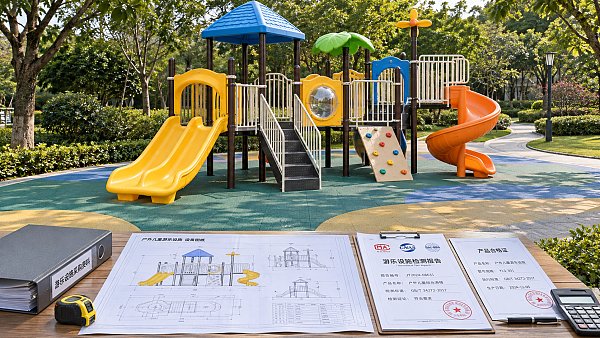
Request the complete certificate and its scope, including annexes. A marketing badge, cropped image, or certificate number alone rarely provides enough information for technical review.
Check the issuing organization’s name, certificate number, holder, product description, model identifiers, standard editions, issue date, and any stated expiry or surveillance conditions.
Compare the certificate holder with the legal manufacturer and contracting supplier. Different names are not necessarily problematic, but the relationship and authorization should be documented.
Verify the certificate directly through the issuing body’s public database or official contact channel. Confirm its status, covered models, and any limitations at the time of review.
If the issuer cannot validate the record, request an explanation and supporting documentation. Treat an unverifiable certificate as unresolved evidence, not as proof of failure.
Pay attention to withdrawn, suspended, or expired certificates. An issue date alone does not establish current validity, and some schemes use surveillance rather than a simple expiry date.
Where the supplier claims accredited certification, check that the issuing body is accredited for the relevant product certification activity and scope, not merely accredited in another field.
What Should You Look for in a Test Report?
Obtain the full report, including identification pages, test methods, results, deviations, photographs, and appendices. A summary page may omit restrictions that change the interpretation.
Match the tested sample’s model, drawings, dimensions, materials, and configuration to the equipment being purchased. Note any differences for formal technical assessment.
Check the standard and edition against the project specification. A report may cover only selected clauses, components, or tests rather than an entire playground system.
Review the result for each relevant test and examine any conditions or exclusions. A passing result for one hazard does not establish compliance with unrelated requirements.
Look for sample selection and identification details. A report based on a supplier-submitted prototype can be useful, but it does not by itself establish production consistency.
Check whether the report identifies testing dates, laboratory location, and any subcontracted work. Ask the laboratory to authenticate the report when its authenticity is uncertain.
Older reports are not automatically invalid. Their usefulness depends on the standard edition, design changes, project requirements, and whether the evidence still describes the supplied product.
Request an engineering assessment or updated testing when changes could affect safety, including changes to openings, structural members, fasteners, moving parts, or protective barriers.
How Do You Assess the Testing Laboratory or Certification Body?
Identify the accreditation body behind any accreditation claim and use its official directory to verify the organization’s status, location, and published scope.
For laboratories, ISO/IEC 17025 accreditation concerns competence for specified testing activities. Accreditation does not mean every test the laboratory performs falls within its accredited scope.
For product certification bodies, ISO/IEC 17065 is a relevant accreditation standard. Confirm that the accredited scope includes the product category and certification activity claimed.
Compare the exact test methods or certification scheme with the scope listing. If the document is unclear, ask the accreditation body or issuer to clarify.
Accreditation status can change, so record when you checked it. Also consider whether the applicable contract requires accreditation at the time of testing or certification.
Recognition under an international accreditation arrangement may support confidence, but it does not automatically establish legal acceptance in every destination market. Confirm local acceptance separately.
Does the Evidence Cover the Exact Equipment You Will Receive?
A certificate for a product family may cover several configurations, but only if its scope or supporting documents identify them. Ask for the configuration schedule.
Compare the procurement drawings and bill of materials with the assessed design. Check platform heights, access routes, guardrails, slide geometry, connectors, and fall-space arrangements.
Confirm materials and finishes where they affect structural performance, durability, or safety. A substitution that appears cosmetic may alter strength, corrosion resistance, or surface properties.
Review intended age labels and user capacities against the project brief and supplier documentation. A product assessed for one user group should not be assumed suitable for another.
For custom equipment, request a documented assessment of each design change. The issuer or a competent evaluator should determine whether existing evidence remains applicable or additional testing is needed.
Where multiple manufacturers supply a combined structure, assess the interfaces and overall configuration. Separate component reports do not automatically establish compliance of the assembled playground.
Include model numbers, approved drawings, materials, and evidence requirements in the purchase order. Require written approval before substitutions or safety-relevant design changes.
How Should You Review Surfacing and Installation?
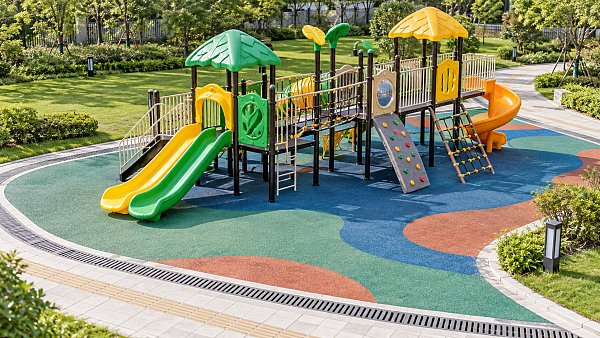
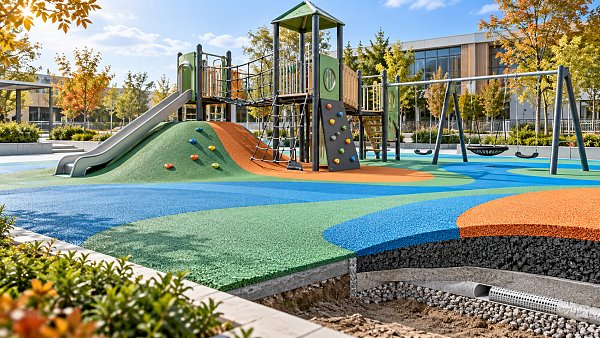
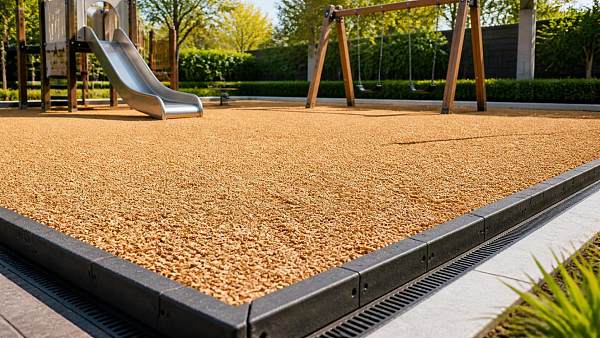
Equipment evidence does not establish that the installed surface provides adequate impact attenuation. Evaluate the surfacing system for the relevant fall heights and site conditions.
Request the surfacing test report for the specific material, composition, and installed depth. Compare its tested performance with the equipment’s applicable fall-height requirements.
Check whether the stated performance depends on a particular substrate, binder, curing process, or installation method. These details should appear in the specification and installation instructions.
Laboratory results describe tested conditions; installation quality, wear, compaction, displacement, and weather can affect field performance. Specify inspection and any required field testing accordingly.
Review use zones, equipment spacing, foundations, anchorage, drainage, and accessibility with the applicable standard and site drawings. Equipment compliance alone cannot resolve site-level hazards.
Obtain installation instructions and identify who will inspect the completed playground. Record deviations, corrective actions, and acceptance before opening the installation for use.
Which Supplier Claims Should Trigger Further Review?
Claims such as “internationally certified” or “approved worldwide” are too broad to verify. Request the named scheme, issuing body, standard edition, and covered products.
A certificate displaying a laboratory logo may concern management systems or a different product category. Read the document scope before treating the logo as product evidence.
Likewise, an ISO 9001 certificate addresses a quality management system within its scope; it does not certify that a particular playground design meets safety requirements.
Be cautious when model numbers differ, reports omit tested configurations, or suppliers provide only editable summaries. Ask for traceable originals and written explanations.
Material certificates and structural calculations can supplement the evidence package. They do not automatically replace product testing or certification required by the project specification.
If documentation is incomplete, record the gap, its potential effect, the responsible party, and the deadline for resolution. Avoid accepting ambiguous evidence as a closed issue.
Build a Verification Record Before Award and Handover
Create a requirements matrix linking each applicable requirement to the proposed product, supporting document, issuing organization, verification status, and reviewer decision.
Before award, resolve material gaps with the supplier and document any assumptions. Make delivery and acceptance conditions reflect the approved configuration and required evidence.
At delivery, compare labels, model numbers, quantities, and visible construction with the approved documents. Investigate discrepancies before installation or acceptance.
At handover, retain certificates, reports, drawings, installation records, inspection findings, maintenance instructions, and supplier contacts in a file accessible to the playground operator.
Plan periodic inspections and maintenance according to applicable requirements, manufacturer instructions, and site conditions. Certification at purchase does not eliminate deterioration or future operating risks.
Conclusion: Make Certification a Traceable Procurement Decision
Certified playground equipment is most credible when the applicable requirements, independent evidence, product configuration, and installed conditions can all be traced to documented decisions.
Verify certificates with their issuers, check laboratory and certification scopes, and resolve design or installation gaps before acceptance. This process gives evaluators a defensible basis for procurement.
Search News
Hot Articles
Popular Tags
Need ExpertConsultation?
Connect with our specialized leisureengineering team for procurementstrategies.
Recommended News
 Nov 15, 2026Certified Playground Equipment: How to Verify Safety CertificationsBuying certified playground equipment? Learn how to verify safety certificates, test reports, standards, and installation evidence before you buy.● Theme Park Strategist
 Nov 04, 2026Choosing a Turnkey Entertainment Venue Supplier: Scope, Costs and RisksChoosing an entertainment venue development turnkey supplier? Compare scope, costs, compliance and support to reduce risk and select the right partner.● Theme Park Strategist
 Oct 26, 2026Indoor Playground Maintenance Checklist: Daily, Weekly, and Monthly TasksStreamline playground maintenance with daily, weekly, and monthly checklists. Learn how to spot hazards, prioritize repairs, and keep your indoor play area ready for safer fun.● Theme Park Strategist
 Oct 18, 2026Turnkey Playground Installation: What's Included and What Costs Extra?Turnkey playground installation: discover what's included, uncover extra costs, and compare quotes confidently. Learn how to avoid budget surprises before you sign.● Theme Park Strategist
 Oct 24, 2026What Are the Biggest Risks in Entertainment Venue Development?What are the biggest risks in entertainment venue development projects? Explore demand, budget, safety, and opening risks—and learn how to protect your investment before you commit.● Theme Park Strategist
 Oct 08, 2026How to Choose Animatronic Haunted House Props for High-Throughput AttractionsAnimatronic haunted house props for high-throughput attractions: compare motion, triggers, safety, and maintenance to create reliable scares that keep guests moving.● Theme Park Strategist
 Sep 29, 2026Poured Playground Safety Surfacing: How to Specify Thickness for Fall HeightsPoured playground safety surfacing: learn how to specify tested thickness by fall height, ASTM standards, substrate conditions, accessibility, and field verification.● Theme Park Strategist
 Sep 27, 2026Custom Trampoline Park Equipment: Planning Capacity, Safety, and LayoutCustom trampoline park equipment for safer capacity, smooth guest flow, and efficient layouts. Explore practical planning insights for a high-performing park.● Theme Park Strategist
 Aug 30, 2026Entertainment Venue Master Planning: How to Balance Capacity, Flow, and RevenueEntertainment venue development master planning: balance capacity, guest flow, and revenue with practical strategies for resilient, high-performing venues.● Theme Park Strategist
 Sep 07, 2026What Should Buyers Do When a Supplier Delivers Non-Compliant Products?What to do if a supplier delivers non-compliant commercial products: contain risks, document evidence, protect your project, and secure the right remedy.● Theme Park Strategist
 Sep 02, 2026Waterpark Capacity Management: Balancing Queue Times, Safety, and Guest ThroughputWaterpark capacity management strategies to reduce queue times, protect safety, optimize guest throughput, and build a smoother, more profitable park operation.● Theme Park Strategist
 Sep 01, 2026ASTM F2075 Explained: Testing Engineered Wood Fiber for Playground Impact SafetyASTM F2075 explained: learn how engineered wood fiber supports playground impact safety, smarter sourcing, compliance documentation, and reliable maintenance planning.● Theme Park Strategist
 Aug 24, 2026How to Evaluate an Indoor Ninja Warrior Course Supplier in Europe?indoor ninja warrior course Europe supplier guide: learn how to assess safety, EN compliance, engineering, installation, and maintenance support before you choose.● Theme Park Strategist
 Aug 20, 2026How to Choose Modular Indoor Play Equipment for Different Venue Sizes and Age GroupsModular indoor play equipment buying guide: learn how to match venue size, ceiling height, traffic flow, and age groups to create safer, smarter, and more profitable play spaces.● Theme Park Strategist
 Aug 14, 2026POB Push Lifts Overseas Pre-Registrations 45.74%POB boosts overseas pre-registrations for the 2026 China Sport Show by 45.74%, signaling stronger global buyer interest and smarter sourcing opportunities in sports manufacturing.● Theme Park Strategist
 Aug 02, 2026What to Check Before Buying Thick Gymnastic Mats Wholesale for Schools and GymsThick gymnastic mats wholesale buying guide for schools and gyms: learn how to check foam, cover durability, safety documents, samples, and true long-term value before placing a bulk order.● Theme Park Strategist
 Jul 28, 2026How to Design Inclusive Sensory Play Areas for Different Age Groups and NeedsInclusive sensory play starts with smart zoning, age planning, accessibility, and acoustics. Discover practical design tips to create safer, engaging spaces that truly work.● Theme Park Strategist
 Jul 26, 2026How to Evaluate a Bowling Alley Equipment Factory Before Requesting a QuoteBowling alley equipment factory evaluation starts before price. Learn how to check manufacturing scope, engineering, compliance, spare parts, and installation support to avoid costly sourcing mistakes.● Theme Park Strategist
 Jul 16, 2026EN 1176:2026 Takes Effect for Indoor PlaygroundsEN 1176:2026 takes effect for indoor playgrounds in the EU, making conformity assessment mandatory. Learn how this impacts certification, customs clearance, suppliers, and market access.● Theme Park Strategist
 Jul 15, 2026CPSC Sets New ASTM Impact Test for Indoor Playground Metal PartsCPSC sets new ASTM impact test rules for indoor playground metal parts effective Oct. 1, 2026. Learn how the 15kN requirement may affect compliance, testing timelines, and U.S. export delivery.● Theme Park Strategist
 Jul 14, 2026CPSC Tightens Phthalate Limit for Indoor Playground Soft MaterialsCPSC tightens phthalate limits for indoor playground soft materials from Aug 15, 2026. Learn how DIBP control, CBP detention risk, and testing changes impact sourcing, exports, and compliance.● Theme Park Strategist
 Jul 13, 2026Vietnam Tightens IoT Rule for Indoor Playground ImportsVietnam Tightens IoT Rule for Indoor Playground Imports: learn how VNSS-2025 gateway requirements affect exporters, buyers, installers, and delivery timelines before the 2026 deadline.● Theme Park Strategist
 Jul 13, 2026How a Recreational Facility Planning Company Helps Reduce Layout MistakesRecreational facility planning company insights: learn how early layout strategy reduces costly mistakes, improves flow, compliance, and buildability for smoother project delivery.● Theme Park Strategist
 Jul 12, 2026CPSC Halts Imports of Indoor Playground Soft PartsCPSC halts imports of indoor playground soft parts from China under ASTM F3432-26. Learn the compliance risks, testing requirements, and urgent steps importers must take now.● Theme Park Strategist