Poured Playground Safety Surfacing: How to Specify Thickness for Fall Heights
Thickness for poured playground safety surfacing cannot be selected from a generic chart alone. A surface that looks substantial may still be unsuitable for the equipment installed above it, while a thicker system may add cost without improving compliance if the certified test data does not match the specified assembly. The defensible specification is one that links the playground’s verified fall heights to an impact-attenuation test result for the exact poured-in-place system, thickness, and base condition being proposed.
For project delivery, this is not only a safety issue. It affects equipment coordination, grading, accessibility transitions, drainage design, substrate preparation, tender comparability, inspection records, and change-order exposure. The key question is not “How thick should poured rubber be?” but “What system thickness has been demonstrated to meet the applicable impact criteria at or above the highest fall height in each surfacing zone?”
Start with the governing standard and project jurisdiction
In the United States, poured playground safety surfacing is commonly evaluated under ASTM F1292, the Standard Specification for Impact Attenuation of Surfacing Materials Within the Use Zone of Playground Equipment. ASTM F1292 assesses whether a surface limits head-impact severity under controlled testing. Its principal criteria are:
- Head Injury Criterion (HIC) not greater than 1,000; and
- Peak deceleration not greater than 200 g.
The testing establishes a critical fall height: the maximum height for which the tested surface configuration meets both limits. This value is central to thickness selection. A surfacing assembly with a tested critical fall height of 6 feet is not automatically acceptable below equipment with an 8-foot fall height, regardless of its appearance, rubber color, or nominal thickness.
ASTM F1487, the principal U.S. consumer safety performance specification for public playground equipment, also informs the process because it defines equipment-related requirements, including maximum fall height and use-zone concepts. The U.S. Consumer Product Safety Commission’s Public Playground Safety Handbook is widely used as a safety reference, although it is guidance rather than a building code.
Outside the United States, projects may instead be governed by EN 1177 for impact-attenuating playground surfacing, used with EN 1176 equipment requirements. EN 1177 uses a different test framework and reporting convention. It should not be assumed that a report prepared to ASTM F1292 demonstrates EN 1177 compliance, or the reverse. Where an international tender, school group, hotel development, or public authority specifies a standard, the contract documents should identify the applicable standard explicitly rather than refer generally to “international safety standards.”
ASTM and EN standards become enforceable when adopted by an authority having jurisdiction, required in an owner’s standards, incorporated into contract documents, or referenced by a certification program. Local building, park, school, accessibility, or insurance requirements may impose additional conditions. The applicable rule set should be confirmed before surfacing design is finalized.
Fall height is an equipment value, not a surfacing preference
The required performance level begins with the highest fall height that applies within a given use zone. Fall height is generally the vertical distance between a designated play surface and the protective surfacing below. It is determined by the equipment geometry and intended use, not by the height of the deck alone.
For example, a low platform can have a relatively limited fall height, while overhead climbing components, certain swing configurations, and elevated transfer features may create higher values elsewhere in the same playground. A large structure may therefore require more than one surfacing thickness or one system thickness designed for the highest applicable fall height across all connected zones.
Equipment supplier drawings should be reviewed for stated fall heights, but they should not be accepted without checking the installed grades. Changes to finish elevations can alter the effective fall height. If the playground base is raised after equipment anchoring elevations are set, the distance to the surfacing decreases; if the base is lowered or the surface build-up is reduced, the effective fall height increases. This relationship must be controlled through coordinated civil, landscape, equipment, and surfacing drawings.
It is also important to distinguish the manufacturer’s stated fall height from the height at which a child may physically stand or climb in an unintended manner. Standards provide defined measurement methods for particular equipment types. A project should use the standard’s applicable definition rather than create an informal “worst possible” measurement that may not correspond to the compliance method. Where an unusual custom play element is involved, the equipment designer and qualified playground safety reviewer should establish the measurement basis before the surfacing system is priced.
Why nominal thickness is not a compliance certificate
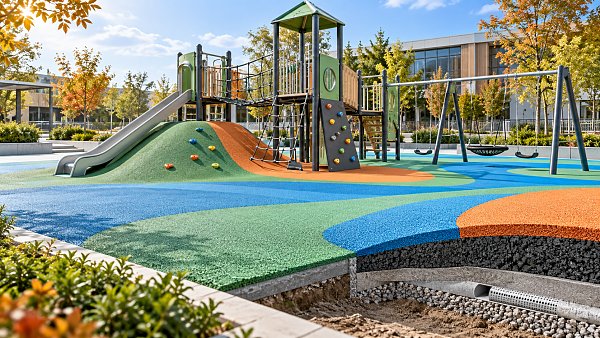
Poured-in-place rubber systems are often described by total thickness, such as 1.5 inches, 2 inches, 3 inches, or more. That dimension is useful for construction control, but it does not independently prove impact performance. Critical fall height is influenced by the complete installed assembly:
- the thickness and density of the resilient base layer;
- the material composition of the base, often recycled rubber granulate bound with polyurethane;
- the thickness and composition of the EPDM or similar wear layer;
- binder type and binder-to-granule ratio;
- granule size and compaction during placement;
- the condition and stiffness of the substrate below the surface;
- temperature, aging, moisture, and maintenance condition; and
- the test method and test location used for the reported result.
Two systems with the same nominal thickness may perform differently because their density, mix design, base material, and installation methods differ. A specification that says only “2-inch poured rubber” creates an avoidable gap: bidders may price materially different systems, and no party has been required to demonstrate that the proposed construction will protect users at the actual fall height.
The top wear layer should not be treated as merely decorative. Its thickness contributes to total system behavior, but its primary operational roles are durability, traction, color retention, and resistance to abrasion and weathering. In many systems, most impact attenuation is delivered by the resilient base course. Altering the top-course thickness, substituting a binder, or increasing pigment content can affect how the system is installed and performs. Any such change should be supported by relevant test evidence, not presumed equivalent.
Use certified system data to build the thickness schedule
A practical specification process starts with a fall-height schedule prepared from the equipment plan. Each equipment area is assigned the maximum applicable fall height, then matched to a surfacing system whose documented critical fall height equals or exceeds that requirement.
The required submittal should identify more than a marketing claim or an undated product brochure. It should include a laboratory report or manufacturer-supported test documentation that states:
- the surfacing manufacturer and system identification;
- the tested total thickness and layer configuration;
- materials used in each layer, including granulate and binder type where reported;
- the substrate or test base condition;
- the standard and edition used for testing;
- the resulting critical fall height, HIC, and g-max results where applicable; and
- the testing laboratory and report date.
Documentation must correspond to the submitted system. A report for one manufacturer’s 3-inch assembly should not be used to qualify a different contractor’s mix design simply because both are called “poured rubber.” Likewise, a laboratory report for a laboratory-prepared specimen may establish system potential but does not eliminate the need to verify field installation quality.
Projects with multiple fall-height categories can use a stepped thickness plan, but transitions require careful detailing. A sudden change in surface elevation can become a trip condition and may disrupt accessible routes. Thickness changes are often tapered outside primary travel paths or coordinated with layout boundaries, graphics, and equipment use zones. The final approach should preserve the required impact performance at every point where a fall can occur, including near equipment edges and around footings.
Do not confuse accessible travel with impact attenuation
Poured-in-place rubber is frequently selected because it can provide a firm, stable, and slip-resistant accessible route when properly designed and maintained. Under the Americans with Disabilities Act framework, accessible ground surfaces must satisfy performance requirements for firmness, stability, and slip resistance. ASTM F1951 is commonly used to evaluate accessibility of surface systems for wheelchair mobility.
These are separate compliance questions from ASTM F1292 impact attenuation. A surface can be firm enough for mobility testing yet not provide sufficient impact attenuation for the fall height below a climber. Conversely, a thicker impact-attenuating system can affect transitions, slopes, and route geometry if the build-up was not considered in grading.
Accessibility should therefore be coordinated at the same time as thickness, not added after surfacing has been selected. Confirm finished elevations at entrances, ramps, transfer points, play components, drainage interfaces, and adjacent pavement. A compliant safety surface cannot compensate for an inaccessible transition, and a smooth route cannot compensate for inadequate fall-height protection.
Substrate design can undermine a correct thickness decision
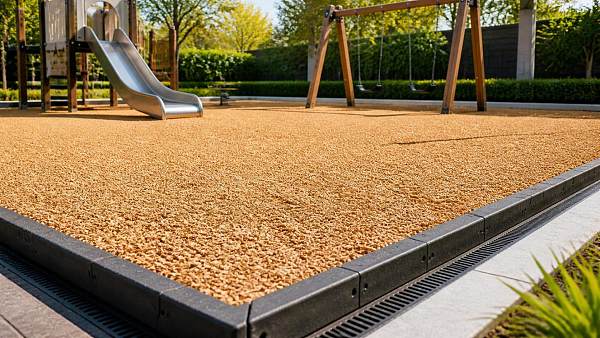
Poured playground surfacing is installed over a prepared base, commonly concrete, asphalt, or another approved stable substrate. The base must provide the intended grade, drainage, and structural continuity. Cracks, standing water, weak patches, inappropriate sealers, or uneven transitions can affect adhesion, finish quality, and long-term performance.
Impact test results are linked to the system configuration. If the report was produced over a rigid substrate, a contractor should not assume identical performance over a different base condition. The specification should define the approved substrate, allowable tolerances, drainage requirements, curing status, and moisture limitations. It should also establish who is responsible for verifying base readiness before installation begins.
Drainage deserves particular attention. Poured rubber is not a drainage system by itself. Even where the material is permeable, water must have a route through and away from the assembly. Water retained beneath the surface can contribute to adhesive stress, freeze-thaw damage in cold climates, and premature deterioration. Surface slopes, perimeter restraint, drainage layers where applicable, and outlet locations must work as a system.
Field testing should be written into the quality plan
A submittal report demonstrates that a system design can meet a performance target. Field testing evaluates whether the installed work achieves acceptable impact attenuation at the project site. ASTM F1292 includes field-testing provisions, and many public or institutional specifications require post-installation testing by a qualified independent party.
Field testing requirements should be clear about timing, test locations, acceptance criteria, responsibility for costs, and corrective action if a result fails. Testing immediately after installation may not represent the same condition as a surface exposed to use and weather, while delayed testing can complicate corrective work. The project documents should state the intended acceptance condition and any required retesting protocol.
Test locations should reflect actual risk areas rather than only open, easily accessible portions of the playground. High-use landing areas, swing zones, the base of climbers, and locations near thickness transitions deserve attention. Inspection should also confirm installed thickness through cores, probes, or other agreed methods where appropriate. Thickness verification alone is not a substitute for impact testing, but it helps establish whether the installed layer build-up matches the approved system.
Specification language should prevent unapproved substitutions
Weak specifications often create disputes because they combine a fall-height requirement with a generic thickness and leave the bidder to resolve the conflict. A more reliable requirement identifies the required critical fall height by area and states that the installed poured-in-place rubber system must comply with the named test standard at the specified fall height.
Useful contract language typically requires an approved manufacturer system, a defined layer build-up, certified or documented test evidence, qualified installer experience, substrate acceptance, mock-up or sample approval where color and finish matter, field quality controls, and post-installation testing. It should also prohibit substitutions that change base granulate, binder, wear-layer composition, total thickness, or substrate assumptions unless revised test evidence and formal approval are provided.
Color graphics require particular control. Decorative EPDM patterns can intersect with impact zones, and their additional or reduced layer thickness must not create an untested assembly. The graphic design should be shown on the surfacing plan, with the total resilient thickness maintained beneath it unless the manufacturer has demonstrated an alternative configuration for the relevant fall height.
The most defensible decision is traceable from equipment to test report
A compliant poured playground safety surfacing specification creates an unbroken record: equipment drawings establish fall heights; the layout defines where those heights apply; the surfacing schedule identifies the required performance; the manufacturer’s data supports the proposed assembly; installation records confirm the approved build-up; and field testing verifies the finished work where required.
That chain is more valuable than relying on a familiar nominal thickness. It reduces the risk that design changes, alternate bids, value-engineering proposals, or site grading adjustments quietly reduce protection below the level required by the equipment. For any project where safety, public use, and long-term asset responsibility matter, thickness should be treated as a tested system decision—not as a standalone construction dimension.
Search News
Hot Articles
- Indoor PlaygroundPoured Playground Safety Surfacing: How to Specify Thickness for Fall HeightsSep 29, 2026
- Smart Campus TechHow U.S. Schools Can Choose Laboratory Equipment for Safe, Compliant Science LabsSep 28, 2026
- Indoor PlaygroundCustom Trampoline Park Equipment: Planning Capacity, Safety, and LayoutSep 27, 2026
Popular Tags
Need ExpertConsultation?
Connect with our specialized leisureengineering team for procurementstrategies.
Recommended News
 Sep 29, 2026Poured Playground Safety Surfacing: How to Specify Thickness for Fall HeightsPoured playground safety surfacing: learn how to specify tested thickness by fall height, ASTM standards, substrate conditions, accessibility, and field verification.● Theme Park Strategist
 Sep 27, 2026Custom Trampoline Park Equipment: Planning Capacity, Safety, and LayoutCustom trampoline park equipment for safer capacity, smooth guest flow, and efficient layouts. Explore practical planning insights for a high-performing park.● Theme Park Strategist
 Aug 30, 2026Entertainment Venue Master Planning: How to Balance Capacity, Flow, and RevenueEntertainment venue development master planning: balance capacity, guest flow, and revenue with practical strategies for resilient, high-performing venues.● Theme Park Strategist
 Sep 07, 2026What Should Buyers Do When a Supplier Delivers Non-Compliant Products?What to do if a supplier delivers non-compliant commercial products: contain risks, document evidence, protect your project, and secure the right remedy.● Theme Park Strategist
 Sep 02, 2026Waterpark Capacity Management: Balancing Queue Times, Safety, and Guest ThroughputWaterpark capacity management strategies to reduce queue times, protect safety, optimize guest throughput, and build a smoother, more profitable park operation.● Theme Park Strategist
 Sep 01, 2026ASTM F2075 Explained: Testing Engineered Wood Fiber for Playground Impact SafetyASTM F2075 explained: learn how engineered wood fiber supports playground impact safety, smarter sourcing, compliance documentation, and reliable maintenance planning.● Theme Park Strategist
 Aug 24, 2026How to Evaluate an Indoor Ninja Warrior Course Supplier in Europe?indoor ninja warrior course Europe supplier guide: learn how to assess safety, EN compliance, engineering, installation, and maintenance support before you choose.● Theme Park Strategist
 Aug 20, 2026How to Choose Modular Indoor Play Equipment for Different Venue Sizes and Age GroupsModular indoor play equipment buying guide: learn how to match venue size, ceiling height, traffic flow, and age groups to create safer, smarter, and more profitable play spaces.● Theme Park Strategist
 Aug 14, 2026POB Push Lifts Overseas Pre-Registrations 45.74%POB boosts overseas pre-registrations for the 2026 China Sport Show by 45.74%, signaling stronger global buyer interest and smarter sourcing opportunities in sports manufacturing.● Theme Park Strategist
 Aug 02, 2026What to Check Before Buying Thick Gymnastic Mats Wholesale for Schools and GymsThick gymnastic mats wholesale buying guide for schools and gyms: learn how to check foam, cover durability, safety documents, samples, and true long-term value before placing a bulk order.● Theme Park Strategist
 Jul 28, 2026How to Design Inclusive Sensory Play Areas for Different Age Groups and NeedsInclusive sensory play starts with smart zoning, age planning, accessibility, and acoustics. Discover practical design tips to create safer, engaging spaces that truly work.● Theme Park Strategist
 Jul 26, 2026How to Evaluate a Bowling Alley Equipment Factory Before Requesting a QuoteBowling alley equipment factory evaluation starts before price. Learn how to check manufacturing scope, engineering, compliance, spare parts, and installation support to avoid costly sourcing mistakes.● Theme Park Strategist
 Jul 16, 2026EN 1176:2026 Takes Effect for Indoor PlaygroundsEN 1176:2026 takes effect for indoor playgrounds in the EU, making conformity assessment mandatory. Learn how this impacts certification, customs clearance, suppliers, and market access.● Theme Park Strategist
 Jul 15, 2026CPSC Sets New ASTM Impact Test for Indoor Playground Metal PartsCPSC sets new ASTM impact test rules for indoor playground metal parts effective Oct. 1, 2026. Learn how the 15kN requirement may affect compliance, testing timelines, and U.S. export delivery.● Theme Park Strategist
 Jul 14, 2026CPSC Tightens Phthalate Limit for Indoor Playground Soft MaterialsCPSC tightens phthalate limits for indoor playground soft materials from Aug 15, 2026. Learn how DIBP control, CBP detention risk, and testing changes impact sourcing, exports, and compliance.● Theme Park Strategist
 Jul 13, 2026Vietnam Tightens IoT Rule for Indoor Playground ImportsVietnam Tightens IoT Rule for Indoor Playground Imports: learn how VNSS-2025 gateway requirements affect exporters, buyers, installers, and delivery timelines before the 2026 deadline.● Theme Park Strategist
 Jul 13, 2026How a Recreational Facility Planning Company Helps Reduce Layout MistakesRecreational facility planning company insights: learn how early layout strategy reduces costly mistakes, improves flow, compliance, and buildability for smoother project delivery.● Theme Park Strategist
 Jul 12, 2026CPSC Halts Imports of Indoor Playground Soft PartsCPSC halts imports of indoor playground soft parts from China under ASTM F3432-26. Learn the compliance risks, testing requirements, and urgent steps importers must take now.● Theme Park Strategist
 Jul 11, 2026CPSC Import Alert Tightens Fire Test Rule for Indoor Playground PaddingCPSC import alert updates indoor playground padding rules to ASTM F3432-26. See how the new fire test affects foam mats, shipments, and U.S. market access.● Theme Park Strategist
 Jul 11, 2026Ice Bumper Cars Bulk Order Checklist for Indoor Parks: Space, Power, and Safety PointsIce bumper cars bulk order guide for indoor parks: learn how to assess space, power, safety, and throughput before buying, so you can avoid costly mistakes and choose the right fleet with confidence.● Theme Park Strategist
 Jul 10, 2026Commercial Playground Equipment for Campuses: Key Safety Standards and Planning TipsCommercial playground equipment for campuses: explore key safety standards, inclusive layout planning, durable materials, and smart procurement tips to avoid costly mistakes.● Theme Park Strategist
 Jul 09, 2026CPSC Recall Escalates Over Phthalates in Indoor Playground PadsCPSC recall escalates over phthalates in indoor playground pads as affected batches exceed CPSIA limits. Learn the risks, supply chain impact, and what buyers should monitor now.● Theme Park Strategist
 Jul 07, 2026How to Choose Ice Skating Rink Equipment in Europe: Key Systems, Standards, and Budget Factorsice skating rink equipment Europe guide: compare refrigeration, rink floors, boards, EU compliance, and total budget factors to choose a safer, more efficient commercial rink solution.● Theme Park Strategist
 Jul 06, 2026CPSC Flags New Flame Test for Indoor Playground PaddingCPSC flags a new flame test for indoor playground padding under ASTM F1487-23b. Learn how this urgent compliance alert affects materials, testing, imports, and U.S. market access.● Theme Park Strategist