How U.S. Schools Can Choose Laboratory Equipment for Safe, Compliant Science Labs
Choosing laboratory equipment for a U.S. school is not a catalog-matching exercise. A microscope, fume hood, eyewash station, hot plate, chemical cabinet, or student workbench can all appear suitable in isolation while creating a safety, compliance, maintenance, or instructional problem once installed in an active classroom.
The sound purchasing decision begins with the intended activity rather than the equipment category. A middle-school classroom conducting small-volume acid-base experiments has different ventilation, storage, supervision, and durability needs than an advanced high-school chemistry lab running organic chemistry demonstrations. Equipment should be selected against the actual hazards, frequency of use, room constraints, local code requirements, and ability of the school to inspect and maintain it over time.
Start with the instructional program and the laboratory risk profile
Before requesting quotes for school laboratory equipment USA institutions can deploy confidently, translate the science curriculum into a working risk profile. This avoids two expensive errors: specifying commercial-grade equipment that is not justified by the program, and buying entry-level equipment that cannot safely support required activities.
A useful review separates the laboratory into functional zones:
- General student work areas: benches, sinks, gas outlets, electrical service, stools, microscopes, balances, and basic glassware.
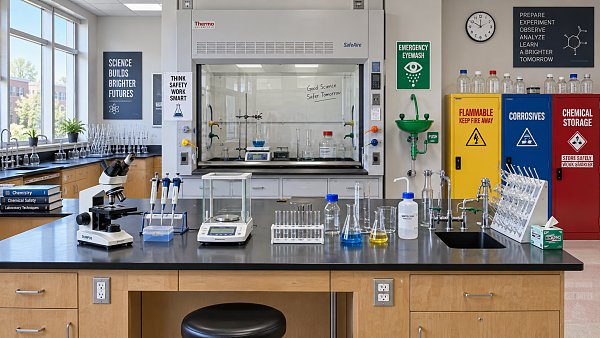
- Chemistry and wet-lab functions: corrosive handling, heating, flammable liquids, chemical storage, local exhaust, spill response, and eyewash capability.
- Biology functions: dissection, microscopy, specimen storage, incubators, sterilization equipment, and waste handling.
- Physics and engineering functions: electrical experiments, lasers, motion equipment, heat sources, tools, compressed gases, and mechanical guarding.
- Preparation and storage areas: chemical receiving, segregation, labeling, secure storage, inventory control, glassware washing, and teacher preparation.
Equipment requirements should follow the highest reasonably anticipated hazard, not the most common low-risk activity. A room used mainly for general science may still require a more robust safety infrastructure if it will periodically support demonstrations involving volatile solvents, strong acids or bases, open flames, or pressurized systems.
Curriculum changes matter as much as current lesson plans. A lab renovation designed only for today’s activities can become restrictive when an advanced placement course, engineering pathway, or expanded life-science program is introduced. That does not mean purchasing every possible capability at the outset. It means ensuring that core infrastructure—electrical capacity, water service, drainage, ventilation pathways, bench layout, and storage locations—does not prevent later upgrades.
Compliance is a system question, not a certificate question
There is no single nationwide “school laboratory equipment certification” that proves a science lab is compliant. Requirements arise from several overlapping sources: state and local building and fire codes, the authority having jurisdiction (AHJ), district policies, workplace safety rules applicable to employees, product safety listing requirements, and recognized laboratory safety guidance.
For that reason, procurement documents should not simply request “OSHA compliant” or “ANSI certified” equipment. Such language is often too broad to be meaningful. It is more effective to define the equipment, its use conditions, the relevant standard or code reference, documentation required, and the local approval path.
Several references commonly shape purchasing decisions:
- NFPA 45, Standard on Fire Protection for Laboratories Using Chemicals, addresses laboratory fire protection principles. Its enforceability depends on adoption by the relevant jurisdiction and applicable code framework.
- NFPA 30, Flammable and Combustible Liquids Code, is often relevant when evaluating storage and handling of flammable liquids. Cabinet selection must be considered alongside allowed quantities, room conditions, storage practices, and local fire-code requirements.
- ANSI/ISEA Z358.1 establishes performance requirements for emergency eyewash and shower equipment. Whether a fixture is required, and where it must be placed, should be determined through hazard assessment and local requirements rather than assumed from the presence of a sink.
- UL or ETL listing by a Nationally Recognized Testing Laboratory is important for electrical equipment, including hot plates, power supplies, refrigerators, incubators, and other plug-in devices. A listing should cover the actual product configuration, not merely a component used within it.
- ANSI Z87.1 is a recognized standard for occupational and educational eye and face protection. Eye protection procurement should also account for fit, splash exposure, ventilation, cleaning, and compatibility with prescription eyewear.
- National Science Teaching Association safety guidance and guidance from scientific education organizations can support equipment planning, chemical management, supervision practices, and curriculum-aligned risk assessment.
Public-school employee coverage under federal OSHA is not uniform across all states, and OSHA does not regulate student conduct in the same way it regulates covered workplaces. That distinction should not be treated as a lower safety threshold. District safety policies, state plans, insurance requirements, adopted codes, and duty-of-care considerations can impose significant operational expectations regardless of the enforcement route.
The AHJ—often the local fire marshal, building official, or code enforcement authority—should be involved early when a purchase affects ventilation, plumbing, gas piping, electrical distribution, fire protection, or hazardous-material storage. A compliant product installed in an unsuitable room does not create a compliant laboratory.
Ventilation equipment needs closer scrutiny than most categories
Fume hoods are frequently purchased as if they were self-contained safety devices. They are not. A chemical fume hood is part of a building exhaust system and must be compatible with the room’s mechanical design, make-up air, duct routing, rooftop discharge, controls, and commissioning process. Buying a hood without confirming these conditions can result in poor containment, uncomfortable room pressure, excessive noise, or a unit that cannot be approved for use.
The purchase specification should distinguish between a ducted chemical fume hood, a ductless filtered enclosure, a biological safety cabinet, and a clean bench. These products serve different hazards:
- A ducted chemical fume hood is intended to control exposure to chemical vapors when properly designed, installed, tested, and operated.
- A ductless filtered enclosure depends on the correct filter media, chemical compatibility, loading assumptions, maintenance schedule, and end-of-life controls. It is not a universal substitute for ducted exhaust.
- A biological safety cabinet is designed for specific biological containment purposes and is not automatically suitable for volatile chemicals or flammable vapors.
- A clean bench protects the work product from contamination; it does not provide personnel protection from hazardous materials.
Vendor proposals for hoods should include clear information on sash configuration, interior materials, service access, plumbing and electrical options, exhaust connection requirements, required face velocity testing or containment verification, and commissioning responsibilities. The supplier should also identify what is excluded. Mechanical design, ductwork, roof penetrations, controls integration, and certification may sit outside the equipment quote, yet determine whether the laboratory can use the hood safely.
For schools with modest chemical use, the decision is not automatically “no hood needed.” The question is whether the planned procedures release hazardous vapors, gases, aerosols, or dusts that require engineering controls. This determination should be made through a documented activity review, preferably involving facilities, science leadership, safety personnel, and qualified design professionals where building changes are involved.
Emergency equipment must match the hazard and be maintainable
Eyewash stations, emergency showers, drench hoses, safety cans, spill kits, fire blankets, and extinguishers are often purchased late in the process. That approach overlooks the fact that emergency response equipment depends on location, accessibility, water supply, drainage, inspection routines, and training.
An eyewash bottle may be useful as an immediate supplementary response measure, but it should not be assumed to replace plumbed emergency equipment where the hazard assessment calls for compliant emergency flushing capability. Portable units also create practical questions: fluid expiration, contamination control, mounting location, accessibility, and whether the available flushing volume and duration match the identified hazard.
For plumbed eyewash or shower units, the purchasing scope should address installation dimensions, tepid-water provisions where required by the applicable standard or local interpretation, clear approach paths, drainage implications, testing access, and weekly activation procedures. A unit located behind stools, storage carts, or a locked preparation-room door is not an effective emergency fixture.
Safety equipment also needs to be compatible with student use. This includes easy-to-operate activation mechanisms, visible identification, clear pathways, and fixtures positioned for the age and physical reach of the users. Accessibility requirements should be reviewed during layout planning, not after cabinetry and plumbing are fixed.
Durability is not the same as heavy construction
School laboratories face a combination of student traffic, repeated cleaning, chemical exposure, vibration, moving stools, and intermittent misuse. Durability should be evaluated as resistance to the specific conditions of the room rather than as a general impression of product quality.
Worksurface selection illustrates the point. Epoxy resin tops offer strong resistance to many laboratory chemicals and heat, making them appropriate for demanding wet-lab environments. Phenolic resin can be suitable for many educational applications and may offer practical advantages in weight and fabrication, but its performance should be assessed against expected chemical exposure, heat loads, seam details, and repair requirements. Laminate surfaces can be economical for dry instructional spaces but are not a substitute for laboratory-grade chemical-resistant worktops in areas where corrosives or solvents are used.
Cabinetry deserves the same level of review. Examine hinge construction, drawer load ratings, edge banding or sealed edges, corrosion resistance, lock arrangements, adjustable shelving, and the ability to clean spills from corners and interiors. For under-counter chemical storage, verify that the cabinet’s intended contents, ventilation approach, and construction align with the chemical inventory and applicable local requirements. “Chemical resistant” is not a complete specification without naming the chemicals and concentrations expected in service.
For equipment such as balances, microscopes, hot plates, centrifuges, and data-collection devices, replaceable consumables and serviceability often matter more than an impressive initial specification. A low-priced unit becomes costly if adapters, lamps, probes, protective covers, calibration support, replacement parts, or repair channels are unavailable after the first failure.
Evaluate suppliers on documentation and execution, not only unit price
A supplier can be technically capable yet unsuitable for a school project if it cannot produce reliable documentation, manage delivery constraints, or support damaged and missing-item claims. This is especially important when equipment is imported, assembled from multiple sources, or delivered to a renovation site with limited receiving space.
Request a submittal package that allows a meaningful comparison between bids. Depending on the category, it should include product data sheets, dimensions, utility requirements, electrical listing information, material specifications, chemical compatibility information, installation instructions, warranty terms, maintenance requirements, parts availability, and applicable test or certification records.
For custom furniture, fume hoods, service fixtures, and laboratory islands, shop drawings should identify exact dimensions, utility rough-in points, clearances, anchoring details, cutouts, and interfaces with other trades. A quotation that states “laboratory workstation” without a drawing, material schedule, and utility plan leaves too much risk to the installation phase.
Delivery terms require similar precision. Confirm whether freight includes liftgate service, inside delivery, placement, uncrating, debris removal, assembly, installation, startup, and operator training. Schools often have restricted delivery windows, secure campuses, narrow corridors, and limited loading access. A large laboratory cabinet or fume hood can be damaged or delayed simply because the route from truck to room was never verified.
For imported equipment, verify the importer of record, electrical conformity for U.S. use, replacement-part lead times, warranty service location, and responsibility for customs delays or damage claims. A supplier’s ability to issue a U.S.-appropriate plug, voltage configuration, and recognized electrical safety listing should be confirmed before purchase order release—not inferred from product photographs or general catalog language.
Use total ownership cost to separate economical purchases from false savings
Initial price remains important, but it should be evaluated alongside the costs created by installation, consumables, inspections, calibration, filter replacement, preventive maintenance, repair, and eventual replacement. This is particularly relevant for ventilation equipment, water purification systems, refrigerators, digital sensors, autoclaves, and specialized biology equipment.
A fume hood with a lower purchase price may require more expensive mechanical modifications. A ductless enclosure may have lower installation cost but ongoing filter replacement and recordkeeping obligations. A refrigerator may appear equivalent to another model but lack the temperature monitoring, alarm capability, shelving configuration, or service support needed for its intended contents. The lowest bid is only comparable when the operating obligations are equally clear.
Where budgets are constrained, prioritize permanent safety infrastructure and equipment that supports the required curriculum. Consumables, accessory packages, and advanced instrumentation can be phased when that does not create a safety gap. Cutting cost by omitting ventilation, emergency flushing capability, chemical segregation, or durable surfaces tends to shift cost into future remediation, facility work, or restricted instruction.
Build acceptance criteria into the purchase order
Many laboratory equipment disputes arise because the buyer discovers defects, missing components, or unsuitable configurations after delivery, when the contract contains no practical acceptance standard. The purchase order should state what must be verified before final acceptance.
For general equipment, this may include model numbers, quantities, accessory lists, electrical compatibility, visible damage inspection, and confirmation of manuals and warranties. For laboratory furniture, acceptance can include dimensions, worktop material, finish quality, utility locations, drawer and door operation, anchoring, and absence of damage from transport or installation.
For safety-critical systems, acceptance should be more formal. Fume hoods, emergency fixtures, gas distribution systems, and specialized electrical installations may require installation verification, performance testing, commissioning records, and sign-off by the appropriate parties. Procurement should retain these documents with the asset record rather than treating them as one-time construction paperwork.
The most reliable laboratory purchases are those where equipment selection, facility conditions, safety expectations, and supplier responsibilities are aligned before ordering. That discipline reduces the risk of buying products that look compliant in a catalog but cannot support safe science instruction in the room where they will actually be used.
Search News
Hot Articles
- Smart Campus TechHow U.S. Schools Can Choose Laboratory Equipment for Safe, Compliant Science LabsSep 28, 2026
- Indoor PlaygroundCustom Trampoline Park Equipment: Planning Capacity, Safety, and LayoutSep 27, 2026
- Pro Stage AudioHow to Choose Dynamic Microphones for Vocals in Live Stage SettingsSep 26, 2026
Popular Tags
Need ExpertConsultation?
Connect with our specialized leisureengineering team for procurementstrategies.
Recommended News
 Sep 28, 2026How U.S. Schools Can Choose Laboratory Equipment for Safe, Compliant Science LabsSchool laboratory equipment USA: learn how to select safe, compliant lab furniture, ventilation, emergency systems, and durable tools for K–12 science labs.● Institutional Buyer
 Sep 16, 2026How to Source Educational Furniture Worldwide for Safe, Flexible Learning SpacesEducational furniture worldwide: learn how to source safe, flexible, durable learning-space solutions while controlling compliance, logistics, and lifecycle costs.● Institutional Buyer
 Aug 31, 2026How to Plan Smart Classroom Solutions That Improve Learning and IT ManageabilitySmart classroom solutions: learn how to plan secure, scalable teaching spaces that improve learning, simplify IT management, and reduce lifecycle costs.● Institutional Buyer
 Aug 01, 2026How to Specify an EN54 School PA System for Safe, Compliant Campus Voice EvacuationEN54 school PA system specification guide for safer, compliant campus voice evacuation. Learn zoning, intelligibility, monitoring, tender tips, and handover checks.● Institutional Buyer
 Jul 15, 2026Vietnam Tightens Import Rules for Smart Campus TechVietnam Tightens Import Rules for Smart Campus Tech: learn how MOIT’s 2026 data hosting and NEP connection rules may reshape import approval, sourcing timelines, and delivery planning.● Institutional Buyer
 Jul 14, 2026Thailand TISI Tightens Rules for Smart Campus TerminalsThailand TISI tightens rules for smart campus terminals, requiring Thai speech recognition and local biometric data storage. Learn the compliance impact, timeline risks, and what exporters must do now.● Institutional Buyer
 Jul 13, 2026Red Sea Rerouting Lifts Smart Campus Tech Shipping CostsRed Sea rerouting lifts Smart Campus Tech shipping costs, extends Asia-Europe booking lead times, and delays delivery. See what exporters, buyers, and logistics teams should do now.● Institutional Buyer
 Jul 12, 2026Event Technology for Live Venues: What Systems Matter Most for Seamless Operations?Event technology defines how live venues handle ticketing, AV, access, and monitoring. Discover which systems matter most for seamless operations, higher uptime, and better guest experiences.● Institutional Buyer
 Jul 11, 2026What Is a Campus Procurement Platform and How Does It Improve School Purchasing Workflows?Campus procurement platform explained: learn how it streamlines school purchasing workflows, improves approval control, boosts spend visibility, and reduces delays across campus buying.● Institutional Buyer
 Jul 10, 2026Vietnam Raises Smart Campus Tech Import Tariff to 12%Vietnam Raises Smart Campus Tech Import Tariff to 12%: explore how the new Vietnam smart campus tech tariff impacts pricing, sourcing, and local assembly strategies across Southeast Asia.● Institutional Buyer
 Jul 10, 2026Interactive Document Camera vs Webcam: Which Works Better for Smart Classrooms?Interactive document camera vs webcam: discover which delivers clearer content sharing, faster lesson flow, and better hybrid teaching performance for smart classrooms.● Institutional Buyer
 Jul 09, 2026RCEP Rule Adds Carbon Footprint Filings for Smart Campus Tech ExportsRCEP Rule reshapes Smart Campus Tech exports: learn how new carbon footprint filings for Singapore, Thailand, and Vietnam affect customs clearance, lead times, and compliance planning before October 1, 2026.● Institutional Buyer
 Jul 09, 2026Basketball Hoops for Campuses: Which Backboard, Rim, and Mounting Type Fits Your Site?Basketball hoops for campuses: compare backboard, rim, and mounting options by site needs. Learn how to choose safer, longer-lasting systems for outdoor courts, gyms, and multipurpose halls.● Institutional Buyer
 Jul 09, 2026Modular Educational Furniture: What to Check Before Planning Flexible ClassroomsModular educational furniture: learn what to check before planning flexible classrooms, from safety and durability to teaching fit, supplier quality, and long-term value.● Institutional Buyer
 Jul 08, 2026Shenzhen-Yokohama Port Delays Fall to 2.1 DaysShenzhen-Yokohama Port Delays fall to 2.1 days, cutting shipment cycles by 5–7 days for smart campus equipment. See how faster port efficiency can ease Q3 school delivery pressure.● Institutional Buyer
 Jul 07, 2026FBX Slide Pushes Smart Campus Freight Below $980/FEUFBX Slide Pushes Smart Campus Freight Below $980/FEU as Asia-Europe rates tumble. Discover what this means for smart campus shipments, booking risks, and cost-saving opportunities.● Institutional Buyer
 Jul 07, 2026Math Manipulatives Bulk Price Guide: Cost Drivers, Pack Sizes, and School Budget PlanningMath manipulatives bulk price explained: compare cost drivers, pack sizes, landed costs, and school budget planning tips to source smarter and avoid hidden expenses.● Institutional Buyer
 Jul 04, 2026RCEP Update Expands Indonesia Duty-Free Quota for Edu DevicesRCEP Update Expands Indonesia Duty-Free Quota for Edu Devices: learn how the new 80,000-unit quota reshapes export costs, compliance, and school procurement opportunities in Indonesia.● Institutional Buyer
 Jul 03, 2026Indonesia Enforces ID-SNI Labels on Smart Campus ImportsIndonesia Enforces ID-SNI Labels on Smart Campus Imports: learn how the new rule affects labeling, customs clearance, certification, and delivery readiness for compliant market entry.● Institutional Buyer
 Jul 03, 2026How to Choose Indoor School Sports Equipment for Age Groups, Space, and Safety NeedsIndoor school sports equipment buying guide for schools: learn how to match age groups, space limits, and safety standards to choose durable, efficient solutions.● Institutional Buyer
 Jul 02, 2026Chromebook Charging Stations for Schools: Cart vs Cabinet vs Wall-Mount OptionsChromebook charging stations for schools compared: cart, cabinet, and wall-mount options. Discover the best fit for security, space, mobility, and budget before you buy.● Institutional Buyer
 Jul 01, 2026Indonesia Opens RCEP Fast Track for Smart Campus IoTIndonesia opens an RCEP fast track for Smart Campus IoT, cutting Jakarta customs clearance to 12 hours for eligible HS 8517.62 devices. See who qualifies and how to prepare.● Institutional Buyer
 Jun 30, 2026Flexible Learning Spaces for K-12 and Higher Ed: Layout Ideas, Furniture, and Tech NeedsFlexible learning spaces for K-12 and higher ed: explore practical layout ideas, durable furniture, and smart tech strategies that improve teaching, flexibility, and long-term campus value.● Institutional Buyer
 Jun 30, 2026Campus Equipment Procurement Checklist: How to Compare Specs, Warranties, and Total CostCampus equipment procurement made practical: compare specs, warranty terms, supplier reliability, and total cost to avoid hidden expenses and make smarter campus buying decisions.● Institutional Buyer