How to Source Educational Furniture Worldwide for Safe, Flexible Learning Spaces
The lowest unit price is rarely the lowest total cost when sourcing educational furniture worldwide. A classroom chair that arrives late, fails a local safety requirement, cannot be repaired, or does not fit the teaching layout can turn an apparently competitive order into an expensive operational problem. The better approach is to source against a defined learning-space brief, then compare suppliers on delivered value: safety, durability, flexibility, documentation, logistics, and after-sales support.
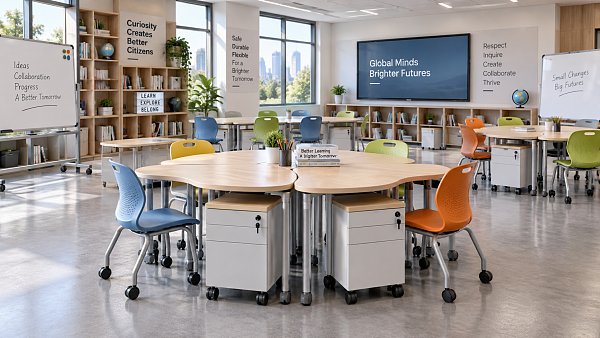
Educational furniture includes far more than desks and chairs. A typical project may combine student seating, adjustable tables, teacher workstations, storage, library furniture, laboratory benches, cafeteria seating, soft seating, mobile whiteboards, and technology-supporting pieces. These products are used intensively, moved frequently, and exposed to different age groups. That changes the sourcing standard. Furniture designed for a light-use office or residential setting may look suitable in a catalogue but perform poorly in a busy school environment.
Start with the learning model, not the supplier catalogue
Before requesting quotations, translate the project into a room-by-room operational brief. “Flexible classroom furniture” is too broad to produce comparable offers. Suppliers need to know what activities happen in the space, how often the layout changes, which users will occupy it, and what conditions affect installation.
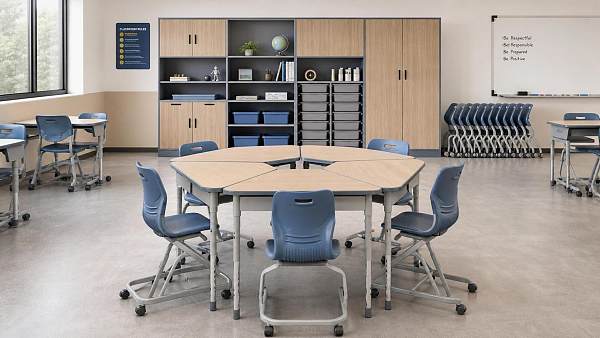
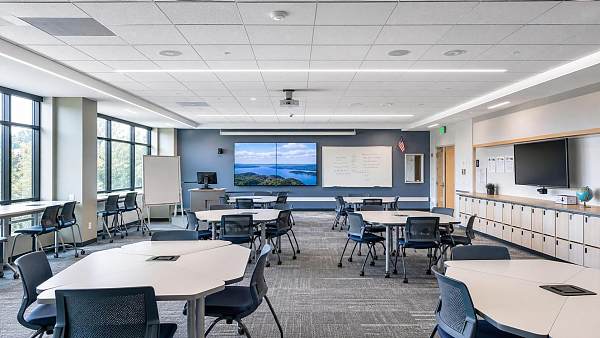
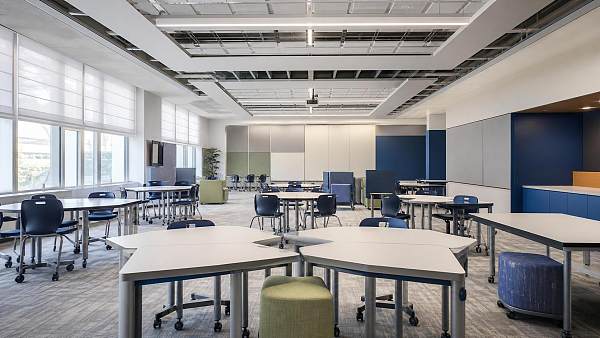
A lecture-focused classroom may prioritize stable rows, easy cleaning, and compact storage. A collaborative classroom needs tables that can be regrouped quickly without becoming unstable, plus chairs that are comfortable enough for extended sessions. Early-years spaces require lower heights, rounded exposed edges, easy-clean finishes, and storage that children can access safely. Libraries and learning commons may need durable lounge seating, integrated charging access, and furniture that creates quiet zones without permanently dividing the room.
Define these conditions before comparing materials or colors:
- Age range and expected user size.
- Teaching activities: individual work, group projects, presentations, practical work, or informal study.
- Whether rooms are reconfigured daily, occasionally, or almost never.
- Space constraints, including door widths, lifts, stairways, floor loading, and access routes.
- Cleaning routines, climate conditions, and the likelihood of spills, impact, or high humidity.
- Technology needs, such as cable management, device storage, power access, and charging.
- Expected service life and whether spare parts must remain available after installation.
This brief prevents a common error in global buying: selecting a visually appealing “multi-purpose” product that does not work for the actual timetable. Mobility is useful only when it supports a real change in teaching activity. Casters, folding mechanisms, and nesting features add cost and maintenance points. In rooms that remain in one layout for most of the year, sturdy fixed furniture may deliver better value.
Separate non-negotiables from preferences
International sourcing becomes manageable when the specification distinguishes mandatory requirements from design preferences. Mandatory requirements are the conditions that make a product acceptable for use and import. Preferences include color palettes, decorative details, or optional accessories that can be traded against cost and lead time.
Safety should sit in the mandatory category. Ask suppliers to provide product-specific evidence for the destination market and the intended use, rather than accepting broad statements that a factory “meets international standards.” The documents should correspond to the offered construction, materials, and product range. A report for one chair model does not automatically cover a modified frame, different caster, or revised tabletop.
Useful evaluation points include structural stability, sharp-edge management, pinch-point risks in folding or adjustable components, tip resistance, load-bearing performance, surface emissions where relevant, and flame-related requirements where applicable. Requirements vary by country, institution type, and product category. The practical sourcing task is to identify the applicable rules at the beginning, include them in the request for quotation, and make compliance documentation a condition of approval before production.
Ergonomics also deserve a more precise discussion than “comfortable seating.” Student furniture should match the relevant age range and support ordinary classroom posture without forcing students into one fixed position for too long. Seat height, desk height, back support, foot contact, and clearance beneath the work surface all matter. Adjustable furniture can help where one room serves mixed age groups, but it adds moving parts and requires staff to set it correctly. For a single, consistent cohort, correctly sized fixed furniture is often simpler and more economical.
Compare construction details that affect lifetime cost
A photograph cannot show whether educational furniture will tolerate daily use. A useful comparison examines the parts most likely to wear, loosen, chip, or become difficult to clean. Request a bill of materials, product drawings with dimensions, finish samples, and clear photographs or videos of joints, underside construction, edges, feet, mechanisms, and caster assemblies.
Material selection should follow the environment. Laminate-faced panels can be practical for desks and storage when edge protection is robust and cleaning is frequent. Solid wood may suit premium common areas but needs a finish appropriate to the maintenance routine and local climate. Metal-framed furniture is often durable, yet the coating quality, weld finish, and frame geometry matter more than the material label alone. Plastic seating may be a sensible choice for wet areas, dining spaces, or frequent rearrangement, provided the shell, frame connection, and surface finish suit the expected use.
Do not assume that heavier furniture is always stronger. Excess weight can make classrooms less flexible, increase delivery and installation effort, and encourage staff to drag products across floors. The appropriate balance is stable construction that can be safely handled by the people who will use it.
Build a supplier comparison around evidence, not promises
When sourcing educational furniture worldwide, supplier qualification should be treated as a project-risk exercise. A low quotation from a supplier with unclear manufacturing control, limited export experience, or inconsistent documentation creates uncertainty precisely where the project needs predictability.
Ask each shortlisted supplier to respond to the same specification and commercial schedule. This makes differences visible. One quotation may include assembly, installation hardware, protective packaging, and replacement glides; another may exclude all of them. A cheaper offer is not comparable until the scope is aligned.
Review the following areas before selecting a factory or trading partner:
- Whether the supplier manufactures the offered products or is coordinating third-party production.
- Experience with projects of a similar product mix, customization level, and delivery destination.
- Ability to provide drawings, finish samples, pre-production samples, and controlled approval records.
- Quality-control procedures for incoming materials, assembly, finish inspection, packing, and loading.
- Clear responsibility for testing documents, labeling, export packing, and shipping marks.
- Availability of installation guides, maintenance instructions, warranties, and spare parts.
- Communication quality during the quotation stage, especially the speed and precision of technical answers.
Factory visits can be valuable for large or repeat programs, but they are not the only way to test supplier capability. A detailed sample review, live video inspection, independent pre-shipment inspection, and disciplined document control can provide useful evidence when travel is impractical. The important point is to inspect the actual approved configuration, not a showroom sample that differs from the production order.
Manage customization without turning it into uncontrolled risk
Custom colors, logos, sizes, and configurations are often necessary in campuses, international schools, and branded learning environments. They can also create avoidable delays. Every custom choice affects material availability, manufacturing setup, approvals, packaging, minimum order requirements, or replacement-part continuity.
Use customization where it improves function or supports a durable design requirement. Custom table dimensions may be justified when a room needs specific circulation clearances. A custom storage layout can reduce clutter and improve supervision. By contrast, a unique color for a small quantity of chairs may add complexity without improving the learning experience.
Freeze critical details in an approved specification package before mass production: drawings, dimensions, finishes, hardware, upholstery, color references, labels, packaging expectations, and acceptable tolerances. A written approval trail is more reliable than relying on annotated photos or email descriptions. For multi-site programs, establish a core range of standardized products and reserve customization for visible, high-impact zones. This lowers unit complexity while retaining design consistency.
Calculate landed cost and operational cost together
The purchase order value is only one layer of the decision. A realistic budget includes product cost, sampling, testing or documentation work, export packaging, freight, insurance, import-related charges, inland transport, unloading, assembly, installation, and contingency for damaged or missing items. The cost of storing furniture before a site is ready can also be significant, particularly for phased construction projects.
Packaging deserves attention because educational furniture often combines large volumes with vulnerable surfaces. Flat-packed tables may reduce freight volume but increase on-site assembly time and create a greater chance of missing hardware. Fully assembled furniture simplifies installation but takes more space in transit. Neither model is automatically better. The right choice depends on freight routes, local labor capability, site access, and the time available before opening.
Operational cost is usually shaped by repairability. Ask whether common wear items can be ordered separately: glides, casters, screws, tabletops, chair shells, covers, and locking components. A supplier that can support a reasonable spare-parts list may offer stronger long-term value than one that only sells complete replacement units.
Plan delivery around the site, not the port
Global delivery plans often fail in the final stage. Furniture can arrive on time at a port while still missing the installation window because the building has restricted access, unfinished floors, limited storage, or no organized receiving area. Match the delivery plan to the construction and handover schedule.
For complex projects, create a simple receiving matrix showing each room, furniture type, quantity, package label, delivery phase, and installation status. This reduces the chance that library seating is delivered to classroom floors or that assembled products block access before other trades have finished. It also makes discrepancies easier to identify before installers leave the site.
Inspection should take place at more than one point. Pre-shipment checks confirm quantity, appearance, packaging, labels, and the approved configuration before goods leave the factory. Receiving checks confirm that transport has not introduced damage or shortages. Photographing damaged packaging before unloading supports a clearer resolution process when responsibility must be determined.
A practical decision sequence
The most reliable sourcing process is not complicated, but it requires discipline. Define rooms and use cases first. Set mandatory safety, technical, and documentation requirements next. Issue one controlled request for quotation, compare the delivered scope rather than headline pricing, and shortlist suppliers based on evidence. Approve samples and final specifications before production. Then align inspections, packaging, shipping, receiving, and installation with the site program.
Global Commercial Trade (GCT) supports this type of informed sourcing by bringing together sector-focused intelligence across office and educational supplies alongside other commercial environments. For projects that involve more than classroom furniture, a wider view can be useful: learning spaces frequently connect to dining areas, hospitality-style common spaces, performance rooms, and specialty retail functions. The sourcing decision should still remain anchored to the project brief, its compliance needs, and its full lifecycle cost.
Questions that often change the buying decision
Is local sourcing always safer than importing?
Local sourcing can simplify communication, site visits, delivery coordination, and replacement support. Importing can be suitable when a supplier offers the required design, manufacturing capability, or product range at a competitive landed cost. The better choice depends on the project timeline, documentation requirements, service expectations, and how easily the supplier can support the destination market.
Should every classroom use mobile furniture?
No. Mobile tables and chairs are useful where staff regularly change layouts and have enough clear floor area to do so. In compact rooms, on uneven floors, or in spaces with fixed equipment, mobile products can add cost without creating meaningful flexibility. A mixed approach is often more practical: mobile pieces in collaborative zones and stable furniture in dedicated teaching rooms.
How many samples are needed before placing a large order?
Review samples for every product type that differs in construction, finish, mechanism, or intended use. One approved chair does not validate a matching stool, table, storage unit, or upholstered bench. For customized items, the sample should reflect the final material and finish combination as closely as possible.
What is the most common cost mistake?
Comparing factory prices without aligning the scope. Freight, packaging, assembly, installation, compliance documentation, spare parts, and delivery conditions can materially change the final cost. A structured comparison sheet exposes these gaps before the order is awarded.
Search News
Hot Articles
- Smart Campus TechHow to Source Educational Furniture Worldwide for Safe, Flexible Learning SpacesSep 16, 2026
- Arcade & VR MachinesHow to Choose Coin-Operated Pool Tables for Bars, Hotels, and Arcade VenuesSep 15, 2026
- Commercial KitchenHow Restaurants Can Choose Disposable Wooden Cutlery for Takeout and CateringSep 14, 2026
Popular Tags
Need ExpertConsultation?
Connect with our specialized leisureengineering team for procurementstrategies.
Recommended News
 Sep 16, 2026How to Source Educational Furniture Worldwide for Safe, Flexible Learning SpacesEducational furniture worldwide: learn how to source safe, flexible, durable learning-space solutions while controlling compliance, logistics, and lifecycle costs.● Institutional Buyer
 Aug 31, 2026How to Plan Smart Classroom Solutions That Improve Learning and IT ManageabilitySmart classroom solutions: learn how to plan secure, scalable teaching spaces that improve learning, simplify IT management, and reduce lifecycle costs.● Institutional Buyer
 Aug 01, 2026How to Specify an EN54 School PA System for Safe, Compliant Campus Voice EvacuationEN54 school PA system specification guide for safer, compliant campus voice evacuation. Learn zoning, intelligibility, monitoring, tender tips, and handover checks.● Institutional Buyer
 Jul 15, 2026Vietnam Tightens Import Rules for Smart Campus TechVietnam Tightens Import Rules for Smart Campus Tech: learn how MOIT’s 2026 data hosting and NEP connection rules may reshape import approval, sourcing timelines, and delivery planning.● Institutional Buyer
 Jul 14, 2026Thailand TISI Tightens Rules for Smart Campus TerminalsThailand TISI tightens rules for smart campus terminals, requiring Thai speech recognition and local biometric data storage. Learn the compliance impact, timeline risks, and what exporters must do now.● Institutional Buyer
 Jul 13, 2026Red Sea Rerouting Lifts Smart Campus Tech Shipping CostsRed Sea rerouting lifts Smart Campus Tech shipping costs, extends Asia-Europe booking lead times, and delays delivery. See what exporters, buyers, and logistics teams should do now.● Institutional Buyer
 Jul 12, 2026Event Technology for Live Venues: What Systems Matter Most for Seamless Operations?Event technology defines how live venues handle ticketing, AV, access, and monitoring. Discover which systems matter most for seamless operations, higher uptime, and better guest experiences.● Institutional Buyer
 Jul 11, 2026What Is a Campus Procurement Platform and How Does It Improve School Purchasing Workflows?Campus procurement platform explained: learn how it streamlines school purchasing workflows, improves approval control, boosts spend visibility, and reduces delays across campus buying.● Institutional Buyer
 Jul 10, 2026Vietnam Raises Smart Campus Tech Import Tariff to 12%Vietnam Raises Smart Campus Tech Import Tariff to 12%: explore how the new Vietnam smart campus tech tariff impacts pricing, sourcing, and local assembly strategies across Southeast Asia.● Institutional Buyer
 Jul 10, 2026Interactive Document Camera vs Webcam: Which Works Better for Smart Classrooms?Interactive document camera vs webcam: discover which delivers clearer content sharing, faster lesson flow, and better hybrid teaching performance for smart classrooms.● Institutional Buyer
 Jul 09, 2026RCEP Rule Adds Carbon Footprint Filings for Smart Campus Tech ExportsRCEP Rule reshapes Smart Campus Tech exports: learn how new carbon footprint filings for Singapore, Thailand, and Vietnam affect customs clearance, lead times, and compliance planning before October 1, 2026.● Institutional Buyer
 Jul 09, 2026Basketball Hoops for Campuses: Which Backboard, Rim, and Mounting Type Fits Your Site?Basketball hoops for campuses: compare backboard, rim, and mounting options by site needs. Learn how to choose safer, longer-lasting systems for outdoor courts, gyms, and multipurpose halls.● Institutional Buyer
 Jul 09, 2026Modular Educational Furniture: What to Check Before Planning Flexible ClassroomsModular educational furniture: learn what to check before planning flexible classrooms, from safety and durability to teaching fit, supplier quality, and long-term value.● Institutional Buyer
 Jul 08, 2026Shenzhen-Yokohama Port Delays Fall to 2.1 DaysShenzhen-Yokohama Port Delays fall to 2.1 days, cutting shipment cycles by 5–7 days for smart campus equipment. See how faster port efficiency can ease Q3 school delivery pressure.● Institutional Buyer
 Jul 07, 2026FBX Slide Pushes Smart Campus Freight Below $980/FEUFBX Slide Pushes Smart Campus Freight Below $980/FEU as Asia-Europe rates tumble. Discover what this means for smart campus shipments, booking risks, and cost-saving opportunities.● Institutional Buyer
 Jul 07, 2026Math Manipulatives Bulk Price Guide: Cost Drivers, Pack Sizes, and School Budget PlanningMath manipulatives bulk price explained: compare cost drivers, pack sizes, landed costs, and school budget planning tips to source smarter and avoid hidden expenses.● Institutional Buyer
 Jul 04, 2026RCEP Update Expands Indonesia Duty-Free Quota for Edu DevicesRCEP Update Expands Indonesia Duty-Free Quota for Edu Devices: learn how the new 80,000-unit quota reshapes export costs, compliance, and school procurement opportunities in Indonesia.● Institutional Buyer
 Jul 03, 2026Indonesia Enforces ID-SNI Labels on Smart Campus ImportsIndonesia Enforces ID-SNI Labels on Smart Campus Imports: learn how the new rule affects labeling, customs clearance, certification, and delivery readiness for compliant market entry.● Institutional Buyer
 Jul 03, 2026How to Choose Indoor School Sports Equipment for Age Groups, Space, and Safety NeedsIndoor school sports equipment buying guide for schools: learn how to match age groups, space limits, and safety standards to choose durable, efficient solutions.● Institutional Buyer
 Jul 02, 2026Chromebook Charging Stations for Schools: Cart vs Cabinet vs Wall-Mount OptionsChromebook charging stations for schools compared: cart, cabinet, and wall-mount options. Discover the best fit for security, space, mobility, and budget before you buy.● Institutional Buyer
 Jul 01, 2026Indonesia Opens RCEP Fast Track for Smart Campus IoTIndonesia opens an RCEP fast track for Smart Campus IoT, cutting Jakarta customs clearance to 12 hours for eligible HS 8517.62 devices. See who qualifies and how to prepare.● Institutional Buyer
 Jun 30, 2026Flexible Learning Spaces for K-12 and Higher Ed: Layout Ideas, Furniture, and Tech NeedsFlexible learning spaces for K-12 and higher ed: explore practical layout ideas, durable furniture, and smart tech strategies that improve teaching, flexibility, and long-term campus value.● Institutional Buyer
 Jun 30, 2026Campus Equipment Procurement Checklist: How to Compare Specs, Warranties, and Total CostCampus equipment procurement made practical: compare specs, warranty terms, supplier reliability, and total cost to avoid hidden expenses and make smarter campus buying decisions.● Institutional Buyer
 Jun 26, 2026Learning Environments: What Design Elements Improve Focus and Engagement?Learning environments shape focus and engagement through smarter layout, acoustics, lighting, and furniture. Discover practical design elements that improve performance and create better learning outcomes.● Institutional Buyer