How to Specify an EN54 School PA System for Safe, Compliant Campus Voice Evacuation
Where does an EN54 school PA system specification usually go wrong?
Most mistakes happen before anyone looks at a loudspeaker schedule. A school voice evacuation system is often treated as a standard paging job with a fire interface added later. That approach creates problems fast: poor speech intelligibility in teaching spaces, unclear zoning across multi-building campuses, missing fault monitoring, and gaps between the electrical, fire, and ICT packages.
For a project manager, the practical starting point is this: an EN54 school PA system is part of life safety, not just convenience audio. The specification has to support emergency broadcasting under fault conditions, maintain message clarity in real school environments, and fit the site’s evacuation strategy. If the brief starts with “music, assemblies, and routine announcements,” the life-safety requirements tend to get squeezed in later. Reverse that order.
What does EN54 actually mean in this context?
In school projects, “EN54” is shorthand for the European standards framework used for fire detection, fire alarm, and voice alarm components. It does not mean every box in the audio chain carries the same part number or certificate type. It means the system must be built from components appropriate to a compliant voice alarm application, and the overall design must align with the fire strategy and local code requirements.
That distinction matters. Teams sometimes ask for an “EN54 amplifier” or “EN54 speaker” without defining the system role. A better method is to identify which parts of the school PA system are performing voice alarm functions, what monitoring is required, how faults are reported, and how evacuation messages are prioritized over routine paging.
Does every school need an EN54 voice alarm system, or is a standard PA enough?
Not every campus uses the same evacuation method, so the answer depends on the fire strategy, building layout, occupancy profile, and the authority having jurisdiction. Some smaller or simpler buildings may rely on tone-based fire alarm notification rather than voice evacuation. Larger campuses, multi-storey teaching blocks, assembly halls, sports facilities, boarding areas, and buildings with complex circulation often benefit from voice messages because they reduce confusion and improve directed evacuation.
The key is to check the project fire strategy and cause-and-effect requirements early. If the evacuation approach depends on spoken instructions, phased evacuation, or selective messaging by zone, a standard non-monitored school PA is not enough. At that point, the system needs to be specified as a voice alarm solution from the outset.
Which documents should be on your desk before you write the specification?
Project managers save time when they collect the right source documents first. Without them, the specification becomes guesswork.
- Fire strategy report
- Cause-and-effect matrix
- Architectural drawings with room functions and occupancy types
- Campus zoning plan, including external circulation and refuge areas
- Acoustic or background noise information for key spaces
- Electrical resilience requirements, including standby power expectations
- Interface requirements with the fire alarm system, BMS, clocks, or telephony
If one of those documents is missing, the gap usually shows up later as a variation order. The most common examples are extra loudspeaker circuits, additional call stations, or revised zoning after the school realizes it cannot evacuate a sports hall, canteen, and classroom wing in the way the fire plan assumed.
How should campus zoning be planned for safe voice evacuation?
Zoning should follow evacuation logic, not just building names or installer convenience. In schools, that means considering how people actually move: classrooms empty into corridors, corridors feed stair cores, halls may discharge separately, and external muster movement may need instructions after people leave the building.
A good zoning plan separates areas that may need different messages at the same time. That often includes:
One warning: too many micro-zones can make operation confusing and rack design more expensive. Too few zones can make phased or directed evacuation impossible. The right balance is operational, not cosmetic.
What matters more in a school: sound coverage or speech intelligibility?
For voice evacuation, intelligibility wins. A campus can have plenty of sound pressure and still fail in practice if messages blur in corridors, stairwells, atriums, or sports spaces. Students do not stop and decode garbled announcements during an alarm. They react to what they think they heard, which is exactly where risk starts.
That is why specification language should not stop at speaker counts or wattage taps. It should require intelligibility-focused design in acoustically difficult areas and define testing expectations at commissioning. This is especially relevant in schools with hard finishes, double-height circulation zones, or multipurpose rooms that were not originally designed with speech reinforcement in mind.
Which system features are non-negotiable in an EN54 school PA system?
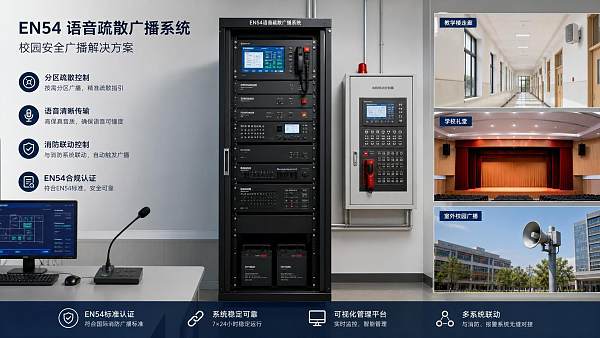
The exact feature list depends on the design, but several functions are usually fundamental when the system is carrying voice alarm duties:
- Supervised loudspeaker lines and monitored critical paths
- Automatic fault reporting and clear fault indication
- Priority management so emergency messages override routine paging and background audio
- Emergency microphone access at defined control points
- Standby power sized for the required duty period
- Integration logic that matches the fire alarm cause-and-effect sequence
- Redundancy or resilience measures where the risk assessment requires them
This is where generic school intercom systems usually fall short. They may work well for bells and daily announcements, but that does not make them suitable for monitored life-safety operation.
How much coordination is needed with the fire alarm contractor?
A lot more than many programmes allow. The PA and voice alarm package cannot be fully specified in isolation because message triggering, zoning, fault reporting, and priority rules often depend on the fire alarm logic. If those packages are procured separately without a clean interface matrix, you tend to get disputes during commissioning about who owns which input, relay, message trigger, or fault response.
A workable specification names the interfaces, the signal types, the control logic, and the witnessing responsibilities. It should also define who provides the final cause-and-effect verification. If that is left vague, the handover phase becomes longer and more expensive than it needs to be.
What should be written into the tender, beyond product names?
A strong tender package describes performance, interfaces, testing, and documentation, not just equipment categories. Naming acceptable standards and system functions is useful; relying only on a parts list is weak. Two bidders can price the same number of amplifiers and speakers while offering very different levels of supervision, battery autonomy, rack resilience, and commissioning support.
At minimum, the tender should call for:
- Detailed zoning drawings and cable topology
- Interface schedules with fire alarm and other relevant systems
- Battery and power calculations
- Loudspeaker layout rationale for intelligibility-critical areas
- Factory and site test documentation
- As-built drawings, operating manuals, and staff training scope
That level of detail gives you something measurable during submittal review and something enforceable at handover.
Where do school projects most often underestimate cost?
Usually in the parts nobody notices on an equipment room render. Batteries, monitored line hardware, fire-rated cabling approaches where required by the design, networked control architecture, call stations, rack segregation, and commissioning time all add cost. So does trying to fix intelligibility late with extra speakers after finishes are complete.
Another budget trap is assuming a combined PA and voice alarm system will automatically be cheaper than separate systems. Sometimes it is. Sometimes the operational complexity, resilience requirements, and integration burden make the combined solution harder to execute well. The comparison should be based on the fire strategy, daily use case, and maintenance model, not on a headline equipment count.
How do you know the system is ready for handover?
Handover is not just “audio comes out of every speaker.” The right question is whether the installed system matches the approved cause-and-effect logic, passes supervision and fault tests, delivers intelligible messages where required, and leaves the school with usable records.
Before practical completion, check for these items:
- Witnessed emergency message triggering by zone
- Verified priority override over routine paging or music
- Documented fault monitoring tests
- Power failure and standby operation checks
- Final drawings matching installed circuits and device locations
- Operations training for the school’s responsible staff
If the school team cannot understand zone labels, call-station functions, or fault indications at handover, the project is not operationally complete even if the installer says commissioning is finished.
What is the safest way to approach specification if the campus may expand later?
Plan for expansion at the architecture level, not by leaving a vague note about future capacity. If a school expects new classroom blocks, sports facilities, or boarding accommodation, the original specification should consider spare amplifier capacity, cabinet space, network architecture, fibre or backbone routes, and zoning logic that can grow without forcing a full rework.
That does not mean overbuying everything on day one. It means deciding which elements are expensive to retrofit later and protecting those pathways now. In campus work, backbone decisions made early tend to be far cheaper than emergency upgrades after occupancy.
A practical rule for project managers
If you can describe the proposed system only in terms of speakers, amplifiers, and announcements, the specification is still too shallow. If you can explain the evacuation logic by zone, the supervision method, the priority behavior, the intelligibility risk areas, the standby strategy, and the handover evidence required, you are much closer to a school PA specification that will stand up during review, commissioning, and real emergency use.
Search News
Hot Articles
- Arcade & VR MachinesHow to Choose Coin-Operated Pool Tables for Bars, Hotels, and Arcade VenuesSep 15, 2026
- Commercial KitchenHow Restaurants Can Choose Disposable Wooden Cutlery for Takeout and CateringSep 14, 2026
- Jewelry Packaging & DisplayHow U.S. Retailers Can Choose Jewelry Displays for Better Security and SalesSep 13, 2026
Popular Tags
Need ExpertConsultation?
Connect with our specialized leisureengineering team for procurementstrategies.
Recommended News
 Aug 31, 2026How to Plan Smart Classroom Solutions That Improve Learning and IT ManageabilitySmart classroom solutions: learn how to plan secure, scalable teaching spaces that improve learning, simplify IT management, and reduce lifecycle costs.● Institutional Buyer
 Aug 01, 2026How to Specify an EN54 School PA System for Safe, Compliant Campus Voice EvacuationEN54 school PA system specification guide for safer, compliant campus voice evacuation. Learn zoning, intelligibility, monitoring, tender tips, and handover checks.● Institutional Buyer
 Jul 15, 2026Vietnam Tightens Import Rules for Smart Campus TechVietnam Tightens Import Rules for Smart Campus Tech: learn how MOIT’s 2026 data hosting and NEP connection rules may reshape import approval, sourcing timelines, and delivery planning.● Institutional Buyer
 Jul 14, 2026Thailand TISI Tightens Rules for Smart Campus TerminalsThailand TISI tightens rules for smart campus terminals, requiring Thai speech recognition and local biometric data storage. Learn the compliance impact, timeline risks, and what exporters must do now.● Institutional Buyer
 Jul 13, 2026Red Sea Rerouting Lifts Smart Campus Tech Shipping CostsRed Sea rerouting lifts Smart Campus Tech shipping costs, extends Asia-Europe booking lead times, and delays delivery. See what exporters, buyers, and logistics teams should do now.● Institutional Buyer
 Jul 12, 2026Event Technology for Live Venues: What Systems Matter Most for Seamless Operations?Event technology defines how live venues handle ticketing, AV, access, and monitoring. Discover which systems matter most for seamless operations, higher uptime, and better guest experiences.● Institutional Buyer
 Jul 11, 2026What Is a Campus Procurement Platform and How Does It Improve School Purchasing Workflows?Campus procurement platform explained: learn how it streamlines school purchasing workflows, improves approval control, boosts spend visibility, and reduces delays across campus buying.● Institutional Buyer
 Jul 10, 2026Vietnam Raises Smart Campus Tech Import Tariff to 12%Vietnam Raises Smart Campus Tech Import Tariff to 12%: explore how the new Vietnam smart campus tech tariff impacts pricing, sourcing, and local assembly strategies across Southeast Asia.● Institutional Buyer
 Jul 10, 2026Interactive Document Camera vs Webcam: Which Works Better for Smart Classrooms?Interactive document camera vs webcam: discover which delivers clearer content sharing, faster lesson flow, and better hybrid teaching performance for smart classrooms.● Institutional Buyer
 Jul 09, 2026RCEP Rule Adds Carbon Footprint Filings for Smart Campus Tech ExportsRCEP Rule reshapes Smart Campus Tech exports: learn how new carbon footprint filings for Singapore, Thailand, and Vietnam affect customs clearance, lead times, and compliance planning before October 1, 2026.● Institutional Buyer
 Jul 09, 2026Basketball Hoops for Campuses: Which Backboard, Rim, and Mounting Type Fits Your Site?Basketball hoops for campuses: compare backboard, rim, and mounting options by site needs. Learn how to choose safer, longer-lasting systems for outdoor courts, gyms, and multipurpose halls.● Institutional Buyer
 Jul 09, 2026Modular Educational Furniture: What to Check Before Planning Flexible ClassroomsModular educational furniture: learn what to check before planning flexible classrooms, from safety and durability to teaching fit, supplier quality, and long-term value.● Institutional Buyer
 Jul 08, 2026Shenzhen-Yokohama Port Delays Fall to 2.1 DaysShenzhen-Yokohama Port Delays fall to 2.1 days, cutting shipment cycles by 5–7 days for smart campus equipment. See how faster port efficiency can ease Q3 school delivery pressure.● Institutional Buyer
 Jul 07, 2026FBX Slide Pushes Smart Campus Freight Below $980/FEUFBX Slide Pushes Smart Campus Freight Below $980/FEU as Asia-Europe rates tumble. Discover what this means for smart campus shipments, booking risks, and cost-saving opportunities.● Institutional Buyer
 Jul 07, 2026Math Manipulatives Bulk Price Guide: Cost Drivers, Pack Sizes, and School Budget PlanningMath manipulatives bulk price explained: compare cost drivers, pack sizes, landed costs, and school budget planning tips to source smarter and avoid hidden expenses.● Institutional Buyer
 Jul 04, 2026RCEP Update Expands Indonesia Duty-Free Quota for Edu DevicesRCEP Update Expands Indonesia Duty-Free Quota for Edu Devices: learn how the new 80,000-unit quota reshapes export costs, compliance, and school procurement opportunities in Indonesia.● Institutional Buyer
 Jul 03, 2026Indonesia Enforces ID-SNI Labels on Smart Campus ImportsIndonesia Enforces ID-SNI Labels on Smart Campus Imports: learn how the new rule affects labeling, customs clearance, certification, and delivery readiness for compliant market entry.● Institutional Buyer
 Jul 03, 2026How to Choose Indoor School Sports Equipment for Age Groups, Space, and Safety NeedsIndoor school sports equipment buying guide for schools: learn how to match age groups, space limits, and safety standards to choose durable, efficient solutions.● Institutional Buyer
 Jul 02, 2026Chromebook Charging Stations for Schools: Cart vs Cabinet vs Wall-Mount OptionsChromebook charging stations for schools compared: cart, cabinet, and wall-mount options. Discover the best fit for security, space, mobility, and budget before you buy.● Institutional Buyer
 Jul 01, 2026Indonesia Opens RCEP Fast Track for Smart Campus IoTIndonesia opens an RCEP fast track for Smart Campus IoT, cutting Jakarta customs clearance to 12 hours for eligible HS 8517.62 devices. See who qualifies and how to prepare.● Institutional Buyer
 Jun 30, 2026Flexible Learning Spaces for K-12 and Higher Ed: Layout Ideas, Furniture, and Tech NeedsFlexible learning spaces for K-12 and higher ed: explore practical layout ideas, durable furniture, and smart tech strategies that improve teaching, flexibility, and long-term campus value.● Institutional Buyer
 Jun 30, 2026Campus Equipment Procurement Checklist: How to Compare Specs, Warranties, and Total CostCampus equipment procurement made practical: compare specs, warranty terms, supplier reliability, and total cost to avoid hidden expenses and make smarter campus buying decisions.● Institutional Buyer
 Jun 26, 2026Learning Environments: What Design Elements Improve Focus and Engagement?Learning environments shape focus and engagement through smarter layout, acoustics, lighting, and furniture. Discover practical design elements that improve performance and create better learning outcomes.● Institutional Buyer
 Jun 26, 2026Event Technology Systems: Key Features, Use Cases, and Selection TipsEvent technology systems help venues streamline registration, access, engagement, and reporting. Discover key features, use cases, and selection tips to choose a reliable platform.● Institutional Buyer