How to Choose Indoor School Sports Equipment for Age Groups, Space, and Safety Needs
How to Choose Indoor School Sports Equipment for Age Groups, Space, and Safety Needs
Choosing indoor school sports equipment is not just a purchasing task. It shapes daily movement, class participation, supervision efficiency, and long-term facility value.
The right mix depends on three factors first: student age, available space, and safety requirements. Cost matters, but poor fit usually costs more later.
In real projects, indoor school sports equipment also affects installation planning, maintenance schedules, storage design, and procurement timing. That makes early evaluation much more important.
This guide explains how to compare options with a practical lens. The goal is to help decision-making stay safe, efficient, and aligned with actual school use.
Start With the Real Use Case
Before reviewing product catalogs, define how the space will be used. A multi-use gym needs different indoor school sports equipment than a dedicated PE training room.
Some schools prioritize structured PE classes. Others need flexible equipment for after-school programs, exams, student wellness, or rainy-day activity coverage.
That also changes the buying criteria. Daily high-frequency use requires stronger frames, faster setup, easier storage, and simpler inspection routines.
- How many students use the area per session
- Which age groups share the same facility
- Whether the room supports one sport or many
- How quickly equipment must be moved or stored
- What level of staff supervision is available
A clear use profile prevents overbuying. It also reduces the common mistake of choosing commercial-looking products that do not match school operations.
Match Indoor School Sports Equipment to Age Groups
Age fit is the first technical filter. Indoor school sports equipment should support ability development without creating unnecessary reach, weight, or impact risks.
Early Years and Lower Primary
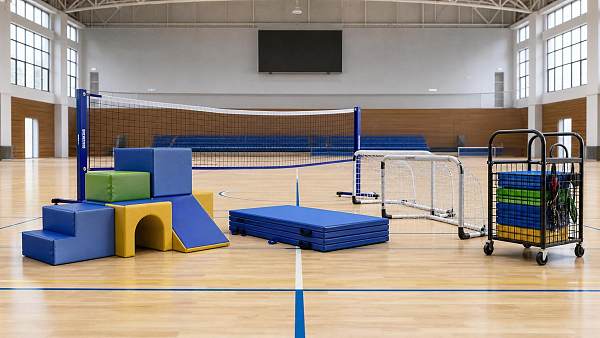
Younger students need equipment that builds confidence first. Lightweight balls, soft modular shapes, low-balance elements, and padded activity stations work best.
At this stage, coordination matters more than competition. Surface softness, rounded edges, and low fall height are more important than advanced sport-specific design.
Upper Primary and Middle School
This group usually needs mixed-function indoor school sports equipment. Skill-building, team activity, and flexible circuits become more relevant.
Adjustable nets, portable goals, reaction-training tools, climbing elements, and storage-friendly mats often deliver the best value in shared spaces.
Secondary and Senior Students
Older students can use more demanding equipment, but durability expectations rise sharply. Frames, anchors, and wear surfaces should handle stronger force and repeated use.
In this category, indoor school sports equipment may include regulation-style systems, strength stations, advanced training accessories, and higher-performance court solutions.
Where mixed ages share one hall, adjustable equipment is usually the smarter choice. It improves utilization and reduces future replacement pressure.
Evaluate Space Before Choosing Products
Space planning should go beyond room dimensions. Ceiling height, wall clearance, traffic flow, storage access, and emergency routes all influence indoor school sports equipment selection.
A product may fit on paper but fail during operation. Fold-out units, rebound zones, and run-up distances often create hidden conflicts in school gyms.
For compact campuses, flexibility matters more than quantity. Multi-purpose indoor school sports equipment often delivers better scheduling efficiency than single-use installations.
Make Safety Compliance a Core Selection Standard
Safety should not be checked only at the end. It needs to shape the shortlist from the start, especially for institutional procurement and tender evaluation.
Reliable indoor school sports equipment should be reviewed for material safety, structural stability, edge protection, anti-slip performance, and installation integrity.
Look closely at product testing records and applicable standards. Depending on the region, buyers may need EN, ASTM, ISO, or local educational facility compliance evidence.
- Certified materials and finish safety
- Load-bearing and structural test data
- Anchoring method and floor compatibility
- Protective padding in impact zones
- Inspection access for ongoing maintenance
A lower quoted price can hide higher risk. Missing certificates, weak weld quality, or unclear installation responsibility often become the real project problem.
Compare Fixed, Mobile, and Modular Equipment
Most school projects involve a choice between fixed systems, mobile units, and modular sets. Each serves different operational needs.
Fixed Systems
Fixed indoor school sports equipment offers strong stability and a professional feel. It suits dedicated gyms with predictable layouts and high usage frequency.
However, installation is more complex. Changes later may require floor work, wall reinforcement, or downtime.
Mobile Units
Mobile indoor school sports equipment supports multi-use halls and fast transitions. It works well when one room serves PE, events, and community programs.
The key is wheel quality, locking reliability, and handling safety. Poor mobility design creates staff strain and higher accident risk.
Modular Sets
Modular indoor school sports equipment is useful for younger ages and flexible training zones. It supports varied activities without permanent layout commitment.
This option is often ideal when schools want phased investment, easier replacement, or changing curriculum needs across academic years.
Look Beyond Purchase Price
The best indoor school sports equipment is not always the cheapest line item. Total value comes from lifespan, serviceability, warranty support, and operating efficiency.
This is where sourcing discipline matters. For institutional buyers, supplier transparency and after-sales capability deserve the same attention as product specifications.
- Estimate expected usage cycles per year.
- Calculate storage, setup, and labor implications.
- Review spare part availability and lead time.
- Confirm warranty coverage for frames and moving parts.
- Check whether training or installation support is included.
From a project delivery perspective, dependable indoor school sports equipment reduces disruption later. That matters far more than a short-term procurement saving.
Build a Practical Evaluation Checklist
A structured checklist helps compare suppliers fairly. It also keeps internal stakeholders aligned during design review, procurement approval, and installation planning.
- Age suitability for current and future users
- Fit with room size and circulation paths
- Compliance documents and test reports
- Surface safety and edge protection details
- Storage efficiency and handling requirements
- Maintenance burden and replacement parts
- Lead time, installation scope, and supplier support
In practice, the strongest indoor school sports equipment choice is the one that performs well across all categories, not just one impressive specification.
Final Decision Guidance
Choosing indoor school sports equipment becomes much easier when the sequence is clear. Start with age needs, then confirm space limits, then filter by safety and lifecycle value.
That order helps avoid common project mistakes. It prevents overspecification, reduces operational friction, and supports more defensible procurement decisions.
For schools planning upgrades or new facilities, indoor school sports equipment should be assessed as part of the full environment, not as isolated products.
When the selection process is grounded in actual use, safety evidence, and long-term function, the result is a better learning space and a stronger investment outcome.
Search News
Hot Articles
- Restaurant FurnitureFast-Casual Restaurant Interiors: Design Choices That Improve Speed and Guest FlowOct 04, 2026
- Outdoor RidesHow to Select Leisure Park Equipment for Safe, High-Throughput Visitor AreasOct 03, 2026
- Fashion & Gem JewelryDiamond Tester Wholesale: How to Vet Accuracy, Calibration, and MOQ Before OrderingOct 02, 2026
Popular Tags
Need ExpertConsultation?
Connect with our specialized leisureengineering team for procurementstrategies.
Recommended News
 Sep 28, 2026How U.S. Schools Can Choose Laboratory Equipment for Safe, Compliant Science LabsSchool laboratory equipment USA: learn how to select safe, compliant lab furniture, ventilation, emergency systems, and durable tools for K–12 science labs.● Institutional Buyer
 Sep 16, 2026How to Source Educational Furniture Worldwide for Safe, Flexible Learning SpacesEducational furniture worldwide: learn how to source safe, flexible, durable learning-space solutions while controlling compliance, logistics, and lifecycle costs.● Institutional Buyer
 Aug 31, 2026How to Plan Smart Classroom Solutions That Improve Learning and IT ManageabilitySmart classroom solutions: learn how to plan secure, scalable teaching spaces that improve learning, simplify IT management, and reduce lifecycle costs.● Institutional Buyer
 Aug 01, 2026How to Specify an EN54 School PA System for Safe, Compliant Campus Voice EvacuationEN54 school PA system specification guide for safer, compliant campus voice evacuation. Learn zoning, intelligibility, monitoring, tender tips, and handover checks.● Institutional Buyer
 Jul 15, 2026Vietnam Tightens Import Rules for Smart Campus TechVietnam Tightens Import Rules for Smart Campus Tech: learn how MOIT’s 2026 data hosting and NEP connection rules may reshape import approval, sourcing timelines, and delivery planning.● Institutional Buyer
 Jul 14, 2026Thailand TISI Tightens Rules for Smart Campus TerminalsThailand TISI tightens rules for smart campus terminals, requiring Thai speech recognition and local biometric data storage. Learn the compliance impact, timeline risks, and what exporters must do now.● Institutional Buyer
 Jul 13, 2026Red Sea Rerouting Lifts Smart Campus Tech Shipping CostsRed Sea rerouting lifts Smart Campus Tech shipping costs, extends Asia-Europe booking lead times, and delays delivery. See what exporters, buyers, and logistics teams should do now.● Institutional Buyer
 Jul 12, 2026Event Technology for Live Venues: What Systems Matter Most for Seamless Operations?Event technology defines how live venues handle ticketing, AV, access, and monitoring. Discover which systems matter most for seamless operations, higher uptime, and better guest experiences.● Institutional Buyer
 Jul 11, 2026What Is a Campus Procurement Platform and How Does It Improve School Purchasing Workflows?Campus procurement platform explained: learn how it streamlines school purchasing workflows, improves approval control, boosts spend visibility, and reduces delays across campus buying.● Institutional Buyer
 Jul 10, 2026Vietnam Raises Smart Campus Tech Import Tariff to 12%Vietnam Raises Smart Campus Tech Import Tariff to 12%: explore how the new Vietnam smart campus tech tariff impacts pricing, sourcing, and local assembly strategies across Southeast Asia.● Institutional Buyer
 Jul 10, 2026Interactive Document Camera vs Webcam: Which Works Better for Smart Classrooms?Interactive document camera vs webcam: discover which delivers clearer content sharing, faster lesson flow, and better hybrid teaching performance for smart classrooms.● Institutional Buyer
 Jul 09, 2026RCEP Rule Adds Carbon Footprint Filings for Smart Campus Tech ExportsRCEP Rule reshapes Smart Campus Tech exports: learn how new carbon footprint filings for Singapore, Thailand, and Vietnam affect customs clearance, lead times, and compliance planning before October 1, 2026.● Institutional Buyer
 Jul 09, 2026Basketball Hoops for Campuses: Which Backboard, Rim, and Mounting Type Fits Your Site?Basketball hoops for campuses: compare backboard, rim, and mounting options by site needs. Learn how to choose safer, longer-lasting systems for outdoor courts, gyms, and multipurpose halls.● Institutional Buyer
 Jul 09, 2026Modular Educational Furniture: What to Check Before Planning Flexible ClassroomsModular educational furniture: learn what to check before planning flexible classrooms, from safety and durability to teaching fit, supplier quality, and long-term value.● Institutional Buyer
 Jul 08, 2026Shenzhen-Yokohama Port Delays Fall to 2.1 DaysShenzhen-Yokohama Port Delays fall to 2.1 days, cutting shipment cycles by 5–7 days for smart campus equipment. See how faster port efficiency can ease Q3 school delivery pressure.● Institutional Buyer
 Jul 07, 2026FBX Slide Pushes Smart Campus Freight Below $980/FEUFBX Slide Pushes Smart Campus Freight Below $980/FEU as Asia-Europe rates tumble. Discover what this means for smart campus shipments, booking risks, and cost-saving opportunities.● Institutional Buyer
 Jul 07, 2026Math Manipulatives Bulk Price Guide: Cost Drivers, Pack Sizes, and School Budget PlanningMath manipulatives bulk price explained: compare cost drivers, pack sizes, landed costs, and school budget planning tips to source smarter and avoid hidden expenses.● Institutional Buyer
 Jul 04, 2026RCEP Update Expands Indonesia Duty-Free Quota for Edu DevicesRCEP Update Expands Indonesia Duty-Free Quota for Edu Devices: learn how the new 80,000-unit quota reshapes export costs, compliance, and school procurement opportunities in Indonesia.● Institutional Buyer
 Jul 03, 2026Indonesia Enforces ID-SNI Labels on Smart Campus ImportsIndonesia Enforces ID-SNI Labels on Smart Campus Imports: learn how the new rule affects labeling, customs clearance, certification, and delivery readiness for compliant market entry.● Institutional Buyer
 Jul 03, 2026How to Choose Indoor School Sports Equipment for Age Groups, Space, and Safety NeedsIndoor school sports equipment buying guide for schools: learn how to match age groups, space limits, and safety standards to choose durable, efficient solutions.● Institutional Buyer
 Jul 02, 2026Chromebook Charging Stations for Schools: Cart vs Cabinet vs Wall-Mount OptionsChromebook charging stations for schools compared: cart, cabinet, and wall-mount options. Discover the best fit for security, space, mobility, and budget before you buy.● Institutional Buyer
 Jul 01, 2026Indonesia Opens RCEP Fast Track for Smart Campus IoTIndonesia opens an RCEP fast track for Smart Campus IoT, cutting Jakarta customs clearance to 12 hours for eligible HS 8517.62 devices. See who qualifies and how to prepare.● Institutional Buyer
 Jun 30, 2026Flexible Learning Spaces for K-12 and Higher Ed: Layout Ideas, Furniture, and Tech NeedsFlexible learning spaces for K-12 and higher ed: explore practical layout ideas, durable furniture, and smart tech strategies that improve teaching, flexibility, and long-term campus value.● Institutional Buyer
 Jun 30, 2026Campus Equipment Procurement Checklist: How to Compare Specs, Warranties, and Total CostCampus equipment procurement made practical: compare specs, warranty terms, supplier reliability, and total cost to avoid hidden expenses and make smarter campus buying decisions.● Institutional Buyer