How to Choose Commercial Carpet Tiles for Hospitality Projects by Traffic and Maintenance Needs
Choosing commercial carpet tiles hospitality teams can rely on is not just about style. For project managers and specifiers, the real question is whether the product will perform under actual traffic, fit the housekeeping model, and protect lifecycle budget.
In hospitality projects, the best choice is rarely the softest finish or the lowest unit price. It is the carpet tile system that matches zone-specific wear, cleaning frequency, replacement logistics, and brand expectations across guestrooms and public areas.
This guide explains how to select commercial carpet tiles hospitality buyers can specify with confidence. It focuses on traffic patterns, maintenance realities, technical criteria, and sourcing decisions that reduce long-term operational risk.
Why Traffic and Maintenance Should Drive the First Specification Decision
Many hospitality flooring decisions fail because selection starts with color, pattern, or sample-board appeal. Those factors matter, but they should come after defining how each area will be used, cleaned, and maintained over time.
A hotel lobby, corridor, guestroom, lounge, meeting room, and back-of-house office do not experience the same load. Applying one carpet tile specification across all zones often creates avoidable wear issues and unnecessary replacement costs.
For project managers, the practical approach is to divide the property into traffic categories first. Then map each category to durability, stain resistance, underfoot comfort, and maintenance access before reviewing design options.
This traffic-first method improves forecasting. It also helps align procurement, interior design, facility management, and ownership expectations early, before unsuitable products become embedded in tender packages or mock-up approvals.
How to Classify Hospitality Areas by Traffic Intensity
The most useful starting framework is low, medium, high, and severe traffic. These categories are simple, but they create a solid basis for evaluating construction, fiber type, backing stability, and cleaning requirements.
Low-traffic zones usually include standard guestrooms, private offices, and some low-use suites. Here, comfort, acoustic performance, and visual warmth can carry more weight, provided the tile still meets commercial durability requirements.
Medium-traffic areas often include meeting rooms, executive lounges, and secondary corridors. These spaces need a better balance between design and resilience because traffic is periodic, furniture movement is common, and spills are not unusual.
High-traffic zones typically include main corridors, lift lobbies, reception-adjacent circulation, and all-day dining edges. In these locations, pattern retention, seam stability, and cleanability become more important than plush appearance.
Severe-traffic areas include main entrances, porte-cochere transition zones, baggage routes, and event circulation paths. In such spaces, project teams should evaluate whether carpet tile is appropriate at all or should be paired with hard flooring transitions.
This zoning exercise matters because hospitality wear is not only about footfall volume. It also reflects wheeled luggage, moisture ingress, food service movement, localized staining, and the speed at which damaged tiles must be replaced.
What Project Managers Should Check in Carpet Tile Construction
Once zones are defined, construction details become critical. Two carpet tiles can look similar on a sample board while performing very differently after months of rolling loads, daily vacuuming, and repeated spot-cleaning.
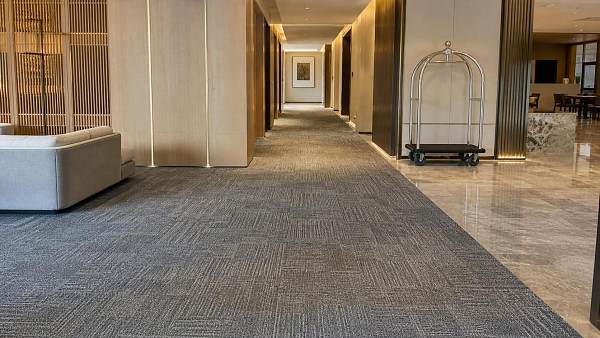
Pile construction is a major factor. For many hospitality public areas, low-loop or patterned loop constructions generally offer stronger wear resistance and better appearance retention than higher cut-pile surfaces.
Cut-and-loop options can still work well where design expression matters, especially in guestrooms or selected premium areas. However, they should be assessed carefully for crushing, shading, and how visible soiling becomes under real operating conditions.
Face weight alone should not drive the decision. Buyers often assume heavier means better, but density, fiber resilience, construction quality, and backing integrity usually have greater influence on long-term commercial performance.
Tile dimensions and dimensional stability also matter. In hospitality environments where fast replacement is essential, stable tiles with reliable edge performance reduce the risk of peaking, gapping, or visible maintenance-related irregularities.
Backing system quality deserves close review. A strong backing improves stability, supports rolling traffic, influences comfort underfoot, and can contribute to acoustic control, which is especially relevant in guestrooms and corridor applications.
Which Fiber Types Make the Most Sense for Hospitality Use
Fiber selection affects stain resistance, cleanability, appearance retention, and cost. For most commercial carpet tiles hospitality projects use, the real comparison usually centers on solution-dyed nylon, standard nylon, and polypropylene.
Solution-dyed nylon is often the strongest all-around choice for demanding hospitality applications. It combines good resilience with strong stain resistance and colorfastness, making it suitable for corridors, public areas, and mixed-use spaces.
Standard nylon can also perform well in many projects, particularly when supported by a reputable manufacturer and a suitable maintenance program. However, its stain performance may depend more heavily on topical treatments and cleaning discipline.
Polypropylene is usually attractive on initial cost, but project teams should be cautious in high-profile or heavy-use hospitality environments. It can be more vulnerable to crushing and may not deliver the same long-term appearance retention.
For owners focused on total cost rather than procurement cost alone, fiber should be evaluated over the expected replacement cycle. The cheapest fiber on day one can become the most expensive option once early wear and visible degradation appear.
How Maintenance Capacity Should Influence Product Selection
One of the biggest specification mistakes is choosing flooring that assumes a maintenance standard the operator cannot realistically sustain. A carpet tile must fit the actual housekeeping model, not the ideal one described in planning meetings.
If the property has strong in-house maintenance resources, more design-sensitive surfaces may remain viable. If staffing is lean, turnover is high, or specialist equipment is limited, the flooring should be more forgiving by design.
Project managers should ask practical questions early. How often will each zone be vacuumed? Is interim cleaning available? How quickly can spills be treated? Are replacement tiles stored on site? Who approves reactive replacements?
In hotel operations, delay matters. A floor finish that technically can be maintained but requires long intervention windows or specialized chemicals may still be the wrong choice for a busy property with limited shutdown flexibility.
Stain camouflage is therefore not a superficial design issue. In hospitality, pattern scale, color variation, and texture can significantly reduce the visual impact of soil between cleaning cycles, especially in circulation-heavy areas.
Modular replacement is another operational advantage of carpet tile. But that advantage only exists if the pattern repeat, dye-lot management, attic stock planning, and installation orientation are managed correctly from the start.
Where Carpet Tiles Work Best in Hospitality Projects
Commercial carpet tiles hospitality teams specify are especially useful where acoustic comfort, phased replacement, and access efficiency matter. Corridors, meeting rooms, business lounges, guestrooms, and selected office-support areas are common examples.
In corridors, carpet tile can help manage noise from luggage and guest movement while allowing localized replacement after damage. The key is selecting a construction that resists tracking, crushing, and seam visibility.
In guestrooms, the value proposition often includes comfort, warmth, and acoustic performance. Here, project teams can allow more design softness, but they still need to consider furniture drag, housekeeping chemicals, and turnover frequency.
Meeting and event spaces need more careful evaluation. Carpet tile can work well, but only if the backing and construction can tolerate reconfiguration, chair movement, catering equipment, and occasional high-intensity traffic peaks.
At entrances and wet transition zones, teams should be more selective. Moisture and soil load can accelerate failure, so robust walk-off systems and hard-surface transitions may be necessary to protect adjacent carpet tile installations.
How to Compare Cost Beyond the Initial Material Price
For project managers, the most important financial question is not tile price per square meter. It is the combined cost of installation, maintenance, replacement frequency, guest-facing appearance, and operational disruption over the asset life.
A lower-cost tile may look attractive in bid comparison sheets. But if it requires more aggressive cleaning, shows wear earlier, or forces broader area replacement, the savings usually disappear quickly in active hospitality settings.
Lifecycle cost discussions should include attic stock volume, spare tile storage conditions, replacement labor access, expected cleaning frequency, and the cost of appearance decline in guest-visible spaces. These factors affect the true ownership equation.
There is also a coordination cost when poor flooring choices trigger complaints from operations, design, or ownership after opening. Recovering from a wrong specification in a live hotel is far more expensive than specifying correctly during planning.
What to Ask Suppliers Before Finalizing a Specification
Supplier evaluation should go beyond catalog claims. Hospitality buyers need evidence that a manufacturer can support commercial performance, lead-time reliability, and post-installation consistency across phased orders or multi-property rollouts.
Ask for application-specific performance data, not just general brochures. Relevant details include wear classification, stain resistance, backing construction, dimensional stability, acoustic values, fire performance, and maintenance recommendations.
It is also worth confirming whether the supplier has hospitality references with comparable traffic profiles. A product that performs well in offices may not behave the same way in hotels with luggage wheels, food spills, and round-the-clock occupancy.
Project teams should review shade consistency, dye-lot controls, minimum order quantities, and spare tile strategy. If future replacement pieces cannot be matched reliably, the modular benefit of carpet tile is weakened significantly.
For international procurement, lead times, packaging standards, installation guidance, and compliance documentation deserve close attention. Delays or paperwork gaps can affect not just procurement schedules, but also handover risk and operator readiness.
A Practical Selection Framework for Hospitality Carpet Tile Decisions
A reliable specification process can be kept simple. First, define each zone by traffic level, soil exposure, moisture risk, and guest visibility. Second, align maintenance capacity with realistic cleaning frequency and replacement response time.
Third, shortlist constructions and fiber types that fit those conditions. Fourth, compare lifecycle cost rather than material cost alone. Finally, validate the choice with supplier documentation, reference projects, and, where possible, physical mock-up testing.
Mock-ups are especially valuable in hospitality because lighting, trolley movement, and visible soil behavior often look different on site than in showrooms. Small practical trials can reveal issues that spec sheets do not fully capture.
When multiple stakeholders are involved, this framework also improves communication. Designers can protect brand intent, operators can protect maintainability, and project managers can protect budget, schedule, and performance accountability.
Conclusion: Choose for Operating Reality, Not Sample-Board Appeal
The right commercial carpet tiles hospitality projects require are the ones that suit actual operating conditions. Traffic intensity, maintenance capability, and replacement logistics should shape the specification before aesthetics are finalized.
For project managers and engineering leads, the strongest decision is usually a zone-based one: resilient construction in high-use areas, appropriate comfort in lower-use spaces, and clear supplier validation across performance and continuity.
When carpet tile is selected through that lens, it supports guest experience, protects visual standards, reduces avoidable maintenance pressure, and delivers a more predictable lifecycle outcome for hospitality assets.
Search News
Hot Articles
- Outdoor RidesHow to Select Leisure Park Equipment for Safe, High-Throughput Visitor AreasOct 03, 2026
- Fashion & Gem JewelryDiamond Tester Wholesale: How to Vet Accuracy, Calibration, and MOQ Before OrderingOct 02, 2026
- Hotel Room AmenitiesHow Hotels Can Choose Amenity Bottles That Balance Brand Image and Refill CostsOct 01, 2026
Popular Tags
Need ExpertConsultation?
Connect with our specialized leisureengineering team for procurementstrategies.
Recommended News
 Aug 19, 2026How to Choose Commercial Carpet Tiles for Hospitality Projects by Traffic and Maintenance NeedsCommercial carpet tiles hospitality buyers trust should match traffic, maintenance, and lifecycle cost. Learn how to specify durable, guest-ready flooring with confidence.● Hospitality Sourcing Dir
 Aug 15, 2026How to Evaluate Commercial Product Compliance for Hospitality Procurementcommercial product compliance hospitality guide to evaluating supplier documents, reducing risk, and choosing compliant products that protect guest safety and project timelines.● Hospitality Sourcing Dir
 Aug 10, 2026What Does Global Hospitality Procurement Cover and How to Reduce Sourcing Risk?Global hospitality procurement covers supplier screening, compliance, quality control, and logistics. Learn practical ways to reduce sourcing risk, avoid delays, and protect hotel project outcomes.● Hospitality Sourcing Dir
 Aug 07, 2026Hotel Operations Standards Explained: Key SOPs, Audits, and Compliance BasicsHotel operations standards explained clearly: learn the key SOPs, audit methods, and compliance basics that help hotels reduce risk, improve consistency, and strengthen guest experience.● Hospitality Sourcing Dir
 Jul 13, 2026Hotel Operations Metrics That Matter: Occupancy, ADR, RevPAR, and Labor CostHotel operations metrics explained: learn how occupancy, ADR, RevPAR, and labor cost shape revenue, staffing efficiency, and smarter hotel performance decisions.● Hospitality Sourcing Dir
 Jun 27, 2026Hotel Operations Management Basics: Key Departments, KPIs, and Daily WorkflowsHotel operations management made simple: explore key hotel departments, essential KPIs, and daily workflows that improve guest satisfaction, efficiency, and profitability.● Hospitality Sourcing Dir
 Jun 24, 2026Commercial Hospitality Procurement: What to Source First for Hotel OpeningsCommercial hospitality procurement starts with the right categories. Learn what hotels should source first to protect timelines, compliance, and opening readiness.● Hospitality Sourcing Dir
 Jun 05, 2026Safari Tents Wholesale: How to Compare Frame Materials, Sizes, and MOQSafari tents wholesale guide: compare frame materials, tent sizes, and MOQ to reduce sourcing risk, control costs, and choose a scalable supplier for profitable hospitality projects.● Hospitality Sourcing Dir
 May 18, 2026How to judge simultaneous interpretation equipment qualitySimultaneous interpretation equipment quality affects clarity, stability, and event success. Learn the key checklist, testing points, and sourcing tips to choose with confidence.● Hospitality Sourcing Dir
 May 18, 2026What to check before choosing tour guide systems wholesaleTour guide systems wholesale: learn what to check before buying, from audio stability and certifications to battery life, customization, and supplier support.● Hospitality Sourcing Dir
 May 13, 2026China's MCT Launches 'Travel Services' Overseas Compliance GuideChina's MCT Travel Services Compliance Guide: Essential for sports tourism, study-abroad & customized tour operators expanding to EU/US markets under GDPR, CCPA & CSDDD.● Hospitality Sourcing Dir
 May 09, 2026Inflatable clear bubble tents and the privacy trade-offInflatable clear bubble tents offer immersive appeal, but is the privacy trade-off worth it? Explore scenario-based insights for resorts, events, dining, and public spaces.● Hospitality Sourcing Dir
 May 09, 2026Camping glamping tents: what guests notice before anything elseCamping glamping tents guests love start with first impressions—space, privacy, materials, light, and comfort. Discover what buyers should prioritize to boost appeal and bookings.● Hospitality Sourcing Dir
 May 09, 2026Safari tents wholesale and the weatherproofing details that matterSafari tents wholesale buyers now prioritize weatherproofing. Learn which waterproof, windproof, ventilation, and corrosion details reduce risk, protect uptime, and improve long-term value.● Hospitality Sourcing Dir
 May 09, 2026Geodesic dome tents: are they practical for year-round stays?Geodesic dome tents can work for year-round stays—but only with the right insulation, ventilation, and structural planning. Discover what makes them practical, comfortable, and cost-effective.● Hospitality Sourcing Dir
 May 09, 2026Inflatable paddle boards commercial buyers often overlook thisInflatable paddle boards commercial buyers often miss the factors that drive long-term value—durability, safety, compliance, and supplier consistency. Learn what to check before you buy.● Hospitality Sourcing Dir
 May 09, 2026Why ski resort equipment budgets often miss hidden costsSki resort equipment budgets often miss freight, installation, compliance, and service costs. Learn the hidden drivers behind overruns and budget smarter for stronger ROI.● Hospitality Sourcing Dir
 May 09, 2026Artificial snow mats vs real snow for beginner ski zonesArtificial snow mats vs real snow: discover which option gives beginner ski zones safer training, longer seasons, lower operating risk, and stronger commercial value.● Hospitality Sourcing Dir
 Apr 25, 2026Discover the Best of the Silk Road: Top Xi'an Hot Tourism Routes for 2026● Hospitality Sourcing Dir
 Apr 22, 2026Peak of China: The Ultimate 7-Day Central Plains Heritage Odyssey 2026Plan a 7-day Henan heritage tour in 2026 with Luoyang, Shaolin Temple and Kaifeng highlights, plus visa-free transit and rail tips.● Hospitality Sourcing Dir