Commercial Hospitality Procurement: What to Source First for Hotel Openings
Commercial Hospitality Procurement: What to Source First for Hotel Openings
In hotel development, timing shapes cost, quality, and opening readiness.
That is why commercial hospitality procurement must start with categories that protect schedule and compliance.
Buying everything at once sounds efficient, but it often creates storage issues, design conflicts, and cash flow pressure.
A smarter approach is to source in phases, based on lead time, installation sequence, and operational impact.
In practice, strong commercial hospitality procurement connects procurement planning with engineering, fit-out, and pre-opening operations.
When that alignment happens early, hotel openings become easier to control and far less expensive to recover.
Why early sourcing decisions matter most
The first wave of sourcing decisions usually locks in the project’s risk profile.
If priority items arrive late, other trades wait, rework increases, and opening dates slip.
More importantly, late decisions can force substitutions that damage guest experience or violate brand standards.
From a cost view, commercial hospitality procurement should focus first on items with long manufacturing cycles and strict technical dependencies.
This also means procurement teams should separate “important” items from “critical first” items.
The four filters for first-priority sourcing
- Long lead time due to custom production or imported components.
- Direct connection to MEP coordination, structural openings, or fixed dimensions.
- High compliance risk involving fire safety, hygiene, or electrical certification.
- Strong effect on revenue readiness, guest rooms, kitchens, or public areas.
These filters create a practical framework for commercial hospitality procurement, especially when schedules are compressed.
What to source first for hotel openings
The first sourcing package should not be based on department size.
It should be based on what unlocks the rest of the project.
1. Kitchen and back-of-house core equipment
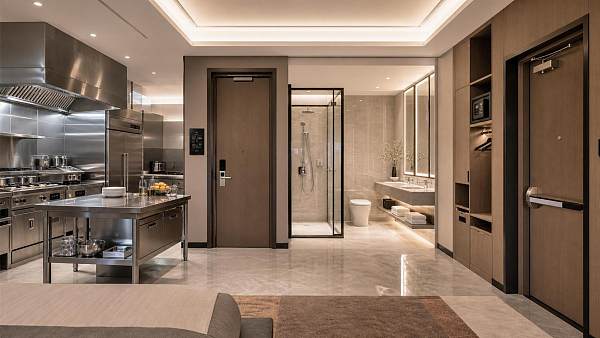
Commercial kitchens are usually among the earliest procurement priorities.
Cooking lines, ventilation systems, refrigeration, dishwashing systems, and stainless fabrication often require detailed shop drawings.
These items affect drainage points, power loads, gas routes, and exhaust coordination.
In commercial hospitality procurement, delaying kitchen equipment usually causes expensive redesign later.
If the hotel includes banquet operations, specialty dining, or high-volume breakfast service, this category moves even higher.
2. Guestroom bathroom fixtures and sanitary systems
Bathroom packages should also be sourced early.
Bathtubs, shower systems, mixers, concealed valves, and custom vanities influence rough-in accuracy.
A small specification change here can trigger wall opening, waterproofing repair, and finish replacement.
For this reason, commercial hospitality procurement should lock bathroom technical submittals before finishing trades accelerate.
3. Fixed guestroom millwork and built-in furniture
Loose furniture can often wait longer than built-in items.
Headboards, wardrobes, minibar units, workstations, and integrated luggage benches need exact site dimensions.
They also affect power outlets, lighting locations, and wall protection details.
Early commercial hospitality procurement here helps avoid misalignment between design intent and manufacturing reality.
4. Fire-rated doors, locks, and access systems
This category is easy to underestimate.
But fire-rated doors, electronic locks, closers, panic hardware, and access control systems are tied to life safety and occupancy approval.
They also require coordination across security, IT, interior design, and operations.
Strong commercial hospitality procurement treats this as a critical path package, not a finishing accessory.
5. Laundry, housekeeping, and service-area equipment
Hotels often focus on front-of-house first, yet back-of-house readiness determines service quality from day one.
Laundry systems, linen handling, housekeeping storage, and waste management equipment support immediate daily operations.
These items may not define aesthetics, but they strongly affect labor efficiency and operating cost.
That is why practical commercial hospitality procurement gives them earlier attention than many teams expect.
What can be sourced later without hurting the schedule
Not every product category belongs in the first purchasing wave.
Some items are important, but they do not block construction or compliance.
- Decorative accessories and tabletop items.
- Loose seating for secondary lounges.
- Artwork, styling objects, and soft decorative layers.
- Selected spa or recreation add-ons without technical impact.
This does not mean they are low value.
It simply means commercial hospitality procurement should protect critical-path categories before aesthetic final touches.
How to balance procurement timing with budget control
Cost pressure is real, especially when hotel openings face inflation or design revisions.
Still, delaying first-priority purchases rarely saves money in the end.
A better strategy is to stage commitment levels within the commercial hospitality procurement plan.
Use three commitment stages
- Approve technical specifications early.
- Release long-lead production with controlled quantities.
- Finalize finishes and non-critical options later.
This approach keeps factories moving while preserving some flexibility on appearance or optional features.
For commercial hospitality procurement, that balance often delivers better budget discipline than waiting for perfect information.
Common sourcing risks during hotel openings
Most hotel opening delays are not caused by one dramatic failure.
They come from small procurement mistakes that compound across trades.
- Specifications approved before site dimensions are frozen.
- Suppliers chosen on price alone, without compliance review.
- Imported goods ordered without realistic customs and inland delivery buffers.
- Operations teams excluded from equipment usability decisions.
- Procurement packages grouped too broadly, hiding critical dependencies.
The more complex the property, the more visible these risks become.
Effective commercial hospitality procurement reduces them with tighter package logic and earlier cross-functional review.
A practical sourcing sequence for opening success
A useful hotel opening sequence starts with technical, fixed, and regulated items.
Then it moves to operational essentials, followed by visual enhancement items.
This structure keeps commercial hospitality procurement aligned with both construction logic and opening economics.
How GCT supports smarter commercial hospitality procurement
In today’s market, sourcing decisions need more than supplier lists.
They require verified intelligence, category expertise, and confidence in manufacturing capability.
Global Commercial Trade supports commercial hospitality procurement with sector-focused insights across hotel equipment and commercial fit-out categories.
Its editorial framework is built around practical sourcing issues, including OEM and ODM capacity, safety expectations, supply chain reliability, and project-fit evaluation.
For hotel opening teams, that kind of intelligence helps reduce guesswork before purchase orders are released.
Final takeaway
The best commercial hospitality procurement strategy is not the fastest buying strategy.
It is the one that sources the right categories first.
For hotel openings, that usually means core kitchen systems, bathroom technical packages, fixed millwork, life-safety hardware, and service-area essentials.
When priorities are clear, teams spend less time reacting and more time delivering a smooth launch.
That is the real value of disciplined commercial hospitality procurement.
Start with the categories that lock schedule, compliance, and operations, and the rest of the opening becomes much easier to manage.
Search News
Hot Articles
- Commercial KitchenCommercial Kitchen Design Price: Budgeting by Layout, Equipment, and MEP ScopeSep 22, 2026
- Stationery & UniformsHow Schools Can Cut Printing Costs When Buying Ink Cartridges in BulkSep 21, 2026
- Jewelry Packaging & DisplayHow to Evaluate a Luxury Retail Packaging Supplier for Premium Brand ConsistencySep 20, 2026
Popular Tags
Need ExpertConsultation?
Connect with our specialized leisureengineering team for procurementstrategies.
Recommended News
 Aug 19, 2026How to Choose Commercial Carpet Tiles for Hospitality Projects by Traffic and Maintenance NeedsCommercial carpet tiles hospitality buyers trust should match traffic, maintenance, and lifecycle cost. Learn how to specify durable, guest-ready flooring with confidence.● Hospitality Sourcing Dir
 Aug 15, 2026How to Evaluate Commercial Product Compliance for Hospitality Procurementcommercial product compliance hospitality guide to evaluating supplier documents, reducing risk, and choosing compliant products that protect guest safety and project timelines.● Hospitality Sourcing Dir
 Aug 10, 2026What Does Global Hospitality Procurement Cover and How to Reduce Sourcing Risk?Global hospitality procurement covers supplier screening, compliance, quality control, and logistics. Learn practical ways to reduce sourcing risk, avoid delays, and protect hotel project outcomes.● Hospitality Sourcing Dir
 Aug 07, 2026Hotel Operations Standards Explained: Key SOPs, Audits, and Compliance BasicsHotel operations standards explained clearly: learn the key SOPs, audit methods, and compliance basics that help hotels reduce risk, improve consistency, and strengthen guest experience.● Hospitality Sourcing Dir
 Jul 13, 2026Hotel Operations Metrics That Matter: Occupancy, ADR, RevPAR, and Labor CostHotel operations metrics explained: learn how occupancy, ADR, RevPAR, and labor cost shape revenue, staffing efficiency, and smarter hotel performance decisions.● Hospitality Sourcing Dir
 Jun 27, 2026Hotel Operations Management Basics: Key Departments, KPIs, and Daily WorkflowsHotel operations management made simple: explore key hotel departments, essential KPIs, and daily workflows that improve guest satisfaction, efficiency, and profitability.● Hospitality Sourcing Dir
 Jun 24, 2026Commercial Hospitality Procurement: What to Source First for Hotel OpeningsCommercial hospitality procurement starts with the right categories. Learn what hotels should source first to protect timelines, compliance, and opening readiness.● Hospitality Sourcing Dir
 Jun 05, 2026Safari Tents Wholesale: How to Compare Frame Materials, Sizes, and MOQSafari tents wholesale guide: compare frame materials, tent sizes, and MOQ to reduce sourcing risk, control costs, and choose a scalable supplier for profitable hospitality projects.● Hospitality Sourcing Dir
 May 18, 2026How to judge simultaneous interpretation equipment qualitySimultaneous interpretation equipment quality affects clarity, stability, and event success. Learn the key checklist, testing points, and sourcing tips to choose with confidence.● Hospitality Sourcing Dir
 May 18, 2026What to check before choosing tour guide systems wholesaleTour guide systems wholesale: learn what to check before buying, from audio stability and certifications to battery life, customization, and supplier support.● Hospitality Sourcing Dir
 May 13, 2026China's MCT Launches 'Travel Services' Overseas Compliance GuideChina's MCT Travel Services Compliance Guide: Essential for sports tourism, study-abroad & customized tour operators expanding to EU/US markets under GDPR, CCPA & CSDDD.● Hospitality Sourcing Dir
 May 09, 2026Inflatable clear bubble tents and the privacy trade-offInflatable clear bubble tents offer immersive appeal, but is the privacy trade-off worth it? Explore scenario-based insights for resorts, events, dining, and public spaces.● Hospitality Sourcing Dir
 May 09, 2026Camping glamping tents: what guests notice before anything elseCamping glamping tents guests love start with first impressions—space, privacy, materials, light, and comfort. Discover what buyers should prioritize to boost appeal and bookings.● Hospitality Sourcing Dir
 May 09, 2026Safari tents wholesale and the weatherproofing details that matterSafari tents wholesale buyers now prioritize weatherproofing. Learn which waterproof, windproof, ventilation, and corrosion details reduce risk, protect uptime, and improve long-term value.● Hospitality Sourcing Dir
 May 09, 2026Geodesic dome tents: are they practical for year-round stays?Geodesic dome tents can work for year-round stays—but only with the right insulation, ventilation, and structural planning. Discover what makes them practical, comfortable, and cost-effective.● Hospitality Sourcing Dir
 May 09, 2026Inflatable paddle boards commercial buyers often overlook thisInflatable paddle boards commercial buyers often miss the factors that drive long-term value—durability, safety, compliance, and supplier consistency. Learn what to check before you buy.● Hospitality Sourcing Dir
 May 09, 2026Why ski resort equipment budgets often miss hidden costsSki resort equipment budgets often miss freight, installation, compliance, and service costs. Learn the hidden drivers behind overruns and budget smarter for stronger ROI.● Hospitality Sourcing Dir
 May 09, 2026Artificial snow mats vs real snow for beginner ski zonesArtificial snow mats vs real snow: discover which option gives beginner ski zones safer training, longer seasons, lower operating risk, and stronger commercial value.● Hospitality Sourcing Dir
 Apr 25, 2026Discover the Best of the Silk Road: Top Xi'an Hot Tourism Routes for 2026● Hospitality Sourcing Dir
 Apr 22, 2026Peak of China: The Ultimate 7-Day Central Plains Heritage Odyssey 2026Plan a 7-day Henan heritage tour in 2026 with Luoyang, Shaolin Temple and Kaifeng highlights, plus visa-free transit and rail tips.● Hospitality Sourcing Dir