How to Evaluate a Trumpets OEM Manufacturer for Quality, MOQ, and Custom Design
Choosing the right trumpets OEM manufacturer affects far more than unit cost. For procurement teams, the real decision is whether a supplier can deliver consistent build quality, workable MOQ terms, and reliable custom development without creating delays, warranty issues, or brand risk.
When buyers search for a trumpet OEM partner, their core intent is practical and evaluative. They want a clear framework for comparing factories, reducing sourcing uncertainty, and deciding which manufacturer can support both current orders and future product development.
This matters especially in the musical instruments segment, where perceived quality is tied to details that are easy to miss during early sourcing. Finish durability, valve action, intonation stability, material consistency, and packaging protection all influence commercial outcomes after shipment.
For procurement professionals, the most important questions are usually straightforward. Can the factory meet expected quality levels? Is the minimum order quantity commercially realistic? Can the supplier execute custom designs without extending lead times beyond acceptable limits?
Buyers also want to know how to validate claims. Catalog photos and broad capability statements are not enough. They need ways to audit production discipline, compare sample quality, test communication speed, and understand whether the supplier is built for long-term cooperation.
This guide focuses on the issues that matter most in a sourcing decision. Rather than treating quality, MOQ, and customization as separate checkboxes, it explains how these factors interact and how to evaluate a trumpets OEM manufacturer with procurement logic, not marketing assumptions.
Start with the commercial question, not the catalog
A capable supplier is not simply one that can manufacture trumpets. It is one that can produce the right product configuration for your market, at the right quality threshold, within the cost and volume structure your business can sustain.
That means procurement should begin by defining the intended product position. A student-line trumpet for school distribution requires a different sourcing profile than an intermediate instrument for specialty retail or a branded private-label series for regional wholesalers.
Without that clarity, buyers often compare factories on incomplete criteria. One supplier may look attractive on price but fail on finish consistency. Another may offer premium samples but require MOQ levels that tie up working capital and increase inventory risk.
Before approaching any trumpets OEM manufacturer, buyers should document target specifications, acceptable price band, expected annual volume, compliance needs, packaging requirements, and whether custom branding or structural modification is necessary from the first production run.
This sourcing brief becomes the baseline for supplier evaluation. It also improves the quality of quotations, because factories can respond to concrete technical and commercial requirements instead of trying to infer your expectations from a generic product inquiry.
How to evaluate trumpet quality beyond surface appearance
Quality assessment should begin with the understanding that a trumpet is both a precision product and a perception product. End users may not describe defects in technical manufacturing language, but they will immediately notice poor playability, visible flaws, or unstable performance.
For procurement, the first step is to separate cosmetic quality from functional quality. Attractive lacquer and polished brass may look convincing in photos, but inconsistent valve response, weak solder joints, or poor intonation will create complaints long after the shipment is delivered.
Ask the manufacturer for detailed specifications covering brass composition, bell forming method, leadpipe material, valve casing tolerance, piston material, surface finish options, and assembly controls. Serious factories should be able to provide structured technical information, not only sales descriptions.
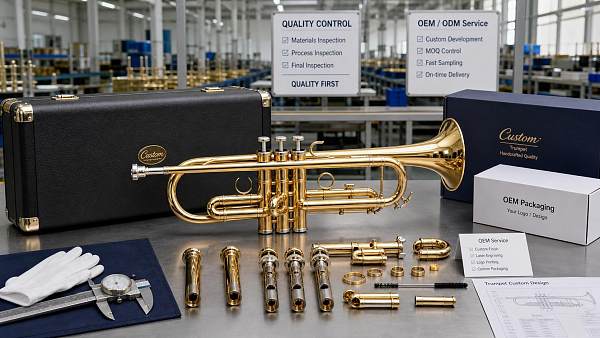
Sample evaluation is essential. A pre-production sample should be checked for valve smoothness, compression consistency, tuning slide fit, water key alignment, brace placement, solder cleanliness, finish uniformity, and engraving accuracy if branding is included.
If your team has access to a qualified player or instrument technician, involve them early. Procurement decisions improve substantially when commercial review is combined with play-testing feedback on intonation, tone response, slotting, and overall instrument balance.
Packaging quality also deserves attention. Trumpets can be damaged by inadequate case support, weak outer cartons, or poor internal cushioning. A manufacturer that builds a good instrument but ships it carelessly still creates avoidable cost through returns, claims, and brand damage.
It is also useful to ask for defect rate history, in-line inspection procedures, and final quality control checklists. A reliable trumpets OEM manufacturer should be able to explain how problems are detected during production, not only how finished units are inspected at the end.
Factories with mature systems usually have clear checkpoints for raw material verification, machining accuracy, polishing consistency, plating or lacquer inspection, assembly testing, and packaging approval. The presence of a process often matters as much as the sample itself.
What MOQ really tells you about a manufacturer
Many buyers treat MOQ as a simple negotiation point, but it is more revealing than that. Minimum order quantity often reflects the supplier’s production economics, material purchasing structure, line setup efficiency, and willingness to support smaller branded programs.
A very high MOQ may indicate that the factory is optimized for large-volume standard products and has limited interest in fragmented custom orders. A very low MOQ, on the other hand, may sound attractive but can come with higher unit costs or reduced flexibility on specifications.
Procurement should therefore ask why the MOQ is set at a certain level. Is it driven by bell tooling, lacquer color batching, case customization, logo engraving, packaging print runs, or raw material procurement? The answer helps reveal what is negotiable and what is structural.
For private-label buyers, MOQ should be reviewed at three levels: instrument body, accessory set, and packaging. A factory may accept a moderate MOQ for the trumpet itself but require much larger quantities for custom cases, printed cartons, or branded care kits.
It is also worth asking whether the manufacturer can support phased ordering. Some suppliers will allow one total MOQ to be split across finish variants or shipment windows. That can improve inventory control while still meeting the factory’s production requirements.
From a risk perspective, the best MOQ is not always the lowest one. It is the one that aligns with your sales forecast, cash flow, and replenishment model. Procurement should avoid committing to quantities that only look efficient on paper but create slow-moving stock in practice.
How to assess custom design capability without relying on promises
Custom design is where many sourcing projects become unstable. A factory may be competent at standard trumpet production yet struggle when asked to adjust bore specifications, bell dimensions, finish combinations, logo placement, case construction, or accessory configuration.
To evaluate real OEM capability, ask for examples of previous custom work. These should include modified product specifications, private-label projects, packaging adaptations, and, ideally, cases where the supplier developed products for different regional or brand requirements.
Then examine the development process. A credible manufacturer should explain how drawings are reviewed, how samples are revised, who approves artwork, how tooling changes are handled, and what lead time impact is expected for each stage of customization.
It is especially important to distinguish cosmetic customization from structural customization. Laser logos, carton printing, and color changes are relatively routine. Changes affecting acoustic performance, component dimensions, or playing characteristics require stronger engineering control.
Ask whether the factory manages development internally or depends heavily on external subcontractors. The more fragmented the process, the greater the risk of communication gaps, inconsistent tolerances, and delays during sample revision and mass production.
Procurement should also request a sample approval workflow in writing. This should define revision rounds, confirmation standards, sign-off responsibility, and the rule that mass production must match the approved reference sample in all agreed specifications.
A strong trumpets OEM manufacturer will usually be disciplined in documentation. That includes artwork files, specification sheets, finish standards, carton dimensions, accessory lists, and revision records. Documentation strength is often a reliable predictor of production consistency.
Factory reliability matters as much as manufacturing skill
Even a technically capable supplier can become a poor sourcing partner if communication is weak or production planning is unstable. Procurement should evaluate responsiveness, clarity, and follow-through from the first inquiry stage onward.
Notice how the supplier answers technical questions. Do they provide direct specifications, practical limits, and realistic lead times, or do they give vague assurances? Early communication behavior often mirrors how problems will be handled once orders are live.
Lead time control is another key indicator. Ask for standard production time, sample development time, peak-season impact, and historical on-time shipment performance. A manufacturer that cannot explain scheduling discipline may create planning risk for your downstream customers.
It is also useful to understand production ownership. Some trumpet suppliers are true manufacturers, while others are trading intermediaries coordinating multiple workshops. That does not automatically disqualify them, but it changes how you should assess traceability and accountability.
If possible, request a factory audit or third-party inspection. Review workshop organization, component storage, finishing area control, assembly stations, testing procedures, and packaging operations. Process visibility reduces the chance of discovering structural problems after payment and shipment.
Questions procurement teams should ask before approving a supplier
The strongest sourcing decisions are usually based on disciplined questioning. Buyers should ask what percentage of output is OEM or private label, which export markets the factory already serves, and whether it has experience with the quality expectations of those markets.
Request clarity on warranty handling, spare parts availability, replacement policy, and post-shipment claim response. Musical instruments are not immune to transit damage or minor assembly issues, so service support should be reviewed before commercial terms are finalized.
Payment terms, tooling ownership, logo usage rights, and exclusivity conditions also need attention. If custom development is involved, procurement should know who owns molds, artwork, and design modifications, especially when future orders depend on those assets.
Ask whether the supplier can maintain consistency across repeat orders. This includes finish shade, case quality, accessory assortment, and packaging layout. Repeatability is one of the clearest markers of a dependable trumpets OEM manufacturer.
Finally, compare suppliers using a weighted scorecard rather than instinct alone. Typical categories include sample quality, technical transparency, MOQ fit, customization ability, communication speed, lead time reliability, quality system maturity, and total landed cost.
Common sourcing mistakes when selecting a trumpets OEM manufacturer
One common mistake is choosing based on sample appearance alone. A polished sample can hide weak process control if the factory cannot reproduce the same standard consistently across a full production batch.
Another is negotiating MOQ aggressively without understanding cost consequences. Lower order quantities may seem attractive at approval stage but can result in higher pricing, reduced component options, or compromised packaging execution.
Buyers also underestimate the complexity of custom design. Minor specification changes in brass instruments can affect tooling, assembly rhythm, and acoustic behavior. Custom requests should therefore be validated carefully before launch commitments are made.
A further mistake is treating all quality issues as visible defects. In this product category, delayed user complaints often come from performance issues such as sticky valves, air leakage, unstable pitch, or weak durability under repeated handling.
Finally, some procurement teams fail to document approvals thoroughly. When specifications, artwork, and sample sign-offs are not centralized, disputes become harder to resolve and consistency across repeat orders becomes more difficult to maintain.
Build the decision around total sourcing fit
The best supplier is rarely the one with the lowest quote or the broadest catalog. It is the one whose manufacturing capability, MOQ structure, and custom development process match your commercial model with the least operational friction.
That is why evaluation should combine product testing, process review, commercial analysis, and communication assessment. Quality, MOQ, and design capability are connected, and treating them separately can produce an incomplete sourcing decision.
For procurement professionals, a dependable trumpets OEM manufacturer should demonstrate consistent product standards, commercially realistic order structures, documented customization workflows, and a stable ability to support repeat business over time.
When those elements are verified properly, sourcing becomes more predictable. You reduce the risk of defective shipments, avoid overcommitting on inventory, and gain a partner capable of supporting brand positioning in a competitive musical instruments market.
In practical terms, the right evaluation framework is simple: define your market target clearly, validate quality through evidence, test MOQ against business reality, and confirm that custom development is backed by process rather than sales language. That is the basis of a sound supplier decision.
Search News
Hot Articles
- Commercial KitchenCommercial Kitchen Design Price: Budgeting by Layout, Equipment, and MEP ScopeSep 22, 2026
- Stationery & UniformsHow Schools Can Cut Printing Costs When Buying Ink Cartridges in BulkSep 21, 2026
- Jewelry Packaging & DisplayHow to Evaluate a Luxury Retail Packaging Supplier for Premium Brand ConsistencySep 20, 2026
Popular Tags
Need ExpertConsultation?
Connect with our specialized leisureengineering team for procurementstrategies.
Recommended News
 Sep 11, 2026How to Choose Touring Instrument Cases for Flights, Trucks, and Daily Load-InsInstrument cases for touring: learn how to balance flight protection, truck durability, weight, fit, and serviceable hardware for safer, faster load-ins.● Pro Audio Engineer
 Sep 07, 2026How to Choose Wood Frame Tambourines for Sound Quality and Long-Term UseWood frame tambourines: learn how to compare frame construction, jingle tone, head options, durability, and supplier quality for reliable long-term performance.● Pro Audio Engineer
 Sep 05, 2026How Often Should Music Education Equipment Be Serviced?How often should music education equipment be serviced? Explore practical schedules, maintenance tips, and lifecycle planning to keep instruments and audio systems reliable.● Pro Audio Engineer
 Aug 21, 2026How to Choose Marching Band Drums for Sound Projection, Weight, and DurabilityMarching band drums buying guide: learn how to balance sound projection, weight, and durability for better field performance, easier carrying, and longer-lasting value.● Pro Audio Engineer
 Aug 09, 2026How to Evaluate a MIDI Cable Manufacturer for Audio Quality and OEM ReliabilityMIDI cable manufacturer evaluation guide: learn how to assess signal stability, connector quality, OEM process control, and batch consistency to reduce failures and source with confidence.● Pro Audio Engineer
 Aug 08, 2026How to Evaluate a Trumpets OEM Manufacturer for Quality, MOQ, and Custom DesignTrumpets OEM manufacturer selection starts with quality, MOQ, and custom design control. Learn how to compare suppliers, reduce sourcing risk, and choose a reliable long-term factory partner.● Pro Audio Engineer
 Jul 27, 2026How to Source Conga Drums in Bulk for Schools, Bands, and Event ProgramsConga drums bulk sourcing for schools, bands, and event programs made easier. Learn how to compare quality, durability, compliance, and total cost before you place a large order.● Pro Audio Engineer
 Jul 24, 2026How to Choose Low Dust Violin Rosin for Cleaner Practice and Better Bow ControlLow dust violin rosin buying guide: learn how to compare formula, climate fit, grip, and string compatibility for cleaner practice, better bow control, and smarter purchase decisions.● Pro Audio Engineer
 Jul 15, 2026Plastic Tambourines Bulk Buying Guide: Sizes, Materials, and MOQ QuestionsPlastic tambourines bulk buying guide covering sizes, ABS vs PP materials, sound consistency, customization, and MOQ questions to help buyers cut risk and choose the right supplier.● Pro Audio Engineer
 Jul 13, 2026Acoustic Guitars Wholesale China: How to Evaluate Build Quality and OEM OptionsAcoustic guitars wholesale China guide: learn how to assess build quality, factory consistency, and OEM options to choose reliable suppliers and reduce sourcing risk.● Pro Audio Engineer
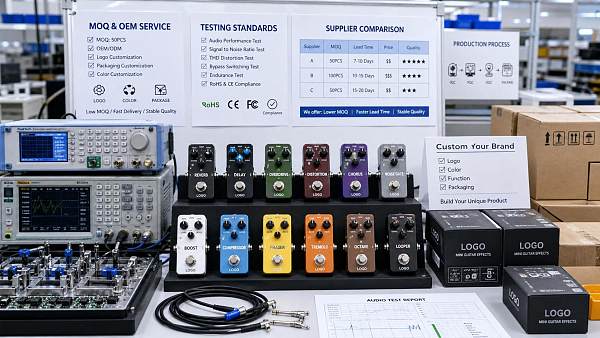
 Jul 12, 2026Mini Effect Pedals Wholesale: MOQ, OEM Options, Testing, and Supplier ComparisonMini effect pedals wholesale guide covering MOQ, OEM options, testing standards, and supplier comparison to help buyers reduce risk, improve margins, and choose reliable partners.● Pro Audio Engineer
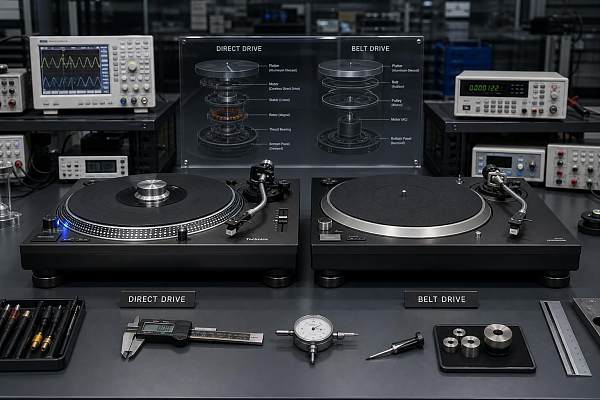
 Jul 11, 2026DJ Turntables OEM Guide: Key Torque, Drive, and Build Specs to CompareDJ turntables OEM guide covering torque, drive type, speed stability, platter build, and manufacturing consistency. Compare the specs that impact performance, reliability, and sourcing confidence.● Pro Audio Engineer
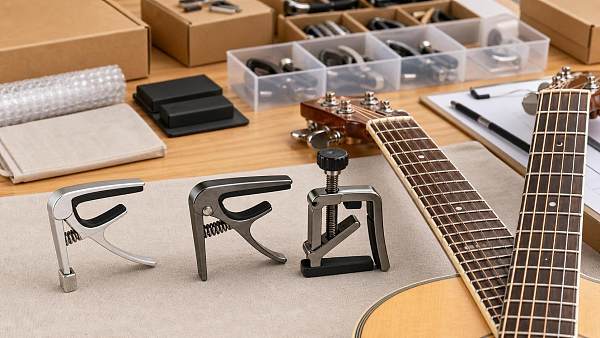
 Jul 08, 2026Guitar Capos Wholesale: What Materials, Clamp Types, and MOQ Terms Should You Compare?Guitar capos wholesale buying starts with more than price. Compare materials, clamp types, quality checks, and MOQ terms to reduce returns, protect margins, and choose a supplier with confidence.● Pro Audio Engineer
 Jul 07, 2026Birch Drum Kits Manufacturer Comparison: Shell Construction, Hardware Quality, and OEM OptionsBirch drum kits manufacturer comparison covering shell construction, hardware quality, and OEM options to help buyers reduce sourcing risk and choose reliable suppliers.● Pro Audio Engineer
 Jul 06, 2026Spruce Top Acoustic Guitars Explained: Tone, Wood Grades, and Who They Suit BestSpruce top acoustic guitars explained: compare tone, wood grades, and build quality to find the best fit for players, retailers, and commercial buyers.● Pro Audio Engineer
 Jun 30, 2026Xylophones and Glockenspiels: Key Differences in Range, Tone, and Classroom UseXylophones and glockenspiels compared: discover key differences in range, tone, durability, and classroom use to choose the right instrument for teaching, buying, or school programs.● Pro Audio Engineer
 Jun 25, 2026Musical Instrument Industry Report: Key Market Segments, Demand Drivers, and Price TrendsMusical instrument industry report covering key market segments, demand drivers, and price trends. Explore sourcing risks, premium growth, and where buyer demand is shifting next.● Pro Audio Engineer
 Jun 23, 2026Metronomes and Tuners Explained: Types, Key Features, and Who Needs BothMetronomes and tuners explained: compare types, key features, and who needs both. Learn how to choose the right tool for better timing, pitch, and practical daily use.● Pro Audio Engineer
 Jun 22, 2026How the Musical Instrument Industry Supply Chain Affects Lead Times, Cost, and QualityMusical instrument industry supply chain trends now shape lead times, cost, and quality. Discover how smarter sourcing and supplier transparency reduce risk and improve buying outcomes.● Pro Audio Engineer
 Jun 20, 2026DJ Headphones Wholesale Buying Guide: OEM Options, MOQ, and Audio Specs to CompareDJ headphones wholesale guide covering OEM options, MOQ strategy, and key audio specs. Compare build quality, compliance, and total cost to source smarter and reduce returns.● Pro Audio Engineer
 Jun 19, 2026Acoustic Guitars Wholesale: 7 Specs Buyers Should Compare Before Placing an OrderAcoustic guitars wholesale buyers can compare 7 key specs before ordering, from tonewoods and playability to OEM, packaging, and QC, to reduce risk and protect margins.● Pro Audio Engineer
 Jun 15, 2026Tambourines Bulk Buying Guide: Materials, Sound Quality, and Pack Size DifferencesTambourines bulk buying guide covering material choices, sound consistency, and pack size differences. Compare suppliers smarter, reduce risk, and choose the best fit for schools, retail, and events.● Pro Audio Engineer
 Jun 14, 2026Professional Musical Instruments Explained: Types, Skill Levels, and Buying CriteriaProfessional musical instruments explained: discover key types, ideal skill levels, and practical buying criteria to choose reliable, high-performance instruments with confidence.● Pro Audio Engineer
 Jun 10, 2026Drum Kits Manufacturer Comparison: What to Check Before OEM or Bulk OrdersDrum kits manufacturer comparison guide for OEM and bulk buyers: check quality, compliance, lead times, packaging, and true cost before placing large orders.● Pro Audio Engineer