Acoustic Guitars Wholesale China: How to Evaluate Build Quality and OEM Options
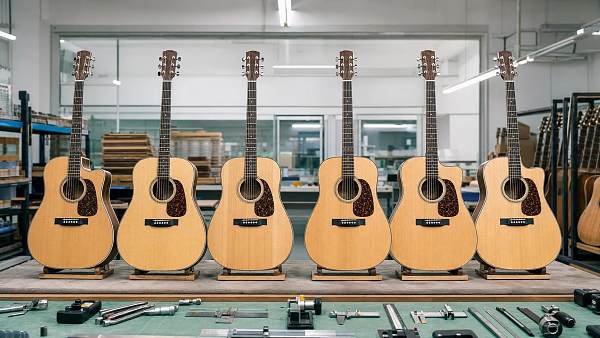
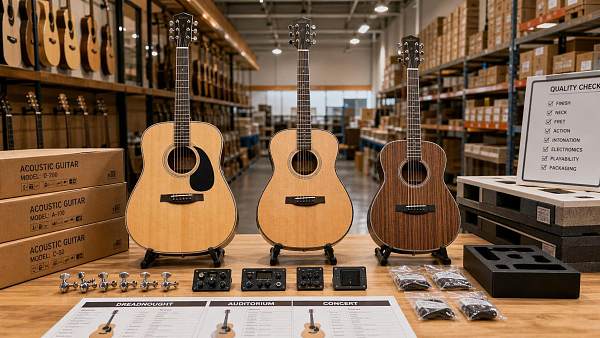
For buyers comparing acoustic guitars wholesale China sources, price is only the visible layer. The real decision sits in build stability, material control, repeatability, and the supplier’s ability to translate a specification into a consistent export product.
That matters more now because commercial demand for instruments extends beyond retail shelves. Hospitality venues, music programs, branded merchandise projects, and specialty distributors increasingly need reliable mid-volume and OEM-ready supply.
Within that setting, acoustic guitars wholesale China remains strategically important. China offers broad factory depth, component ecosystems, and flexible customization, but quality levels vary enough that technical evaluation cannot be reduced to sampling one polished prototype.
Why this sourcing segment deserves closer scrutiny
Acoustic guitars look straightforward, yet they combine woodworking, environmental control, hardware fit, finishing discipline, and acoustic performance. Small inconsistencies can become visible only after shipping, climate change, or repeated use.
In commercial procurement, failure is rarely just a return rate. It can damage a venue launch, delay a school program, weaken a distributor’s brand position, or create expensive after-sales handling across several markets.
This is where GCT’s sourcing perspective becomes useful. In experience-driven sectors, product quality, compliance confidence, and supply continuity matter as much as unit economics, especially when the item carries visible brand value.
What build quality really means in acoustic guitars wholesale China
Build quality is not limited to whether a guitar sounds pleasant during a factory demo. It includes structural integrity, dimensional consistency, finishing accuracy, and how the instrument behaves after packaging, transit, and seasonal humidity change.
A solid assessment usually starts with five connected areas:
- Tonewood selection and moisture content
- Neck geometry and fretwork precision
- Body joint strength and bracing accuracy
- Finish consistency and cosmetic tolerance
- Hardware installation and final setup repeatability
If one of these areas is weak, the guitar may still look acceptable at inspection. It may not remain acceptable after three months in a warehouse or after reaching a dry or humid destination market.
Tonewood and moisture control
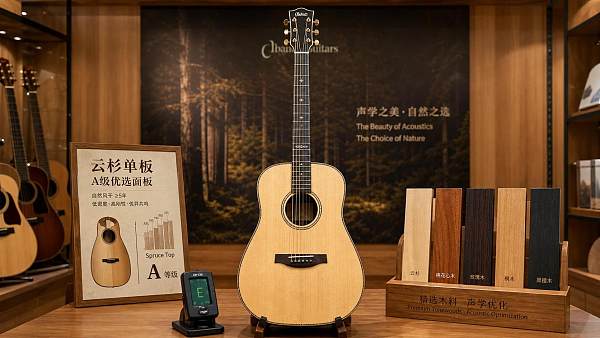
Material claims deserve verification. Solid spruce, mahogany, sapele, laminated back and sides, or engineered alternatives should be matched against the bill of materials and the actual sample construction.
Moisture control often tells more than species names. Poor seasoning or unstable workshop humidity can lead to top sinking, fret sprout, bridge lift, or neck movement after export.
A capable supplier should be able to explain wood storage conditions, moisture testing methods, and how materials are separated by grade before production begins.
Neck angle, fretwork, and playability
Many sourcing problems appear in playability rather than finish. Neck relief, nut slot depth, saddle height, fret leveling, and intonation should be checked across several units, not one reference sample.
In acoustic guitars wholesale China programs, repeatability matters more than a single excellent piece. Consistent action and fret dressing across a batch usually indicate process control rather than workshop luck.
Bracing, joints, and finish discipline
Internal bracing affects both tone and durability. Uneven glue application, weak bridge plate work, or excess adhesive can reduce resonance and increase failure risk.
Finish quality should also be judged with restraint. A mirror gloss can hide sanding inconsistency, edge repair, or filler use. Thin, stable, well-controlled finish systems usually outperform decorative heaviness.
How to read factory capability beyond the sample room
A good sample does not automatically mean a good factory. When reviewing acoustic guitars wholesale China suppliers, the stronger signal is whether the same result can be repeated across volume, deadlines, and model variations.
The factory review should cover production logic, not only showroom output.
Factories serving global buyers should also demonstrate traceable revision control. If the bridge pin material, finish thickness, or truss rod specification changes, that change must be documented and approved.
OEM options are valuable only when specifications are controlled
OEM is one of the strongest reasons buyers enter the acoustic guitars wholesale China market. Custom body shapes, headstock designs, logos, finish colors, pickup systems, and packaging can all support brand differentiation.
Still, customization adds complexity. Every new detail introduces tolerance, tooling, or approval risk. A supplier that says yes to everything is not always the safest partner.
Common OEM variables worth defining early
- Top, back, and side construction: solid, laminate, or mixed
- Scale length, nut width, neck profile, and fingerboard radius
- Bracing pattern and tonal target
- Pickup or preamp configuration for electro-acoustic models
- Logo application, rosette detail, binding, and inlay treatment
- Retail carton, gig bag, hard case, and private label inserts
The strongest OEM workflow usually starts with a master specification sheet, approved reference sample, tolerance notes, and a change-control process linked to production purchase orders.
Without that discipline, acoustic guitars wholesale China projects can drift. A model may keep the same appearance while neck feel, hardware grade, or acoustic response slowly changes between shipments.
Where commercial use cases shape the specification
The right guitar is tied to the actual business setting. A resort lounge, school music room, lifestyle retailer, and online private-label brand do not need the same balance of cost, tone, cosmetic finish, and durability.
That broader commercial context aligns with GCT’s cross-sector view of sourcing. Products serving public-facing experiences must perform reliably, look credible, and fit a larger brand environment.
Practical checks before approving a supplier
A technical review process works best when it moves from sample quality to system quality. The goal is to prove that the factory can hold specifications over time, not simply impress during quotation.
- Request multiple units from the same model, not one beauty sample
- Measure neck relief, action, nut width, scale length, and fret finish
- Inspect glue lines, bridge seating, brace cleanliness, and internal workmanship
- Review moisture management and storage conditions during the factory audit
- Confirm packaging design for drop resistance and climate exposure
- Define acceptable cosmetic and acoustic tolerances before production
- Use pre-production approval and final random inspection on finished lots
For acoustic guitars wholesale China, these checks often reveal more than negotiation language. They show whether the supplier thinks like a long-term manufacturing partner or only like a trading contact chasing the next order.
A grounded next step
The best sourcing decisions usually begin with a tighter brief. Define target users, price architecture, construction level, compliance needs, and packaging expectations before comparing factories.
Then evaluate acoustic guitars wholesale China suppliers against a common scorecard covering materials, structural quality, OEM discipline, inspection records, and export readiness. That creates a clearer basis for pilot orders and future scaling.
In practice, reliable supply comes from controlled specifications, documented processes, and realistic expectations about quality tiers. Those are the signals worth following when moving from inquiry to a durable sourcing program.
Search News
Hot Articles
- Fashion & Gem JewelryHow to Choose Designer Eyewear That Fits Your Store’s Customer ProfileOct 12, 2026
- Musical InstrumentsA Practical Guide to Identifying Wooden Orchestral Instruments by Family and ToneOct 10, 2026
- Indoor PlaygroundHow to Choose Animatronic Haunted House Props for High-Throughput AttractionsOct 08, 2026
Popular Tags
Need ExpertConsultation?
Connect with our specialized leisureengineering team for procurementstrategies.
Recommended News
 Oct 10, 2026A Practical Guide to Identifying Wooden Orchestral Instruments by Family and ToneWooden orchestral instruments made simple: identify strings, flutes, clarinets, oboes, and bassoons by sound source, design, and tone.● Pro Audio Engineer
 Sep 11, 2026How to Choose Touring Instrument Cases for Flights, Trucks, and Daily Load-InsInstrument cases for touring: learn how to balance flight protection, truck durability, weight, fit, and serviceable hardware for safer, faster load-ins.● Pro Audio Engineer
 Sep 07, 2026How to Choose Wood Frame Tambourines for Sound Quality and Long-Term UseWood frame tambourines: learn how to compare frame construction, jingle tone, head options, durability, and supplier quality for reliable long-term performance.● Pro Audio Engineer
 Sep 05, 2026How Often Should Music Education Equipment Be Serviced?How often should music education equipment be serviced? Explore practical schedules, maintenance tips, and lifecycle planning to keep instruments and audio systems reliable.● Pro Audio Engineer
 Aug 21, 2026How to Choose Marching Band Drums for Sound Projection, Weight, and DurabilityMarching band drums buying guide: learn how to balance sound projection, weight, and durability for better field performance, easier carrying, and longer-lasting value.● Pro Audio Engineer
 Aug 09, 2026How to Evaluate a MIDI Cable Manufacturer for Audio Quality and OEM ReliabilityMIDI cable manufacturer evaluation guide: learn how to assess signal stability, connector quality, OEM process control, and batch consistency to reduce failures and source with confidence.● Pro Audio Engineer
 Aug 08, 2026How to Evaluate a Trumpets OEM Manufacturer for Quality, MOQ, and Custom DesignTrumpets OEM manufacturer selection starts with quality, MOQ, and custom design control. Learn how to compare suppliers, reduce sourcing risk, and choose a reliable long-term factory partner.● Pro Audio Engineer
 Jul 27, 2026How to Source Conga Drums in Bulk for Schools, Bands, and Event ProgramsConga drums bulk sourcing for schools, bands, and event programs made easier. Learn how to compare quality, durability, compliance, and total cost before you place a large order.● Pro Audio Engineer
 Jul 24, 2026How to Choose Low Dust Violin Rosin for Cleaner Practice and Better Bow ControlLow dust violin rosin buying guide: learn how to compare formula, climate fit, grip, and string compatibility for cleaner practice, better bow control, and smarter purchase decisions.● Pro Audio Engineer
 Jul 15, 2026Plastic Tambourines Bulk Buying Guide: Sizes, Materials, and MOQ QuestionsPlastic tambourines bulk buying guide covering sizes, ABS vs PP materials, sound consistency, customization, and MOQ questions to help buyers cut risk and choose the right supplier.● Pro Audio Engineer
 Jul 13, 2026Acoustic Guitars Wholesale China: How to Evaluate Build Quality and OEM OptionsAcoustic guitars wholesale China guide: learn how to assess build quality, factory consistency, and OEM options to choose reliable suppliers and reduce sourcing risk.● Pro Audio Engineer
 Jul 12, 2026Mini Effect Pedals Wholesale: MOQ, OEM Options, Testing, and Supplier ComparisonMini effect pedals wholesale guide covering MOQ, OEM options, testing standards, and supplier comparison to help buyers reduce risk, improve margins, and choose reliable partners.● Pro Audio Engineer
 Jul 11, 2026DJ Turntables OEM Guide: Key Torque, Drive, and Build Specs to CompareDJ turntables OEM guide covering torque, drive type, speed stability, platter build, and manufacturing consistency. Compare the specs that impact performance, reliability, and sourcing confidence.● Pro Audio Engineer
 Jul 08, 2026Guitar Capos Wholesale: What Materials, Clamp Types, and MOQ Terms Should You Compare?Guitar capos wholesale buying starts with more than price. Compare materials, clamp types, quality checks, and MOQ terms to reduce returns, protect margins, and choose a supplier with confidence.● Pro Audio Engineer
 Jul 07, 2026Birch Drum Kits Manufacturer Comparison: Shell Construction, Hardware Quality, and OEM OptionsBirch drum kits manufacturer comparison covering shell construction, hardware quality, and OEM options to help buyers reduce sourcing risk and choose reliable suppliers.● Pro Audio Engineer
 Jul 06, 2026Spruce Top Acoustic Guitars Explained: Tone, Wood Grades, and Who They Suit BestSpruce top acoustic guitars explained: compare tone, wood grades, and build quality to find the best fit for players, retailers, and commercial buyers.● Pro Audio Engineer
 Jun 30, 2026Xylophones and Glockenspiels: Key Differences in Range, Tone, and Classroom UseXylophones and glockenspiels compared: discover key differences in range, tone, durability, and classroom use to choose the right instrument for teaching, buying, or school programs.● Pro Audio Engineer
 Jun 25, 2026Musical Instrument Industry Report: Key Market Segments, Demand Drivers, and Price TrendsMusical instrument industry report covering key market segments, demand drivers, and price trends. Explore sourcing risks, premium growth, and where buyer demand is shifting next.● Pro Audio Engineer
 Jun 23, 2026Metronomes and Tuners Explained: Types, Key Features, and Who Needs BothMetronomes and tuners explained: compare types, key features, and who needs both. Learn how to choose the right tool for better timing, pitch, and practical daily use.● Pro Audio Engineer
 Jun 22, 2026How the Musical Instrument Industry Supply Chain Affects Lead Times, Cost, and QualityMusical instrument industry supply chain trends now shape lead times, cost, and quality. Discover how smarter sourcing and supplier transparency reduce risk and improve buying outcomes.● Pro Audio Engineer
 Jun 20, 2026DJ Headphones Wholesale Buying Guide: OEM Options, MOQ, and Audio Specs to CompareDJ headphones wholesale guide covering OEM options, MOQ strategy, and key audio specs. Compare build quality, compliance, and total cost to source smarter and reduce returns.● Pro Audio Engineer
 Jun 19, 2026Acoustic Guitars Wholesale: 7 Specs Buyers Should Compare Before Placing an OrderAcoustic guitars wholesale buyers can compare 7 key specs before ordering, from tonewoods and playability to OEM, packaging, and QC, to reduce risk and protect margins.● Pro Audio Engineer
 Jun 15, 2026Tambourines Bulk Buying Guide: Materials, Sound Quality, and Pack Size DifferencesTambourines bulk buying guide covering material choices, sound consistency, and pack size differences. Compare suppliers smarter, reduce risk, and choose the best fit for schools, retail, and events.● Pro Audio Engineer
 Jun 14, 2026Professional Musical Instruments Explained: Types, Skill Levels, and Buying CriteriaProfessional musical instruments explained: discover key types, ideal skill levels, and practical buying criteria to choose reliable, high-performance instruments with confidence.● Pro Audio Engineer