How to Choose Marching Band Drums for Sound Projection, Weight, and Durability
Choosing marching band drums starts with a practical tradeoff: the loudest drum is not automatically the best drum, and the lightest shell is not automatically the smartest purchase. Field use places three demands on the same instrument at once. It has to project across open air, remain stable under repeated transport and weather shifts, and stay manageable on the body through rehearsals, parades, and long performance blocks. A model that excels in only one area often creates trouble somewhere else, usually in tuning stability, fatigue, or hardware failure.
Sound projection is the first point most people notice, but projection in an outdoor setting is not simply volume. A drum projects well when its fundamental tone stays clear at distance, the attack remains defined in ensemble texture, and the shell does not collapse into a short, boxy response when played at full stroke. That usually brings shell depth, shell material, head selection, bearing edge quality, and tension consistency into the same conversation. If one of those is weak, projection becomes uneven even when the drum seems loud up close.
Start with the role each drum must cover
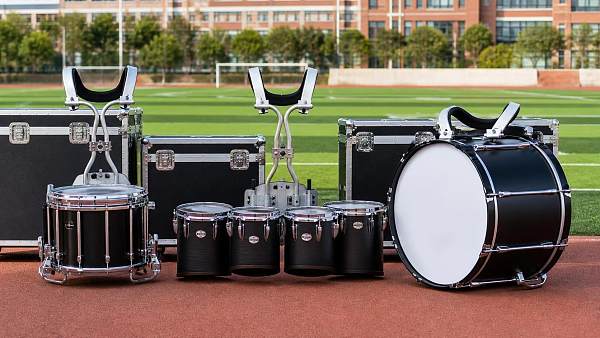
Marching snare, tenor, and bass drums solve different acoustic problems, so selection should not flatten them into one generic specification exercise. Snare drums need a sharp, articulate response that carries rhythmic detail through wind and brass layers. Tenors need note separation and shell-to-shell consistency, because interval clarity matters more than brute force. Bass drums depend on controlled low-end bloom, and they are often judged poorly when only close-range impact is considered. On a field, an oversized bass drum may sound impressive nearby but lose clarity if the tone spreads too slowly or becomes too soft at the front edge.
That is why projection should be judged in likely performance conditions rather than in a rehearsal room alone. Hard indoor walls flatter many drums by adding reflected energy. Open-air performance exposes weaknesses in shell rigidity, head seating, and tuning range. If evaluation happens only indoors, the final choice may lean toward a sound that feels bigger than it actually carries outside.
Shell material changes both tone and carrying burden
Wood and synthetic shell constructions behave differently under stress, and the choice affects more than timbre. Many wood shells offer warmth and a broader tonal character, which can be attractive when the ensemble wants a fuller voice. Depending on species, ply structure, and shell thickness, wood may also provide a satisfying attack without sounding brittle. The tradeoff is that some wood shells are more sensitive to moisture swings and repeated impacts during loading, unloading, and truck transport. Edge damage, ply separation, or finish wear can become long-term concerns if handling discipline is inconsistent.
Synthetic shells, often made from laminated or molded composite materials, are commonly selected when stability and projection under variable conditions matter most. A stiffer synthetic shell may produce a more focused tone and strong forward attack, especially in snares and tenors. It may also resist dents, swelling, and finish damage better than some wood builds. The downside can be feel and tonal character. Certain synthetic drums can sound overly hard or narrow if paired with aggressive heads and high tensions, so the shell should be judged as part of a full setup, not as an isolated material choice.
Shell thickness deserves close attention. A thicker shell may increase rigidity and help preserve projection under high tension, but extra material adds mass. A thinner shell may reduce weight and open the tone, yet it can become less forgiving if the drum is expected to hold extreme tuning or survive frequent impact. There is no single ideal number; what matters is whether the shell construction matches the drum’s intended pitch range and transport cycle.
Hardware often decides durability more than the shell does
Broken lugs, loosening carriers, bent tension rods, and cracked mounting points end service life faster than shell fatigue in many marching setups. Hardware quality is therefore not a cosmetic detail. Lug casings should feel mechanically solid, with clean threading and secure mounting. Tension rods need enough strength to tolerate repeated tuning changes without deforming or binding. Hoops should resist warping, because a distorted hoop makes even a good shell difficult to tune and can cause head seating issues that never fully disappear.
Mounting hardware deserves even more scrutiny. On marching band drums, the carrier interface is a constant stress point because it transfers movement from the body into the instrument. If the bracket flexes, rattles, or relies on a thin attachment area, the drum may gradually shift alignment or develop micro-cracks around the mount. These issues usually appear after transport, curb transitions, parade routes, or abrupt directional movement, not during a short demo. A robust bracket system with secure fasteners and sensible load distribution is often worth extra weight if it prevents recurring maintenance downtime.
Corrosion resistance also matters. Even without extreme weather exposure, sweat, damp fields, and storage in fluctuating environments can degrade metal parts. Coated or plated components may age differently depending on the finish process, so surface appearance should not be treated as proof of durability. Tight tolerances, stable fastener fit, and replaceable standard parts are more useful than decorative polish.
Weight has to be judged as a system, not a catalog number
A drum that seems acceptable on paper can still become punishing in use if the balance point is wrong or the harness geometry is poor. Weight distribution matters as much as total weight. A slightly heavier drum with a well-centered mount may feel easier to carry than a lighter drum that hangs forward or twists during motion. This is especially relevant for tenor configurations, where added shells and accessory placements can pull the setup away from the torso and increase lower back strain.
The carrier or harness should therefore be evaluated with the actual drum attached and adjusted to realistic height. Padding density, shoulder shape, abdominal support, and back plate stiffness all influence fatigue. A harness that looks substantial can still create pressure points if its contact surfaces are too narrow or if adjustment points slip under movement. Quick bench testing rarely reveals that problem. Walking, marking time, and directional movement usually do.
Snare and tenor drums benefit from a stable, close-to-body carry position that preserves posture and stick path. Bass drum systems need different attention because the instrument can obstruct stride and rotational movement if the frame pushes the shell too far away. In any category, removable components should be checked for play. Slight looseness at the carrier joint tends to grow into audible rattle and alignment drift after repeated use.
Tuning range and head compatibility shape real-world projection
Even a durable drum can disappoint if its usable tuning window is too narrow. Marching applications often demand high tension, controlled sustain, and fast response, especially for snares. The shell and hardware need to accept that stress without choking the tone or causing rods to seize. A drum that sounds good only at one exact pitch point may be difficult to integrate across different repertoire or ensemble voicings.
Head compatibility matters here. Batter and resonant head combinations can either extend the instrument’s useful range or expose weaknesses in shell design. A very stiff head on a rigid shell may sharpen articulation but remove body from the sound. A softer combination may broaden the tone while sacrificing definition outdoors. Since head replacement is routine, it is worth confirming that hoop profile, collar fit, and shell dimensions do not create unusual sourcing or seating issues. Drums that depend on uncommon component dimensions can complicate maintenance and restocking.
Snare mechanism design should also be inspected closely. The strainer and gut or cable system need predictable tension control and reliable engagement. A mechanism that shifts under vibration or responds unevenly across the head can reduce articulation even when the shell itself is strong. In field use, small mechanical inconsistencies become audible quickly.
Transport and storage conditions can change the best choice
Selection often goes wrong when the instrument is judged only in performance terms and not in logistics terms. A drum that travels in hard cases, moves through ramps, sits in trailers, and waits in mixed-temperature storage sees a very different life from a drum used mostly on a controlled campus route. Shell finish hardness, hardware protrusion, case fit, and replacement part availability all matter more once transport frequency rises.
Large or deeply profiled drums may create packing inefficiencies. They can consume more truck volume, require heavier cases, and increase handling strain. That may not disqualify them, but it changes the durability equation because every extra loading challenge creates another chance for damage at hoops, mounts, or tension points. Compact dimensions with efficient nesting and standard case options can lower operational friction over time.
Climate variation is another filter. If drums will move between humid parade conditions, air-conditioned storage, and dry rehearsal surfaces, shell stability and hardware retention become more important than subtle tonal preference. Wood shells with excellent sound may still be the right choice, but only if construction quality and maintenance routines support that environment.
Common selection mistakes
- Choosing by indoor loudness alone. Projection outside depends on clarity, not just perceived impact at close distance.
- Comparing shell weight without including harness, mount, and case implications.
- Focusing on shell material while ignoring lug quality, bracket strength, and parts serviceability.
- Testing a single drum in isolation instead of listening to matched instruments across the line.
- Accepting an aggressive factory tuning as proof of performance, even though that setup may mask uneven bearing edges or limited tuning range.
A practical evaluation sequence
It helps to move from structure to sound rather than the other way around. First inspect shell roundness, bearing edge cleanliness, hoop fit, and mount solidity. Then assess the carrier with the drum attached. After that, tune the instrument through a moderate range before pushing it to likely field tension. Listen at player distance and then at front-ensemble distance or beyond. Finally, repeat after basic movement. A drum that changes character dramatically after being carried, tilted, or marched may have mounting or hardware stability issues that a stand test hides.
When several drums are being considered, consistency across units is as important as the quality of a single sample. Matching depth, hardware alignment, finish integrity, and tuning response indicate better manufacturing control. If one sample sounds excellent but another of the same model behaves differently under similar tension, that inconsistency can become a larger problem than any single tonal advantage.
Durability should be treated as predictable service life under normal abuse, not as showroom strength. Marching instruments are lifted quickly, set down on imperfect surfaces, moved through doors, and exposed to constant vibration. The best choice is usually the one that preserves tone and alignment after those ordinary stresses rather than the one that delivers the most dramatic first impression.
When sound projection, weight, and durability are evaluated together, the strongest marching band drums tend to be the models with stable shell construction, disciplined hardware design, comfortable load distribution, and a tuning range that remains usable in open air. That combination holds up better than any single headline feature.
Search News
Hot Articles
- Hotel Room AmenitiesHow to Select Hotel Hair Dryers That Balance Guest Safety, Durability, and CostOct 05, 2026
- Restaurant FurnitureFast-Casual Restaurant Interiors: Design Choices That Improve Speed and Guest FlowOct 04, 2026
- Outdoor RidesHow to Select Leisure Park Equipment for Safe, High-Throughput Visitor AreasOct 03, 2026
Popular Tags
Need ExpertConsultation?
Connect with our specialized leisureengineering team for procurementstrategies.
Recommended News
 Sep 11, 2026How to Choose Touring Instrument Cases for Flights, Trucks, and Daily Load-InsInstrument cases for touring: learn how to balance flight protection, truck durability, weight, fit, and serviceable hardware for safer, faster load-ins.● Pro Audio Engineer
 Sep 07, 2026How to Choose Wood Frame Tambourines for Sound Quality and Long-Term UseWood frame tambourines: learn how to compare frame construction, jingle tone, head options, durability, and supplier quality for reliable long-term performance.● Pro Audio Engineer
 Sep 05, 2026How Often Should Music Education Equipment Be Serviced?How often should music education equipment be serviced? Explore practical schedules, maintenance tips, and lifecycle planning to keep instruments and audio systems reliable.● Pro Audio Engineer
 Aug 21, 2026How to Choose Marching Band Drums for Sound Projection, Weight, and DurabilityMarching band drums buying guide: learn how to balance sound projection, weight, and durability for better field performance, easier carrying, and longer-lasting value.● Pro Audio Engineer
 Aug 09, 2026How to Evaluate a MIDI Cable Manufacturer for Audio Quality and OEM ReliabilityMIDI cable manufacturer evaluation guide: learn how to assess signal stability, connector quality, OEM process control, and batch consistency to reduce failures and source with confidence.● Pro Audio Engineer
 Aug 08, 2026How to Evaluate a Trumpets OEM Manufacturer for Quality, MOQ, and Custom DesignTrumpets OEM manufacturer selection starts with quality, MOQ, and custom design control. Learn how to compare suppliers, reduce sourcing risk, and choose a reliable long-term factory partner.● Pro Audio Engineer
 Jul 27, 2026How to Source Conga Drums in Bulk for Schools, Bands, and Event ProgramsConga drums bulk sourcing for schools, bands, and event programs made easier. Learn how to compare quality, durability, compliance, and total cost before you place a large order.● Pro Audio Engineer
 Jul 24, 2026How to Choose Low Dust Violin Rosin for Cleaner Practice and Better Bow ControlLow dust violin rosin buying guide: learn how to compare formula, climate fit, grip, and string compatibility for cleaner practice, better bow control, and smarter purchase decisions.● Pro Audio Engineer
 Jul 15, 2026Plastic Tambourines Bulk Buying Guide: Sizes, Materials, and MOQ QuestionsPlastic tambourines bulk buying guide covering sizes, ABS vs PP materials, sound consistency, customization, and MOQ questions to help buyers cut risk and choose the right supplier.● Pro Audio Engineer
 Jul 13, 2026Acoustic Guitars Wholesale China: How to Evaluate Build Quality and OEM OptionsAcoustic guitars wholesale China guide: learn how to assess build quality, factory consistency, and OEM options to choose reliable suppliers and reduce sourcing risk.● Pro Audio Engineer
 Jul 12, 2026Mini Effect Pedals Wholesale: MOQ, OEM Options, Testing, and Supplier ComparisonMini effect pedals wholesale guide covering MOQ, OEM options, testing standards, and supplier comparison to help buyers reduce risk, improve margins, and choose reliable partners.● Pro Audio Engineer
 Jul 11, 2026DJ Turntables OEM Guide: Key Torque, Drive, and Build Specs to CompareDJ turntables OEM guide covering torque, drive type, speed stability, platter build, and manufacturing consistency. Compare the specs that impact performance, reliability, and sourcing confidence.● Pro Audio Engineer
 Jul 08, 2026Guitar Capos Wholesale: What Materials, Clamp Types, and MOQ Terms Should You Compare?Guitar capos wholesale buying starts with more than price. Compare materials, clamp types, quality checks, and MOQ terms to reduce returns, protect margins, and choose a supplier with confidence.● Pro Audio Engineer
 Jul 07, 2026Birch Drum Kits Manufacturer Comparison: Shell Construction, Hardware Quality, and OEM OptionsBirch drum kits manufacturer comparison covering shell construction, hardware quality, and OEM options to help buyers reduce sourcing risk and choose reliable suppliers.● Pro Audio Engineer
 Jul 06, 2026Spruce Top Acoustic Guitars Explained: Tone, Wood Grades, and Who They Suit BestSpruce top acoustic guitars explained: compare tone, wood grades, and build quality to find the best fit for players, retailers, and commercial buyers.● Pro Audio Engineer
 Jun 30, 2026Xylophones and Glockenspiels: Key Differences in Range, Tone, and Classroom UseXylophones and glockenspiels compared: discover key differences in range, tone, durability, and classroom use to choose the right instrument for teaching, buying, or school programs.● Pro Audio Engineer
 Jun 25, 2026Musical Instrument Industry Report: Key Market Segments, Demand Drivers, and Price TrendsMusical instrument industry report covering key market segments, demand drivers, and price trends. Explore sourcing risks, premium growth, and where buyer demand is shifting next.● Pro Audio Engineer
 Jun 23, 2026Metronomes and Tuners Explained: Types, Key Features, and Who Needs BothMetronomes and tuners explained: compare types, key features, and who needs both. Learn how to choose the right tool for better timing, pitch, and practical daily use.● Pro Audio Engineer
 Jun 22, 2026How the Musical Instrument Industry Supply Chain Affects Lead Times, Cost, and QualityMusical instrument industry supply chain trends now shape lead times, cost, and quality. Discover how smarter sourcing and supplier transparency reduce risk and improve buying outcomes.● Pro Audio Engineer
 Jun 20, 2026DJ Headphones Wholesale Buying Guide: OEM Options, MOQ, and Audio Specs to CompareDJ headphones wholesale guide covering OEM options, MOQ strategy, and key audio specs. Compare build quality, compliance, and total cost to source smarter and reduce returns.● Pro Audio Engineer
 Jun 19, 2026Acoustic Guitars Wholesale: 7 Specs Buyers Should Compare Before Placing an OrderAcoustic guitars wholesale buyers can compare 7 key specs before ordering, from tonewoods and playability to OEM, packaging, and QC, to reduce risk and protect margins.● Pro Audio Engineer
 Jun 15, 2026Tambourines Bulk Buying Guide: Materials, Sound Quality, and Pack Size DifferencesTambourines bulk buying guide covering material choices, sound consistency, and pack size differences. Compare suppliers smarter, reduce risk, and choose the best fit for schools, retail, and events.● Pro Audio Engineer
 Jun 14, 2026Professional Musical Instruments Explained: Types, Skill Levels, and Buying CriteriaProfessional musical instruments explained: discover key types, ideal skill levels, and practical buying criteria to choose reliable, high-performance instruments with confidence.● Pro Audio Engineer
 Jun 10, 2026Drum Kits Manufacturer Comparison: What to Check Before OEM or Bulk OrdersDrum kits manufacturer comparison guide for OEM and bulk buyers: check quality, compliance, lead times, packaging, and true cost before placing large orders.● Pro Audio Engineer