How Often Should Music Education Equipment Be Serviced?
How Often Should Music Education Equipment Be Serviced?
How often should music education equipment be serviced? The short answer is: not all equipment needs the same interval, and a single annual check is rarely enough for a busy school or institutional program. A piano used for daily classes, a set of student headphones passed between multiple users, a digital mixing console in a performance hall, and a classroom projector or interactive display all age in different ways.
For most music departments, the sensible approach is a layered maintenance plan. Staff carry out simple checks before or after use, facilities teams inspect higher-risk items on a regular schedule, and qualified technicians service instruments and electronic systems at intervals based on use, environment, warranty requirements, and manufacturer guidance. This is less glamorous than buying new equipment, but it is usually what keeps a music room usable during the busiest part of the term.
The key distinction is between routine care and professional servicing. Routine care covers cleaning, visual inspections, cable management, battery checks, and safe storage. Professional servicing involves tasks such as piano regulation, electrical diagnosis, speaker testing, firmware review, calibration, internal cleaning, and repairs that should not be attempted by untrained staff.
Start with Usage, Not a Calendar Date
A fixed service date can be useful for budgeting, but usage is usually the better indicator. A keyboard in a locked teaching studio may receive light use. The same model in a shared rehearsal room can endure hundreds of key presses, repeated transport, drink spills, loose power connections, and hurried setup changes every week. Treating both assets identically is an easy way to miss problems in the high-use room while spending unnecessarily on the low-use one.
Schools should also consider who is handling the equipment. Student-accessible gear needs more frequent inspection than equipment operated only by a trained technician. This does not imply careless use; it simply reflects the reality of shared spaces, changing class groups, and limited transition time between lessons.
Environmental conditions matter just as much. Humidity changes can affect acoustic instruments, especially pianos, string instruments, and wooden percussion. Dust and airborne debris are a recurring issue for amplifiers, projectors, mixers, computers, and ventilation openings. A music room near a sports field, workshop, kitchen, or exterior entrance may require a different maintenance rhythm from a climate-controlled recital space.
A Practical Service Schedule by Equipment Type
The following guide is a practical starting point rather than a substitute for a manufacturer’s instructions or a technician’s assessment. Where safety, electrical inspection, or warranty obligations apply, the relevant local requirements and supplier documentation should take priority.
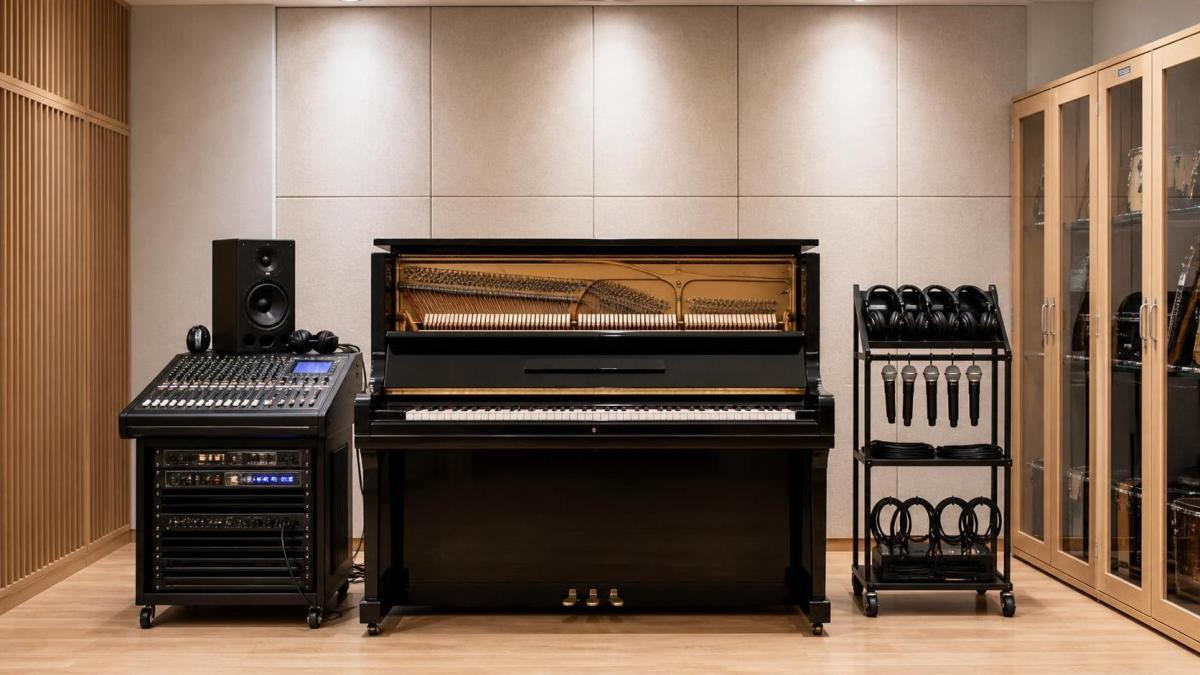
That piano line deserves emphasis. Tuning and repair are not the same thing. A piano may still be broadly in tune yet have uneven action, sticking keys, worn hammers, pedal noise, or poor response in quieter dynamics. In a teaching environment, those faults can quietly distort a student’s technique and make practice unnecessarily frustrating.
What Should Be Checked Between Professional Visits?
The most effective maintenance systems do not rely on staff remembering everything. They make inspection routine and quick. A short opening checklist for each room can catch many issues before a lesson begins: is the power cable intact, are speaker stands stable, is there any exposed wiring, do the microphone channels work, and is the volume set at a safe starting point?
For shared technology, staff should listen for changes rather than waiting for total failure. A faint intermittent crackle from an audio interface, a keyboard key that occasionally double-triggers, or a wireless microphone that loses connection only in one corner of a room may look minor. In practice, these are the faults that turn into disruption during a concert, examination recording, or parent event.
Keep a simple fault log with the equipment name or asset number, date, reported symptom, room, and action taken. This does not need to become an elaborate facilities database. Its value is in identifying repeat issues. If three “different” microphone problems occur on the same cable run, the microphones may not be the problem at all. If digital pianos fail more often after being moved for assemblies, storage and transport procedures need attention.
The Equipment Most Often Missed in Music Rooms
Cables, power supplies, stands, cases, and mounting hardware tend to receive the least attention because they are viewed as accessories. Yet they are often the components exposed to the hardest treatment. A damaged XLR cable can create noise or signal loss that looks like a mixer fault. A loose keyboard stand is a safety problem before it becomes an equipment problem. A poorly fitting instrument case can expose an otherwise well-maintained instrument to avoidable damage in corridors and transport vehicles.
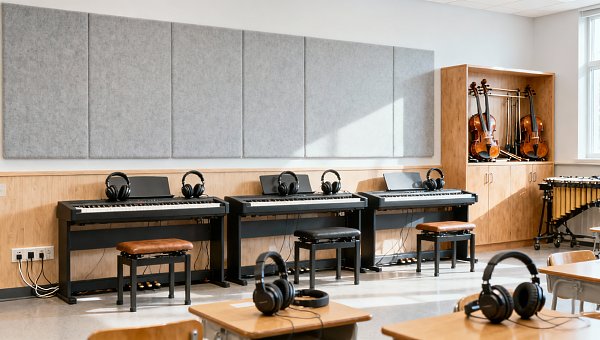
Headphones deserve their own maintenance policy. In language labs and music production rooms, they are regularly folded, pulled by the cable, shared, and stored quickly. Replaceable ear pads, detachable cables, and clearly numbered storage positions can make a large difference to serviceability. When specifying new stock, the cheapest headset is not always the lower-cost choice if common wear parts cannot be sourced separately.
The same procurement logic applies to more substantial systems. For institutional buyers comparing music education equipment, maintainability should sit alongside sound quality and purchase price. Ask whether spare parts are available, whether local technical support exists, how firmware updates are handled, what documentation is supplied, and whether the product can be repaired without replacing an entire assembly.
When “Annual Service” Is Not Enough
An annual professional visit is a reasonable baseline for many installed audio systems and lower-use electronic instruments, but certain situations call for more frequent intervention. These include intensive rehearsal schedules, student recording studios, venues used for public performances, touring ensembles, rooms with known humidity fluctuations, and programs with a large inventory of loan instruments.
A school preparing for a major performance should not wait until the week of the event to discover that a powered speaker has a damaged input socket or that the wireless microphone batteries are no longer holding charge. A pre-event technical review, ideally early enough to order parts if needed, is a sensible operational step. It should include a full signal-path test: source, cable, mixer or interface, amplification, speakers, monitoring, and any recording or streaming connection.
Likewise, instruments returning from holidays, building works, relocation, or extended storage should be checked before normal teaching resumes. Temperature changes and dust are predictable threats. Water ingress, pest damage, and accidental knocks during room moves are less predictable, but common enough that a quick inspection is worthwhile.
Build Maintenance into Purchasing Decisions
Servicing is easier when it is considered before equipment arrives on site. Procurement teams should avoid treating maintenance as a separate downstream problem. The decision to buy a specialist digital console, an imported acoustic instrument, or a proprietary classroom audio platform has consequences for lead times, spare parts, technician access, and training needs.
For global buyers, this is especially relevant when equipment is sourced across markets. Voltage configuration, plug type, replacement-part availability, language of technical documentation, and local service coverage should be checked before purchase orders are finalized. A product can be excellent on paper and still become difficult to maintain if a basic power supply or proprietary connector must travel through a long supply chain.
This broader view of lifecycle support is increasingly relevant in commercial education and performance spaces. Sourcing platforms such as Global Commercial Trade can help procurement teams compare suppliers and evaluate the practical questions behind a specification: not merely whether a product performs on day one, but whether it can remain reliable through daily institutional use.
A Service Plan That Staff Will Actually Use
The best plan is usually modest: daily visual checks for shared rooms, a more deliberate review at the end of each term, an annual professional service schedule, and a clear route for reporting faults. Add separate triggers for high-use equipment, public events, and environmental incidents. Keep manufacturer manuals, warranty information, service records, and supplier contacts in one accessible location rather than in an individual staff member’s inbox.
Do not wait for every item to fail before approving maintenance. In music education, a small fault rarely stays small when equipment is used by many people in rapid succession. Regular servicing protects the asset, but more importantly, it protects teaching time. If an instrument, microphone, or playback system is unreliable, the lesson plan changes immediately—and usually not for the better.
So, how often should music education equipment be serviced? Use annual professional servicing as a baseline where appropriate, increase the frequency for heavily used or performance-critical assets, and rely on simple ongoing inspections to catch issues in between. That combination is more dependable than any one-size-fits-all timetable.
Search News
Hot Articles
- Watch OEM & SmartwatchesWatch Movement Parts: How to Check Compatibility With a Specific CaliberOct 21, 2026
- Outdoor RidesEnergylandia Announces Rokan, Set to Be Europe’s Tallest and Longest B&M Wing CoasterOct 20, 2026
- Musical InstrumentsChoosing a Classical Guitar Manufacturer in China: Quality Checks Before OrderingOct 20, 2026
Popular Tags
Need ExpertConsultation?
Connect with our specialized leisureengineering team for procurementstrategies.
Recommended News
 Oct 20, 2026Choosing a Classical Guitar Manufacturer in China: Quality Checks Before OrderingSearching for “classical guitars manufacturer China”? Discover essential checks for materials, playability, and factory quality control to reduce costly returns and order with confidence.● Pro Audio Engineer
 Oct 17, 2026Professional String Instruments: How to Evaluate Tone, Response, and ProjectionCompare professional string instruments with expert tips on tone, response, and projection. Learn practical tests to choose the right instrument for your performance needs.● Pro Audio Engineer
 Oct 15, 2026How Do You Choose Music Education Equipment for a New Campus?Learn how to choose music education equipment for a new campus with practical tips on curriculum fit, acoustics, suppliers, and ownership costs. Equip classrooms confidently and avoid costly mistakes.● Pro Audio Engineer
 Oct 10, 2026A Practical Guide to Identifying Wooden Orchestral Instruments by Family and ToneWooden orchestral instruments made simple: identify strings, flutes, clarinets, oboes, and bassoons by sound source, design, and tone.● Pro Audio Engineer
 Sep 11, 2026How to Choose Touring Instrument Cases for Flights, Trucks, and Daily Load-InsInstrument cases for touring: learn how to balance flight protection, truck durability, weight, fit, and serviceable hardware for safer, faster load-ins.● Pro Audio Engineer
 Sep 07, 2026How to Choose Wood Frame Tambourines for Sound Quality and Long-Term UseWood frame tambourines: learn how to compare frame construction, jingle tone, head options, durability, and supplier quality for reliable long-term performance.● Pro Audio Engineer
 Sep 05, 2026How Often Should Music Education Equipment Be Serviced?How often should music education equipment be serviced? Explore practical schedules, maintenance tips, and lifecycle planning to keep instruments and audio systems reliable.● Pro Audio Engineer
 Aug 21, 2026How to Choose Marching Band Drums for Sound Projection, Weight, and DurabilityMarching band drums buying guide: learn how to balance sound projection, weight, and durability for better field performance, easier carrying, and longer-lasting value.● Pro Audio Engineer
 Aug 09, 2026How to Evaluate a MIDI Cable Manufacturer for Audio Quality and OEM ReliabilityMIDI cable manufacturer evaluation guide: learn how to assess signal stability, connector quality, OEM process control, and batch consistency to reduce failures and source with confidence.● Pro Audio Engineer
 Aug 08, 2026How to Evaluate a Trumpets OEM Manufacturer for Quality, MOQ, and Custom DesignTrumpets OEM manufacturer selection starts with quality, MOQ, and custom design control. Learn how to compare suppliers, reduce sourcing risk, and choose a reliable long-term factory partner.● Pro Audio Engineer
 Jul 27, 2026How to Source Conga Drums in Bulk for Schools, Bands, and Event ProgramsConga drums bulk sourcing for schools, bands, and event programs made easier. Learn how to compare quality, durability, compliance, and total cost before you place a large order.● Pro Audio Engineer
 Jul 24, 2026How to Choose Low Dust Violin Rosin for Cleaner Practice and Better Bow ControlLow dust violin rosin buying guide: learn how to compare formula, climate fit, grip, and string compatibility for cleaner practice, better bow control, and smarter purchase decisions.● Pro Audio Engineer
 Jul 15, 2026Plastic Tambourines Bulk Buying Guide: Sizes, Materials, and MOQ QuestionsPlastic tambourines bulk buying guide covering sizes, ABS vs PP materials, sound consistency, customization, and MOQ questions to help buyers cut risk and choose the right supplier.● Pro Audio Engineer
 Jul 13, 2026Acoustic Guitars Wholesale China: How to Evaluate Build Quality and OEM OptionsAcoustic guitars wholesale China guide: learn how to assess build quality, factory consistency, and OEM options to choose reliable suppliers and reduce sourcing risk.● Pro Audio Engineer
 Jul 12, 2026Mini Effect Pedals Wholesale: MOQ, OEM Options, Testing, and Supplier ComparisonMini effect pedals wholesale guide covering MOQ, OEM options, testing standards, and supplier comparison to help buyers reduce risk, improve margins, and choose reliable partners.● Pro Audio Engineer
 Jul 11, 2026DJ Turntables OEM Guide: Key Torque, Drive, and Build Specs to CompareDJ turntables OEM guide covering torque, drive type, speed stability, platter build, and manufacturing consistency. Compare the specs that impact performance, reliability, and sourcing confidence.● Pro Audio Engineer
 Jul 08, 2026Guitar Capos Wholesale: What Materials, Clamp Types, and MOQ Terms Should You Compare?Guitar capos wholesale buying starts with more than price. Compare materials, clamp types, quality checks, and MOQ terms to reduce returns, protect margins, and choose a supplier with confidence.● Pro Audio Engineer
 Jul 07, 2026Birch Drum Kits Manufacturer Comparison: Shell Construction, Hardware Quality, and OEM OptionsBirch drum kits manufacturer comparison covering shell construction, hardware quality, and OEM options to help buyers reduce sourcing risk and choose reliable suppliers.● Pro Audio Engineer
 Jul 06, 2026Spruce Top Acoustic Guitars Explained: Tone, Wood Grades, and Who They Suit BestSpruce top acoustic guitars explained: compare tone, wood grades, and build quality to find the best fit for players, retailers, and commercial buyers.● Pro Audio Engineer
 Jun 30, 2026Xylophones and Glockenspiels: Key Differences in Range, Tone, and Classroom UseXylophones and glockenspiels compared: discover key differences in range, tone, durability, and classroom use to choose the right instrument for teaching, buying, or school programs.● Pro Audio Engineer
 Jun 25, 2026Musical Instrument Industry Report: Key Market Segments, Demand Drivers, and Price TrendsMusical instrument industry report covering key market segments, demand drivers, and price trends. Explore sourcing risks, premium growth, and where buyer demand is shifting next.● Pro Audio Engineer
 Jun 23, 2026Metronomes and Tuners Explained: Types, Key Features, and Who Needs BothMetronomes and tuners explained: compare types, key features, and who needs both. Learn how to choose the right tool for better timing, pitch, and practical daily use.● Pro Audio Engineer
 Jun 22, 2026How the Musical Instrument Industry Supply Chain Affects Lead Times, Cost, and QualityMusical instrument industry supply chain trends now shape lead times, cost, and quality. Discover how smarter sourcing and supplier transparency reduce risk and improve buying outcomes.● Pro Audio Engineer
 Jun 20, 2026DJ Headphones Wholesale Buying Guide: OEM Options, MOQ, and Audio Specs to CompareDJ headphones wholesale guide covering OEM options, MOQ strategy, and key audio specs. Compare build quality, compliance, and total cost to source smarter and reduce returns.● Pro Audio Engineer