DJ Headphones Wholesale Buying Guide: OEM Options, MOQ, and Audio Specs to Compare
Why does dj headphones wholesale selection require more than a price check?
Buying dj headphones wholesale looks simple until performance complaints, branding limits, or reorder delays start affecting margin.
In practice, the better question is not only “What is the unit cost?” but “What supports repeat sales and fewer returns?”
For DJ use, headphones sit in a demanding category inside pro audio and musical instruments.
They must handle loud monitoring, long sessions, folding transport, and visible brand presentation.
That is why dj headphones wholesale decisions often combine sourcing, technical comparison, and OEM planning in one process.
Across commercial sourcing platforms such as Global Commercial Trade, buyers usually compare not only product catalogs but also factory discipline, compliance readiness, and customization depth.
The strongest shortlist usually comes from balancing three things early: OEM options, realistic MOQ, and audio specs that match the target market.
What should count as a good OEM option for wholesale DJ headphones?
OEM is often misunderstood as logo printing only.
A stronger OEM program covers cosmetic identity, packaging, component choices, and documentation support.
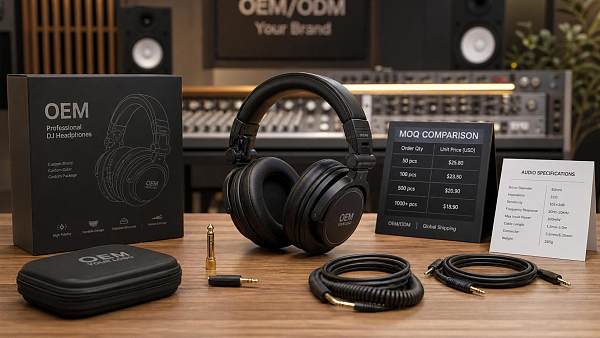
For dj headphones wholesale, useful OEM choices usually include color matching, earcup branding, retail box design, cable options, and accessory bundles.
Some suppliers can also adjust driver tuning, headband materials, or connector format.
That matters when the product is aimed at club monitoring, studio crossover use, or lifestyle retail with DJ styling.
The key is to separate cosmetic OEM from functional OEM.
Cosmetic changes are faster and usually fit lower volumes.
Functional changes need stronger engineering control and longer approval cycles.
A simple comparison table helps clarify what is worth negotiating.
When comparing OEM proposals, ask for pre-production samples, Pantone references, packaging dielines, and confirmation of spare parts availability.
Those details reveal whether the supplier is organized or only flexible in sales language.
How low can MOQ really go without creating hidden cost problems?
MOQ is one of the most searched issues in dj headphones wholesale because it shapes cash flow, testing risk, and inventory speed.
A low MOQ sounds attractive, but it is not always cheaper in the full landed model.
Suppliers may accept small runs, then recover margin through setup fees, packaging surcharges, or limited accessory inclusion.
More common is a tiered MOQ structure.
A standard model may start at a modest quantity.
A private label version often needs more volume.
A structural change usually needs the highest commitment.
The practical move is to compare MOQ against four cost layers:
- Unit price by volume break
- Tooling or artwork setup charges
- Sampling and revision cost
- Freight efficiency by carton and pallet ratio
If a supplier offers 200 pieces but shipping becomes inefficient and packaging fees spike, the low MOQ may not be the best commercial choice.
For many programs, a pilot order works best when it proves market response without forcing a fully customized build too early.
That approach reduces risk while preserving room for a second-stage OEM rollout.
Which audio specs matter most when comparing dj headphones wholesale offers?
Spec sheets often look impressive, but not every number has equal buying value.
For DJ headphones, several parameters deserve close reading because they affect real monitoring performance.
Driver size is not the full story
Many wholesale listings highlight 40mm, 50mm, or 57mm drivers.
Larger drivers can help low-end presence, but tuning and enclosure design matter just as much.
A poorly tuned 50mm unit may sound less controlled than a refined 40mm design.
Impedance affects device matching
Lower impedance models are easier to drive from portable gear.
Higher impedance can suit professional setups, but may reduce loudness on weaker outputs.
If the target use includes controllers, mixers, and mobile previewing, moderate impedance is often safer.
Sensitivity tells you how loudly the headphone plays
This figure matters in loud club environments.
Still, very high sensitivity without control can create harshness or listener fatigue.
Frequency range is easy to overread
A printed range like 5Hz to 30kHz looks impressive.
What matters more is usable balance in bass, mids, and treble at real listening levels.
If possible, request measurement summaries and listening samples from the same production batch.
For dj headphones wholesale, consistency between batches often matters more than one excellent prototype.
Where do buyers usually misjudge build quality and compliance?
The biggest mistakes are often physical, not acoustic.
DJ headphones are folded, twisted, worn for long sets, and packed repeatedly.
Weak hinges, thin headband padding, and low-grade cable joints create failure long before driver issues appear.
A wholesale quote should therefore be checked against durability details such as hinge cycle testing, detachable cable life, ear pad replacement support, and headband reinforcement.
Compliance is another area where assumptions create risk.
For cross-border trade, confirm the exact standards needed for the destination market.
That may include CE, RoHS, FCC, REACH, or packaging-related labeling requirements.
It is safer to request current test reports tied to the exact model, not a similar series.
This is where a research-driven sourcing environment adds value.
Platforms shaped by verified commercial intelligence, like GCT, tend to emphasize documentation quality, sector relevance, and supplier credibility rather than price alone.
How should lead time, sample approval, and total cost be judged together?
A cheap quote loses value if approval cycles stretch too long or reorders become unstable.
For dj headphones wholesale, timing usually depends on stock model availability, OEM complexity, and packaging confirmation speed.
The more custom the program, the more carefully the approval calendar must be mapped.
- Sample lead time for standard and branded versions
- Time needed for artwork revision and box proofing
- Mass production window after approval
- Spare parts support for later after-sales needs
Total cost should include more than ex-works pricing.
Add sample charges, compliance testing, packaging upgrades, freight mode, duties, and expected defect allowance.
When suppliers are close in price, the better choice often shows clearer communication, cleaner technical files, and more reliable replenishment planning.
What is the smartest next step before placing a dj headphones wholesale order?
Start by defining the real market position of the product.
Is it entry-level retail, event resale, branded pro audio, or a crossover lifestyle line with DJ styling?
That choice affects the right OEM depth, acceptable MOQ, and which audio specs deserve priority.
Then build a comparison sheet using the same inputs for every supplier.
Include unit cost, MOQ, sample timing, compliance files, build details, accessory list, and batch consistency notes.
The most reliable dj headphones wholesale decisions usually come from disciplined comparison, not broad catalog browsing.
If the offer includes OEM branding, confirm where the supplier is truly flexible and where cost or volume changes begin.
If the program is long term, ask about component continuity and reorder protection.
That final check helps prevent a good first order from becoming a difficult second one.
In short, compare sound, structure, MOQ realism, and documentation together.
That is the clearest route to a dj headphones wholesale program that supports margin, brand fit, and dependable supply.
Search News
Hot Articles
- Outdoor RidesWhat Drives Animatronic Dinosaur Manufacturer Prices for Theme Park Projects?Sep 18, 2026
- Stationery & UniformsHow to Source Wholesale Packing Tape Without Compromising Carton Seal StrengthSep 17, 2026
- Smart Campus TechHow to Source Educational Furniture Worldwide for Safe, Flexible Learning SpacesSep 16, 2026
Popular Tags
Need ExpertConsultation?
Connect with our specialized leisureengineering team for procurementstrategies.
Recommended News
 Sep 11, 2026How to Choose Touring Instrument Cases for Flights, Trucks, and Daily Load-InsInstrument cases for touring: learn how to balance flight protection, truck durability, weight, fit, and serviceable hardware for safer, faster load-ins.● Pro Audio Engineer
 Sep 07, 2026How to Choose Wood Frame Tambourines for Sound Quality and Long-Term UseWood frame tambourines: learn how to compare frame construction, jingle tone, head options, durability, and supplier quality for reliable long-term performance.● Pro Audio Engineer
 Sep 05, 2026How Often Should Music Education Equipment Be Serviced?How often should music education equipment be serviced? Explore practical schedules, maintenance tips, and lifecycle planning to keep instruments and audio systems reliable.● Pro Audio Engineer
 Aug 21, 2026How to Choose Marching Band Drums for Sound Projection, Weight, and DurabilityMarching band drums buying guide: learn how to balance sound projection, weight, and durability for better field performance, easier carrying, and longer-lasting value.● Pro Audio Engineer
 Aug 09, 2026How to Evaluate a MIDI Cable Manufacturer for Audio Quality and OEM ReliabilityMIDI cable manufacturer evaluation guide: learn how to assess signal stability, connector quality, OEM process control, and batch consistency to reduce failures and source with confidence.● Pro Audio Engineer
 Aug 08, 2026How to Evaluate a Trumpets OEM Manufacturer for Quality, MOQ, and Custom DesignTrumpets OEM manufacturer selection starts with quality, MOQ, and custom design control. Learn how to compare suppliers, reduce sourcing risk, and choose a reliable long-term factory partner.● Pro Audio Engineer
 Jul 27, 2026How to Source Conga Drums in Bulk for Schools, Bands, and Event ProgramsConga drums bulk sourcing for schools, bands, and event programs made easier. Learn how to compare quality, durability, compliance, and total cost before you place a large order.● Pro Audio Engineer
 Jul 24, 2026How to Choose Low Dust Violin Rosin for Cleaner Practice and Better Bow ControlLow dust violin rosin buying guide: learn how to compare formula, climate fit, grip, and string compatibility for cleaner practice, better bow control, and smarter purchase decisions.● Pro Audio Engineer
 Jul 15, 2026Plastic Tambourines Bulk Buying Guide: Sizes, Materials, and MOQ QuestionsPlastic tambourines bulk buying guide covering sizes, ABS vs PP materials, sound consistency, customization, and MOQ questions to help buyers cut risk and choose the right supplier.● Pro Audio Engineer
 Jul 13, 2026Acoustic Guitars Wholesale China: How to Evaluate Build Quality and OEM OptionsAcoustic guitars wholesale China guide: learn how to assess build quality, factory consistency, and OEM options to choose reliable suppliers and reduce sourcing risk.● Pro Audio Engineer
 Jul 12, 2026Mini Effect Pedals Wholesale: MOQ, OEM Options, Testing, and Supplier ComparisonMini effect pedals wholesale guide covering MOQ, OEM options, testing standards, and supplier comparison to help buyers reduce risk, improve margins, and choose reliable partners.● Pro Audio Engineer
 Jul 11, 2026DJ Turntables OEM Guide: Key Torque, Drive, and Build Specs to CompareDJ turntables OEM guide covering torque, drive type, speed stability, platter build, and manufacturing consistency. Compare the specs that impact performance, reliability, and sourcing confidence.● Pro Audio Engineer
 Jul 08, 2026Guitar Capos Wholesale: What Materials, Clamp Types, and MOQ Terms Should You Compare?Guitar capos wholesale buying starts with more than price. Compare materials, clamp types, quality checks, and MOQ terms to reduce returns, protect margins, and choose a supplier with confidence.● Pro Audio Engineer
 Jul 07, 2026Birch Drum Kits Manufacturer Comparison: Shell Construction, Hardware Quality, and OEM OptionsBirch drum kits manufacturer comparison covering shell construction, hardware quality, and OEM options to help buyers reduce sourcing risk and choose reliable suppliers.● Pro Audio Engineer
 Jul 06, 2026Spruce Top Acoustic Guitars Explained: Tone, Wood Grades, and Who They Suit BestSpruce top acoustic guitars explained: compare tone, wood grades, and build quality to find the best fit for players, retailers, and commercial buyers.● Pro Audio Engineer
 Jun 30, 2026Xylophones and Glockenspiels: Key Differences in Range, Tone, and Classroom UseXylophones and glockenspiels compared: discover key differences in range, tone, durability, and classroom use to choose the right instrument for teaching, buying, or school programs.● Pro Audio Engineer
 Jun 25, 2026Musical Instrument Industry Report: Key Market Segments, Demand Drivers, and Price TrendsMusical instrument industry report covering key market segments, demand drivers, and price trends. Explore sourcing risks, premium growth, and where buyer demand is shifting next.● Pro Audio Engineer
 Jun 23, 2026Metronomes and Tuners Explained: Types, Key Features, and Who Needs BothMetronomes and tuners explained: compare types, key features, and who needs both. Learn how to choose the right tool for better timing, pitch, and practical daily use.● Pro Audio Engineer
 Jun 22, 2026How the Musical Instrument Industry Supply Chain Affects Lead Times, Cost, and QualityMusical instrument industry supply chain trends now shape lead times, cost, and quality. Discover how smarter sourcing and supplier transparency reduce risk and improve buying outcomes.● Pro Audio Engineer
 Jun 20, 2026DJ Headphones Wholesale Buying Guide: OEM Options, MOQ, and Audio Specs to CompareDJ headphones wholesale guide covering OEM options, MOQ strategy, and key audio specs. Compare build quality, compliance, and total cost to source smarter and reduce returns.● Pro Audio Engineer
 Jun 19, 2026Acoustic Guitars Wholesale: 7 Specs Buyers Should Compare Before Placing an OrderAcoustic guitars wholesale buyers can compare 7 key specs before ordering, from tonewoods and playability to OEM, packaging, and QC, to reduce risk and protect margins.● Pro Audio Engineer
 Jun 15, 2026Tambourines Bulk Buying Guide: Materials, Sound Quality, and Pack Size DifferencesTambourines bulk buying guide covering material choices, sound consistency, and pack size differences. Compare suppliers smarter, reduce risk, and choose the best fit for schools, retail, and events.● Pro Audio Engineer
 Jun 14, 2026Professional Musical Instruments Explained: Types, Skill Levels, and Buying CriteriaProfessional musical instruments explained: discover key types, ideal skill levels, and practical buying criteria to choose reliable, high-performance instruments with confidence.● Pro Audio Engineer
 Jun 10, 2026Drum Kits Manufacturer Comparison: What to Check Before OEM or Bulk OrdersDrum kits manufacturer comparison guide for OEM and bulk buyers: check quality, compliance, lead times, packaging, and true cost before placing large orders.● Pro Audio Engineer