Mini Effect Pedals Wholesale: MOQ, OEM Options, Testing, and Supplier Comparison
Mini Effect Pedals Wholesale: what matters before price?
Mini effect pedals wholesale looks simple at first glance.
A compact enclosure, familiar circuits, and many factories can make early quotes look interchangeable.
In practice, the real decision sits deeper.
MOQ structure, OEM flexibility, testing discipline, and delivery stability usually decide whether a project scales smoothly.
This is especially relevant in pro audio and musical instruments, where private label margins depend on consistency.
It also matters in broader commercial sourcing, where reliability and compliance influence long-term supplier value.
GCT often frames sourcing this way.
Good supplier selection is rarely just a transaction.
It is a balance of product fit, risk control, and market positioning.
How should mini effect pedals wholesale MOQ really be evaluated?
MOQ is one of the first questions buyers ask, but the useful answer is rarely a single number.
Many suppliers quote one MOQ for standard models and a higher one for custom branding.
The gap becomes larger when housing color, logo methods, packaging, or circuit tuning are changed.
A factory offering 50 units may only support that level for stock pedals.
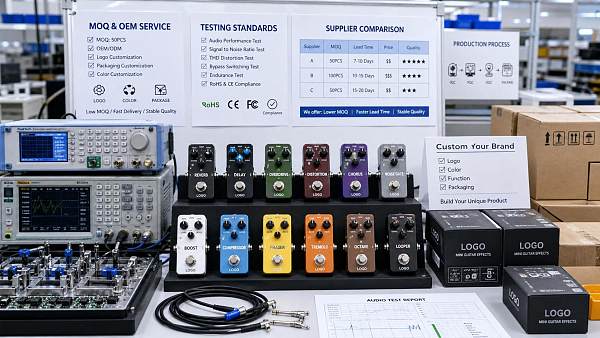
For OEM orders, the realistic entry point may be 200 to 500 units per model.
That is not necessarily a negative sign.
It can indicate structured production planning and better component control.
A practical MOQ review should cover more than carton quantity:
- MOQ by model, not only by total order volume
- MOQ for logo printing, custom color, and gift box packaging
- Whether mixed-model orders are accepted
- Whether repeat orders can be smaller after first tooling approval
- How MOQ changes when using imported ICs or footswitches
More often, the best mini effect pedals wholesale partner is not the one with the lowest MOQ.
It is the one whose MOQ aligns with forecasted sell-through and replenishment rhythm.
What OEM options are actually useful, and which ones only add cost?
OEM capability is a major reason companies enter mini effect pedals wholesale rather than buying unbranded stock.
Still, not every custom request adds commercial value.
Some changes improve shelf identity and channel fit.
Others only create new tooling charges, slower approvals, and future reorder complexity.
The most useful OEM options usually include enclosure finish, logo treatment, packaging, user manual branding, and power labeling.
For established channels, small circuit voicing changes can also matter.
That applies when the target market expects a certain gain structure, modulation range, or noise floor.
Less useful customization often includes unnecessary housing redesigns for mature product types.
A fully new enclosure may look attractive, but it can increase die cost, extend lead time, and complicate replacement parts.
A clearer way to judge OEM value is to compare requests by business impact:
In short, good OEM in mini effect pedals wholesale should reinforce market fit, not just appearance.
Testing standards: what should be confirmed before placing the order?
This is where supplier comparison becomes more serious.
Mini pedals are compact, but they combine electronics, hardware, paint finish, footswitch stress, and packaging durability.
A low quote can become expensive if field failures rise after shipment.
Useful testing should cover both sound performance and production consistency.
Basic confirmation points include input and output signal checks, bypass function, noise level, switch life, knob stability, and power compatibility.
For export programs, it is also sensible to ask about RoHS, CE-related documentation, and material declarations where relevant.
Some buyers focus only on the final sample.
The better question is whether the factory has batch-level controls.
That usually means incoming component inspection, in-line functional checks, and final random inspection.
A short supplier questionnaire can reveal a lot:
- Is every unit function-tested, or only sampled by batch?
- How is switch durability validated?
- Are audio tests documented or judged only by listening?
- What is the rework rate for recent production runs?
- How are failed units isolated and traced?
GCT sourcing analysis often emphasizes this point across categories.
A factory with visible process discipline usually creates more predictable commercial outcomes than one with only fast quoting.
When comparing suppliers, what separates a stable partner from a cheap one?
Supplier comparison in mini effect pedals wholesale should combine price with execution evidence.
The easiest mistake is to compare only unit cost across three or four factories.
A better method is to compare operating reliability side by side.
The table below helps organize that review.
Another useful distinction is communication accuracy.
When specifications, labels, voltages, and packaging marks are confirmed carefully, later disputes are reduced.
That may sound basic, but it directly affects landed cost.
What cost and lead-time mistakes appear most often in mini effect pedals wholesale?
The most common mistake is treating ex-works price as the full sourcing picture.
Mini effect pedals wholesale cost usually shifts after packaging upgrades, compliance paperwork, spare parts requests, and retest cycles.
A factory that looks cheaper at quotation stage may become more expensive after revisions.
Lead time is similar.
Standard pedals may ship quickly, while OEM versions depend on artwork approval, enclosure finish confirmation, and custom print schedules.
It is wise to separate timeline into sample lead time, approval lead time, mass production lead time, and shipping preparation.
That level of detail makes supplier comparison more realistic.
Need-to-check cost items often include:
- Printing plate or packaging setup charges
- Sample fee treatment after bulk order confirmation
- Spare unit ratio for service support
- Export carton drop-test or labeling requirements
- Payment terms tied to production milestone
Where commercial sourcing becomes more strategic, these details matter as much as price negotiation.
That is why GCT-style evaluation often looks at total supply readiness, not only quote competitiveness.
So, how should the final decision be made?
A sound mini effect pedals wholesale decision usually comes from ranking suppliers on four points.
First, check whether MOQ fits actual launch volume.
Second, confirm that OEM options support the intended market position.
Third, verify that testing is documented and repeatable.
Fourth, compare lead-time credibility and issue-handling discipline.
When two suppliers are close on price, the one with cleaner process control often delivers better long-term value.
Before moving forward, it helps to build a short decision sheet.
List required models, target price band, branding scope, test expectations, and acceptable replenishment cycle.
Then validate each supplier against the same criteria.
That approach keeps mini effect pedals wholesale sourcing grounded in evidence, not optimism.
The next practical step is simple: refine the specification, request comparable quotations, and pressure-test MOQ, OEM, and quality claims before committing volume.
Search News
Hot Articles
- Musical InstrumentsA Practical Guide to Identifying Wooden Orchestral Instruments by Family and ToneOct 10, 2026
- Indoor PlaygroundHow to Choose Animatronic Haunted House Props for High-Throughput AttractionsOct 08, 2026
- Fashion & Gem JewelryThermal Diamond Testers: How They Work and When They Can Misidentify StonesOct 07, 2026
Popular Tags
Need ExpertConsultation?
Connect with our specialized leisureengineering team for procurementstrategies.
Recommended News
 Oct 10, 2026A Practical Guide to Identifying Wooden Orchestral Instruments by Family and ToneWooden orchestral instruments made simple: identify strings, flutes, clarinets, oboes, and bassoons by sound source, design, and tone.● Pro Audio Engineer
 Sep 11, 2026How to Choose Touring Instrument Cases for Flights, Trucks, and Daily Load-InsInstrument cases for touring: learn how to balance flight protection, truck durability, weight, fit, and serviceable hardware for safer, faster load-ins.● Pro Audio Engineer
 Sep 07, 2026How to Choose Wood Frame Tambourines for Sound Quality and Long-Term UseWood frame tambourines: learn how to compare frame construction, jingle tone, head options, durability, and supplier quality for reliable long-term performance.● Pro Audio Engineer
 Sep 05, 2026How Often Should Music Education Equipment Be Serviced?How often should music education equipment be serviced? Explore practical schedules, maintenance tips, and lifecycle planning to keep instruments and audio systems reliable.● Pro Audio Engineer
 Aug 21, 2026How to Choose Marching Band Drums for Sound Projection, Weight, and DurabilityMarching band drums buying guide: learn how to balance sound projection, weight, and durability for better field performance, easier carrying, and longer-lasting value.● Pro Audio Engineer
 Aug 09, 2026How to Evaluate a MIDI Cable Manufacturer for Audio Quality and OEM ReliabilityMIDI cable manufacturer evaluation guide: learn how to assess signal stability, connector quality, OEM process control, and batch consistency to reduce failures and source with confidence.● Pro Audio Engineer
 Aug 08, 2026How to Evaluate a Trumpets OEM Manufacturer for Quality, MOQ, and Custom DesignTrumpets OEM manufacturer selection starts with quality, MOQ, and custom design control. Learn how to compare suppliers, reduce sourcing risk, and choose a reliable long-term factory partner.● Pro Audio Engineer
 Jul 27, 2026How to Source Conga Drums in Bulk for Schools, Bands, and Event ProgramsConga drums bulk sourcing for schools, bands, and event programs made easier. Learn how to compare quality, durability, compliance, and total cost before you place a large order.● Pro Audio Engineer
 Jul 24, 2026How to Choose Low Dust Violin Rosin for Cleaner Practice and Better Bow ControlLow dust violin rosin buying guide: learn how to compare formula, climate fit, grip, and string compatibility for cleaner practice, better bow control, and smarter purchase decisions.● Pro Audio Engineer
 Jul 15, 2026Plastic Tambourines Bulk Buying Guide: Sizes, Materials, and MOQ QuestionsPlastic tambourines bulk buying guide covering sizes, ABS vs PP materials, sound consistency, customization, and MOQ questions to help buyers cut risk and choose the right supplier.● Pro Audio Engineer
 Jul 13, 2026Acoustic Guitars Wholesale China: How to Evaluate Build Quality and OEM OptionsAcoustic guitars wholesale China guide: learn how to assess build quality, factory consistency, and OEM options to choose reliable suppliers and reduce sourcing risk.● Pro Audio Engineer
 Jul 12, 2026Mini Effect Pedals Wholesale: MOQ, OEM Options, Testing, and Supplier ComparisonMini effect pedals wholesale guide covering MOQ, OEM options, testing standards, and supplier comparison to help buyers reduce risk, improve margins, and choose reliable partners.● Pro Audio Engineer
 Jul 11, 2026DJ Turntables OEM Guide: Key Torque, Drive, and Build Specs to CompareDJ turntables OEM guide covering torque, drive type, speed stability, platter build, and manufacturing consistency. Compare the specs that impact performance, reliability, and sourcing confidence.● Pro Audio Engineer
 Jul 08, 2026Guitar Capos Wholesale: What Materials, Clamp Types, and MOQ Terms Should You Compare?Guitar capos wholesale buying starts with more than price. Compare materials, clamp types, quality checks, and MOQ terms to reduce returns, protect margins, and choose a supplier with confidence.● Pro Audio Engineer
 Jul 07, 2026Birch Drum Kits Manufacturer Comparison: Shell Construction, Hardware Quality, and OEM OptionsBirch drum kits manufacturer comparison covering shell construction, hardware quality, and OEM options to help buyers reduce sourcing risk and choose reliable suppliers.● Pro Audio Engineer
 Jul 06, 2026Spruce Top Acoustic Guitars Explained: Tone, Wood Grades, and Who They Suit BestSpruce top acoustic guitars explained: compare tone, wood grades, and build quality to find the best fit for players, retailers, and commercial buyers.● Pro Audio Engineer
 Jun 30, 2026Xylophones and Glockenspiels: Key Differences in Range, Tone, and Classroom UseXylophones and glockenspiels compared: discover key differences in range, tone, durability, and classroom use to choose the right instrument for teaching, buying, or school programs.● Pro Audio Engineer
 Jun 25, 2026Musical Instrument Industry Report: Key Market Segments, Demand Drivers, and Price TrendsMusical instrument industry report covering key market segments, demand drivers, and price trends. Explore sourcing risks, premium growth, and where buyer demand is shifting next.● Pro Audio Engineer
 Jun 23, 2026Metronomes and Tuners Explained: Types, Key Features, and Who Needs BothMetronomes and tuners explained: compare types, key features, and who needs both. Learn how to choose the right tool for better timing, pitch, and practical daily use.● Pro Audio Engineer
 Jun 22, 2026How the Musical Instrument Industry Supply Chain Affects Lead Times, Cost, and QualityMusical instrument industry supply chain trends now shape lead times, cost, and quality. Discover how smarter sourcing and supplier transparency reduce risk and improve buying outcomes.● Pro Audio Engineer
 Jun 20, 2026DJ Headphones Wholesale Buying Guide: OEM Options, MOQ, and Audio Specs to CompareDJ headphones wholesale guide covering OEM options, MOQ strategy, and key audio specs. Compare build quality, compliance, and total cost to source smarter and reduce returns.● Pro Audio Engineer
 Jun 19, 2026Acoustic Guitars Wholesale: 7 Specs Buyers Should Compare Before Placing an OrderAcoustic guitars wholesale buyers can compare 7 key specs before ordering, from tonewoods and playability to OEM, packaging, and QC, to reduce risk and protect margins.● Pro Audio Engineer
 Jun 15, 2026Tambourines Bulk Buying Guide: Materials, Sound Quality, and Pack Size DifferencesTambourines bulk buying guide covering material choices, sound consistency, and pack size differences. Compare suppliers smarter, reduce risk, and choose the best fit for schools, retail, and events.● Pro Audio Engineer
 Jun 14, 2026Professional Musical Instruments Explained: Types, Skill Levels, and Buying CriteriaProfessional musical instruments explained: discover key types, ideal skill levels, and practical buying criteria to choose reliable, high-performance instruments with confidence.● Pro Audio Engineer