Event Technology for Live Venues: What Systems Matter Most for Seamless Operations?
Why event technology decisions now shape venue performance
Live venues no longer run on isolated tools. Event technology now influences uptime, guest flow, technical accuracy, staffing pressure, and revenue stability across the entire operation.
That matters across the wider commercial experience economy tracked by Global Commercial Trade. Hotels, leisure parks, music spaces, campuses, and branded environments all depend on coordinated systems.
In practice, the strongest event technology stack is rarely the one with the most features. It is the one that keeps ticketing, access, AV, networking, scheduling, and monitoring aligned under real operating pressure.
A venue hosting touring concerts faces different constraints than a ballroom inside a five-star hotel. A campus auditorium differs again, even when the room size looks similar on paper.
Actual use cases change what matters most
The biggest mistake in event technology planning is assuming every live venue needs the same core priorities. The systems may sound familiar, but the decision logic changes with the operating model.
Some venues care most about rapid turnover between events. Others need premium audience control, broadcast-ready audio paths, or strict compliance with security and emergency protocols.
More often, the right evaluation starts with three questions: how the venue earns, how often the room configuration changes, and how many teams touch the system daily.
Those questions usually reveal whether event technology should prioritize resilience, flexibility, integration depth, or operational simplicity.
Touring and high-volume entertainment venues
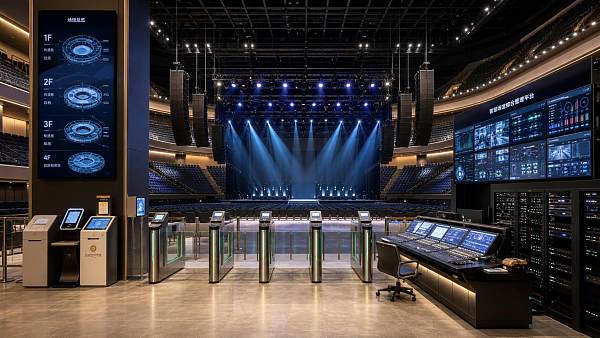
For concert halls, clubs, and leisure-driven venues, event technology must absorb constant change. Guest volumes spike quickly, production requirements vary, and faults become visible immediately.
In these settings, network reliability, digital audio transport, stage patching, and access control often matter more than decorative front-end features.
A system that saves ten minutes during load-in can be more valuable than one offering a longer dashboard menu. Fast recovery is part of seamless operations.
Hotel ballrooms and multi-use hospitality spaces
Hospitality venues usually need event technology that blends technical control with service polish. The room may host a conference, wedding, product launch, and gala in the same week.
Here, preset-based AV control, movable partition logic, digital signage, hybrid meeting support, and simple operator interfaces become more important.
The key judgment is not raw system power. It is whether non-specialist staff can switch modes without breaking audio routes, lighting scenes, or room scheduling.
Auditoriums, campuses, and civic venues
Educational and institutional environments often place more weight on longevity, interoperability, and policy compliance. Budget cycles are slower, but lifecycle expectations are usually longer.
In these cases, event technology should support standardized control protocols, clear user permissions, remote support access, and stable firmware management.
The system must also tolerate mixed usage. One day may require a lecture capture workflow, while the next needs a live performance with guest engineers.
Which event technology systems usually matter first
Although venue priorities differ, several event technology layers consistently determine whether operations stay smooth or become fragile.
- AV control and signal management: needed for repeatability, room presets, and faster fault isolation.
- Ticketing and CRM-linked entry systems: critical where demand, pricing, and audience movement affect revenue directly.
- Access management: supports credentialing, restricted zones, staff routing, and emergency response.
- Venue networking: often underestimated, yet central to modern event technology across audio, signage, POS, and monitoring.
- Real-time monitoring and alerting: reduces downtime by catching thermal, power, or device failures before show impact.
- Scheduling and resource coordination: important where rooms, labor, and equipment shift several times per week.
These systems matter most when they share data cleanly. Fragmented event technology can look impressive during procurement and still fail under live conditions.
Different venue conditions create different priorities
A useful comparison is to look at operational pressure points rather than architecture diagrams. That usually exposes where event technology needs deeper investment.
This is where many cross-industry venue projects succeed or fail. A technically capable system can still be a poor fit when room turnover, staffing, or lifecycle assumptions are wrong.
Where seamless operations usually break down
Most event technology failures do not begin with dramatic equipment collapse. They start with smaller mismatches between the system design and the venue’s daily rhythm.
One common misjudgment is buying around product specifications alone. Bandwidth, channel count, or screen resolution mean little without confirming cable paths, rack conditions, heat load, and operator workflow.
Another issue is treating similar venues as identical. A luxury hotel theater and an amusement venue showroom may share capacity, yet their event technology priorities differ sharply.
Hotels often need discreet interfaces and elegant guest-facing consistency. Leisure venues usually accept more visible technical infrastructure if it improves throughput and uptime.
A third blind spot is ignoring maintenance cost. Event technology that depends on specialist intervention for every update may create long-term friction even when the initial deployment goes smoothly.
Signals that a venue stack is under-matched
- Staff rely on workarounds to switch room modes.
- Guest entry slows during peak arrival windows.
- Temporary productions need repeated manual repatching.
- System health is checked only after users report a fault.
- Routine updates risk breaking unrelated devices or integrations.
A practical way to match event technology to the venue
A better approach is to map event technology against live operational moments. Entry, setup, performance, reset, and maintenance each reveal different system requirements.
Start by identifying which functions must never fail during a live event. Those systems usually deserve redundancy, cleaner interfaces, and priority support structures.
Then separate fixed infrastructure from changeable production layers. That distinction is especially useful in venues serving hospitality, education, and entertainment within one property group.
In practical sourcing terms, this means evaluating not only device performance, but also standards compliance, regional service coverage, spare availability, and integration maturity.
- Define the busiest operating day, not the average day.
- Test how systems behave during simultaneous room use.
- Confirm who can troubleshoot without external escalation.
- Review upgrade paths before finalizing proprietary dependencies.
- Include power, network, and environmental tolerances in every comparison.
What a future-ready venue ecosystem really requires
Future-ready event technology is not defined by novelty. It is defined by how well the venue can adapt without rebuilding its operational logic each season.
That is why the most durable systems usually combine open integration, stable remote management, disciplined monitoring, and interfaces matched to the people actually using them.
Across the commercial sectors followed by GCT, the strongest projects tend to treat event technology as part of a broader experience infrastructure, not an isolated technical purchase.
The next step is straightforward. Clarify the venue’s real operating scenarios, compare where conditions diverge, then build an event technology standard around uptime, compatibility, maintenance, and change readiness.
That process produces better sourcing decisions, fewer deployment surprises, and more seamless operations when the room is live and every system is under pressure.
Search News
Hot Articles
- Musical InstrumentsA Practical Guide to Identifying Wooden Orchestral Instruments by Family and ToneOct 10, 2026
- Indoor PlaygroundHow to Choose Animatronic Haunted House Props for High-Throughput AttractionsOct 08, 2026
- Fashion & Gem JewelryThermal Diamond Testers: How They Work and When They Can Misidentify StonesOct 07, 2026
Popular Tags
Need ExpertConsultation?
Connect with our specialized leisureengineering team for procurementstrategies.
Recommended News
 Sep 28, 2026How U.S. Schools Can Choose Laboratory Equipment for Safe, Compliant Science LabsSchool laboratory equipment USA: learn how to select safe, compliant lab furniture, ventilation, emergency systems, and durable tools for K–12 science labs.● Institutional Buyer
 Sep 16, 2026How to Source Educational Furniture Worldwide for Safe, Flexible Learning SpacesEducational furniture worldwide: learn how to source safe, flexible, durable learning-space solutions while controlling compliance, logistics, and lifecycle costs.● Institutional Buyer
 Aug 31, 2026How to Plan Smart Classroom Solutions That Improve Learning and IT ManageabilitySmart classroom solutions: learn how to plan secure, scalable teaching spaces that improve learning, simplify IT management, and reduce lifecycle costs.● Institutional Buyer
 Aug 01, 2026How to Specify an EN54 School PA System for Safe, Compliant Campus Voice EvacuationEN54 school PA system specification guide for safer, compliant campus voice evacuation. Learn zoning, intelligibility, monitoring, tender tips, and handover checks.● Institutional Buyer
 Jul 15, 2026Vietnam Tightens Import Rules for Smart Campus TechVietnam Tightens Import Rules for Smart Campus Tech: learn how MOIT’s 2026 data hosting and NEP connection rules may reshape import approval, sourcing timelines, and delivery planning.● Institutional Buyer
 Jul 14, 2026Thailand TISI Tightens Rules for Smart Campus TerminalsThailand TISI tightens rules for smart campus terminals, requiring Thai speech recognition and local biometric data storage. Learn the compliance impact, timeline risks, and what exporters must do now.● Institutional Buyer
 Jul 13, 2026Red Sea Rerouting Lifts Smart Campus Tech Shipping CostsRed Sea rerouting lifts Smart Campus Tech shipping costs, extends Asia-Europe booking lead times, and delays delivery. See what exporters, buyers, and logistics teams should do now.● Institutional Buyer
 Jul 12, 2026Event Technology for Live Venues: What Systems Matter Most for Seamless Operations?Event technology defines how live venues handle ticketing, AV, access, and monitoring. Discover which systems matter most for seamless operations, higher uptime, and better guest experiences.● Institutional Buyer
 Jul 11, 2026What Is a Campus Procurement Platform and How Does It Improve School Purchasing Workflows?Campus procurement platform explained: learn how it streamlines school purchasing workflows, improves approval control, boosts spend visibility, and reduces delays across campus buying.● Institutional Buyer
 Jul 10, 2026Vietnam Raises Smart Campus Tech Import Tariff to 12%Vietnam Raises Smart Campus Tech Import Tariff to 12%: explore how the new Vietnam smart campus tech tariff impacts pricing, sourcing, and local assembly strategies across Southeast Asia.● Institutional Buyer
 Jul 10, 2026Interactive Document Camera vs Webcam: Which Works Better for Smart Classrooms?Interactive document camera vs webcam: discover which delivers clearer content sharing, faster lesson flow, and better hybrid teaching performance for smart classrooms.● Institutional Buyer
 Jul 09, 2026RCEP Rule Adds Carbon Footprint Filings for Smart Campus Tech ExportsRCEP Rule reshapes Smart Campus Tech exports: learn how new carbon footprint filings for Singapore, Thailand, and Vietnam affect customs clearance, lead times, and compliance planning before October 1, 2026.● Institutional Buyer
 Jul 09, 2026Basketball Hoops for Campuses: Which Backboard, Rim, and Mounting Type Fits Your Site?Basketball hoops for campuses: compare backboard, rim, and mounting options by site needs. Learn how to choose safer, longer-lasting systems for outdoor courts, gyms, and multipurpose halls.● Institutional Buyer
 Jul 09, 2026Modular Educational Furniture: What to Check Before Planning Flexible ClassroomsModular educational furniture: learn what to check before planning flexible classrooms, from safety and durability to teaching fit, supplier quality, and long-term value.● Institutional Buyer
 Jul 08, 2026Shenzhen-Yokohama Port Delays Fall to 2.1 DaysShenzhen-Yokohama Port Delays fall to 2.1 days, cutting shipment cycles by 5–7 days for smart campus equipment. See how faster port efficiency can ease Q3 school delivery pressure.● Institutional Buyer
 Jul 07, 2026FBX Slide Pushes Smart Campus Freight Below $980/FEUFBX Slide Pushes Smart Campus Freight Below $980/FEU as Asia-Europe rates tumble. Discover what this means for smart campus shipments, booking risks, and cost-saving opportunities.● Institutional Buyer
 Jul 07, 2026Math Manipulatives Bulk Price Guide: Cost Drivers, Pack Sizes, and School Budget PlanningMath manipulatives bulk price explained: compare cost drivers, pack sizes, landed costs, and school budget planning tips to source smarter and avoid hidden expenses.● Institutional Buyer
 Jul 04, 2026RCEP Update Expands Indonesia Duty-Free Quota for Edu DevicesRCEP Update Expands Indonesia Duty-Free Quota for Edu Devices: learn how the new 80,000-unit quota reshapes export costs, compliance, and school procurement opportunities in Indonesia.● Institutional Buyer
 Jul 03, 2026Indonesia Enforces ID-SNI Labels on Smart Campus ImportsIndonesia Enforces ID-SNI Labels on Smart Campus Imports: learn how the new rule affects labeling, customs clearance, certification, and delivery readiness for compliant market entry.● Institutional Buyer
 Jul 03, 2026How to Choose Indoor School Sports Equipment for Age Groups, Space, and Safety NeedsIndoor school sports equipment buying guide for schools: learn how to match age groups, space limits, and safety standards to choose durable, efficient solutions.● Institutional Buyer
 Jul 02, 2026Chromebook Charging Stations for Schools: Cart vs Cabinet vs Wall-Mount OptionsChromebook charging stations for schools compared: cart, cabinet, and wall-mount options. Discover the best fit for security, space, mobility, and budget before you buy.● Institutional Buyer
 Jul 01, 2026Indonesia Opens RCEP Fast Track for Smart Campus IoTIndonesia opens an RCEP fast track for Smart Campus IoT, cutting Jakarta customs clearance to 12 hours for eligible HS 8517.62 devices. See who qualifies and how to prepare.● Institutional Buyer
 Jun 30, 2026Flexible Learning Spaces for K-12 and Higher Ed: Layout Ideas, Furniture, and Tech NeedsFlexible learning spaces for K-12 and higher ed: explore practical layout ideas, durable furniture, and smart tech strategies that improve teaching, flexibility, and long-term campus value.● Institutional Buyer
 Jun 30, 2026Campus Equipment Procurement Checklist: How to Compare Specs, Warranties, and Total CostCampus equipment procurement made practical: compare specs, warranty terms, supplier reliability, and total cost to avoid hidden expenses and make smarter campus buying decisions.● Institutional Buyer