School Laboratory Equipment Checklist: Key Safety, Accuracy, and Maintenance Points
School Laboratory Equipment Checklist: Key Safety, Accuracy, and Maintenance Points
Choosing the right school laboratory equipment is not only about filling a lab room with basic tools.
It is a purchasing decision that affects safety, teaching quality, long-term costs, and compliance.
For schools, colleges, and training institutions, a practical checklist makes sourcing more controlled and less risky.
It also helps compare vendors fairly when specifications look similar on paper.
This guide explains how to evaluate school laboratory equipment with a focus on safety, accuracy, durability, and maintenance.
The goal is simple: buy equipment that performs well today and stays reliable over time.
Why a Checklist Matters Before You Source
In real purchasing work, problems usually come from missing details, not from missing budget alone.
A school may buy low-cost school laboratory equipment, then spend more on repairs, replacements, or compliance fixes.
That is why a structured checklist is useful from the first quotation request.
It aligns technical requirements with academic needs and keeps total ownership cost visible.
More importantly, it reduces the chance of buying equipment that teachers will not trust or students cannot use safely.
- Clarifies what each science lab actually needs.
- Makes supplier comparison more objective.
- Highlights safety and certification gaps early.
- Supports lifecycle cost control, not just unit price.
- Improves planning for maintenance and spare parts.
Start With the Right Equipment Scope
Before comparing brands, define exactly which school laboratory equipment categories are required.
A physics lab, chemistry lab, and biology lab need different layouts, safety controls, and precision levels.
A general list often creates overbuying in one room and shortages in another.
From a cost perspective, scope accuracy is the first savings lever.
Core categories to define
- Measurement tools such as balances, thermometers, pH meters, and microscopes.
- Glassware and consumables for daily teaching tasks.
- Heating, mixing, and storage units.
- Safety equipment including eyewash stations, fire blankets, and fume extraction systems.
- Lab furniture and utility connections that support equipment use.
When this list is clear, school laboratory equipment sourcing becomes more accurate and easier to budget.
Safety Comes First, Not Last
Safety should never be treated as an add-on after equipment selection.
For school laboratory equipment, safety design must be built into every product decision.
This is especially important in shared school environments where user experience levels vary widely.
A cheaper item can become expensive fast if it increases accident risk or fails inspection.
Safety checkpoints for buyers
- Check compliance with relevant CE, UL, ISO, or local education safety standards.
- Confirm chemical resistance, heat resistance, and impact resistance where needed.
- Review electrical protection, grounded plugs, emergency shutoff features, and overload safeguards.
- Verify whether sharp edges, hot surfaces, or exposed moving parts are properly protected.
- Ask for user manuals, warning labels, and maintenance instructions in clear English.
In practice, safety documentation is often a strong signal of supplier discipline.
Reliable school laboratory equipment suppliers can explain both product features and risk-control logic.
Accuracy Must Match Educational Use
Not all school laboratory equipment needs high-end research precision.
However, accuracy still matters because teaching outcomes depend on stable and repeatable results.
If a balance drifts or a microscope performs poorly, class time gets wasted and confidence drops.
The better approach is to match performance level to curriculum needs.
Questions to ask about accuracy
- What is the tolerance range under normal classroom conditions?
- How often does calibration need to be performed?
- Is calibration supported locally or only by the factory?
- Can the equipment maintain consistency after repeated student use?
- Are calibration certificates or test reports available?
This is where smart school laboratory equipment procurement avoids overpaying for precision that the classroom does not require.
Durability and Maintenance Drive Real Cost
Purchase price is visible immediately, but maintenance cost appears later.
That is why durability should be one of the main filters when buying school laboratory equipment.
School labs face repeated handling, frequent cleaning, and occasional misuse.
Products that survive commercial-style use usually deliver better value over several academic years.
Maintenance points that affect cost
- Availability of spare parts and lead times.
- Ease of cleaning and resistance to staining or corrosion.
- Service access for replacing sensors, bulbs, filters, or seals.
- Warranty coverage for heavy school use.
- Expected service life under normal educational conditions.
A good supplier should explain planned maintenance, not just promise long life.
That conversation often reveals whether the school laboratory equipment is truly designed for institutional use.
Evaluate Supplier Capability Beyond the Catalog
Many catalogs show similar school laboratory equipment, but supplier capability can vary sharply.
This matters because after-sales response, document quality, and production consistency affect the buying result.
A polished brochure does not guarantee stable delivery.
What to review during supplier screening
- Previous school or institutional project experience.
- Quality control process and inspection records.
- Ability to provide OEM or custom configurations if needed.
- Export packaging standards and shipping protection.
- Speed of technical support and replacement handling.
For larger projects, sample evaluation is often the safest way to validate school laboratory equipment quality before full rollout.
Use a Total Cost View, Not a Unit Price View
From a procurement angle, the lowest quotation is not always the lowest cost.
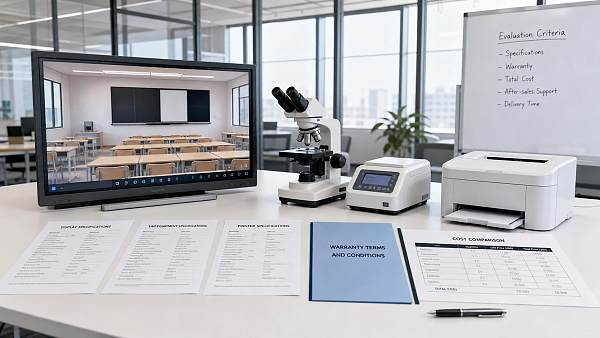
A complete school laboratory equipment cost review should include installation, training, maintenance, calibration, and downtime risk.
This broader view supports better budget control and avoids surprise expenses later.
When school laboratory equipment is assessed this way, budget decisions become easier to defend internally.
A Practical Checklist for Final Selection
Before issuing a purchase order, run through one final decision checklist.
This helps confirm that the chosen school laboratory equipment is operationally suitable, not just technically acceptable.
- Specifications match curriculum and lab function.
- Safety certifications and test records are complete.
- Accuracy level fits classroom teaching requirements.
- Maintenance plan and spare parts support are confirmed.
- Lead time matches installation schedule.
- Warranty terms are clear and realistic.
- Total cost is reviewed across the expected service life.
That final review is often the difference between a smooth rollout and repeated operational issues.
Final Thought
The best school laboratory equipment is not simply the cheapest or the most advanced option.
It is the option that balances safety, accuracy, durability, support, and long-term value.
A careful checklist keeps purchasing decisions grounded in practical use, not just product claims.
As school lab standards continue to rise, better sourcing decisions will matter even more.
If you are reviewing school laboratory equipment for a new project or upgrade, start with the checklist above and compare suppliers with a full lifecycle view.
Search News
Hot Articles
- Stationery & UniformsHow Schools Can Cut Printing Costs When Buying Ink Cartridges in BulkSep 21, 2026
- Jewelry Packaging & DisplayHow to Evaluate a Luxury Retail Packaging Supplier for Premium Brand ConsistencySep 20, 2026
- Commercial KitchenHow to Select a Spiral Dough Mixer for Bakery Batch Size and Dough HydrationSep 19, 2026
Popular Tags
Need ExpertConsultation?
Connect with our specialized leisureengineering team for procurementstrategies.
Recommended News
 Sep 16, 2026How to Source Educational Furniture Worldwide for Safe, Flexible Learning SpacesEducational furniture worldwide: learn how to source safe, flexible, durable learning-space solutions while controlling compliance, logistics, and lifecycle costs.● Institutional Buyer
 Aug 31, 2026How to Plan Smart Classroom Solutions That Improve Learning and IT ManageabilitySmart classroom solutions: learn how to plan secure, scalable teaching spaces that improve learning, simplify IT management, and reduce lifecycle costs.● Institutional Buyer
 Aug 01, 2026How to Specify an EN54 School PA System for Safe, Compliant Campus Voice EvacuationEN54 school PA system specification guide for safer, compliant campus voice evacuation. Learn zoning, intelligibility, monitoring, tender tips, and handover checks.● Institutional Buyer
 Jul 15, 2026Vietnam Tightens Import Rules for Smart Campus TechVietnam Tightens Import Rules for Smart Campus Tech: learn how MOIT’s 2026 data hosting and NEP connection rules may reshape import approval, sourcing timelines, and delivery planning.● Institutional Buyer
 Jul 14, 2026Thailand TISI Tightens Rules for Smart Campus TerminalsThailand TISI tightens rules for smart campus terminals, requiring Thai speech recognition and local biometric data storage. Learn the compliance impact, timeline risks, and what exporters must do now.● Institutional Buyer
 Jul 13, 2026Red Sea Rerouting Lifts Smart Campus Tech Shipping CostsRed Sea rerouting lifts Smart Campus Tech shipping costs, extends Asia-Europe booking lead times, and delays delivery. See what exporters, buyers, and logistics teams should do now.● Institutional Buyer
 Jul 12, 2026Event Technology for Live Venues: What Systems Matter Most for Seamless Operations?Event technology defines how live venues handle ticketing, AV, access, and monitoring. Discover which systems matter most for seamless operations, higher uptime, and better guest experiences.● Institutional Buyer
 Jul 11, 2026What Is a Campus Procurement Platform and How Does It Improve School Purchasing Workflows?Campus procurement platform explained: learn how it streamlines school purchasing workflows, improves approval control, boosts spend visibility, and reduces delays across campus buying.● Institutional Buyer
 Jul 10, 2026Vietnam Raises Smart Campus Tech Import Tariff to 12%Vietnam Raises Smart Campus Tech Import Tariff to 12%: explore how the new Vietnam smart campus tech tariff impacts pricing, sourcing, and local assembly strategies across Southeast Asia.● Institutional Buyer
 Jul 10, 2026Interactive Document Camera vs Webcam: Which Works Better for Smart Classrooms?Interactive document camera vs webcam: discover which delivers clearer content sharing, faster lesson flow, and better hybrid teaching performance for smart classrooms.● Institutional Buyer
 Jul 09, 2026RCEP Rule Adds Carbon Footprint Filings for Smart Campus Tech ExportsRCEP Rule reshapes Smart Campus Tech exports: learn how new carbon footprint filings for Singapore, Thailand, and Vietnam affect customs clearance, lead times, and compliance planning before October 1, 2026.● Institutional Buyer
 Jul 09, 2026Basketball Hoops for Campuses: Which Backboard, Rim, and Mounting Type Fits Your Site?Basketball hoops for campuses: compare backboard, rim, and mounting options by site needs. Learn how to choose safer, longer-lasting systems for outdoor courts, gyms, and multipurpose halls.● Institutional Buyer
 Jul 09, 2026Modular Educational Furniture: What to Check Before Planning Flexible ClassroomsModular educational furniture: learn what to check before planning flexible classrooms, from safety and durability to teaching fit, supplier quality, and long-term value.● Institutional Buyer
 Jul 08, 2026Shenzhen-Yokohama Port Delays Fall to 2.1 DaysShenzhen-Yokohama Port Delays fall to 2.1 days, cutting shipment cycles by 5–7 days for smart campus equipment. See how faster port efficiency can ease Q3 school delivery pressure.● Institutional Buyer
 Jul 07, 2026FBX Slide Pushes Smart Campus Freight Below $980/FEUFBX Slide Pushes Smart Campus Freight Below $980/FEU as Asia-Europe rates tumble. Discover what this means for smart campus shipments, booking risks, and cost-saving opportunities.● Institutional Buyer
 Jul 07, 2026Math Manipulatives Bulk Price Guide: Cost Drivers, Pack Sizes, and School Budget PlanningMath manipulatives bulk price explained: compare cost drivers, pack sizes, landed costs, and school budget planning tips to source smarter and avoid hidden expenses.● Institutional Buyer
 Jul 04, 2026RCEP Update Expands Indonesia Duty-Free Quota for Edu DevicesRCEP Update Expands Indonesia Duty-Free Quota for Edu Devices: learn how the new 80,000-unit quota reshapes export costs, compliance, and school procurement opportunities in Indonesia.● Institutional Buyer
 Jul 03, 2026Indonesia Enforces ID-SNI Labels on Smart Campus ImportsIndonesia Enforces ID-SNI Labels on Smart Campus Imports: learn how the new rule affects labeling, customs clearance, certification, and delivery readiness for compliant market entry.● Institutional Buyer
 Jul 03, 2026How to Choose Indoor School Sports Equipment for Age Groups, Space, and Safety NeedsIndoor school sports equipment buying guide for schools: learn how to match age groups, space limits, and safety standards to choose durable, efficient solutions.● Institutional Buyer
 Jul 02, 2026Chromebook Charging Stations for Schools: Cart vs Cabinet vs Wall-Mount OptionsChromebook charging stations for schools compared: cart, cabinet, and wall-mount options. Discover the best fit for security, space, mobility, and budget before you buy.● Institutional Buyer
 Jul 01, 2026Indonesia Opens RCEP Fast Track for Smart Campus IoTIndonesia opens an RCEP fast track for Smart Campus IoT, cutting Jakarta customs clearance to 12 hours for eligible HS 8517.62 devices. See who qualifies and how to prepare.● Institutional Buyer
 Jun 30, 2026Flexible Learning Spaces for K-12 and Higher Ed: Layout Ideas, Furniture, and Tech NeedsFlexible learning spaces for K-12 and higher ed: explore practical layout ideas, durable furniture, and smart tech strategies that improve teaching, flexibility, and long-term campus value.● Institutional Buyer
 Jun 30, 2026Campus Equipment Procurement Checklist: How to Compare Specs, Warranties, and Total CostCampus equipment procurement made practical: compare specs, warranty terms, supplier reliability, and total cost to avoid hidden expenses and make smarter campus buying decisions.● Institutional Buyer
 Jun 26, 2026Learning Environments: What Design Elements Improve Focus and Engagement?Learning environments shape focus and engagement through smarter layout, acoustics, lighting, and furniture. Discover practical design elements that improve performance and create better learning outcomes.● Institutional Buyer