Basketball Hoops for Campuses: Which Backboard, Rim, and Mounting Type Fits Your Site?
Why basketball hoops for campuses need a site-based decision
Choosing basketball hoops for campuses is rarely a simple equipment choice. It affects safety, supervision, maintenance cycles, and the long-term value of the sports area.
A hoop that works well in one campus setting can underperform in another. The main reason is that backboard material, rim behavior, and mounting style respond differently to use intensity and space conditions.
In education and mixed-use commercial environments, the better approach is to judge the site first. Product selection comes after circulation patterns, user age range, weather exposure, and maintenance access are clear.
That is also why basketball hoops for campuses are often reviewed alongside broader facility standards. In practice, sports equipment must align with safety compliance, visual quality, and lifecycle reliability.
Different campus spaces create different performance priorities
The same campus may include outdoor courts, indoor gyms, recreation zones, and flexible multipurpose areas. These locations look related, but the decision criteria are not identical.
Outdoor installations usually demand stronger weather resistance and less frequent intervention. Indoor setups often place more emphasis on rebound consistency, visual clarity, and reduced structural vibration.
Use intensity matters as much as location. A court used for daily physical education has a different wear profile than a residence hall court used mainly in the evening.
More importantly, campus projects often stay in service for years without major redesign. That makes early choices about basketball hoops for campuses especially important, because retrofit costs can quickly exceed the initial savings.
A quick comparison of common site conditions
Outdoor courts usually expose the weak points first
For open-air sites, weather is only one part of the story. Sun exposure, drainage quality, and wind load also influence how basketball hoops for campuses hold up over time.
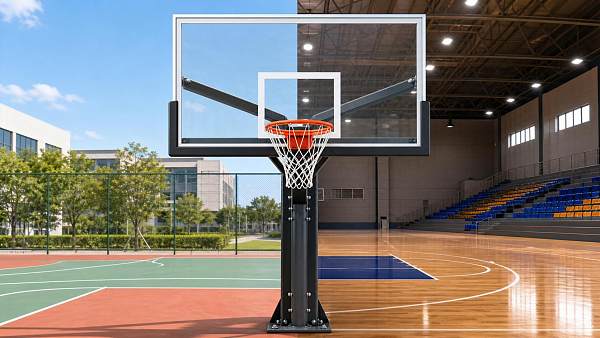
Tempered glass backboards offer strong rebound performance and a premium look. They suit campuses that treat sports spaces as part of the overall institutional image.
Yet acrylic can still be the better choice in some outdoor areas. It is lighter, easier to handle during installation, and often more forgiving where replacement access is limited.
The more important question is support stability. If the slab is thin, or if soil conditions vary, an in-ground system may need extra engineering review before it becomes the right answer.
Fixed systems generally outperform portable units outdoors. Movement, uneven settlement, and repeated impact all shorten service life when the frame is not properly anchored.
Where outdoor decisions often go wrong
- Selecting by backboard size alone, without checking post projection and safety clearance.
- Comparing only unit price, while ignoring coating quality and replacement frequency.
- Assuming every outdoor court needs the same rim stiffness, regardless of user behavior.
Indoor gyms call for more precise backboard and rim choices
Indoor sports halls usually reveal performance differences more clearly. Ball response, panel rigidity, and vibration control become more noticeable when lines are marked for regular drills or formal play.
In this setting, tempered glass is often the preferred backboard material. It delivers the rebound quality expected in higher-standard campus gyms and supports a cleaner visual presentation.
Rim choice matters just as much. Breakaway rims are usually the safer long-term option where dunking, repeated hanging loads, or heavier student use are realistic possibilities.
A fixed rim can still make sense in lower-impact environments. However, it should not be treated as the default simply because the purchase cost is lower.
Mounting design also changes the experience. Wall-mounted systems save floor space, but only when the building structure can support the load without excessive deflection.
Ceiling-suspended or retractable systems suit halls shared with assemblies or other sports. In actual campus planning, these systems work best when maintenance access has been considered from the start.
Multipurpose spaces need flexibility more than maximum specification
Not every campus basketball area is built for continuous basketball use. Some courts sit inside halls used for exams, performances, or community programs.
Here, the best basketball hoops for campuses are often the ones that disappear efficiently when needed. Fold-up and retractable systems protect floor flexibility and reduce visual obstruction.
This does not mean the lightest system is automatically best. Repeated opening and closing creates wear at hinges, lift points, and locking mechanisms.
The better judgment is to balance operating convenience with structural simplicity. If a hall changes layout every week, easy handling may save more operational cost than a more elaborate premium system.
On the other hand, if basketball remains the dominant use, a permanent system with stronger frame stability may be the more sensible long-term choice.
Backboard, rim, and mounting type should be matched together
A common mistake is to compare each component in isolation. In practice, basketball hoops for campuses perform as a system, not as separate parts.
A high-quality backboard can still feel unstable if the support frame vibrates. A strong rim can still create maintenance issues if the mounting bracket complicates service access.
The most useful matching logic is usually this:
- Choose the backboard by rebound expectation, appearance standards, and risk of impact damage.
- Choose the rim by user behavior, load tolerance, and replacement practicality.
- Choose the mounting type by structural limits, space use, and maintenance access.
This system view is especially relevant in commercial sourcing environments. GCT-style evaluation frameworks tend to favor solutions that hold up across specification, compliance, and service life together.
Practical fit guide for basketball hoops for campuses
Long-term value depends on what gets checked before installation
Many problems linked to basketball hoops for campuses start before the first game. They begin with incomplete site review, unclear usage assumptions, or weak coordination between structure and equipment selection.
It helps to confirm slab condition, setback distances, player circulation, drainage paths, and service access before finalizing any model. These checks often reveal whether a preferred configuration is actually practical.
Another overlooked factor is how campus use changes over time. An area planned for casual recreation can become a higher-frequency training court once enrollment patterns or programming priorities shift.
That is why lifecycle thinking matters. In educational and commercial facility planning, the best solution is often the one that remains serviceable, compliant, and visually acceptable after years of mixed use.
What to clarify before choosing basketball hoops for campuses
A useful next step is to organize the site by actual use conditions, not by product category alone. That makes decisions faster and reduces expensive late-stage changes.
- List each court by indoor, outdoor, or shared-use condition.
- Estimate user intensity, including informal high-impact play.
- Check whether premium rebound performance is necessary or simply desirable.
- Review structural and maintenance constraints before selecting the mounting system.
- Compare upfront price with repair, replacement, and downtime exposure.
When those conditions are clear, the right combination of backboard, rim, and support usually becomes obvious. That is the most reliable way to select basketball hoops for campuses that fit the site rather than merely fill the specification.
Search News
Hot Articles
- Fashion & Gem JewelryThermal Diamond Testers: How They Work and When They Can Misidentify StonesOct 07, 2026
- Commercial KitchenWhat Is Driving Demand for Commercial Hospitality Projects Across the GCC?Oct 06, 2026
- Hotel Room AmenitiesHow to Select Hotel Hair Dryers That Balance Guest Safety, Durability, and CostOct 05, 2026
Popular Tags
Need ExpertConsultation?
Connect with our specialized leisureengineering team for procurementstrategies.
Recommended News
 Sep 28, 2026How U.S. Schools Can Choose Laboratory Equipment for Safe, Compliant Science LabsSchool laboratory equipment USA: learn how to select safe, compliant lab furniture, ventilation, emergency systems, and durable tools for K–12 science labs.● Institutional Buyer
 Sep 16, 2026How to Source Educational Furniture Worldwide for Safe, Flexible Learning SpacesEducational furniture worldwide: learn how to source safe, flexible, durable learning-space solutions while controlling compliance, logistics, and lifecycle costs.● Institutional Buyer
 Aug 31, 2026How to Plan Smart Classroom Solutions That Improve Learning and IT ManageabilitySmart classroom solutions: learn how to plan secure, scalable teaching spaces that improve learning, simplify IT management, and reduce lifecycle costs.● Institutional Buyer
 Aug 01, 2026How to Specify an EN54 School PA System for Safe, Compliant Campus Voice EvacuationEN54 school PA system specification guide for safer, compliant campus voice evacuation. Learn zoning, intelligibility, monitoring, tender tips, and handover checks.● Institutional Buyer
 Jul 15, 2026Vietnam Tightens Import Rules for Smart Campus TechVietnam Tightens Import Rules for Smart Campus Tech: learn how MOIT’s 2026 data hosting and NEP connection rules may reshape import approval, sourcing timelines, and delivery planning.● Institutional Buyer
 Jul 14, 2026Thailand TISI Tightens Rules for Smart Campus TerminalsThailand TISI tightens rules for smart campus terminals, requiring Thai speech recognition and local biometric data storage. Learn the compliance impact, timeline risks, and what exporters must do now.● Institutional Buyer
 Jul 13, 2026Red Sea Rerouting Lifts Smart Campus Tech Shipping CostsRed Sea rerouting lifts Smart Campus Tech shipping costs, extends Asia-Europe booking lead times, and delays delivery. See what exporters, buyers, and logistics teams should do now.● Institutional Buyer
 Jul 12, 2026Event Technology for Live Venues: What Systems Matter Most for Seamless Operations?Event technology defines how live venues handle ticketing, AV, access, and monitoring. Discover which systems matter most for seamless operations, higher uptime, and better guest experiences.● Institutional Buyer
 Jul 11, 2026What Is a Campus Procurement Platform and How Does It Improve School Purchasing Workflows?Campus procurement platform explained: learn how it streamlines school purchasing workflows, improves approval control, boosts spend visibility, and reduces delays across campus buying.● Institutional Buyer
 Jul 10, 2026Vietnam Raises Smart Campus Tech Import Tariff to 12%Vietnam Raises Smart Campus Tech Import Tariff to 12%: explore how the new Vietnam smart campus tech tariff impacts pricing, sourcing, and local assembly strategies across Southeast Asia.● Institutional Buyer
 Jul 10, 2026Interactive Document Camera vs Webcam: Which Works Better for Smart Classrooms?Interactive document camera vs webcam: discover which delivers clearer content sharing, faster lesson flow, and better hybrid teaching performance for smart classrooms.● Institutional Buyer
 Jul 09, 2026RCEP Rule Adds Carbon Footprint Filings for Smart Campus Tech ExportsRCEP Rule reshapes Smart Campus Tech exports: learn how new carbon footprint filings for Singapore, Thailand, and Vietnam affect customs clearance, lead times, and compliance planning before October 1, 2026.● Institutional Buyer
 Jul 09, 2026Basketball Hoops for Campuses: Which Backboard, Rim, and Mounting Type Fits Your Site?Basketball hoops for campuses: compare backboard, rim, and mounting options by site needs. Learn how to choose safer, longer-lasting systems for outdoor courts, gyms, and multipurpose halls.● Institutional Buyer
 Jul 09, 2026Modular Educational Furniture: What to Check Before Planning Flexible ClassroomsModular educational furniture: learn what to check before planning flexible classrooms, from safety and durability to teaching fit, supplier quality, and long-term value.● Institutional Buyer
 Jul 08, 2026Shenzhen-Yokohama Port Delays Fall to 2.1 DaysShenzhen-Yokohama Port Delays fall to 2.1 days, cutting shipment cycles by 5–7 days for smart campus equipment. See how faster port efficiency can ease Q3 school delivery pressure.● Institutional Buyer
 Jul 07, 2026FBX Slide Pushes Smart Campus Freight Below $980/FEUFBX Slide Pushes Smart Campus Freight Below $980/FEU as Asia-Europe rates tumble. Discover what this means for smart campus shipments, booking risks, and cost-saving opportunities.● Institutional Buyer
 Jul 07, 2026Math Manipulatives Bulk Price Guide: Cost Drivers, Pack Sizes, and School Budget PlanningMath manipulatives bulk price explained: compare cost drivers, pack sizes, landed costs, and school budget planning tips to source smarter and avoid hidden expenses.● Institutional Buyer
 Jul 04, 2026RCEP Update Expands Indonesia Duty-Free Quota for Edu DevicesRCEP Update Expands Indonesia Duty-Free Quota for Edu Devices: learn how the new 80,000-unit quota reshapes export costs, compliance, and school procurement opportunities in Indonesia.● Institutional Buyer
 Jul 03, 2026Indonesia Enforces ID-SNI Labels on Smart Campus ImportsIndonesia Enforces ID-SNI Labels on Smart Campus Imports: learn how the new rule affects labeling, customs clearance, certification, and delivery readiness for compliant market entry.● Institutional Buyer
 Jul 03, 2026How to Choose Indoor School Sports Equipment for Age Groups, Space, and Safety NeedsIndoor school sports equipment buying guide for schools: learn how to match age groups, space limits, and safety standards to choose durable, efficient solutions.● Institutional Buyer
 Jul 02, 2026Chromebook Charging Stations for Schools: Cart vs Cabinet vs Wall-Mount OptionsChromebook charging stations for schools compared: cart, cabinet, and wall-mount options. Discover the best fit for security, space, mobility, and budget before you buy.● Institutional Buyer
 Jul 01, 2026Indonesia Opens RCEP Fast Track for Smart Campus IoTIndonesia opens an RCEP fast track for Smart Campus IoT, cutting Jakarta customs clearance to 12 hours for eligible HS 8517.62 devices. See who qualifies and how to prepare.● Institutional Buyer
 Jun 30, 2026Flexible Learning Spaces for K-12 and Higher Ed: Layout Ideas, Furniture, and Tech NeedsFlexible learning spaces for K-12 and higher ed: explore practical layout ideas, durable furniture, and smart tech strategies that improve teaching, flexibility, and long-term campus value.● Institutional Buyer
 Jun 30, 2026Campus Equipment Procurement Checklist: How to Compare Specs, Warranties, and Total CostCampus equipment procurement made practical: compare specs, warranty terms, supplier reliability, and total cost to avoid hidden expenses and make smarter campus buying decisions.● Institutional Buyer