Campus Equipment Procurement Checklist: How to Compare Specs, Warranties, and Total Cost
Campus Equipment Procurement Checklist: How to Compare Specs, Warranties, and Total Cost
Effective campus equipment procurement goes beyond comparing price tags.
The real work starts when technical fit, warranty terms, supplier reliability, and lifecycle cost are reviewed together.
That matters even more in modern educational environments.
A classroom display, lab device, cafeteria appliance, or campus printer can affect daily operations for years.
Poor campus equipment procurement decisions often create hidden costs long after delivery.
A practical checklist helps reduce that risk and supports better budget control.
Why Campus Equipment Procurement Needs a Broader Evaluation
Campus equipment procurement usually involves multiple departments, varied usage patterns, and tight approval timelines.
That mix makes simple price comparison unreliable.
For example, a lower-cost product may require more maintenance, consume more energy, or fail compliance checks.
A slightly higher initial quote may deliver lower operating cost and fewer service interruptions.
From a purchasing perspective, the goal is not only cost reduction.
The goal is dependable value across the full service life of the equipment.
Core factors to review before shortlisting suppliers
- Technical specifications and actual performance requirements
- Warranty scope, exclusions, and service response terms
- Compliance with safety, electrical, and institutional standards
- Installation needs, training time, and user adoption
- Energy use, spare parts availability, and maintenance frequency
- Supplier track record, lead time stability, and after-sales support
Step 1: Compare Specifications Against Real Campus Use
Specifications should always be reviewed in context.
In campus equipment procurement, a longer feature list does not automatically mean a better buying decision.
Start by mapping the equipment to the actual environment.
Is it for a lecture hall, science lab, student residence, kitchen, library, or administrative office?
Usage intensity changes the ideal specification baseline.
A product suitable for light office use may underperform in high-traffic campus settings.
Key spec questions
- What daily load, throughput, or occupancy level must the equipment handle?
- Which specifications are mandatory for safety, accessibility, or interoperability?
- Which features are useful, and which are likely to remain unused?
- Can the product integrate with existing campus systems or utilities?
- Does the specification support future expansion or technology upgrades?
This is where many campus equipment procurement projects lose value.
Teams either overbuy for prestige or underbuy for budget relief.
A balanced specification sheet should reflect operational need, not sales language.
Step 2: Read Warranty Terms Like a Cost Document
Warranty language is often treated as a legal formality.
In practice, it is one of the most important parts of campus equipment procurement.
A two-year warranty can be weaker than a one-year warranty with better service coverage.
Look beyond duration and focus on what is actually included.
Warranty checklist
- Parts only, or parts and labor
- On-site service, depot service, or return-to-base requirements
- Travel charges and technician dispatch fees
- Response times for urgent failures
- Exclusions for misuse, wear items, software, or third-party installation
- Availability of extended warranty or preventive maintenance plans
In actual operations, downtime matters almost as much as repair cost.
If a campus security device or classroom display fails, delayed service can disrupt schedules.
That is why warranty review should be part of total cost evaluation, not a separate checkbox.
Step 3: Calculate Total Cost, Not Just Purchase Price
The strongest campus equipment procurement decisions are built on total cost of ownership.
This includes every cost the institution will absorb during the equipment lifecycle.
Initial price is only one line in that model.
Typical total cost elements
- Unit price and freight
- Import duties, taxes, or customs handling where relevant
- Installation materials and commissioning
- Training for staff or end users
- Energy, water, or consumable usage
- Service visits, spare parts, and planned maintenance
- Software licensing or system updates
- Replacement cycle and disposal cost
A low-cost machine with expensive consumables can quickly become the more expensive option.
The same applies to equipment with poor energy efficiency or limited spare parts support.
For campus equipment procurement, lifecycle modeling often reveals the real financial winner.
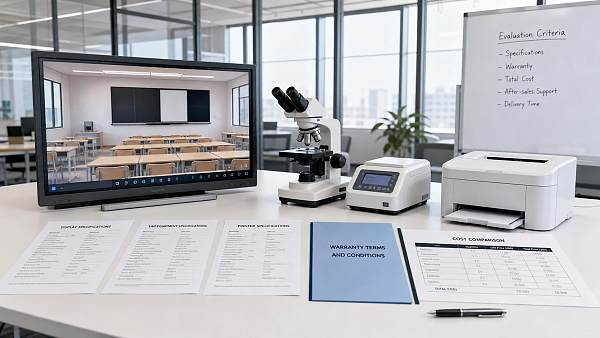
Simple comparison table
Step 4: Test Supplier Reliability Before Award
Reliable campus equipment procurement depends on reliable suppliers.
A technically strong product can still become a poor purchase if delivery or service fails.
Supplier review should combine commercial, operational, and compliance checks.
What to verify
- Recent project references in education, hospitality, or other complex institutional settings
- Certifications, test reports, and documented quality processes
- Production capacity and component sourcing resilience
- Availability of local agents, installers, or service partners
- Clarity of quotation, lead time, and change-order terms
- Willingness to support samples, demos, or pilot deployment
This is where sourcing intelligence becomes useful.
Verified market insight can help compare suppliers beyond catalog claims.
For larger projects, supplier due diligence should be documented before contract approval.
Step 5: Build a Campus Equipment Procurement Scorecard
A scorecard keeps campus equipment procurement decisions consistent and defensible.
It also makes internal review easier when stakeholders have different priorities.
One team may focus on budget, while another is concerned with maintenance or user experience.
A weighted model creates a shared decision framework.
Suggested scoring structure
- Technical compliance: 25%
- Warranty and service support: 20%
- Total cost of ownership: 25%
- Supplier reliability: 20%
- Sustainability or future readiness: 10%
The percentages can be adjusted by category.
For lab equipment, compliance may carry more weight.
For dining or residential equipment, service speed may deserve a stronger score.
The important point is to agree on the criteria before comparing bids.
Common Campus Equipment Procurement Mistakes to Avoid
Even experienced teams can fall into familiar traps.
Most campus equipment procurement problems start with incomplete evaluation.
- Choosing based on purchase price alone
- Accepting generic specifications without use-case validation
- Ignoring exclusions in warranty documents
- Underestimating installation and training requirements
- Failing to confirm spare parts availability
- Awarding suppliers without reference or compliance checks
These issues are preventable when review steps are built into the sourcing process.
That also improves transparency for finance, operations, and end-user departments.
Final Checklist for Better Buying Decisions
A strong campus equipment procurement process is structured, not rushed.
Before placing an order, confirm these points:
- Specifications match actual campus usage and infrastructure.
- Warranty terms are clear, practical, and costed into the comparison.
- Total lifecycle cost has been modeled over a realistic period.
- Supplier reliability has been verified with references and documents.
- A weighted scorecard supports the final recommendation.
That approach creates better outcomes than a quote-by-quote price comparison.
It reduces avoidable risk and helps institutions buy with more confidence.
When campus equipment procurement is treated as a long-term value decision, operational performance and cost control become much easier to achieve.
Search News
Hot Articles
- Restaurant FurnitureFast-Casual Restaurant Interiors: Design Choices That Improve Speed and Guest FlowOct 04, 2026
- Outdoor RidesHow to Select Leisure Park Equipment for Safe, High-Throughput Visitor AreasOct 03, 2026
- Fashion & Gem JewelryDiamond Tester Wholesale: How to Vet Accuracy, Calibration, and MOQ Before OrderingOct 02, 2026
Popular Tags
Need ExpertConsultation?
Connect with our specialized leisureengineering team for procurementstrategies.
Recommended News
 Sep 28, 2026How U.S. Schools Can Choose Laboratory Equipment for Safe, Compliant Science LabsSchool laboratory equipment USA: learn how to select safe, compliant lab furniture, ventilation, emergency systems, and durable tools for K–12 science labs.● Institutional Buyer
 Sep 16, 2026How to Source Educational Furniture Worldwide for Safe, Flexible Learning SpacesEducational furniture worldwide: learn how to source safe, flexible, durable learning-space solutions while controlling compliance, logistics, and lifecycle costs.● Institutional Buyer
 Aug 31, 2026How to Plan Smart Classroom Solutions That Improve Learning and IT ManageabilitySmart classroom solutions: learn how to plan secure, scalable teaching spaces that improve learning, simplify IT management, and reduce lifecycle costs.● Institutional Buyer
 Aug 01, 2026How to Specify an EN54 School PA System for Safe, Compliant Campus Voice EvacuationEN54 school PA system specification guide for safer, compliant campus voice evacuation. Learn zoning, intelligibility, monitoring, tender tips, and handover checks.● Institutional Buyer
 Jul 15, 2026Vietnam Tightens Import Rules for Smart Campus TechVietnam Tightens Import Rules for Smart Campus Tech: learn how MOIT’s 2026 data hosting and NEP connection rules may reshape import approval, sourcing timelines, and delivery planning.● Institutional Buyer
 Jul 14, 2026Thailand TISI Tightens Rules for Smart Campus TerminalsThailand TISI tightens rules for smart campus terminals, requiring Thai speech recognition and local biometric data storage. Learn the compliance impact, timeline risks, and what exporters must do now.● Institutional Buyer
 Jul 13, 2026Red Sea Rerouting Lifts Smart Campus Tech Shipping CostsRed Sea rerouting lifts Smart Campus Tech shipping costs, extends Asia-Europe booking lead times, and delays delivery. See what exporters, buyers, and logistics teams should do now.● Institutional Buyer
 Jul 12, 2026Event Technology for Live Venues: What Systems Matter Most for Seamless Operations?Event technology defines how live venues handle ticketing, AV, access, and monitoring. Discover which systems matter most for seamless operations, higher uptime, and better guest experiences.● Institutional Buyer
 Jul 11, 2026What Is a Campus Procurement Platform and How Does It Improve School Purchasing Workflows?Campus procurement platform explained: learn how it streamlines school purchasing workflows, improves approval control, boosts spend visibility, and reduces delays across campus buying.● Institutional Buyer
 Jul 10, 2026Vietnam Raises Smart Campus Tech Import Tariff to 12%Vietnam Raises Smart Campus Tech Import Tariff to 12%: explore how the new Vietnam smart campus tech tariff impacts pricing, sourcing, and local assembly strategies across Southeast Asia.● Institutional Buyer
 Jul 10, 2026Interactive Document Camera vs Webcam: Which Works Better for Smart Classrooms?Interactive document camera vs webcam: discover which delivers clearer content sharing, faster lesson flow, and better hybrid teaching performance for smart classrooms.● Institutional Buyer
 Jul 09, 2026RCEP Rule Adds Carbon Footprint Filings for Smart Campus Tech ExportsRCEP Rule reshapes Smart Campus Tech exports: learn how new carbon footprint filings for Singapore, Thailand, and Vietnam affect customs clearance, lead times, and compliance planning before October 1, 2026.● Institutional Buyer
 Jul 09, 2026Basketball Hoops for Campuses: Which Backboard, Rim, and Mounting Type Fits Your Site?Basketball hoops for campuses: compare backboard, rim, and mounting options by site needs. Learn how to choose safer, longer-lasting systems for outdoor courts, gyms, and multipurpose halls.● Institutional Buyer
 Jul 09, 2026Modular Educational Furniture: What to Check Before Planning Flexible ClassroomsModular educational furniture: learn what to check before planning flexible classrooms, from safety and durability to teaching fit, supplier quality, and long-term value.● Institutional Buyer
 Jul 08, 2026Shenzhen-Yokohama Port Delays Fall to 2.1 DaysShenzhen-Yokohama Port Delays fall to 2.1 days, cutting shipment cycles by 5–7 days for smart campus equipment. See how faster port efficiency can ease Q3 school delivery pressure.● Institutional Buyer
 Jul 07, 2026FBX Slide Pushes Smart Campus Freight Below $980/FEUFBX Slide Pushes Smart Campus Freight Below $980/FEU as Asia-Europe rates tumble. Discover what this means for smart campus shipments, booking risks, and cost-saving opportunities.● Institutional Buyer
 Jul 07, 2026Math Manipulatives Bulk Price Guide: Cost Drivers, Pack Sizes, and School Budget PlanningMath manipulatives bulk price explained: compare cost drivers, pack sizes, landed costs, and school budget planning tips to source smarter and avoid hidden expenses.● Institutional Buyer
 Jul 04, 2026RCEP Update Expands Indonesia Duty-Free Quota for Edu DevicesRCEP Update Expands Indonesia Duty-Free Quota for Edu Devices: learn how the new 80,000-unit quota reshapes export costs, compliance, and school procurement opportunities in Indonesia.● Institutional Buyer
 Jul 03, 2026Indonesia Enforces ID-SNI Labels on Smart Campus ImportsIndonesia Enforces ID-SNI Labels on Smart Campus Imports: learn how the new rule affects labeling, customs clearance, certification, and delivery readiness for compliant market entry.● Institutional Buyer
 Jul 03, 2026How to Choose Indoor School Sports Equipment for Age Groups, Space, and Safety NeedsIndoor school sports equipment buying guide for schools: learn how to match age groups, space limits, and safety standards to choose durable, efficient solutions.● Institutional Buyer
 Jul 02, 2026Chromebook Charging Stations for Schools: Cart vs Cabinet vs Wall-Mount OptionsChromebook charging stations for schools compared: cart, cabinet, and wall-mount options. Discover the best fit for security, space, mobility, and budget before you buy.● Institutional Buyer
 Jul 01, 2026Indonesia Opens RCEP Fast Track for Smart Campus IoTIndonesia opens an RCEP fast track for Smart Campus IoT, cutting Jakarta customs clearance to 12 hours for eligible HS 8517.62 devices. See who qualifies and how to prepare.● Institutional Buyer
 Jun 30, 2026Flexible Learning Spaces for K-12 and Higher Ed: Layout Ideas, Furniture, and Tech NeedsFlexible learning spaces for K-12 and higher ed: explore practical layout ideas, durable furniture, and smart tech strategies that improve teaching, flexibility, and long-term campus value.● Institutional Buyer
 Jun 30, 2026Campus Equipment Procurement Checklist: How to Compare Specs, Warranties, and Total CostCampus equipment procurement made practical: compare specs, warranty terms, supplier reliability, and total cost to avoid hidden expenses and make smarter campus buying decisions.● Institutional Buyer