How to Source Silicone Watch Bands Bulk: MOQ, Material Grades, and OEM Options
How to Source Silicone Watch Bands Bulk: MOQ, Material Grades, and OEM Options
Sourcing silicone watch bands bulk requires more than comparing prices.
A low quote can hide unstable material quality, poor color consistency, or weak delivery control.
For commercial buyers, the better approach is structured evaluation.
That means checking MOQ, silicone grade, tooling capability, compliance records, and OEM responsiveness together.
This guide explains how to compare suppliers, reduce sourcing risk, and choose silicone watch bands bulk with more confidence.
Start With the Real Buying Scenario
Before requesting quotations, define the actual end use.
Silicone watch bands bulk for fashion retail differs from replacement bands for electronics distributors.
The first case values color variety and branding.
The second often prioritizes fit tolerance, skin safety, and repeatability across production lots.
In practice, three questions shape the sourcing path:
- Is the order for stock resale, private label, or a device bundle?
- Will the band target premium, mid-market, or promotional positioning?
- Are there market-specific compliance requirements?
These answers affect supplier selection immediately.
They also determine whether standard silicone watch bands bulk will work, or whether OEM development is necessary.
How MOQ Changes the Supplier Shortlist
MOQ is usually the first negotiation point, but it should not be viewed in isolation.
For silicone watch bands bulk, MOQ often depends on mold status, color count, logo method, and packaging customization.
A supplier may offer a low MOQ on existing molds.
That same factory may require much larger volume for custom widths, proprietary connectors, or special finishes.
Typical MOQ Factors
- Existing mold with standard color
- Existing mold with custom Pantone color
- New mold development
- Printed or engraved logo
- Custom retail box, insert, or barcode labeling
From a cost perspective, the best MOQ is not always the smallest one.
Very low MOQ orders can increase unit cost, delay replenishment, and weaken color consistency between batches.
A more useful benchmark is MOQ efficiency.
That means asking how much flexibility the supplier gives per SKU, per color, and per size family.
Material Grades Matter More Than Many Quotes Suggest
When comparing silicone watch bands bulk, material grade is one of the biggest quality separators.
Yet many quotations simply state “silicone” without technical detail.
That is not enough for a reliable sourcing decision.
Common Material Options
- Standard silicone for price-sensitive programs
- Food-grade silicone for better safety positioning
- Medical-grade silicone for skin-contact sensitivity and premium applications
- LSR-based solutions for tighter molding consistency in some programs
The right grade depends on brand promise, user profile, and target market regulations.
For example, premium wearable accessories usually benefit from stronger odor control, softer touch, and cleaner surface finish.
That usually points toward better raw materials and stricter process control.
What to Request From the Supplier
- Material data sheet
- REACH and RoHS declarations
- Skin-contact or biocompatibility claims, if relevant
- Test reports for odor, tensile strength, and colorfastness
- Clarification on virgin versus mixed material usage
This is where many silicone watch bands bulk projects go off track.
The approved sample may use a better compound than the production lot.
To avoid that, lock the material specification into the purchase agreement and approved sample record.
Evaluate OEM Options Beyond Logo Printing
OEM for silicone watch bands bulk is often misunderstood.
Some suppliers call simple logo engraving “OEM.”
Others can support actual product development.
The difference matters for long-term competitiveness.
OEM Capability Should Cover
- Custom mold design
- Connector compatibility with target watch models
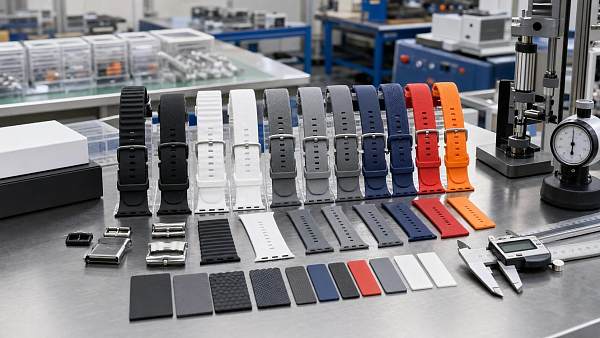
- Custom texture, finish, and hardness
- Dual-color or mixed-material construction
- Packaging, inserts, and retail compliance labeling
A serious OEM supplier should also discuss tolerances, mold life, revision control, and pilot run validation.
That conversation reveals whether they are a trader, a basic converter, or a manufacturing partner.
In recent buying cycles, the stronger signal has been speed of technical feedback.
When a factory can comment quickly on draft angles, connector fit, and silicone shrinkage, execution risk usually drops.
Quality Control Checks That Protect Bulk Orders
Large silicone watch bands bulk orders fail in predictable ways.
Common issues include flashing, uneven edges, unstable buckle fit, and visible color variation.
There can also be odor problems, surface stickiness, or dust attraction after packaging.
Key Inspection Points
- Dimensional fit with watch case and connector
- Hardness consistency across lots
- Tensile and tear performance around pinholes
- Color consistency against approved standard
- Logo clarity and abrasion resistance
- Buckle attachment security
For silicone watch bands bulk, pre-shipment inspection is useful, but it should not be the only control point.
A better system includes first article approval, pilot lot review, and in-line checks during mass production.
This also helps when the order contains multiple colors or mixed packaging formats.
Pricing Should Be Read as a Structure, Not a Number
A quotation for silicone watch bands bulk should be broken into parts.
Otherwise, hidden costs appear later through tooling fees, color charges, packaging extras, or rejected batches.
Read the Cost Stack Carefully
- Base unit price by volume tier
- Mold or tooling charge
- Color matching fee
- Logo application cost
- Packaging and labeling cost
- Testing or certification cost
It also helps to ask what happens if the reorder volume changes.
Some suppliers quote aggressively for the first order, then raise costs on replenishment because the project is already locked in.
A stable long-term partner should explain price logic for both trial and repeat silicone watch bands bulk orders.
A Practical Supplier Selection Framework
When several suppliers look similar, a simple scorecard makes decisions clearer.
Use weighted criteria instead of reacting to the lowest offer.
- Rate MOQ flexibility against forecast accuracy.
- Verify material grade with documents and samples.
- Test OEM responsiveness with a specific technical brief.
- Review quality controls and inspection records.
- Compare total landed cost, not only EXW price.
- Check lead time stability for repeat orders.
This framework makes silicone watch bands bulk sourcing more predictable.
It also creates a record for internal approval, especially when multiple departments influence the final decision.
Final Takeaway
Choosing silicone watch bands bulk is really about fit between product requirements and supplier capability.
MOQ tells you how flexible the program can be.
Material grades show whether the supplier can support quality and compliance goals.
OEM options reveal how far the partnership can grow beyond standard catalog products.
In actual business, the most dependable silicone watch bands bulk suppliers are rarely the ones with the shortest quote.
They are the ones who document materials clearly, manage production consistently, and respond well when specifications become more demanding.
Use that standard from the first inquiry onward, and the final order will be easier to defend, scale, and repeat.
Search News
Hot Articles
- Outdoor RidesHow to Select Leisure Park Equipment for Safe, High-Throughput Visitor AreasOct 03, 2026
- Fashion & Gem JewelryDiamond Tester Wholesale: How to Vet Accuracy, Calibration, and MOQ Before OrderingOct 02, 2026
- Hotel Room AmenitiesHow Hotels Can Choose Amenity Bottles That Balance Brand Image and Refill CostsOct 01, 2026
Popular Tags
Need ExpertConsultation?
Connect with our specialized leisureengineering team for procurementstrategies.
Recommended News
 Sep 08, 2026Water-Resistant Commercial Watches: Choosing Ratings for Workwear and Promotional UseWater resistant commercial watch guide: match 3, 5, or 10 ATM ratings to workwear and promotional needs, verify testing, and protect your budget and brand.● Luxury Retail Analyst
 Sep 07, 2026Commercial Watch Bulk Orders: How to Evaluate Pricing Tiers, Lead Times, and SamplesCommercial watch bulk order guide: evaluate pricing tiers, lead times, samples, landed costs, and supplier readiness to protect margins and launch on schedule.● Luxury Retail Analyst
 Sep 06, 2026Private Label Commercial Watches: A Buyer's Checklist for Branding, MOQ, and QCPrivate label commercial watch sourcing made simple: explore branding, MOQ, materials, supplier QC, and approval steps to build a reliable, market-ready watch program.● Luxury Retail Analyst
 Aug 16, 2026Where to Source Moissanite Iced Out Watches Wholesale Without Sacrificing QualityMoissanite iced out watches wholesale buyers: learn how to source factory-direct quality, verify stone setting and plating, and reduce risk before placing bulk orders.● Luxury Retail Analyst
 Aug 12, 2026How to Evaluate Luxury Watch Winders Wholesale for Retail and Gift Supply?Luxury watch winders wholesale buying guide: learn how to assess quality, noise, compatibility, OEM options, and supplier risk for retail, hospitality, and premium gift supply.● Luxury Retail Analyst
 Jul 15, 2026Kids Smart Watches for School: Key Features Parents Should Compare Before BuyingKids smart watches for school: compare school mode, safe calling, GPS accuracy, battery life, comfort, and privacy controls before you buy the best fit for your child.● Luxury Retail Analyst
 Jul 07, 2026Wholesale Mechanical Watches Stainless Steel: What to Check Before Placing a Bulk OrderWholesale mechanical watches stainless steel sourcing guide: learn how to verify movement quality, steel grade, compliance, and supplier reliability before placing a bulk order.● Luxury Retail Analyst
 Jul 05, 2026Nurse Watches Bulk Buying Guide: Styles, Compliance, and Order QuantitiesNurse watches bulk buying made simple: compare styles, compliance checks, MOQ strategy, and supplier reliability to reduce risk and place smarter orders.● Luxury Retail Analyst
 Jul 05, 2026Stainless Steel Watch Bands Clasp Guide: Types, Fit, and Common Locking IssuesStainless steel watch bands clasp guide covering clasp types, fit checks, and common locking issues. Learn how to compare options, avoid failures, and choose a secure, comfortable band with confidence.● Luxury Retail Analyst
 Jun 30, 2026SASO Arabic UI Rule Tightens Smartwatch ExportsSASO Arabic UI Rule Tightens Smartwatch Exports as Saudi Arabia mandates full Arabic support by Oct 1, 2026. Learn the compliance risks, testing impact, and export actions now.● Luxury Retail Analyst
 Jun 30, 2026How to Source Silicone Watch Bands Bulk: MOQ, Material Grades, and OEM OptionsSilicone watch bands bulk sourcing made simple: compare MOQ, material grades, quality control, and OEM options to reduce risk, choose reliable suppliers, and buy with confidence.● Luxury Retail Analyst
 Jun 29, 2026Saudi SASO Adds Arabic UI Check for SmartwatchesSaudi SASO Adds Arabic UI Check for Smartwatches: learn how the 2026 Arabic UI verification may affect OEM models, certification, imports, and retail listings in Saudi Arabia.● Luxury Retail Analyst
 Jun 17, 2026Automatic Watches OEM Explained: Movement Options, Case Materials, and CustomizationAutomatic watches OEM explained: compare movement options, case materials, and customization factors that shape quality, brand value, and supplier reliability.● Luxury Retail Analyst
 Jun 11, 2026REACH SVHC Update Hits Watch OEMs and SmartwatchesREACH SVHC update puts Watch OEM and smartwatch exports to the EU under new pressure. See how SCIP filing, supplier declarations, and material checks can protect shipments before the 2026 deadline.● Luxury Retail Analyst
 Jun 10, 2026REACH SVHC Update Adds New Watch Export Compliance DutiesREACH SVHC update puts Watch OEM and smartwatch exporters under new EU compliance pressure. Learn the new SCIP duties, 0.1% threshold risks, and what teams must do before December 2026.● Luxury Retail Analyst
 Jun 08, 2026Commercial Watch vs Retail Watch: Key Differences in OEM Specs, Pricing, and Use CasesCommercial watch vs retail watch: discover key OEM specs, pricing factors, and use cases to choose the right sourcing strategy, reduce risk, and improve brand fit.● Luxury Retail Analyst
 Jun 05, 2026Watch Hands and Crowns: Key Specs to Check for OEM Repair and AssemblyWatch hands and crowns for OEM repair and assembly: learn the key specs to verify for fit, sealing, durability, and repeatable quality before approval.● Luxury Retail Analyst
 Jun 02, 2026Sapphire Watch Glass vs Mineral Glass: Durability, Clarity, and Cost DifferencesSapphire watch glass vs mineral glass: compare scratch resistance, clarity, impact behavior, and cost to choose the right lens for premium or value-driven watches.● Luxury Retail Analyst
 May 23, 2026What should buyers check before sourcing iced out watches wholesale?Iced out watches wholesale buyers should check material honesty, stone setting, durability, and supplier compliance before ordering to reduce returns and protect profit.● Luxury Retail Analyst
 May 02, 2026Zheng Qinwen’s Madrid Exit Delays EU Orders for Smart Tennis WearablesSmart tennis wearables face EU procurement delays after Zheng Qinwen’s Madrid Open exit — key for manufacturers navigating WTA data privacy guidelines.● Luxury Retail Analyst
 Apr 30, 2026What separates a commercial watch from a fashion driven modelCommercial watch buying explained: discover how durability, precision, serviceability, and channel fit separate true commercial models from fashion-led watches for retail, gifting, and hospitality.● Luxury Retail Analyst
 Apr 30, 2026ODM watches or private label, which model fits betterODM watches or private label? Compare speed, customization, MOQ, and sourcing risk to choose the best watch model for your brand, launch timeline, and profit goals.● Luxury Retail Analyst
 Apr 24, 2026ODM Watches: Costs, MOQ, and Lead TimesODM watches guide: compare costs, MOQ, and lead times for sports and entertainment sourcing. Ideal for hospitality procurement, resort retail, and branded event merchandise buyers.● Luxury Retail Analyst
 Apr 24, 2026ODM Watches vs OEM: Which Fits Your Brand?ODM watches vs OEM: compare speed, cost, design control, MOQ, and brand value. A practical guide for hospitality procurement, retailers, and distributors.● Luxury Retail Analyst