Nurse Watches Bulk Buying Guide: Styles, Compliance, and Order Quantities
Why does nurse watches bulk buying need more than a simple price comparison?
Nurse watches bulk purchasing looks straightforward at first. In practice, it usually sits between medical utility, uniform presentation, and sourcing control.
That matters because bulk orders often serve hospitals, training centers, pharmacies, gift programs, and uniform distributors at the same time.
A low unit price can quickly lose value when clip strength fails, batteries drain early, or dial markings are hard to read.
The better starting point is to define the use case. Will the watches support daily clinical work, student issue kits, resale programs, or branded uniform packages?
Once that is clear, style, compliance, and order quantities become easier to judge. That is where nurse watches bulk decisions usually become more disciplined.
Across GCT-style sourcing analysis, the most reliable commercial decisions come from matching product detail to operating context, not from chasing the cheapest quotation.
Which styles work best when ordering nurse watches bulk?
Style is not only visual. For nurse watches bulk programs, it affects readability, hygiene handling, user acceptance, and return rates.
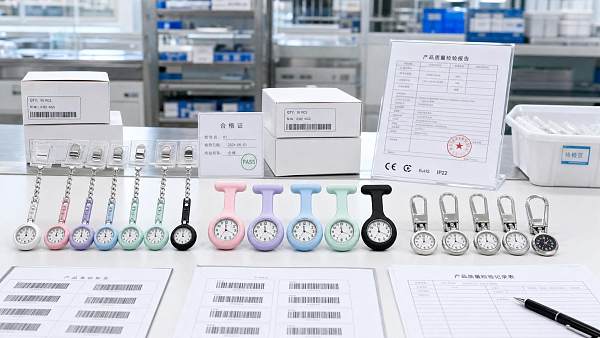
The most common categories are fob watches, silicone-covered fob watches, clip-on pendant styles, and branded fashion-forward uniform accessories.
For clinical environments, fob watches remain the safer default. They are designed to attach to clothing and reduce wristwear concerns in hygiene-sensitive settings.
Silicone-covered versions are often chosen when cleaning frequency is high. They also help when color coding matters across departments or training cohorts.
More decorative options can fit retail and promotional channels, but they should still preserve clear second markers and strong clip security.
When comparing styles, these points usually separate practical products from problematic ones:
- Large, high-contrast dial with visible second hand.
- Easy pin or clip fastening that resists loosening.
- Materials that tolerate routine wiping and light disinfectant exposure.
- Consistent color finish across production lots.
- Packaging suited to issue, resale, or promotional distribution.
A common mistake is overvaluing appearance in the sample stage. In bulk supply, durability and visual consistency matter more than showroom styling.
What compliance checks should be confirmed before placing a bulk order?
This is where many nurse watches bulk projects become risky. Watches may look similar, yet material declarations and labeling standards can differ significantly.
The required compliance level depends on the destination market and sales channel. A hospital issue program may have different documentation needs than retail distribution.
In practical sourcing, four checks usually come first: battery compliance, material safety, labeling accuracy, and product testing records.
Needle alignment, timekeeping tolerance, and finish adhesion should also be reviewed. These are small details, but they often create the largest complaint volume.
In cross-border trade, it is wise to ask whether the supplier has already shipped similar nurse watches bulk orders into your target region.
That shipping history does not replace documentation. It does, however, indicate whether the factory understands recurring compliance routines.
How many units should you order, and when does MOQ become expensive?
Order quantity is rarely just a negotiation issue. It shapes tooling cost recovery, packaging efficiency, inspection cost, and inventory exposure.
For standard nurse watches bulk orders, lower MOQs may be possible when using existing molds, standard colors, and plain packaging.
The cost picture changes when custom logos, special dial printing, color-matched silicone, or retail-ready gift boxes are added.
A practical way to estimate the right quantity is to separate demand into three layers: confirmed use, buffer stock, and display or replacement reserve.
- Confirmed use covers contracted distribution or planned internal issue volume.
- Buffer stock protects against defects, losses, and timing delays.
- Reserve stock supports onboarding waves, promotional needs, or late-stage replenishment.
More often than not, the cheapest quoted tier is not the best commercial choice. Over-ordering basic watches can lock capital into slow-moving stock.
For many programs, a staged nurse watches bulk strategy works better. Start with a pilot lot, confirm field acceptance, then release the repeat order.
That approach is especially useful when the watches will be co-branded, sold across several countries, or bundled with uniforms and accessories.
How can you compare suppliers without getting distracted by sample quality?
A good sample is useful, but it can hide weak bulk execution. Nurse watches bulk sourcing should focus on repeatability, not only presentation.
The stronger comparison method is to look at process evidence. Ask how the supplier controls dial printing, assembly consistency, battery insertion, and final inspection.
Lead time should also be broken down. A quoted delivery date means little unless tooling, pre-production approval, inspection, and shipping windows are visible.
This short checklist usually reveals the difference between a trader, an assembler, and a factory with mature control:
- Can they provide pre-production samples matching final packaging?
- Do they document AQL or equivalent inspection standards?
- Can they maintain the same components for repeat nurse watches bulk orders?
- Do they understand destination labeling, carton marking, and barcode rules?
- Is there a clear policy for dead-on-arrival units or early battery failure?
Within GCT-aligned sourcing practice, supplier credibility improves when commercial claims are supported by traceable documents and repeat project evidence.
That standard matters across healthcare-adjacent goods, office supplies, and specialty retail accessories where reliability influences both brand trust and operating continuity.
What problems show up after delivery, and how can they be prevented?
The most common post-delivery issues are not dramatic. They are small, repetitive faults that create admin work and unnecessary replacement cost.
Typical examples include weak clips, scratched lenses, inconsistent color batches, short battery life, and retail packaging damage during transit.
Many of these problems can be reduced before production starts. The key is to turn assumptions into written approval points.
It helps to define a simple acceptance standard covering function, appearance, packaging, and labeling. That document should be confirmed before mass production.
Where nurse watches bulk orders are tied to launch dates, keep extra attention on packaging compression tests and outer carton design.
If the project spans multiple locations, request carton-level batch identification. It makes replacement handling much faster when a defect appears later.
Another overlooked issue is shelf time. Watches stored too long before distribution may arrive with reduced battery life, even if factory QC was acceptable.
So what does a sound nurse watches bulk decision actually look like?
A sound decision usually combines a realistic style brief, confirmed compliance records, and an order quantity that matches actual rollout timing.
That means choosing products people can use easily, not simply products that photograph well in the sample round.
It also means checking whether the supplier can repeat the result over time. Bulk buying only works when the second order behaves like the first.
Before final approval, consolidate five points in one review sheet: style, compliance, MOQ logic, delivery plan, and failure-response terms.
That single step often prevents the scattered decisions that make nurse watches bulk orders harder to manage later.
The next move is practical: map the target application, request supporting documents, compare total landed cost, and validate one pilot batch before scaling.
Search News
Hot Articles
- Restaurant FurnitureFast-Casual Restaurant Interiors: Design Choices That Improve Speed and Guest FlowOct 04, 2026
- Outdoor RidesHow to Select Leisure Park Equipment for Safe, High-Throughput Visitor AreasOct 03, 2026
- Fashion & Gem JewelryDiamond Tester Wholesale: How to Vet Accuracy, Calibration, and MOQ Before OrderingOct 02, 2026
Popular Tags
Need ExpertConsultation?
Connect with our specialized leisureengineering team for procurementstrategies.
Recommended News
 Sep 08, 2026Water-Resistant Commercial Watches: Choosing Ratings for Workwear and Promotional UseWater resistant commercial watch guide: match 3, 5, or 10 ATM ratings to workwear and promotional needs, verify testing, and protect your budget and brand.● Luxury Retail Analyst
 Sep 07, 2026Commercial Watch Bulk Orders: How to Evaluate Pricing Tiers, Lead Times, and SamplesCommercial watch bulk order guide: evaluate pricing tiers, lead times, samples, landed costs, and supplier readiness to protect margins and launch on schedule.● Luxury Retail Analyst
 Sep 06, 2026Private Label Commercial Watches: A Buyer's Checklist for Branding, MOQ, and QCPrivate label commercial watch sourcing made simple: explore branding, MOQ, materials, supplier QC, and approval steps to build a reliable, market-ready watch program.● Luxury Retail Analyst
 Aug 16, 2026Where to Source Moissanite Iced Out Watches Wholesale Without Sacrificing QualityMoissanite iced out watches wholesale buyers: learn how to source factory-direct quality, verify stone setting and plating, and reduce risk before placing bulk orders.● Luxury Retail Analyst
 Aug 12, 2026How to Evaluate Luxury Watch Winders Wholesale for Retail and Gift Supply?Luxury watch winders wholesale buying guide: learn how to assess quality, noise, compatibility, OEM options, and supplier risk for retail, hospitality, and premium gift supply.● Luxury Retail Analyst
 Jul 15, 2026Kids Smart Watches for School: Key Features Parents Should Compare Before BuyingKids smart watches for school: compare school mode, safe calling, GPS accuracy, battery life, comfort, and privacy controls before you buy the best fit for your child.● Luxury Retail Analyst
 Jul 07, 2026Wholesale Mechanical Watches Stainless Steel: What to Check Before Placing a Bulk OrderWholesale mechanical watches stainless steel sourcing guide: learn how to verify movement quality, steel grade, compliance, and supplier reliability before placing a bulk order.● Luxury Retail Analyst
 Jul 05, 2026Nurse Watches Bulk Buying Guide: Styles, Compliance, and Order QuantitiesNurse watches bulk buying made simple: compare styles, compliance checks, MOQ strategy, and supplier reliability to reduce risk and place smarter orders.● Luxury Retail Analyst
 Jul 05, 2026Stainless Steel Watch Bands Clasp Guide: Types, Fit, and Common Locking IssuesStainless steel watch bands clasp guide covering clasp types, fit checks, and common locking issues. Learn how to compare options, avoid failures, and choose a secure, comfortable band with confidence.● Luxury Retail Analyst
 Jun 30, 2026SASO Arabic UI Rule Tightens Smartwatch ExportsSASO Arabic UI Rule Tightens Smartwatch Exports as Saudi Arabia mandates full Arabic support by Oct 1, 2026. Learn the compliance risks, testing impact, and export actions now.● Luxury Retail Analyst
 Jun 30, 2026How to Source Silicone Watch Bands Bulk: MOQ, Material Grades, and OEM OptionsSilicone watch bands bulk sourcing made simple: compare MOQ, material grades, quality control, and OEM options to reduce risk, choose reliable suppliers, and buy with confidence.● Luxury Retail Analyst
 Jun 29, 2026Saudi SASO Adds Arabic UI Check for SmartwatchesSaudi SASO Adds Arabic UI Check for Smartwatches: learn how the 2026 Arabic UI verification may affect OEM models, certification, imports, and retail listings in Saudi Arabia.● Luxury Retail Analyst
 Jun 17, 2026Automatic Watches OEM Explained: Movement Options, Case Materials, and CustomizationAutomatic watches OEM explained: compare movement options, case materials, and customization factors that shape quality, brand value, and supplier reliability.● Luxury Retail Analyst
 Jun 11, 2026REACH SVHC Update Hits Watch OEMs and SmartwatchesREACH SVHC update puts Watch OEM and smartwatch exports to the EU under new pressure. See how SCIP filing, supplier declarations, and material checks can protect shipments before the 2026 deadline.● Luxury Retail Analyst
 Jun 10, 2026REACH SVHC Update Adds New Watch Export Compliance DutiesREACH SVHC update puts Watch OEM and smartwatch exporters under new EU compliance pressure. Learn the new SCIP duties, 0.1% threshold risks, and what teams must do before December 2026.● Luxury Retail Analyst
 Jun 08, 2026Commercial Watch vs Retail Watch: Key Differences in OEM Specs, Pricing, and Use CasesCommercial watch vs retail watch: discover key OEM specs, pricing factors, and use cases to choose the right sourcing strategy, reduce risk, and improve brand fit.● Luxury Retail Analyst
 Jun 05, 2026Watch Hands and Crowns: Key Specs to Check for OEM Repair and AssemblyWatch hands and crowns for OEM repair and assembly: learn the key specs to verify for fit, sealing, durability, and repeatable quality before approval.● Luxury Retail Analyst
 Jun 02, 2026Sapphire Watch Glass vs Mineral Glass: Durability, Clarity, and Cost DifferencesSapphire watch glass vs mineral glass: compare scratch resistance, clarity, impact behavior, and cost to choose the right lens for premium or value-driven watches.● Luxury Retail Analyst
 May 23, 2026What should buyers check before sourcing iced out watches wholesale?Iced out watches wholesale buyers should check material honesty, stone setting, durability, and supplier compliance before ordering to reduce returns and protect profit.● Luxury Retail Analyst
 May 02, 2026Zheng Qinwen’s Madrid Exit Delays EU Orders for Smart Tennis WearablesSmart tennis wearables face EU procurement delays after Zheng Qinwen’s Madrid Open exit — key for manufacturers navigating WTA data privacy guidelines.● Luxury Retail Analyst
 Apr 30, 2026What separates a commercial watch from a fashion driven modelCommercial watch buying explained: discover how durability, precision, serviceability, and channel fit separate true commercial models from fashion-led watches for retail, gifting, and hospitality.● Luxury Retail Analyst
 Apr 30, 2026ODM watches or private label, which model fits betterODM watches or private label? Compare speed, customization, MOQ, and sourcing risk to choose the best watch model for your brand, launch timeline, and profit goals.● Luxury Retail Analyst
 Apr 24, 2026ODM Watches: Costs, MOQ, and Lead TimesODM watches guide: compare costs, MOQ, and lead times for sports and entertainment sourcing. Ideal for hospitality procurement, resort retail, and branded event merchandise buyers.● Luxury Retail Analyst
 Apr 24, 2026ODM Watches vs OEM: Which Fits Your Brand?ODM watches vs OEM: compare speed, cost, design control, MOQ, and brand value. A practical guide for hospitality procurement, retailers, and distributors.● Luxury Retail Analyst