Stainless Steel Watch Bands Clasp Guide: Types, Fit, and Common Locking Issues
Stainless Steel Watch Bands Clasp Guide: Types, Fit, and Common Locking Issues
Choosing the right stainless steel watch bands clasp affects security, comfort, and long-term wear performance.
That becomes more important during product evaluation, supplier comparison, and sourcing decisions.
A clasp is a small component, but it controls daily usability, perceived quality, and failure risk.
In practical terms, a weak clasp can undermine an otherwise well-made metal bracelet.
This guide explains stainless steel watch bands clasp options, fit checkpoints, and the locking issues that matter before approval or procurement.
Why the clasp matters in technical evaluation
When buyers assess watch bands, bracelet finish often gets attention first.
However, the stainless steel watch bands clasp usually determines real-world retention and user confidence.
The clasp also influences cycle life, serviceability, assembly consistency, and return rates.
For commercial sourcing, these factors directly affect complaint handling and brand reputation.
A reliable clasp should close with predictable force, resist accidental opening, and maintain alignment after repeated use.
It should also match the bracelet’s weight, thickness, and intended wearing conditions.
That is why stainless steel watch bands clasp evaluation should never be treated as a cosmetic detail.
Main stainless steel watch bands clasp types
Not all clasp mechanisms solve the same problem.
Some prioritize slim appearance, while others focus on stronger locking security.
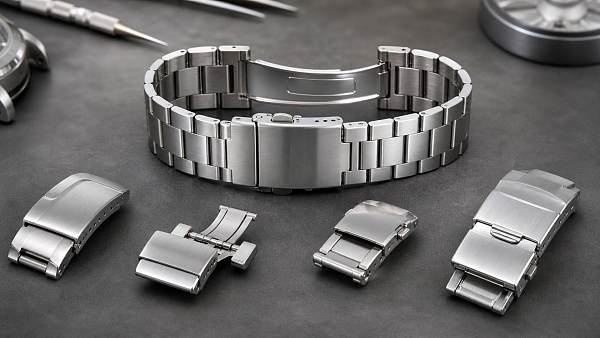
Folding clasp
A folding clasp uses one or two hinged sections that collapse inward.
It is common in mid-range and premium bracelets because it balances profile, comfort, and cost.
For evaluation, check hinge smoothness, stamped edge quality, and closure consistency.
Deployant clasp
The deployant clasp opens wider and supports easier wear without fully detaching the band.
This format reduces drop risk during fastening.
A stainless steel watch bands clasp in deployant form often appears in higher-value products and dress models.
Butterfly clasp
Butterfly clasps fold symmetrically from both sides and hide neatly under the wrist.
They offer a clean look, but tolerances are less forgiving.
Even small misalignment can create uneven closing force or premature wear.
Flip-lock or safety lock clasp
This design adds a secondary locking cover over the main closure.
It is widely used in sport watches, dive styles, and heavier bracelets.
Where shock, motion, or moisture exposure is expected, this stainless steel watch bands clasp design usually gives better retention.
Push-button clasp
Push-button systems use side buttons to release a spring-loaded lock.
They feel refined and controlled, but spring quality becomes critical.
Poor spring material or weak assembly can quickly reduce performance.
Fit and tolerance checks before approval
A clasp can look acceptable in static inspection but fail during repeated use.
That is why fit evaluation should cover both dimensions and behavior.
Bracelet-to-clasp compatibility
Start by confirming end width, link thickness, and pin or screw interface compatibility.
A stainless steel watch bands clasp must match the band geometry, not just the nominal width.
Small mismatches create side play, friction points, and uneven loading.
Closing force and tactile response
The closure should provide a clear click or defined locking response.
Too loose means accidental opening risk.
Too tight means difficult operation, user discomfort, and early wear on hooks or spring elements.
Wrist fit range and micro-adjustment
Micro-adjustment holes or sliding systems improve real wear performance.
This matters when the bracelet is used across different climates or long wearing periods.
A stainless steel watch bands clasp with no adjustment may look clean, but it reduces fit flexibility.
Edge finishing and skin contact
Sharp edges, burrs, or uneven brushing create comfort complaints quickly.
On metal bracelets, comfort is often judged by the underside of the clasp.
This is a practical quality signal during supplier evaluation.
Common locking issues and what causes them
Most field complaints around a stainless steel watch bands clasp fall into a few repeat patterns.
Knowing the root cause helps separate design weakness from process inconsistency.
- Unexpected opening: usually linked to weak hook engagement, worn springs, or poor secondary lock retention.
- Difficult closing: often caused by distorted clasp blades, tolerance stack-up, or hinge resistance.
- Button sticking: common in push-button systems with debris, weak machining, or spring misalignment.
- Side-to-side wobble: usually indicates loose pivot points or inconsistent assembly dimensions.
- Progressive loss of snap feel: often a sign of metal fatigue, wear at the catch point, or poor hardness control.
In many cases, locking problems are not visible in a single opening cycle.
They appear after repeated wear, transport vibration, or small impacts.
That is why cycle testing matters when comparing stainless steel watch bands clasp suppliers.
Material and manufacturing considerations
The clasp mechanism depends on both design and material control.
304 and 316L stainless steel are common choices, but processing quality makes the bigger difference.
Stamped clasps can be cost-effective and durable when tooling is stable.
Milled clasps usually deliver tighter consistency, stronger feel, and better finishing potential.
Heat treatment, spring material selection, deburring quality, and surface coating also affect service life.
When a stainless steel watch bands clasp includes plated finishes, coating adhesion around moving joints deserves extra review.
Practical sourcing checklist for clasp selection
A short checklist can make supplier discussions much more efficient.
- Confirm clasp type against product positioning, wear scenario, and bracelet weight.
- Request dimensional tolerances for clasp body, hinge, lock point, and adjustment holes.
- Review opening and closing cycle test data, not just visual samples.
- Check whether the stainless steel watch bands clasp uses stamped or milled construction.
- Inspect edge smoothness, underside comfort, and consistency across multiple samples.
- Verify secondary lock performance for sport or heavy-use applications.
- Ask for failure analysis records or return-rate data from similar past projects.
How to decide between clasp options
There is no universal best clasp.
The better choice depends on product category, target price, and expected daily stress.
For slim formal watches, butterfly or deployant designs can support a cleaner visual profile.
For active wear, a stainless steel watch bands clasp with a safety lock is usually the stronger option.
For premium sourcing, milled push-button systems often create better perceived value.
Still, perceived value only holds if cycle reliability and fit precision are proven.
Final take
A stainless steel watch bands clasp should be evaluated as a functional system, not an accessory detail.
The best results come from checking mechanism type, fit tolerance, locking behavior, and long-cycle durability together.
In actual sourcing work, the most expensive failures usually begin with small overlooked components.
Use sample testing, structured comparison, and supplier process review to make the clasp decision with confidence.
Search News
Hot Articles
- Restaurant FurnitureFast-Casual Restaurant Interiors: Design Choices That Improve Speed and Guest FlowOct 04, 2026
- Outdoor RidesHow to Select Leisure Park Equipment for Safe, High-Throughput Visitor AreasOct 03, 2026
- Fashion & Gem JewelryDiamond Tester Wholesale: How to Vet Accuracy, Calibration, and MOQ Before OrderingOct 02, 2026
Popular Tags
Need ExpertConsultation?
Connect with our specialized leisureengineering team for procurementstrategies.
Recommended News
 Sep 08, 2026Water-Resistant Commercial Watches: Choosing Ratings for Workwear and Promotional UseWater resistant commercial watch guide: match 3, 5, or 10 ATM ratings to workwear and promotional needs, verify testing, and protect your budget and brand.● Luxury Retail Analyst
 Sep 07, 2026Commercial Watch Bulk Orders: How to Evaluate Pricing Tiers, Lead Times, and SamplesCommercial watch bulk order guide: evaluate pricing tiers, lead times, samples, landed costs, and supplier readiness to protect margins and launch on schedule.● Luxury Retail Analyst
 Sep 06, 2026Private Label Commercial Watches: A Buyer's Checklist for Branding, MOQ, and QCPrivate label commercial watch sourcing made simple: explore branding, MOQ, materials, supplier QC, and approval steps to build a reliable, market-ready watch program.● Luxury Retail Analyst
 Aug 16, 2026Where to Source Moissanite Iced Out Watches Wholesale Without Sacrificing QualityMoissanite iced out watches wholesale buyers: learn how to source factory-direct quality, verify stone setting and plating, and reduce risk before placing bulk orders.● Luxury Retail Analyst
 Aug 12, 2026How to Evaluate Luxury Watch Winders Wholesale for Retail and Gift Supply?Luxury watch winders wholesale buying guide: learn how to assess quality, noise, compatibility, OEM options, and supplier risk for retail, hospitality, and premium gift supply.● Luxury Retail Analyst
 Jul 15, 2026Kids Smart Watches for School: Key Features Parents Should Compare Before BuyingKids smart watches for school: compare school mode, safe calling, GPS accuracy, battery life, comfort, and privacy controls before you buy the best fit for your child.● Luxury Retail Analyst
 Jul 07, 2026Wholesale Mechanical Watches Stainless Steel: What to Check Before Placing a Bulk OrderWholesale mechanical watches stainless steel sourcing guide: learn how to verify movement quality, steel grade, compliance, and supplier reliability before placing a bulk order.● Luxury Retail Analyst
 Jul 05, 2026Nurse Watches Bulk Buying Guide: Styles, Compliance, and Order QuantitiesNurse watches bulk buying made simple: compare styles, compliance checks, MOQ strategy, and supplier reliability to reduce risk and place smarter orders.● Luxury Retail Analyst
 Jul 05, 2026Stainless Steel Watch Bands Clasp Guide: Types, Fit, and Common Locking IssuesStainless steel watch bands clasp guide covering clasp types, fit checks, and common locking issues. Learn how to compare options, avoid failures, and choose a secure, comfortable band with confidence.● Luxury Retail Analyst
 Jun 30, 2026SASO Arabic UI Rule Tightens Smartwatch ExportsSASO Arabic UI Rule Tightens Smartwatch Exports as Saudi Arabia mandates full Arabic support by Oct 1, 2026. Learn the compliance risks, testing impact, and export actions now.● Luxury Retail Analyst
 Jun 30, 2026How to Source Silicone Watch Bands Bulk: MOQ, Material Grades, and OEM OptionsSilicone watch bands bulk sourcing made simple: compare MOQ, material grades, quality control, and OEM options to reduce risk, choose reliable suppliers, and buy with confidence.● Luxury Retail Analyst
 Jun 29, 2026Saudi SASO Adds Arabic UI Check for SmartwatchesSaudi SASO Adds Arabic UI Check for Smartwatches: learn how the 2026 Arabic UI verification may affect OEM models, certification, imports, and retail listings in Saudi Arabia.● Luxury Retail Analyst
 Jun 17, 2026Automatic Watches OEM Explained: Movement Options, Case Materials, and CustomizationAutomatic watches OEM explained: compare movement options, case materials, and customization factors that shape quality, brand value, and supplier reliability.● Luxury Retail Analyst
 Jun 11, 2026REACH SVHC Update Hits Watch OEMs and SmartwatchesREACH SVHC update puts Watch OEM and smartwatch exports to the EU under new pressure. See how SCIP filing, supplier declarations, and material checks can protect shipments before the 2026 deadline.● Luxury Retail Analyst
 Jun 10, 2026REACH SVHC Update Adds New Watch Export Compliance DutiesREACH SVHC update puts Watch OEM and smartwatch exporters under new EU compliance pressure. Learn the new SCIP duties, 0.1% threshold risks, and what teams must do before December 2026.● Luxury Retail Analyst
 Jun 08, 2026Commercial Watch vs Retail Watch: Key Differences in OEM Specs, Pricing, and Use CasesCommercial watch vs retail watch: discover key OEM specs, pricing factors, and use cases to choose the right sourcing strategy, reduce risk, and improve brand fit.● Luxury Retail Analyst
 Jun 05, 2026Watch Hands and Crowns: Key Specs to Check for OEM Repair and AssemblyWatch hands and crowns for OEM repair and assembly: learn the key specs to verify for fit, sealing, durability, and repeatable quality before approval.● Luxury Retail Analyst
 Jun 02, 2026Sapphire Watch Glass vs Mineral Glass: Durability, Clarity, and Cost DifferencesSapphire watch glass vs mineral glass: compare scratch resistance, clarity, impact behavior, and cost to choose the right lens for premium or value-driven watches.● Luxury Retail Analyst
 May 23, 2026What should buyers check before sourcing iced out watches wholesale?Iced out watches wholesale buyers should check material honesty, stone setting, durability, and supplier compliance before ordering to reduce returns and protect profit.● Luxury Retail Analyst
 May 02, 2026Zheng Qinwen’s Madrid Exit Delays EU Orders for Smart Tennis WearablesSmart tennis wearables face EU procurement delays after Zheng Qinwen’s Madrid Open exit — key for manufacturers navigating WTA data privacy guidelines.● Luxury Retail Analyst
 Apr 30, 2026What separates a commercial watch from a fashion driven modelCommercial watch buying explained: discover how durability, precision, serviceability, and channel fit separate true commercial models from fashion-led watches for retail, gifting, and hospitality.● Luxury Retail Analyst
 Apr 30, 2026ODM watches or private label, which model fits betterODM watches or private label? Compare speed, customization, MOQ, and sourcing risk to choose the best watch model for your brand, launch timeline, and profit goals.● Luxury Retail Analyst
 Apr 24, 2026ODM Watches: Costs, MOQ, and Lead TimesODM watches guide: compare costs, MOQ, and lead times for sports and entertainment sourcing. Ideal for hospitality procurement, resort retail, and branded event merchandise buyers.● Luxury Retail Analyst
 Apr 24, 2026ODM Watches vs OEM: Which Fits Your Brand?ODM watches vs OEM: compare speed, cost, design control, MOQ, and brand value. A practical guide for hospitality procurement, retailers, and distributors.● Luxury Retail Analyst