How to Choose Flake Ice Makers for Seafood Displays, Bars, and Food Prep?
Choosing the right flake ice makers can directly affect product freshness, visual appeal, and workflow efficiency in seafood displays, bars, and food prep operations. For procurement professionals, the best decision goes beyond ice output alone—it also involves hygiene standards, storage capacity, energy use, and long-term reliability. This guide outlines the key factors to compare so you can source equipment that supports both operational performance and customer experience.
In practice, flake ice equipment is often mis-specified because buyers focus on headline production capacity and overlook how the machine will actually be used during service. A seafood counter that needs continuous product coverage over a full retail day has very different demands from a cocktail bar topping up wells during evening peaks, or a central kitchen using ice for short, high-volume prep windows. The procurement task is not to buy “more ice,” but to buy the right production pattern, the right form factor, and the right level of reliability for the operating model.
Why flake ice is chosen in these applications
Flake ice is valued because it spreads easily, covers surfaces evenly, and cools products quickly. In seafood merchandising, that matters for both food safety and presentation: fish, shellfish, and fillets sit attractively while remaining surrounded by cold, moldable ice. In prep areas, the same characteristics make it easier to chill ingredients, hold temperature-sensitive items, or pack products temporarily during processing. In bars, flake-style ice may support bottle display, self-service cold presentations, or certain beverage applications, although the exact preferred ice form can vary by concept.
That said, procurement should avoid assuming flake ice is automatically the best option for every cold display need. Cube, nugget, or granular ice may be better in some beverage-led operations. The selection decision should begin with application fit, not with supplier catalog categories.
Start with usage profile, not machine size
A common sourcing mistake is to ask only one question: “How many kilograms per day does the unit produce?” Daily output matters, but it is only one part of the picture.
For a realistic specification, buyers should map four operating variables:
- Peak demand window: Is ice needed steadily across 10–12 hours, or in short bursts?
- Display loss rate: How quickly does ice melt under lighting, ambient heat, door opening, or customer interaction?
- Reload frequency: Can staff replenish often, or must the display hold its condition with minimal intervention?
- Seasonal load: Will summer demand, holiday traffic, or seafood promotion periods materially increase consumption?
A fish counter in a supermarket or premium food hall may need stable, continuous replenishment because melt loss is constant and visual standards are high. By contrast, a back-of-house prep station may use a large volume in a short period, then little for several hours. A bar may consume relatively little total ice for display, but require fast recovery before service begins.
This is why two sites with the same nominal daily usage can require very different machines. One may need a larger bin and lower stress on recovery speed. Another may need stronger hourly production and less storage.
Separate machine production capacity from usable ice availability
Vendor quotations often present production figures under standard test conditions, typically linked to specific ambient and water temperatures. Real-world production can fall when kitchens run hot, ventilation is poor, or inlet water is warmer than expected. Procurement teams should treat nameplate output as a reference point, not a guaranteed field result.
The more useful questions are:
- At what ambient and water temperatures was the rated output measured?
- What is the expected output under the site’s likely operating conditions?
- How much storage is integrated or required externally?
- How quickly can the unit recover after heavy drawdown?
For seafood displays, storage bin sizing can be as important as production. If ice must be loaded before trading starts, a machine with adequate overnight production and a properly sized bin may outperform a higher-output unit with limited storage. In bars and prep areas, recovery rate may matter more than bulk reserve.
Match the machine type to the installation environment
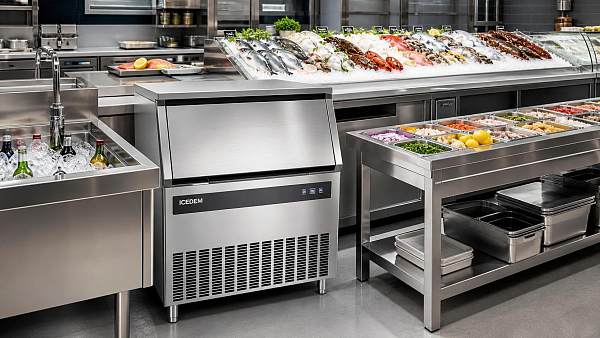
Flake ice makers are not a single-format product class. Buyers will encounter undercounter units, modular head units paired with bins, and larger industrial-style systems for centralized production. The right format depends on space, workflow, and maintenance access.
Undercounter models suit smaller bars, compact prep stations, and limited-volume service points. Their advantage is footprint efficiency, but bin size and service access can be limiting.
Modular systems are common in hospitality and retail because they provide flexibility in production capacity and storage pairing. They are often better for seafood counters or larger foodservice operations where duty cycle and refill consistency matter.
Remote or centralized arrangements may be justified in larger facilities, especially where heat and noise control are priorities or where multiple points of use need supply. These setups can improve operational layout but add installation complexity and dependency on internal logistics.
Procurement should confirm basic site constraints early: floor drain availability, water quality, electrical supply, ventilation clearance, cleaning access, and whether the machine location exposes it to grease, flour, salt air, or high ambient heat.
Hygiene and cleanability are procurement issues, not only maintenance issues
Because flake ice directly contacts food or food-adjacent surfaces, hygiene design should carry significant weight in supplier evaluation. This is especially important in seafood operations, where odor transfer, biofilm risk, and moisture-heavy environments can create sanitation challenges.
Key points to assess include:
- Food-contact materials and corrosion resistance
- Ease of cleaning internal zones, bin interiors, and discharge paths
- Accessibility of filters, panels, and service components
- Availability of automated cleaning or sanitizing functions
- Drain design and water management to reduce stagnant zones
Stainless steel exterior construction is often treated as sufficient proof of hygiene quality, but that is an incomplete view. Buyers should look beyond panel material and ask how the machine is cleaned in routine operations. If staff need to remove multiple components with tools to sanitize critical surfaces, cleaning compliance may deteriorate over time.
For regulated food environments, procurement should also verify applicable market requirements and third-party certifications where relevant. Depending on destination market and application, buyers may need to review sanitation or food equipment certifications such as NSF standards or equivalent regional approvals. Specific certification needs should be confirmed by jurisdiction and project requirement.
Water quality is one of the most underestimated selection variables
In international sourcing, ice machine failure is often blamed on build quality when the deeper issue is site water condition. Hard water, high mineral content, sediment, or inconsistent filtration can reduce efficiency, increase cleaning frequency, and shorten component life.
Procurement teams should not assume the machine specification alone can absorb local water variability. Instead, they should ask suppliers:
- What inlet water conditions are recommended?
- What filtration or treatment is required to maintain warranty validity?
- How does water quality affect maintenance intervals?
- Are replacement filters or treatment consumables locally available?
This matters especially for export projects, hotel groups, and multi-site retail rollouts. A technically acceptable model can become operationally expensive if it depends on a water treatment regime the site will not maintain consistently.
Energy and water efficiency should be evaluated over the duty cycle
For procurement, the cheapest machine to acquire is not always the cheapest machine to run. Energy use and water consumption should be compared in relation to actual output and operating pattern, not as isolated figures.
A useful comparison looks at:
- Energy consumed per unit of ice produced
- Water consumed per unit of ice produced
- Performance stability in high ambient conditions
- Standby and idle behavior when demand is intermittent
In bars or smaller food prep sites with uneven demand, oversized units may create avoidable operating cost. In seafood retail, underpowered machines can force emergency replenishment, product presentation decline, or manual ice purchases from external sources. The right efficiency decision is therefore operational, not purely technical.
Corrosion risk is not the same across seafood, bar, and prep environments
Seafood applications are especially demanding because salt, organic residue, humidity, and frequent washdown can accelerate corrosion. Equipment installed near open fish displays or wet market-style counters should be reviewed more critically for material durability, sealing quality, and resistance to harsh cleaning routines.
Bar environments can be less corrosive overall but may expose machines to sugar residues, citrus acids, constrained ventilation, and inconsistent cleaning practices. Food prep areas vary widely depending on whether they involve bakery dust, hot-line proximity, or protein handling.
For this reason, procurement should request details on evaporator design, exterior and internal material grades where disclosed, anti-corrosion treatment, and exclusions in the warranty related to environmental conditions. Corrosion-related disputes are far easier to prevent at specification stage than to resolve after commissioning.
Noise, heat rejection, and service access affect real usability
These factors are often treated as secondary, yet they have direct consequences in commercial spaces. A bar with a compact front-of-house layout may struggle with a machine that rejects too much heat into the room or generates objectionable noise near guests. A prep kitchen may accept more noise but still require service access that does not interrupt adjacent workflow.
It is worth checking:
- Ventilation clearance requirements
- Air-cooled versus water-cooled configuration suitability
- Panel removal space for maintenance
- Drain routing practicality
- Impact of condenser location on room temperature
Water-cooled options may suit some installations, but site utility cost, water regulations, and maintenance realities must be reviewed carefully. In many projects, air-cooled units remain the more practical choice if ventilation is properly planned.
Supplier evaluation should go beyond the machine specification sheet
For procurement teams, equipment risk often sits less in the brochure and more in the supply chain. Two flake ice makers with similar published output can produce very different ownership experiences depending on manufacturing consistency, spare parts support, and documentation quality.
Questions worth asking suppliers include:
- What is the standard lead time, and how stable is it across seasons?
- Are critical spare parts stocked regionally?
- What is the warranty structure, and what voids it?
- Is there installation guidance tailored to commercial food environments?
- Can the supplier provide references in similar applications?
- Are test reports, certifications, and manuals complete and market-appropriate?
For cross-border sourcing, documentation quality matters more than many buyers expect. Missing electrical conformity records, unclear sanitation certifications, or weak service manuals can delay customs clearance, site approval, or after-sales handover. The procurement decision should therefore include both equipment suitability and supplier execution capability.
Common buying mistakes in flake ice projects
Several patterns appear repeatedly in commercial purchasing:
- Buying on daily output alone: This ignores peak demand and storage behavior.
- Ignoring melt conditions: Display lighting, ambient heat, and product load can sharply increase actual consumption.
- Underestimating water treatment needs: This leads to service issues that are then misdiagnosed as manufacturing defects.
- Choosing compact units for high-duty seafood use: Footprint savings can create replenishment and maintenance problems later.
- Failing to verify cleaning practicality: If sanitation is cumbersome, actual hygiene performance declines over time.
- Treating all foodservice sites as equivalent: Seafood counters, hotel bars, and central prep kitchens are not interchangeable use cases.
These mistakes usually arise when procurement works from a generic equipment list rather than an application-specific operating brief.
A practical selection framework for procurement teams
If the goal is a defensible sourcing decision, start by classifying the site into one of three demand models: continuous display, service-peak replenishment, or batch prep use. Then shortlist units based on the variables that matter most for that model.
For seafood displays, prioritize consistent production, suitable bin capacity, corrosion resistance, sanitation design, and dependable performance in wet, high-visibility environments.
For bars, prioritize footprint, noise, heat rejection, recovery timing, and whether flake ice is truly the best fit for the beverage and display concept.
For food prep, prioritize throughput during prep windows, cleaning ease, integration with workflow, and maintenance simplicity.
After that, compare suppliers on lifecycle risk: service network, spare parts availability, documentation quality, and warranty realism under local water and ambient conditions.
The best purchasing decisions in this category are rarely driven by a single specification. They come from aligning the machine with the site’s usage rhythm, hygiene requirements, and support environment. For procurement professionals, that is the difference between buying an appliance and sourcing a reliable cold-chain tool that protects product quality, labor efficiency, and customer-facing standards.
Search News
Hot Articles
- Jewelry Packaging & DisplayHow to Evaluate a Luxury Retail Packaging Supplier for Premium Brand ConsistencySep 20, 2026
- Commercial KitchenHow to Select a Spiral Dough Mixer for Bakery Batch Size and Dough HydrationSep 19, 2026
- Outdoor RidesWhat Drives Animatronic Dinosaur Manufacturer Prices for Theme Park Projects?Sep 18, 2026
Popular Tags
Need ExpertConsultation?
Connect with our specialized leisureengineering team for procurementstrategies.
Recommended News
 Sep 19, 2026How to Select a Spiral Dough Mixer for Bakery Batch Size and Dough HydrationSpiral dough mixer bakery guide: match batch size, flour load, and hydration to select reliable torque, temperature control, and consistent dough results.● Hospitality Sourcing Dir
 Sep 14, 2026How Restaurants Can Choose Disposable Wooden Cutlery for Takeout and CateringDisposable wooden cutlery fork spoon knife guide for restaurants: compare strength, finish, packaging, food-contact needs, and catering performance.● Hospitality Sourcing Dir
 Sep 12, 2026How to Size a Restaurant Walk-In Cooler for Peak Inventory and Kitchen LayoutRestaurant walk in coolers sized for peak inventory and kitchen workflow help improve food safety, staff efficiency, storage access, and long-term operational performance.● Hospitality Sourcing Dir
 Sep 10, 2026How to Choose a CE Hot Dog Roller for Safe, High-Volume Food Service?Choose a CE hot dog roller with confidence: compare compliance documents, heating consistency, cleaning design, capacity, and total cost for safe, high-volume food service.● Hospitality Sourcing Dir
 Sep 04, 2026How to Evaluate a Commercial Food Warmer Manufacturer for Bulk Catering ProjectsCommercial food warmer manufacturer evaluation guide for bulk catering projects: compare thermal performance, compliance, customization, costs, and after-sales support.● Hospitality Sourcing Dir
 Aug 30, 2026How Can Buyers Verify Supplier Qualifications Before a Bulk Order?How to confirm supplier qualifications before placing a bulk order: verify legal identity, factory capability, certificates, samples, quality controls, and payment safeguards.● Hospitality Sourcing Dir
 Aug 28, 2026Commercial Kitchen Design Standards: A Planning Checklist for Code-Compliant LayoutsCommercial kitchen design standards: use this practical checklist to plan safer, code-compliant layouts, streamline approvals, and avoid costly rework.● Hospitality Sourcing Dir
 Aug 06, 2026How to Choose Flake Ice Makers for Seafood Displays, Bars, and Food Prep?Flake ice makers buying guide: compare output, hygiene, storage, energy use, and reliability to choose the best solution for seafood displays, bars, and food prep.● Hospitality Sourcing Dir
 Aug 03, 2026Commercial Kitchen Design Price: What Drives Cost in a New Build Project?Commercial kitchen design price explained: discover what drives cost in a new build, from layout and equipment to ventilation, compliance, and hidden budget risks.● Hospitality Sourcing Dir
 Jul 30, 2026How to Choose a Countertop Commercial Pizza Oven for Capacity, Speed, and Space?Countertop commercial pizza oven buying guide: learn how to match capacity, bake speed, and kitchen space for consistent output, lower costs, and smarter purchasing decisions.● Hospitality Sourcing Dir
 Jul 22, 2026How to Evaluate a Cotton Candy Machine Supplier for Quality, Lead Time, and MOQCotton candy machine supplier selection starts with quality, lead time, and MOQ. Learn how to compare suppliers, reduce sourcing risk, and choose a partner that supports reliable growth.● Hospitality Sourcing Dir
 Jul 21, 2026How to Choose a Charcoal Commercial Grill for Capacity, Heat Control, and Menu FitCharcoal commercial grill buying guide: learn how to match capacity, heat control, and menu fit to boost consistency, service speed, and ROI in commercial kitchens.● Hospitality Sourcing Dir
 Jul 10, 2026FDA Import Alert Adds NSF/ANSI 50-2026 for Commercial Kitchen EquipmentFDA Import Alert now highlights NSF/ANSI 50-2026 for commercial kitchen equipment. Learn how dishwashers, ice machines, and steam cabinets can avoid U.S. port detention.● Hospitality Sourcing Dir
 Jul 05, 2026How to Select Energy Efficient Display Cabinets for Food Retail and HospitalityEnergy efficient display cabinets can cut operating costs while improving food safety, visibility, and service efficiency. Learn how to choose the right model for retail and hospitality.● Hospitality Sourcing Dir
 Jul 04, 2026CPSC Flags New UL 2595 Label Rule for Commercial Ice MakersCPSC flags a new UL 2595 label rule for commercial ice makers entering the U.S. after Aug. 1, 2026. Learn who is affected, key compliance steps, and how to avoid port delays and recall risk.● Hospitality Sourcing Dir
 Jun 29, 2026How to Choose Thermal Receipt Printers for Retail and Restaurant CountersThermal receipt printers for retail and restaurant counters: learn how to compare speed, durability, connectivity, and total operating cost to choose a model that supports smoother service.● Hospitality Sourcing Dir
 Jun 28, 2026Stainless Steel Kitchen Ventilation Systems: Key Specifications for Commercial ProjectsStainless steel kitchen ventilation systems: compare material grades, airflow capture, hygiene, fire safety, and installation specs for commercial projects before you buy.● Hospitality Sourcing Dir
 Jun 27, 2026Commercial Shawarma Machines: What to Check Before Buying for High-Volume ServiceShawarma machines commercial buying guide: learn how to compare capacity, heat control, durability, compliance, and lifecycle cost before choosing equipment for high-volume service.● Hospitality Sourcing Dir
 Jun 26, 2026Restaurant POS Systems: How to Compare Features, Costs, and ScalabilityRestaurant POS systems: compare features, costs, and scalability to find the best fit for your restaurant and boost long-term efficiency.● Hospitality Sourcing Dir
 Jun 25, 2026Kitchen Ventilation Systems Design: How to Size Hoods, Airflow, and Make-Up AirKitchen ventilation systems design explained clearly: learn how to size hoods, set exhaust airflow, and balance make-up air for safer, more efficient commercial kitchens.● Hospitality Sourcing Dir
 Jun 14, 2026Hot Dog Rollers for Convenience Stores and Cafes: Capacity, Heating Zones, and Cleaning TipsHot dog rollers buying guide for convenience stores and cafes: compare real capacity, heating zones, energy use, and cleaning tips to choose a smarter, lower-waste setup.● Hospitality Sourcing Dir
 Jun 13, 2026Commercial Milkshake Mixers vs Blenders: Which Is Better for High-Volume Service?Commercial milkshake mixers or blenders—which suits high-volume service better? Compare texture, speed, consistency, and cost to choose the right machine.● Hospitality Sourcing Dir
 Jun 12, 2026Blast Chillers Commercial Buying Guide: Capacity, Cooling Rate, and Kitchen Workflow FitBlast chillers commercial buying guide covering capacity, cooling rate, and workflow fit. Learn how to choose safer, faster, audit-ready equipment for real kitchen performance.● Hospitality Sourcing Dir
 Jun 10, 2026How to Choose Sushi Display Cases for Temperature Control, Visibility, and Counter SpaceSushi display cases buying guide: learn how to compare temperature control, product visibility, and counter space to choose safer, smarter, and more profitable commercial solutions.● Hospitality Sourcing Dir