How Restaurants Can Choose Disposable Wooden Cutlery for Takeout and Catering
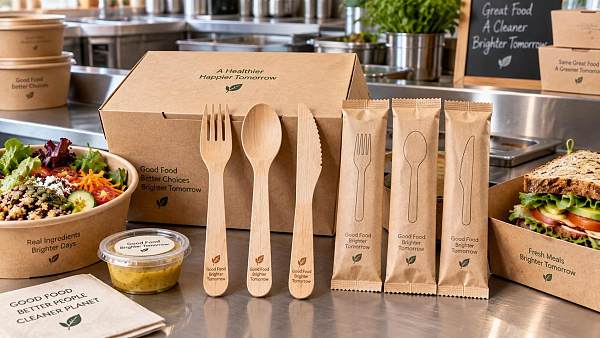
Takeout cutlery is often noticed only when it fails: a fork bends in a grain-heavy salad, a knife cannot separate a sandwich, or a rough spoon leaves an unpleasant impression during a catered meal. For restaurant operators, these small failures can affect guest comfort, cleanup, brand presentation, and staff workflow. Choosing a disposable wooden cutlery fork spoon knife set should therefore begin with the menu and service format, not with a generic “eco-friendly” claim.
The practical choice is usually a food-contact suitable, smoothly finished wooden set sized for the most demanding item on the menu, packed in a format that matches how orders are assembled. Before comparing unit prices, buyers should confirm wood species or material declaration, surface quality, strength, dimensions, hygiene controls, packaging configuration, and the supplier’s ability to maintain the same specification across repeat orders.
Start with the meal customers will actually eat
A wooden utensil that works adequately for a pastry counter may be unsuitable for a delivery menu built around rice bowls, grilled proteins, noodles, dense desserts, or sauces. The first useful question is not “Which wooden cutlery is cheapest?” but “What must the customer be able to do with it?”
Map the cutlery requirement to the menu’s most difficult eating task. A fork should lift slippery food without flexing excessively. A spoon should hold soup, yogurt, grain bowls, and dressings without feeling shallow or splinter-prone. A knife should manage soft proteins, bakery items, wraps, and side dishes without breaking at the neck or producing a ragged cut.
- Light snack and beverage service: Smaller, lighter utensils may be sufficient where the cutlery is used briefly for fruit, cakes, tasting portions, or simple sides.
- Everyday takeout meals: Standard full-length forks, spoons, and knives are typically more appropriate for salads, rice dishes, pasta, sandwiches, and desserts.
- Catering and buffet service: Appearance, consistency, and handling matter more because guests may use the utensils in public-facing settings rather than at home.
- Hot or moisture-heavy foods: Test the utensil after contact with hot sauces, soups, steamed items, and oily food. Dry-sample inspection alone does not show how it will perform during service.
Do not assume that a larger utensil is automatically stronger. Thickness, grain orientation, pressing quality, and finishing can matter as much as length. Conversely, an oversized fork in a compact delivery box can create packing problems and increase the chance of the wrapper tearing. A good specification balances handling performance with the realities of the package.
Assess material and finish separately
“Wooden” does not describe a single material standard. Disposable utensils may be made from different hardwoods or other plant-based materials, and the exact source, processing method, color, density, and grain pattern can vary. Material declarations should be clear enough for the buyer to understand what is being supplied and whether it aligns with internal sourcing requirements and applicable food-contact rules in the destination market.
Wood selection influences more than appearance. Denser materials can feel firmer, while lighter woods may offer a pale, clean visual profile but require careful design to avoid excessive flex. Natural variations in color and grain are normal, especially in products without heavy coatings or bleaching. The relevant concern is not whether every piece looks identical, but whether variation remains within an agreed and commercially acceptable range.
Surface finishing deserves its own review. Guests notice rough edges immediately, especially on spoons and fork tines. Poor sanding may create a fibrous texture, while inconsistent die-cutting can leave uneven tips, sharp corners, or thin sections near the handle. Ask for physical samples from the intended production specification rather than relying only on studio images or a sample from an unrelated batch.
What to inspect when samples arrive
- Run a finger along the handle edge, spoon rim, fork tines, and knife cutting edge to check for roughness or splinters.
- Look at the transition between handle and functional head; this is often where a thin or weak design becomes apparent.
- Place several pieces side by side to compare shape consistency, thickness, color variation, and warping.
- Use each item with representative food, including hot, wet, oily, and dense menu components.
- Check whether the natural wood odor is acceptable for food service. Strong or unusual odors should be investigated before approval.
- Open wrapped units as staff and guests would. A difficult-to-open package can slow service and frustrate customers.
A smooth finish should not be confused with an undisclosed surface treatment. If the cutlery has been coated, printed, waxed, or otherwise treated, request documentation describing the materials used and their suitability for intended food contact. The same applies to inks and adhesives used on individual wrappers or paper sleeves.
Choose the right fork, spoon, and knife configuration
Restaurants sometimes order each item independently, while others buy preassembled sets. Neither option is universally better. The decision depends on menu variation, assembly labor, storage space, hygiene expectations, and the percentage of orders requiring all three utensils.
For a menu centered on bowls and salads, a fork-and-spoon set may be more useful than a full set. Sending a knife with every order can add cost and package volume without improving the guest experience. On the other hand, catering orders often benefit from a consistent disposable wooden cutlery fork spoon knife bundle because staff do not have to make a separate utensil decision for every boxed meal.
Knife performance requires especially careful expectations. Disposable wooden knives are not intended to replace a metal steak knife. They are better suited to soft foods, cooked vegetables, sandwiches, pastries, tender proteins, and prepared meals that have already been portioned. If the menu includes thick crusts, very firm vegetables, bone-in items, or steak-style service, the food presentation and pre-cutting method should be reviewed rather than expecting a lightweight wooden knife to solve the problem.
Dimensions affect both comfort and packaging
Length is often treated as a simple catalog feature, but it affects user comfort, leverage, and box layout. Short utensils can feel acceptable with dessert cups or snack trays, yet become awkward in deep bowls or tall containers. Full-length pieces generally improve usability for meal delivery, although they can force changes to carton size or cutlery placement.
Ask suppliers for dimensional tolerances, not only nominal measurements. A stated length alone does not reveal head width, handle thickness, fork tine depth, spoon bowl capacity, or knife edge profile. These details determine whether the utensil feels functional in the hand.
Packaging should be checked with the actual takeout container. A wrapped set may look compact in a master carton but bend against a lid, slide into sauces, or prevent a box from closing cleanly. Catering trays present another issue: long utensils can shift during transport unless there is a designated compartment or a secure sleeve. Reviewing cutlery alongside the finished food package avoids discovering these problems after menu rollout.
Food-contact documentation is part of the product decision
Wooden cutlery must be suitable for food contact in the market where it will be sold or used. Requirements differ by destination, product construction, packaging components, and the buyer’s own quality standards. A supplier should be able to provide relevant product information and supporting documents upon request, rather than offering only broad environmental statements.
Documentation requests may include a product specification, material declaration, food-contact compliance information relevant to the destination market, details of coatings or inks where applicable, and traceability information for production lots. Where wood origin or forestry sourcing is relevant to a purchasing policy, ask what records are available instead of assuming that a natural-looking product automatically meets internal requirements.
It is also sensible to clarify whether the utensils are intended for direct contact with hot foods, oily foods, acidic foods, or beverages. The answer may affect which product construction is appropriate. When packaging is marketed as compostable, recyclable, biodegradable, or similar, request the precise basis for that claim and verify that it can be used in the intended market and disposal environment. Disposal claims can be limited by local collection systems, contamination, and the presence of wrappers or mixed materials.
Test for service conditions, not just appearance
A sample review becomes more useful when it mirrors the operation. Place utensils into assembled takeout bags, store them in the same conditions used by the restaurant, and have staff use them during a normal packing sequence. For catered meals, evaluate how they look after transport and whether the set remains clean and intact when guests receive it.
Testing does not need to be elaborate, but it should answer practical questions. Does the spoon remain comfortable after several bites of a hot dish? Can the fork pierce a roasted vegetable without twisting? Does the knife handle a sandwich without splitting? Does an individually wrapped set stay sealed when rubbed against containers in a delivery bag? Are loose utensils being added in inconsistent quantities during busy periods?
Pay attention to moisture exposure before use as well. Wood-based products stored in humid back rooms, near dishwashing areas, or in poorly protected delivery staging zones may absorb moisture or lose their clean appearance. Master cartons and inner packaging should protect the cutlery during ordinary storage and transport. Buyers should also confirm recommended storage conditions, shelf-life guidance where provided, and carton handling requirements.
Build the purchase specification around failure points
A short, usable purchase specification reduces the chance that future orders drift away from the approved sample. It should identify each utensil separately, even when products are sold as a set. “Wooden cutlery set” is too broad to control quality across repeat purchases.
- Material or wood type, including any permitted natural variation.
- Fork, spoon, and knife dimensions, with acceptable tolerances where needed.
- Required thickness or strength-related construction details if these are critical.
- Surface quality expectations, including no visible splinters, sharp edges, excessive warping, or obvious staining.
- Packaging type: loose, paper-banded, individually wrapped, or bundled set.
- Number of pieces per inner pack and master carton, plus carton dimensions if storage space is limited.
- Required product markings, lot identification, and documentation supplied with each shipment.
- Approved sample reference and a process for reviewing substitutions or material changes before shipment.
Specify defects in terms that can be inspected. “Premium quality” is subjective; “smooth edges, intact fork tines, consistent wrapping, and no loose fibers in the functional eating area” is easier to evaluate. For high-volume programs, establish a receiving inspection routine that checks a small selection from multiple cartons for dimensions, finish, packaging integrity, and consistency against the approval sample.
Do not let customization undermine usability
Custom sleeves, printed wrappers, napkins, and branded bundles can make a catering package feel more deliberate, but they introduce additional variables. Printing should remain legible after handling and should not transfer onto the utensil. A sleeve must hold the set securely without making it difficult to remove. Added components also change package dimensions, assembly time, and the materials involved in disposal.
Customization is most useful when it solves an operational need: differentiating meal types, keeping utensils clean in delivery, or creating a neater catering presentation. It is less useful when it adds bulk to a compact order or forces staff to assemble multiple loose components during peak service. Before approving a customized format, run it through the full packing process rather than judging it as a standalone sample.
Questions that reveal supplier readiness
Reliable supply depends on more than a supplier’s ability to send an initial sample. Useful conversations focus on whether the approved specification can be repeated, documented, packed, and shipped consistently.
- Can the supplier identify the exact material and production specification for the approved sample?
- What quality checks are performed for sanding, breakage, warping, contamination, and packaging seals?
- How are lots identified and traced if a receiving issue is discovered?
- Can packaging quantities, wrapper formats, and carton dimensions remain consistent across reorders?
- What is the process when raw material availability requires a change in wood tone, grain, or construction?
- Which food-contact and product documents can be provided for the intended destination market?
The best choice is not necessarily the palest-looking utensil or the lowest-cost set. It is the one that handles the menu reliably, arrives in a usable format, meets the documentation requirements of the buying organization, and can be reordered without unexpected changes in finish, strength, or packing configuration.
Search News
Hot Articles
- Commercial KitchenHow Restaurants Can Choose Disposable Wooden Cutlery for Takeout and CateringSep 14, 2026
- Jewelry Packaging & DisplayHow U.S. Retailers Can Choose Jewelry Displays for Better Security and SalesSep 13, 2026
- Commercial KitchenHow to Size a Restaurant Walk-In Cooler for Peak Inventory and Kitchen LayoutSep 12, 2026
Popular Tags
Need ExpertConsultation?
Connect with our specialized leisureengineering team for procurementstrategies.
Recommended News
 Sep 14, 2026How Restaurants Can Choose Disposable Wooden Cutlery for Takeout and CateringDisposable wooden cutlery fork spoon knife guide for restaurants: compare strength, finish, packaging, food-contact needs, and catering performance.● Hospitality Sourcing Dir
 Sep 12, 2026How to Size a Restaurant Walk-In Cooler for Peak Inventory and Kitchen LayoutRestaurant walk in coolers sized for peak inventory and kitchen workflow help improve food safety, staff efficiency, storage access, and long-term operational performance.● Hospitality Sourcing Dir
 Sep 10, 2026How to Choose a CE Hot Dog Roller for Safe, High-Volume Food Service?Choose a CE hot dog roller with confidence: compare compliance documents, heating consistency, cleaning design, capacity, and total cost for safe, high-volume food service.● Hospitality Sourcing Dir
 Sep 04, 2026How to Evaluate a Commercial Food Warmer Manufacturer for Bulk Catering ProjectsCommercial food warmer manufacturer evaluation guide for bulk catering projects: compare thermal performance, compliance, customization, costs, and after-sales support.● Hospitality Sourcing Dir
 Aug 30, 2026How Can Buyers Verify Supplier Qualifications Before a Bulk Order?How to confirm supplier qualifications before placing a bulk order: verify legal identity, factory capability, certificates, samples, quality controls, and payment safeguards.● Hospitality Sourcing Dir
 Aug 28, 2026Commercial Kitchen Design Standards: A Planning Checklist for Code-Compliant LayoutsCommercial kitchen design standards: use this practical checklist to plan safer, code-compliant layouts, streamline approvals, and avoid costly rework.● Hospitality Sourcing Dir
 Aug 06, 2026How to Choose Flake Ice Makers for Seafood Displays, Bars, and Food Prep?Flake ice makers buying guide: compare output, hygiene, storage, energy use, and reliability to choose the best solution for seafood displays, bars, and food prep.● Hospitality Sourcing Dir
 Aug 03, 2026Commercial Kitchen Design Price: What Drives Cost in a New Build Project?Commercial kitchen design price explained: discover what drives cost in a new build, from layout and equipment to ventilation, compliance, and hidden budget risks.● Hospitality Sourcing Dir
 Jul 30, 2026How to Choose a Countertop Commercial Pizza Oven for Capacity, Speed, and Space?Countertop commercial pizza oven buying guide: learn how to match capacity, bake speed, and kitchen space for consistent output, lower costs, and smarter purchasing decisions.● Hospitality Sourcing Dir
 Jul 22, 2026How to Evaluate a Cotton Candy Machine Supplier for Quality, Lead Time, and MOQCotton candy machine supplier selection starts with quality, lead time, and MOQ. Learn how to compare suppliers, reduce sourcing risk, and choose a partner that supports reliable growth.● Hospitality Sourcing Dir
 Jul 21, 2026How to Choose a Charcoal Commercial Grill for Capacity, Heat Control, and Menu FitCharcoal commercial grill buying guide: learn how to match capacity, heat control, and menu fit to boost consistency, service speed, and ROI in commercial kitchens.● Hospitality Sourcing Dir
 Jul 10, 2026FDA Import Alert Adds NSF/ANSI 50-2026 for Commercial Kitchen EquipmentFDA Import Alert now highlights NSF/ANSI 50-2026 for commercial kitchen equipment. Learn how dishwashers, ice machines, and steam cabinets can avoid U.S. port detention.● Hospitality Sourcing Dir
 Jul 05, 2026How to Select Energy Efficient Display Cabinets for Food Retail and HospitalityEnergy efficient display cabinets can cut operating costs while improving food safety, visibility, and service efficiency. Learn how to choose the right model for retail and hospitality.● Hospitality Sourcing Dir
 Jul 04, 2026CPSC Flags New UL 2595 Label Rule for Commercial Ice MakersCPSC flags a new UL 2595 label rule for commercial ice makers entering the U.S. after Aug. 1, 2026. Learn who is affected, key compliance steps, and how to avoid port delays and recall risk.● Hospitality Sourcing Dir
 Jun 29, 2026How to Choose Thermal Receipt Printers for Retail and Restaurant CountersThermal receipt printers for retail and restaurant counters: learn how to compare speed, durability, connectivity, and total operating cost to choose a model that supports smoother service.● Hospitality Sourcing Dir
 Jun 28, 2026Stainless Steel Kitchen Ventilation Systems: Key Specifications for Commercial ProjectsStainless steel kitchen ventilation systems: compare material grades, airflow capture, hygiene, fire safety, and installation specs for commercial projects before you buy.● Hospitality Sourcing Dir
 Jun 27, 2026Commercial Shawarma Machines: What to Check Before Buying for High-Volume ServiceShawarma machines commercial buying guide: learn how to compare capacity, heat control, durability, compliance, and lifecycle cost before choosing equipment for high-volume service.● Hospitality Sourcing Dir
 Jun 26, 2026Restaurant POS Systems: How to Compare Features, Costs, and ScalabilityRestaurant POS systems: compare features, costs, and scalability to find the best fit for your restaurant and boost long-term efficiency.● Hospitality Sourcing Dir
 Jun 25, 2026Kitchen Ventilation Systems Design: How to Size Hoods, Airflow, and Make-Up AirKitchen ventilation systems design explained clearly: learn how to size hoods, set exhaust airflow, and balance make-up air for safer, more efficient commercial kitchens.● Hospitality Sourcing Dir
 Jun 14, 2026Hot Dog Rollers for Convenience Stores and Cafes: Capacity, Heating Zones, and Cleaning TipsHot dog rollers buying guide for convenience stores and cafes: compare real capacity, heating zones, energy use, and cleaning tips to choose a smarter, lower-waste setup.● Hospitality Sourcing Dir
 Jun 13, 2026Commercial Milkshake Mixers vs Blenders: Which Is Better for High-Volume Service?Commercial milkshake mixers or blenders—which suits high-volume service better? Compare texture, speed, consistency, and cost to choose the right machine.● Hospitality Sourcing Dir
 Jun 12, 2026Blast Chillers Commercial Buying Guide: Capacity, Cooling Rate, and Kitchen Workflow FitBlast chillers commercial buying guide covering capacity, cooling rate, and workflow fit. Learn how to choose safer, faster, audit-ready equipment for real kitchen performance.● Hospitality Sourcing Dir
 Jun 10, 2026How to Choose Sushi Display Cases for Temperature Control, Visibility, and Counter SpaceSushi display cases buying guide: learn how to compare temperature control, product visibility, and counter space to choose safer, smarter, and more profitable commercial solutions.● Hospitality Sourcing Dir
 Jun 08, 2026How to Choose Commercial Bread Slicers for Bakeries, Cafes, and Foodservice KitchensCommercial bread slicers buying guide for bakeries, cafes, and foodservice kitchens. Compare capacity, slice consistency, safety, cleaning, and supplier support to choose with confidence.● Hospitality Sourcing Dir