How to Evaluate a Commercial Food Warmer Manufacturer for Bulk Catering Projects
How to Evaluate a Commercial Food Warmer Manufacturer for Bulk Catering Projects
Selecting a commercial food warmer manufacturer for a bulk catering project is rarely a simple price comparison. A warmer that performs acceptably during a showroom demonstration can become a service problem when it must hold hundreds of portions through a hotel breakfast rush, a university lunch period, or a multi-station banquet. Uneven heat, difficult cleaning, slow recovery after replenishment, missing export documentation, and delayed spare parts can all turn a relatively small equipment purchase into an operational liability.
The right evaluation process starts with the service model, not the catalogue. A static buffet line, a central production kitchen, a mobile event catering operation, and a hospital meal-distribution setup may all use food warmers, but they place very different demands on equipment. Before requesting quotations, define what the warmer must actually do: maintain temperature, recover heat after cold trays are loaded, display food attractively, withstand frequent movement, or integrate into a larger serving counter. That distinction will shape almost every sourcing decision that follows.
Begin with the holding task, not the product name
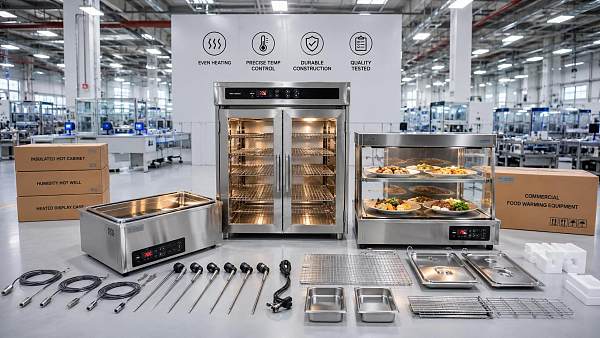
“Commercial food warmer” covers a broad family of equipment: dry heat cabinets, wet bain-marie units, infrared heat lamps, heated display cases, countertop wells, mobile banquet cabinets, and built-in buffet modules. Treating them as interchangeable is one of the most common mistakes in bulk procurement.
A moist dish such as braised meat, soup, sauce, or steamed vegetables may require a different holding environment from fried items, baked products, or plated meals. Wet heat can help reduce surface drying in some applications, while dry heat may be more suitable where water pans would compromise texture or create extra maintenance. Infrared equipment is useful for pass-through or short-duration service, but it should not automatically be assumed to replace a properly insulated holding cabinet for longer periods.
Ask the manufacturer to explain the intended operating condition for each proposed model. Useful questions include how the unit distributes heat, where the sensing point is located, whether the cabinet has active airflow, and what happens when doors or lids are opened repeatedly. A supplier that only responds with external dimensions and nominal wattage has not yet demonstrated a strong understanding of catering operations.
Assess thermal performance under real service conditions
Temperature control is the core technical issue, but the stated temperature range is only part of the picture. What matters operationally is stability across the usable holding area and the unit’s ability to recover after food is replenished. In a large-volume environment, warmer doors may open continuously, lids may remain partially lifted, and pans may be loaded at different temperatures. Those conditions are much harsher than an empty-unit test.
Request a clear explanation of the control system: mechanical thermostat, electronic controller, probe-based sensing, timer functions, alarms, or separate zone controls. Electronic controls can offer more precise adjustment, but they also introduce another component that must be supported over the life of the equipment. If a project is headed to a remote venue or a market with limited technical service coverage, simple and serviceable controls may sometimes be a better choice than a feature-heavy interface.
For larger orders, it is reasonable to ask for a sample or a witnessed test plan based on actual pans, food loads, and service duration. The purpose is not to demand laboratory-grade validation from every supplier. It is to avoid accepting vague claims such as “uniform heating” without knowing how that claim was assessed. Measure what matters to the project: recovery time, temperature variation between shelves or wells, external surface heat, condensation behavior, and ease of adjustment by kitchen staff.
Food safety compliance must match the destination market
Food warmers sit directly within a food safety workflow, even when they are not cooking equipment. Materials in food-contact areas, cleanability, electrical safety, temperature maintenance, and drainage design should all be reviewed against the requirements of the installation market. There is no universal document set that applies to every country, so a commercial food warmer manufacturer should be able to identify which approvals, test reports, markings, or declarations are relevant to the proposed destination.
Do not treat a general statement such as “international standard” as sufficient evidence. Ask which specific standard or certification applies, whether it covers the complete unit or only a component, and whether the documentation remains valid for the chosen voltage, plug, controller, and material configuration. This matters especially when the same base model is offered in several electrical versions.
Material selection deserves equally careful attention. Stainless steel grades, insulation materials, glass, seals, coatings, fasteners, and food pans should be disclosed in the supplier’s technical documentation. In humid kitchens or coastal locations, corrosion resistance may influence lifecycle cost more than a modest difference in initial price. Weld finish, corners, seams, drainage points, and removable parts also affect how quickly staff can clean the equipment between services.
Look beyond factory photos when judging manufacturing capability
A polished website does not reveal whether a supplier can build consistent units across a multi-site rollout. For bulk catering projects, assess process control rather than relying solely on sample appearance. A factory visit can be valuable, but a structured remote review can also reveal a great deal when travel is impractical.
Ask how the manufacturer manages incoming components, electrical assembly, insulation installation, water testing where relevant, functional checks, and final packaging. Clarify whether heating elements, thermostats, controllers, castors, glass panels, and gastronorm-compatible accessories are produced in-house or sourced externally. Outsourced components are not inherently a risk; many are sensible choices. The important question is whether the supplier has qualified sources, documented specifications, and a plan when a component is discontinued.
Production capacity should also be discussed in practical terms. A supplier may quote an attractive lead time for fifty units but struggle when the order requires different finishes, multiple voltage variants, custom signage, or staggered deliveries to several countries. Ask for a production schedule that separates engineering confirmation, sample approval, material preparation, assembly, inspection, packing, and shipment. If the schedule has no allowance for approval cycles or component procurement, it is probably more optimistic than reliable.
Customization is useful only when it is controlled
Hotels, premium buffets, cruise operators, and branded event venues often need warmer equipment that fits a visual concept as well as a kitchen plan. Custom dimensions, counter cut-outs, powder-coated panels, logo placement, glass sneeze guards, shelving layouts, and bespoke mobility features can all be legitimate requirements. Yet customization becomes expensive when the design is not frozen early enough.
The safest route is to distinguish between cosmetic changes and engineering changes. A badge, finish, or standard accessory may be relatively straightforward. Altering ventilation paths, heater placement, cabinet depth, electrical layout, or a food-contact surface requires a more formal review. It may affect thermal performance, compliance documentation, service access, tooling, and production lead time.
Request approved drawings before mass production, with dimensions, materials, electrical requirements, accessory lists, and visible finishes clearly stated. Where equipment will be built into a buffet or counter, confirm responsibility for tolerances, ventilation gaps, power connection points, and access for maintenance. A warmer can look excellent in a rendering and still be impossible to service once fixed into millwork.
Compare total landed and operating cost, not just the unit quotation
The lowest ex-works price is not necessarily the lowest project cost. Freight volume, packing quality, customs documentation, installation labor, electrical adaptation, spare parts, energy use, cleaning time, and downtime should all enter the comparison. A compact unit with poor insulation may appear economical until it operates through long service windows every day. Conversely, an over-specified cabinet with advanced controls may not justify its cost for occasional banquet use.
Create a comparison sheet that separates one-time and recurring costs. This makes supplier quotations easier to evaluate without forcing every project into a simplistic price ranking.
After-sales support is part of the manufacturing decision
For a catering operation, a failed heating element or broken door seal is not merely a maintenance ticket. It can take a serving station out of use during a high-profile event. Before placing a bulk order, establish who provides troubleshooting, which parts are recommended for local stock, how warranty claims are handled, and whether service manuals and wiring diagrams are available in a usable format.
A manufacturer does not need to maintain a technician in every market to be a credible partner. But it should have a clear escalation path, identifiable spare-part codes, sensible packaging for replacements, and staff capable of answering technical questions. If the supplier cannot explain the replacement process before the order is placed, support is unlikely to improve after payment.
Use samples and inspections to reduce avoidable risk
For standard, low-risk replenishment purchases, documentation and a previous production record may be enough. For a first-time supplier, a custom buffet line, or a project with strict opening dates, a sample approval and pre-shipment inspection are usually worth considering. Inspectors should not focus only on scratches or packaging. They should check model configuration, voltage and plug details, dimensions, weld quality, door and castor operation, controller response, accessory counts, labelling, and the accuracy of the packing list.
It is also wise to decide in advance what counts as a critical defect, a rework item, or an acceptable cosmetic variation. This avoids disagreement when finished units are waiting for shipment. The aim is not to make the supplier’s process burdensome; it is to ensure both parties are working from the same acceptance standard.
A better supplier decision is usually a better project decision
The strongest commercial food warmer manufacturer is not always the one with the broadest catalogue or the cheapest offer. For a bulk catering project, the better fit is usually the supplier that can connect equipment design with food-holding realities, destination-market requirements, repeatable production, and practical service support.
This is why sourcing decisions benefit from combining technical review with commercial intelligence. Platforms such as Global Commercial Trade help project teams place hospitality equipment choices within a wider view of supplier capability, compliance expectations, design requirements, and supply-chain reliability. Still, the final decision should rest on the specifics of the site, menu, operating hours, local regulations, and approved equipment specification. A well-asked question before purchase is usually far less expensive than a correction after installation.
Search News
Hot Articles
- Stationery & UniformsChoosing a Wholesale Chef Coat Supplier: MOQs, Samples, and Lead TimesOct 19, 2026
- Indoor PlaygroundTurnkey Playground Installation: What's Included and What Costs Extra?Oct 18, 2026
- Musical InstrumentsProfessional String Instruments: How to Evaluate Tone, Response, and ProjectionOct 17, 2026
Popular Tags
Need ExpertConsultation?
Connect with our specialized leisureengineering team for procurementstrategies.
Recommended News
 Oct 06, 2026What Is Driving Demand for Commercial Hospitality Projects Across the GCC?Commercial hospitality GCC demand is rising through destination-led tourism, mixed-use development, and premium operational standards. Explore the procurement strategies shaping resilient projects.● Hospitality Sourcing Dir
 Sep 24, 2026Conveyor Pizza Oven Price: What Buyers Should Budget for Capacity and FeaturesConveyor pizza oven price guide: compare capacity, features, installation costs, and quote factors to choose the right commercial oven for your operation.● Hospitality Sourcing Dir
 Sep 23, 2026How Restaurant Buyers Can Source Hospitality Supplies Without OverorderingHospitality supplies for restaurants: learn practical sourcing strategies to cut excess inventory, protect cash flow, improve supplier reliability, and keep every service running smoothly.● Hospitality Sourcing Dir
 Sep 22, 2026Commercial Kitchen Design Price: Budgeting by Layout, Equipment, and MEP ScopeCommercial kitchen design price explained: budget smarter for layout, equipment, MEP scope, compliance, installation, and long-term operational performance.● Hospitality Sourcing Dir
 Sep 19, 2026How to Select a Spiral Dough Mixer for Bakery Batch Size and Dough HydrationSpiral dough mixer bakery guide: match batch size, flour load, and hydration to select reliable torque, temperature control, and consistent dough results.● Hospitality Sourcing Dir
 Sep 14, 2026How Restaurants Can Choose Disposable Wooden Cutlery for Takeout and CateringDisposable wooden cutlery fork spoon knife guide for restaurants: compare strength, finish, packaging, food-contact needs, and catering performance.● Hospitality Sourcing Dir
 Sep 12, 2026How to Size a Restaurant Walk-In Cooler for Peak Inventory and Kitchen LayoutRestaurant walk in coolers sized for peak inventory and kitchen workflow help improve food safety, staff efficiency, storage access, and long-term operational performance.● Hospitality Sourcing Dir
 Sep 10, 2026How to Choose a CE Hot Dog Roller for Safe, High-Volume Food Service?Choose a CE hot dog roller with confidence: compare compliance documents, heating consistency, cleaning design, capacity, and total cost for safe, high-volume food service.● Hospitality Sourcing Dir
 Sep 04, 2026How to Evaluate a Commercial Food Warmer Manufacturer for Bulk Catering ProjectsCommercial food warmer manufacturer evaluation guide for bulk catering projects: compare thermal performance, compliance, customization, costs, and after-sales support.● Hospitality Sourcing Dir
 Aug 30, 2026How Can Buyers Verify Supplier Qualifications Before a Bulk Order?How to confirm supplier qualifications before placing a bulk order: verify legal identity, factory capability, certificates, samples, quality controls, and payment safeguards.● Hospitality Sourcing Dir
 Aug 28, 2026Commercial Kitchen Design Standards: A Planning Checklist for Code-Compliant LayoutsCommercial kitchen design standards: use this practical checklist to plan safer, code-compliant layouts, streamline approvals, and avoid costly rework.● Hospitality Sourcing Dir
 Aug 06, 2026How to Choose Flake Ice Makers for Seafood Displays, Bars, and Food Prep?Flake ice makers buying guide: compare output, hygiene, storage, energy use, and reliability to choose the best solution for seafood displays, bars, and food prep.● Hospitality Sourcing Dir
 Aug 03, 2026Commercial Kitchen Design Price: What Drives Cost in a New Build Project?Commercial kitchen design price explained: discover what drives cost in a new build, from layout and equipment to ventilation, compliance, and hidden budget risks.● Hospitality Sourcing Dir
 Jul 30, 2026How to Choose a Countertop Commercial Pizza Oven for Capacity, Speed, and Space?Countertop commercial pizza oven buying guide: learn how to match capacity, bake speed, and kitchen space for consistent output, lower costs, and smarter purchasing decisions.● Hospitality Sourcing Dir
 Jul 22, 2026How to Evaluate a Cotton Candy Machine Supplier for Quality, Lead Time, and MOQCotton candy machine supplier selection starts with quality, lead time, and MOQ. Learn how to compare suppliers, reduce sourcing risk, and choose a partner that supports reliable growth.● Hospitality Sourcing Dir
 Jul 21, 2026How to Choose a Charcoal Commercial Grill for Capacity, Heat Control, and Menu FitCharcoal commercial grill buying guide: learn how to match capacity, heat control, and menu fit to boost consistency, service speed, and ROI in commercial kitchens.● Hospitality Sourcing Dir
 Jul 10, 2026FDA Import Alert Adds NSF/ANSI 50-2026 for Commercial Kitchen EquipmentFDA Import Alert now highlights NSF/ANSI 50-2026 for commercial kitchen equipment. Learn how dishwashers, ice machines, and steam cabinets can avoid U.S. port detention.● Hospitality Sourcing Dir
 Jul 05, 2026How to Select Energy Efficient Display Cabinets for Food Retail and HospitalityEnergy efficient display cabinets can cut operating costs while improving food safety, visibility, and service efficiency. Learn how to choose the right model for retail and hospitality.● Hospitality Sourcing Dir
 Jul 04, 2026CPSC Flags New UL 2595 Label Rule for Commercial Ice MakersCPSC flags a new UL 2595 label rule for commercial ice makers entering the U.S. after Aug. 1, 2026. Learn who is affected, key compliance steps, and how to avoid port delays and recall risk.● Hospitality Sourcing Dir
 Jun 29, 2026How to Choose Thermal Receipt Printers for Retail and Restaurant CountersThermal receipt printers for retail and restaurant counters: learn how to compare speed, durability, connectivity, and total operating cost to choose a model that supports smoother service.● Hospitality Sourcing Dir
 Jun 28, 2026Stainless Steel Kitchen Ventilation Systems: Key Specifications for Commercial ProjectsStainless steel kitchen ventilation systems: compare material grades, airflow capture, hygiene, fire safety, and installation specs for commercial projects before you buy.● Hospitality Sourcing Dir
 Jun 27, 2026Commercial Shawarma Machines: What to Check Before Buying for High-Volume ServiceShawarma machines commercial buying guide: learn how to compare capacity, heat control, durability, compliance, and lifecycle cost before choosing equipment for high-volume service.● Hospitality Sourcing Dir
 Jun 26, 2026Restaurant POS Systems: How to Compare Features, Costs, and ScalabilityRestaurant POS systems: compare features, costs, and scalability to find the best fit for your restaurant and boost long-term efficiency.● Hospitality Sourcing Dir
 Jun 25, 2026Kitchen Ventilation Systems Design: How to Size Hoods, Airflow, and Make-Up AirKitchen ventilation systems design explained clearly: learn how to size hoods, set exhaust airflow, and balance make-up air for safer, more efficient commercial kitchens.● Hospitality Sourcing Dir