How to Choose a CE Hot Dog Roller for Safe, High-Volume Food Service?
How to Choose a CE Hot Dog Roller for Safe, High-Volume Food Service
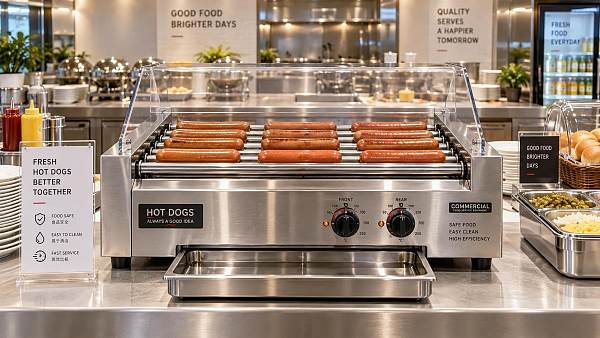
Choosing a CE hot dog roller for a hotel breakfast area, stadium concession, convenience store, campus café, or leisure venue is not simply a matter of counting rollers and comparing unit prices. In high-volume service, this compact appliance sits at the intersection of food safety, electrical compliance, labour efficiency, presentation, and operating cost. A low-priced roller grill that heats unevenly, is difficult to clean, or arrives with incomplete compliance documents can cost far more than its purchase price through waste, downtime, complaints, and replacement procurement.
The right sourcing decision starts with the operating model. Is the equipment reheating pre-cooked hot dogs for rapid counter service? Will it run continuously through a long event? Does the site need separate cooking and holding zones? Is it installed in a self-service location where staff cannot constantly monitor it? These questions determine which specification matters most. Capacity is visible; safe, repeatable performance is where the commercial value lies.
Treat CE Marking as a Documentation Question, Not a Sticker
For buyers supplying or operating equipment in the European Economic Area, CE marking deserves closer scrutiny than it often receives. A CE mark on the rear panel or packaging is not, by itself, sufficient evidence that a unit is suitable for the intended market. CE marking is the manufacturer’s declaration that the product meets applicable European Union requirements. The exact requirements depend on the equipment design, electrical configuration, and market placement route.
For an electrically heated roller grill, procurement teams should request the EU Declaration of Conformity and verify that it identifies the legal manufacturer, product or model reference, relevant legislation, date, signature, and responsible signatory. Electrical safety, electromagnetic compatibility, and restrictions on hazardous substances may all be relevant areas, although the applicable framework must be confirmed for the individual product. A supplier should also be able to explain whether the unit is intended for commercial use and what voltage, plug, and frequency variants are available.
Do not confuse a test report, a voluntary certificate, and the Declaration of Conformity. Each may have a role in supplier assessment, but they are not interchangeable. Where a distributor imports equipment under its own name, or where private-label branding is involved, responsibility can become more complicated. Clarify who is the legal manufacturer, who retains the technical documentation, and who will support authorities or customers if a compliance query arises after delivery.
Food-contact components need a separate review. Rollers, drip trays, sneeze guards, handles, and any surface likely to contact food should be supported by material information appropriate to the destination market. In the EU, food-contact materials are subject to a dedicated regulatory framework. Procurement should ask for declarations and traceability information relevant to the actual materials used rather than accepting a broad statement such as “food grade stainless steel.”
Size Capacity Around Throughput, Not the Biggest Roller Count
Roller count is a useful starting point, but it is an incomplete measure of output. The usable holding capacity changes with sausage diameter, bun service method, loading pattern, and whether staff need space to rotate stock. A crowded machine may technically hold more items but make first-in, first-out stock rotation difficult. That increases the likelihood of overholding and inconsistent product quality.
A better approach is to map the busiest service window. Estimate how many portions must be available at the peak, how quickly new stock must be ready, and how long cooked product can be held under the site’s food-safety procedures. Then add operational headroom rather than purchasing solely for the average hour. A venue with a short but intense halftime rush needs a different appliance strategy from a hotel lounge with steady evening demand.
For high-volume sites, independently controlled heating zones can be more valuable than a larger single-zone grill. They allow one section to remain in active use while another holds a lower volume or is temporarily switched off. This can reduce unnecessary energy use during quieter periods, but only if controls are clear enough for staff to use correctly. More controls do not automatically mean better operation.
Heating Consistency Is a Food Quality and Safety Issue
Commercial buyers should ask how heat is transferred through the rollers and how temperature is controlled across the cooking surface. Uneven heating may leave one side of the grill performing differently from the other, resulting in split casings, dried product, or items that do not reach the site’s required service condition. A basic thermostat setting alone does not prove that a roller grill provides consistent food temperatures under a full load.
During sample evaluation, test the appliance with the actual sausage type and expected loading pattern. Assess warm-up time, roller rotation, heat recovery after cold stock is added, and variation between the centre and outer positions. The relevant internal food temperatures and holding limits should be set by the operator’s food-safety system and local requirements, not by an unverified generic claim from a supplier.
Roller construction also affects real-world performance. Smooth, corrosion-resistant rollers are generally easier to wipe down and less likely to trap residue than poorly finished surfaces. Yet material labels alone are not enough. Look at joins, roller end caps, gaps around bearings, and whether grease can migrate into inaccessible areas. A machine can look polished in a catalogue and still create a difficult cleaning task at the end of every shift.
Cleaning Design Often Determines the True Labour Cost
A roller grill is exposed to fat, salt, condensation, and frequent wiping. In busy food service, the best cleaning design is not necessarily the one with the most removable parts. It is the one that allows staff to remove grease and food debris reliably without dismantling electrical components, using excessive water, or leaving hidden residue behind.
Examine the drip tray first. It should be adequately sized, securely positioned, and removable without tipping accumulated grease onto the counter. Check whether the front and side panels can be reached with ordinary cleaning tools. If a guard is included, confirm that it protects food from nearby handling and sneeze exposure while still allowing staff to load, rotate, and clean the unit safely.
Ask the supplier for cleaning instructions, approved cleaning-agent guidance, exploded parts drawings, and replacement part references. These documents reveal whether a manufacturer has thought beyond export packaging. Instructions should make clear that electrical equipment must be isolated before cleaning and should not be treated as a wash-down appliance unless the manufacturer specifically states otherwise.
Compare Total Cost of Ownership, Not Just the Quote
A CE hot dog roller is a relatively small capital purchase, which makes it easy for buyers to apply an overly simple price comparison. The lowest ex-works or landed price may be attractive for a single outlet, but multi-site operators need to account for failures, parts availability, cleaning time, freight for warranty claims, and the cost of a counter station being unavailable during a busy period.
Energy consumption should be reviewed in context. Rated power indicates the electrical demand at a stated condition, but it does not predict actual daily consumption by itself. Duty cycle, thermostat behavior, ambient temperature, loading frequency, and staff habits all influence operating use. Request rated power, electrical connection details, and clear guidance on intended operating cycles; then compare units against the site’s service pattern rather than assuming that a lower wattage rating always means lower practical cost.
The cost review should include:
- purchase price, packaging, freight, duty, local delivery, and installation requirements;
- electrical compatibility, plug type, cable length, and any required local adaptation;
- expected cleaning labour and the availability of drip trays, rollers, switches, guards, and heating components;
- warranty terms, exclusions, response process, and the location of service support;
- the cost of holding a spare unit or critical parts for high-revenue locations.
For a rollout, standardisation can reduce cost even when the individual unit is not the cheapest option. One approved model simplifies staff training, cleaning procedures, spare parts stocking, counter planning, and compliance recordkeeping. It also makes it easier to compare performance across locations.
Supplier Assessment Should Continue After the Sample Passes
A successful sample is useful, but it does not guarantee production consistency. Before issuing a volume order, confirm whether the quoted model, materials, controls, plug, carton markings, and compliance documents will match the approved sample. If the appliance is being sourced under a private label, define artwork approval, nameplate content, manuals, packaging language, and traceability requirements before production begins.
It is also reasonable to ask how the factory manages incoming components, final electrical checks, functional testing, and serial or batch traceability. The answer need not be elaborate, but it should be specific. Vague assurances are less useful than a clear explanation of inspection points and what records can be provided with the shipment.
For hospitality groups, project developers, and institutional procurement teams, sourcing is often complicated by differing electrical systems, local food-service practices, and brand presentation standards. Global Commercial Trade follows these practical intersections across hotel and catering equipment and other commercial environments, where equipment decisions are rarely isolated from operational design, supply continuity, and market-entry obligations.
A Practical Approval Gate Before Purchase
Before approving a supplier, assemble a short file that links the equipment to the actual site requirement: target market, electrical specification, expected peak demand, food-contact material evidence, EU Declaration of Conformity where applicable, manuals, cleaning method, spare-parts list, warranty process, and final sample or pre-shipment approval criteria. This is more useful than an oversized specification sheet because it makes omissions visible.
The strongest choice is usually not the roller grill with the longest feature list. It is the unit whose compliance evidence is traceable, whose heating and cleaning performance have been checked with the intended food product, and whose supplier can support the machine after it reaches the counter. For high-volume food service, that discipline protects both the cost plan and the customer experience.
Search News
Hot Articles
- Outdoor RidesSix Flags to Add Seat Belts to Goliath and Eight Other Coasters to Improve SafetyOct 25, 2026
- Commercial KitchenChoosing an Electric Shawarma Machine: Capacity and Power RequirementsOct 25, 2026
- Pro Stage AudioRME Launches ADI-2/4 PRO EX Audio Converter with Integrated ProcessingOct 24, 2026
Popular Tags
Need ExpertConsultation?
Connect with our specialized leisureengineering team for procurementstrategies.
Recommended News
 Oct 25, 2026Choosing an Electric Shawarma Machine: Capacity and Power RequirementsChoose the right electric shawarma machine by comparing capacity, power requirements, and peak-hour output. Discover practical buying tips to avoid costly mistakes and keep service moving.● Hospitality Sourcing Dir
 Oct 06, 2026What Is Driving Demand for Commercial Hospitality Projects Across the GCC?Commercial hospitality GCC demand is rising through destination-led tourism, mixed-use development, and premium operational standards. Explore the procurement strategies shaping resilient projects.● Hospitality Sourcing Dir
 Sep 24, 2026Conveyor Pizza Oven Price: What Buyers Should Budget for Capacity and FeaturesConveyor pizza oven price guide: compare capacity, features, installation costs, and quote factors to choose the right commercial oven for your operation.● Hospitality Sourcing Dir
 Sep 23, 2026How Restaurant Buyers Can Source Hospitality Supplies Without OverorderingHospitality supplies for restaurants: learn practical sourcing strategies to cut excess inventory, protect cash flow, improve supplier reliability, and keep every service running smoothly.● Hospitality Sourcing Dir
 Sep 22, 2026Commercial Kitchen Design Price: Budgeting by Layout, Equipment, and MEP ScopeCommercial kitchen design price explained: budget smarter for layout, equipment, MEP scope, compliance, installation, and long-term operational performance.● Hospitality Sourcing Dir
 Sep 19, 2026How to Select a Spiral Dough Mixer for Bakery Batch Size and Dough HydrationSpiral dough mixer bakery guide: match batch size, flour load, and hydration to select reliable torque, temperature control, and consistent dough results.● Hospitality Sourcing Dir
 Sep 14, 2026How Restaurants Can Choose Disposable Wooden Cutlery for Takeout and CateringDisposable wooden cutlery fork spoon knife guide for restaurants: compare strength, finish, packaging, food-contact needs, and catering performance.● Hospitality Sourcing Dir
 Sep 12, 2026How to Size a Restaurant Walk-In Cooler for Peak Inventory and Kitchen LayoutRestaurant walk in coolers sized for peak inventory and kitchen workflow help improve food safety, staff efficiency, storage access, and long-term operational performance.● Hospitality Sourcing Dir
 Sep 10, 2026How to Choose a CE Hot Dog Roller for Safe, High-Volume Food Service?Choose a CE hot dog roller with confidence: compare compliance documents, heating consistency, cleaning design, capacity, and total cost for safe, high-volume food service.● Hospitality Sourcing Dir
 Sep 04, 2026How to Evaluate a Commercial Food Warmer Manufacturer for Bulk Catering ProjectsCommercial food warmer manufacturer evaluation guide for bulk catering projects: compare thermal performance, compliance, customization, costs, and after-sales support.● Hospitality Sourcing Dir
 Aug 30, 2026How Can Buyers Verify Supplier Qualifications Before a Bulk Order?How to confirm supplier qualifications before placing a bulk order: verify legal identity, factory capability, certificates, samples, quality controls, and payment safeguards.● Hospitality Sourcing Dir
 Aug 28, 2026Commercial Kitchen Design Standards: A Planning Checklist for Code-Compliant LayoutsCommercial kitchen design standards: use this practical checklist to plan safer, code-compliant layouts, streamline approvals, and avoid costly rework.● Hospitality Sourcing Dir
 Aug 06, 2026How to Choose Flake Ice Makers for Seafood Displays, Bars, and Food Prep?Flake ice makers buying guide: compare output, hygiene, storage, energy use, and reliability to choose the best solution for seafood displays, bars, and food prep.● Hospitality Sourcing Dir
 Aug 03, 2026Commercial Kitchen Design Price: What Drives Cost in a New Build Project?Commercial kitchen design price explained: discover what drives cost in a new build, from layout and equipment to ventilation, compliance, and hidden budget risks.● Hospitality Sourcing Dir
 Jul 30, 2026How to Choose a Countertop Commercial Pizza Oven for Capacity, Speed, and Space?Countertop commercial pizza oven buying guide: learn how to match capacity, bake speed, and kitchen space for consistent output, lower costs, and smarter purchasing decisions.● Hospitality Sourcing Dir
 Jul 22, 2026How to Evaluate a Cotton Candy Machine Supplier for Quality, Lead Time, and MOQCotton candy machine supplier selection starts with quality, lead time, and MOQ. Learn how to compare suppliers, reduce sourcing risk, and choose a partner that supports reliable growth.● Hospitality Sourcing Dir
 Jul 21, 2026How to Choose a Charcoal Commercial Grill for Capacity, Heat Control, and Menu FitCharcoal commercial grill buying guide: learn how to match capacity, heat control, and menu fit to boost consistency, service speed, and ROI in commercial kitchens.● Hospitality Sourcing Dir
 Jul 10, 2026FDA Import Alert Adds NSF/ANSI 50-2026 for Commercial Kitchen EquipmentFDA Import Alert now highlights NSF/ANSI 50-2026 for commercial kitchen equipment. Learn how dishwashers, ice machines, and steam cabinets can avoid U.S. port detention.● Hospitality Sourcing Dir
 Jul 05, 2026How to Select Energy Efficient Display Cabinets for Food Retail and HospitalityEnergy efficient display cabinets can cut operating costs while improving food safety, visibility, and service efficiency. Learn how to choose the right model for retail and hospitality.● Hospitality Sourcing Dir
 Jul 04, 2026CPSC Flags New UL 2595 Label Rule for Commercial Ice MakersCPSC flags a new UL 2595 label rule for commercial ice makers entering the U.S. after Aug. 1, 2026. Learn who is affected, key compliance steps, and how to avoid port delays and recall risk.● Hospitality Sourcing Dir
 Jun 29, 2026How to Choose Thermal Receipt Printers for Retail and Restaurant CountersThermal receipt printers for retail and restaurant counters: learn how to compare speed, durability, connectivity, and total operating cost to choose a model that supports smoother service.● Hospitality Sourcing Dir
 Jun 28, 2026Stainless Steel Kitchen Ventilation Systems: Key Specifications for Commercial ProjectsStainless steel kitchen ventilation systems: compare material grades, airflow capture, hygiene, fire safety, and installation specs for commercial projects before you buy.● Hospitality Sourcing Dir
 Jun 27, 2026Commercial Shawarma Machines: What to Check Before Buying for High-Volume ServiceShawarma machines commercial buying guide: learn how to compare capacity, heat control, durability, compliance, and lifecycle cost before choosing equipment for high-volume service.● Hospitality Sourcing Dir
 Jun 26, 2026Restaurant POS Systems: How to Compare Features, Costs, and ScalabilityRestaurant POS systems: compare features, costs, and scalability to find the best fit for your restaurant and boost long-term efficiency.● Hospitality Sourcing Dir