How to Choose a Countertop Commercial Pizza Oven for Capacity, Speed, and Space?
Start with output, not oven size
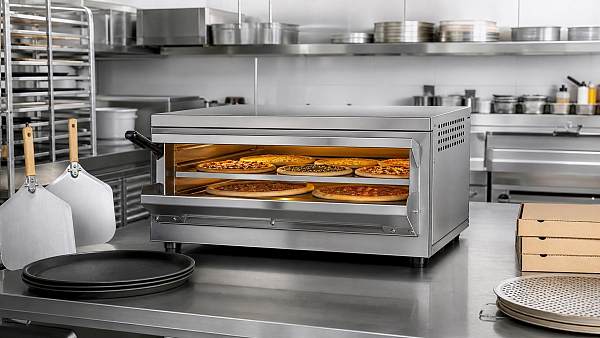
A countertop commercial pizza oven looks compact on a spec sheet, but in service it affects ticket times, menu range, labor flow, and how much room the rest of the line has left to function. That is why procurement teams usually get better results when they begin with demand planning rather than with brand, temperature claims, or exterior dimensions.
The practical question is simple: how many pizzas need to leave the kitchen during the busiest 15 to 30 minutes, and what kind of pizza are you actually baking? A unit that works for reheating thin-crust slices in a cafe may struggle in a hotel bar serving full pies during an event rush. Before comparing models, write down four things: average order size, peak-hour volume, pizza diameter, and target bake time. Without that, buyers often end up purchasing either too much oven for the site or a machine that cannot recover fast enough once the queue builds.
Map the real capacity requirement
Capacity is usually misread because sellers present it in the most flattering way possible: maximum pizza count inside the chamber. That number matters less than usable output per hour under normal service conditions. A countertop commercial pizza oven may physically hold more product than it can bake evenly at speed.
Check these points in order:
- Internal deck or chamber dimensions compared with your actual pizza diameter, not the menu name. A “12-inch pizza” may need more clearance once pans, screens, or loading space are considered.
- Recovery behavior between batches. Fast preheat is useful, but recovery after repeated loading is what protects service speed.
- Whether output is measured for fresh dough, par-baked product, frozen product, or slice finishing. These are not interchangeable workloads.
- How much operator intervention is needed. If staff must rotate pizzas constantly to avoid hot spots, theoretical capacity will never become actual capacity.
A common buying mistake is matching oven capacity to average demand. For procurement, peak demand is the safer design point, especially in hospitality, leisure, and campus environments where traffic can spike suddenly.
Separate bake speed from throughput
Suppliers often talk about bake speed as if it settles the decision. It does not. A very short bake cycle sounds attractive, but it only helps when the oven can maintain consistency over consecutive orders and when the kitchen can load and unload at that pace.
For buyers, the better question is: what throughput can this oven sustain during a realistic rush? That includes loading time, door opening losses, product variation, and staff behavior. Conveyor designs, deck designs, and high-speed impingement styles all behave differently, and the right choice depends on menu and service model more than on headline speed.
If the operation needs repeatable output with mixed-skill staff, consistency often deserves more weight than pure top-end speed.
Measure the installation space like an operator would
Countertop does not mean space-efficient by default. Many installations fail at the final step because the team measured only the footprint. In practice, you need room for door swing, loading clearance, ventilation-related spacing, side access for cleaning, power connection routes, and the movement path of trays, peels, or boxed product.
Ask for the technical drawing and check the full installed envelope, not just width and depth. Then compare it against the actual line layout. In smaller kitchens, the issue is often not whether the oven fits on the counter, but whether staff can work around it without blocking adjacent prep, fry, or pass stations.
Two details get missed often:
- Counter load capacity. A heavier unit may require a reinforced stand rather than a standard worktop.
- Vertical clearance. This matters for stacked units, overhead shelving, heat buildup, and service access.
Match the heat style to the menu
Not every countertop commercial pizza oven produces the same crust result. That matters more than buyers sometimes expect, especially when the venue promises a specific texture or visual finish. A crisp thin base, a pan pizza, a reheated slice, and a premium artisan-style pie place different demands on heat distribution and deck behavior.
Instead of asking which technology is “best,” tie the choice to the product mix:
- If the site runs a narrow menu with one dominant pizza format, optimize around that core product.
- If the oven will also handle garlic bread, flatbreads, reheating, or snack items, review whether the chamber and controls can support that without slowing the main pizza workflow.
- If presentation matters, ask for proof of bake uniformity on the actual product category, not just generic food demos.
This is one of those decisions where menu engineering and equipment sourcing need to be in the same conversation.
Check utilities before comparing prices
A lower purchase price loses its appeal quickly if the site needs electrical upgrades, a different plug configuration, additional ventilation work, or a changed counter arrangement. Procurement should request the electrical data sheet early and have facilities review it against the installation site.
The check is straightforward:
- Confirm the site power supply and available connection type.
- Match that against the oven’s rated electrical requirements on the manufacturer documentation.
- Review whether the installation requires any exhaust arrangement, clearance condition, or dedicated circuit.
- Include those site works in the total acquisition cost before awarding.
For cross-border buying, also check whether the supplied unit version is configured for the destination market rather than assuming all variants are interchangeable.
Look at controls through the lens of labor risk
On paper, advanced controls look like added value. In operation, they are only useful if staff can run them consistently. If the site depends on temporary labor, shift rotation, or multi-role kitchen staff, a simpler control interface with stable presets may outperform a more flexible system that few people use correctly.
Check whether the oven allows separate control of top and bottom heat, whether preset programs can be locked, and how easy it is to recover after a wrong setting is selected. Errors here usually show up as waste and customer complaints, not as obvious equipment failure.
Do not treat energy use as a side note
For a procurement decision, energy use matters in two ways: operating cost and heat load in the kitchen. A unit that runs hot externally or draws heavily during long service windows can create knock-on costs beyond the utility bill, especially in compact hospitality or institutional kitchens.
The practical approach is to compare how the oven is expected to be used, not just its rated power. A site with intermittent orders may value standby efficiency and quick recovery. A high-volume venue may accept higher draw if throughput is materially better. The point is to compare operating profile against service profile, instead of reducing the decision to one number.
Review cleaning and maintenance before the PO goes out
Many countertop ovens are easy to sell and annoying to maintain. Crumb buildup, grease access, removable parts, door seals, and service reach all affect uptime. If maintenance is awkward, staff delay it. Then performance drifts, cleaning time rises, and the oven gets blamed for problems that started with poor maintainability.
Ask for the cleaning routine, recommended intervals, and parts most likely to need replacement. Then check whether those parts can be sourced locally or through a reliable regional channel. This is especially important for distributed groups managing multiple sites, because a low-cost oven becomes expensive if it sits idle waiting for ordinary service parts.
Verify compliance by market and installation context
Compliance should be checked as a document review exercise, not as a marketing claim. The relevant requirements depend on the destination market, the equipment configuration, and the installation environment. Buyers should request the exact technical file for the model being quoted and verify the product identification, electrical rating, and any declared approvals against the destination project requirements.
In practice, that means checking the supplier quotation, model code, rating label details, and the compliance documents attached to that exact unit family. If the purchase is part of a hotel, education, or institutional fit-out, procurement should also compare site-level requirements from the project team against the equipment documentation before release. Generic statements from catalog pages are not enough for a final buying decision.
Compare total ownership cost, not just landed price
When two ovens look close in performance, the better buying choice often comes down to ownership friction. Include installation work, accessories required for normal use, operator training time, cleaning labor, expected service frequency, spare parts availability, and warranty handling process. This gives procurement a more honest comparison than unit price alone.
One more useful test: ask what would interrupt service fastest at this site. If the answer is slow output, buy for throughput. If the answer is lack of space, buy for operational fit. If the answer is mixed-skill labor, buy for repeatability. That framing usually clears up borderline decisions faster than another round of brochure comparisons.
A short decision path that works
A reliable selection process for a countertop commercial pizza oven is usually less complicated than buyers expect. Define peak output first. Check pizza format and menu range. Validate the installed space with working clearances. Review utilities and site constraints. Then compare consistency, recovery, cleaning burden, and service support.
If one model is faster but harder to fit, or larger but harder to run, bring the decision back to the service bottleneck you are trying to remove. That keeps the purchase tied to kitchen performance instead of surface-level specifications, which is where most expensive mistakes begin.
Search News
Hot Articles
- Jewelry Packaging & DisplayHow U.S. Retailers Can Choose Jewelry Displays for Better Security and SalesSep 13, 2026
- Commercial KitchenHow to Size a Restaurant Walk-In Cooler for Peak Inventory and Kitchen LayoutSep 12, 2026
- Musical InstrumentsHow to Choose Touring Instrument Cases for Flights, Trucks, and Daily Load-InsSep 11, 2026
Popular Tags
Need ExpertConsultation?
Connect with our specialized leisureengineering team for procurementstrategies.
Recommended News
 Sep 12, 2026How to Size a Restaurant Walk-In Cooler for Peak Inventory and Kitchen LayoutRestaurant walk in coolers sized for peak inventory and kitchen workflow help improve food safety, staff efficiency, storage access, and long-term operational performance.● Hospitality Sourcing Dir
 Sep 10, 2026How to Choose a CE Hot Dog Roller for Safe, High-Volume Food Service?Choose a CE hot dog roller with confidence: compare compliance documents, heating consistency, cleaning design, capacity, and total cost for safe, high-volume food service.● Hospitality Sourcing Dir
 Sep 04, 2026How to Evaluate a Commercial Food Warmer Manufacturer for Bulk Catering ProjectsCommercial food warmer manufacturer evaluation guide for bulk catering projects: compare thermal performance, compliance, customization, costs, and after-sales support.● Hospitality Sourcing Dir
 Aug 30, 2026How Can Buyers Verify Supplier Qualifications Before a Bulk Order?How to confirm supplier qualifications before placing a bulk order: verify legal identity, factory capability, certificates, samples, quality controls, and payment safeguards.● Hospitality Sourcing Dir
 Aug 28, 2026Commercial Kitchen Design Standards: A Planning Checklist for Code-Compliant LayoutsCommercial kitchen design standards: use this practical checklist to plan safer, code-compliant layouts, streamline approvals, and avoid costly rework.● Hospitality Sourcing Dir
 Aug 06, 2026How to Choose Flake Ice Makers for Seafood Displays, Bars, and Food Prep?Flake ice makers buying guide: compare output, hygiene, storage, energy use, and reliability to choose the best solution for seafood displays, bars, and food prep.● Hospitality Sourcing Dir
 Aug 03, 2026Commercial Kitchen Design Price: What Drives Cost in a New Build Project?Commercial kitchen design price explained: discover what drives cost in a new build, from layout and equipment to ventilation, compliance, and hidden budget risks.● Hospitality Sourcing Dir
 Jul 30, 2026How to Choose a Countertop Commercial Pizza Oven for Capacity, Speed, and Space?Countertop commercial pizza oven buying guide: learn how to match capacity, bake speed, and kitchen space for consistent output, lower costs, and smarter purchasing decisions.● Hospitality Sourcing Dir
 Jul 22, 2026How to Evaluate a Cotton Candy Machine Supplier for Quality, Lead Time, and MOQCotton candy machine supplier selection starts with quality, lead time, and MOQ. Learn how to compare suppliers, reduce sourcing risk, and choose a partner that supports reliable growth.● Hospitality Sourcing Dir
 Jul 21, 2026How to Choose a Charcoal Commercial Grill for Capacity, Heat Control, and Menu FitCharcoal commercial grill buying guide: learn how to match capacity, heat control, and menu fit to boost consistency, service speed, and ROI in commercial kitchens.● Hospitality Sourcing Dir
 Jul 10, 2026FDA Import Alert Adds NSF/ANSI 50-2026 for Commercial Kitchen EquipmentFDA Import Alert now highlights NSF/ANSI 50-2026 for commercial kitchen equipment. Learn how dishwashers, ice machines, and steam cabinets can avoid U.S. port detention.● Hospitality Sourcing Dir
 Jul 05, 2026How to Select Energy Efficient Display Cabinets for Food Retail and HospitalityEnergy efficient display cabinets can cut operating costs while improving food safety, visibility, and service efficiency. Learn how to choose the right model for retail and hospitality.● Hospitality Sourcing Dir
 Jul 04, 2026CPSC Flags New UL 2595 Label Rule for Commercial Ice MakersCPSC flags a new UL 2595 label rule for commercial ice makers entering the U.S. after Aug. 1, 2026. Learn who is affected, key compliance steps, and how to avoid port delays and recall risk.● Hospitality Sourcing Dir
 Jun 29, 2026How to Choose Thermal Receipt Printers for Retail and Restaurant CountersThermal receipt printers for retail and restaurant counters: learn how to compare speed, durability, connectivity, and total operating cost to choose a model that supports smoother service.● Hospitality Sourcing Dir
 Jun 28, 2026Stainless Steel Kitchen Ventilation Systems: Key Specifications for Commercial ProjectsStainless steel kitchen ventilation systems: compare material grades, airflow capture, hygiene, fire safety, and installation specs for commercial projects before you buy.● Hospitality Sourcing Dir
 Jun 27, 2026Commercial Shawarma Machines: What to Check Before Buying for High-Volume ServiceShawarma machines commercial buying guide: learn how to compare capacity, heat control, durability, compliance, and lifecycle cost before choosing equipment for high-volume service.● Hospitality Sourcing Dir
 Jun 26, 2026Restaurant POS Systems: How to Compare Features, Costs, and ScalabilityRestaurant POS systems: compare features, costs, and scalability to find the best fit for your restaurant and boost long-term efficiency.● Hospitality Sourcing Dir
 Jun 25, 2026Kitchen Ventilation Systems Design: How to Size Hoods, Airflow, and Make-Up AirKitchen ventilation systems design explained clearly: learn how to size hoods, set exhaust airflow, and balance make-up air for safer, more efficient commercial kitchens.● Hospitality Sourcing Dir
 Jun 14, 2026Hot Dog Rollers for Convenience Stores and Cafes: Capacity, Heating Zones, and Cleaning TipsHot dog rollers buying guide for convenience stores and cafes: compare real capacity, heating zones, energy use, and cleaning tips to choose a smarter, lower-waste setup.● Hospitality Sourcing Dir
 Jun 13, 2026Commercial Milkshake Mixers vs Blenders: Which Is Better for High-Volume Service?Commercial milkshake mixers or blenders—which suits high-volume service better? Compare texture, speed, consistency, and cost to choose the right machine.● Hospitality Sourcing Dir
 Jun 12, 2026Blast Chillers Commercial Buying Guide: Capacity, Cooling Rate, and Kitchen Workflow FitBlast chillers commercial buying guide covering capacity, cooling rate, and workflow fit. Learn how to choose safer, faster, audit-ready equipment for real kitchen performance.● Hospitality Sourcing Dir
 Jun 10, 2026How to Choose Sushi Display Cases for Temperature Control, Visibility, and Counter SpaceSushi display cases buying guide: learn how to compare temperature control, product visibility, and counter space to choose safer, smarter, and more profitable commercial solutions.● Hospitality Sourcing Dir
 Jun 08, 2026How to Choose Commercial Bread Slicers for Bakeries, Cafes, and Foodservice KitchensCommercial bread slicers buying guide for bakeries, cafes, and foodservice kitchens. Compare capacity, slice consistency, safety, cleaning, and supplier support to choose with confidence.● Hospitality Sourcing Dir
 Jun 06, 2026Dough Sheeters Wholesale Buying Guide: Roller Width, Capacity, and Safety FeaturesDough sheeters wholesale buying guide: compare roller width, real capacity, and safety features to choose a reliable machine for bakeries, hotels, and foodservice operations.● Hospitality Sourcing Dir