How to Select a Spiral Dough Mixer for Bakery Batch Size and Dough Hydration
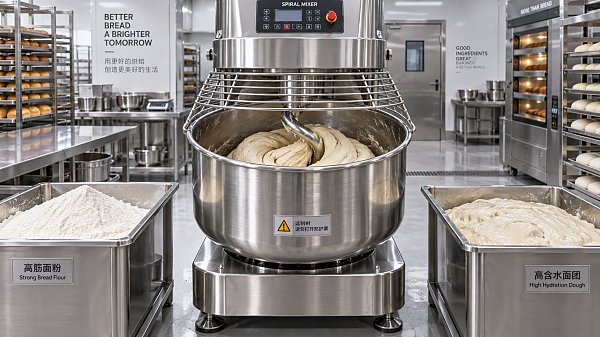
Select the mixer from the smallest routine dough load and the most demanding dough formula, then confirm that its usable capacity also supports the largest planned production run. A spiral mixer that performs well only near its maximum rated bowl load can struggle during small batches; one chosen only for a single low-hydration dough can overheat or under-develop softer products. Bowl volume, flour capacity, motor rating, spiral geometry, bowl speed, and control functions must be read together.
For bread, pizza, laminated yeast dough, bagel dough, and enriched dough, hydration changes the mechanical load more sharply than a bowl-capacity label suggests. Low-hydration dough resists the spiral and demands torque. High-hydration dough moves more freely but can climb the hook, smear along the bowl, or reach its desired gluten development faster than expected. The suitable machine is therefore defined by the production mix, not by the largest dough mass listed in a catalog.
Start with flour weight rather than nominal bowl volume
A mixer bowl described in liters or quarts does not state how much dough it can mix reliably. Dough density varies by formula, hydration, inclusions, fermentation stage, and mixing method. Flour weight is the more useful baseline because dough formulas are normally expressed as baker's percentages and because the mechanical work imposed on the machine begins with the flour-and-water mass.
Calculate the expected dough weight from the flour charge and total formula percentage. For example, a dough at 65% water plus salt, yeast, and minor ingredients weighs substantially more than its flour weight. Oil, sugar, eggs, milk solids, seeds, dried fruit, and inclusions further raise total bowl weight while changing the way the dough moves. The machine specification should state both its maximum flour capacity and its maximum dough capacity for the intended dough category. If a listing gives only bowl volume or total dough capacity, request the tested flour quantity and hydration range.
Minimum capacity matters just as much. A large spiral mixer can leave a small dough piece rolling around the bowl without receiving enough mechanical action from the spiral. This produces uneven hydration, unmixed flour at the bowl edge, or a dough mass that repeatedly rides up the hook rather than being stretched and folded. A practical operating range should cover the normal daily batch, not merely an occasional high-output run.
Translate the production schedule into batch size
Do not size the mixer by total daily flour consumption alone. Divide output into actual mixing cycles: the number of dough types, proofing windows, oven loading rhythm, cooling space, and the need for dough between scheduled runs all affect batch size. A single large batch is efficient only when downstream scaling, dividing, resting, shaping, and proofing can absorb it without creating a queue.
A bakery producing several dough styles in short windows often needs a mixer that is well matched to medium batches and fast changeovers. A large machine may have enough capacity but still create delays when the bowl must be cleaned between formulas, when one dough needs a longer final mix, or when another must be removed immediately to avoid excess dough temperature. Conversely, a compact mixer with a short cycle may meet a moderate output target if its bowl capacity aligns with the divider and fermentation schedule.
Build the capacity calculation around the heaviest regular batch, then review the lightest routine batch. Include expected process loss only where it is actually measured; avoid adding arbitrary margin that pushes the selected bowl beyond its minimum effective load. Expansion should be addressed separately. A model that is already operated at its stated limit with a stiff dough leaves little room for a larger formula or a hotter production day. A moderate reserve is useful when it remains inside the machine's documented operating range.
Hydration determines the type of load
Hydration is often treated as a recipe number, yet it is also a direct mixer-selection variable. Water lubricates movement within the dough mass. As hydration drops, the dough becomes firmer, travels more slowly around the bowl, and requires the spiral to exert greater force for each fold. Bagel-style, pretzel, cracker, and certain pizza doughs can therefore be more demanding than a larger quantity of standard pan-bread dough.
Motor power alone does not settle the question. Two machines with similar motor ratings can differ in gearbox design, belt or chain arrangement, spiral speed, bowl rotation, transmission durability, and overload protection. Ask whether the stated capacity applies to stiff dough, standard bread dough, or a soft dough. Also establish whether the maximum is a one-off limit or an appropriate load for consecutive batches. Repeated stiff mixing creates heat in the dough and stress in bearings, shafts, belts, and drive components even when the machine completes an individual cycle.
High-hydration dough requires a different form of control. It may reach sufficient development quickly at higher speed, then lose structure if mixing continues without adjustment. A two-speed spiral design or programmable mixing stages allow a slow incorporation phase followed by controlled development. This is particularly useful where flour absorption changes from delivery to delivery or where cold water, pre-ferments, and chilled ingredients affect dough behavior. Time settings should be repeatable, but the mixer should also permit a production supervisor to stop the cycle based on dough condition rather than forcing every formula through one fixed duration.
Use the most difficult formula as the first filter
List dough families by hydration, fat and sugar level, inclusion load, target finished dough temperature, and batch frequency. The most difficult formula is not always the lowest-hydration one. A small stiff dough may fall below the minimum load of a large machine. A dough containing seeds, grains, nuts, or dried fruit requires careful timing because ingredients added too early can damage the dough structure or create uneven distribution. Rich doughs may appear soft but develop differently as butter, eggs, and sugar are incorporated.
When formulas vary widely, separate the evaluation into workable ranges. One spiral mixer may cover standard bread and medium-hydration pizza dough efficiently while a smaller unit is needed for test batches, specialty products, or low-volume enriched dough. Expecting one oversized machine to handle every formula can increase rework and reduce consistency.
Read speeds, mixing action, and dough temperature together
A spiral mixer develops dough through the interaction of a rotating bowl and spiral hook. The bowl carries the dough around the spiral, while the spiral stretches and folds the mass. This action is generally well suited to yeast-raised dough because it develops gluten with less aggressive beating than a planetary mixer. That advantage depends on the dough remaining engaged with both moving elements.
Compare the number of bowl and spiral speeds, but do not assume more speed is always better. A slow first stage should incorporate flour and water cleanly before stronger development begins. A faster stage reduces mixing time, yet it also adds frictional heat. If finished dough temperature rises above the formula target, fermentation can accelerate, handling can change, and product consistency may drift from batch to batch. The apparent solution is sometimes to shorten the cycle, but insufficient development can then show up as weak volume or poor machining performance.
Ask for the actual mixing sequence recommended for representative formulas, including low-hydration dough. The answer should distinguish incorporation time from development time and state whether the bowl reverses, whether speeds can be changed during a cycle, and how the timer behaves after a pause. A machine with a digital controller is useful only when settings remain understandable during daily production and when manually adjusted programs do not compromise repeatability.
A dough temperature measurement at discharge is more informative than relying on motor temperature or mixing duration. During evaluation, record ingredient temperature, room temperature, mix time, dough temperature, and observed dough condition for comparable test batches. This identifies whether a variation is caused by the mixer setting, water temperature, flour absorption, or a change in batch mass. Similar-looking sticky dough can result from excessive development, warm dough, under-absorption, or delayed addition of ingredients; changing speed without identifying the cause can conceal the problem rather than resolve it.
Assess the bowl, head, and discharge arrangement
Fixed-bowl spiral mixers are compact and often suitable where batches are manually removed or transferred with a dough trough. Removable-bowl systems support higher throughput because a second bowl can be prepared while another batch is mixed, and the bowl can move to dividing or resting areas. The gain depends on the floor layout. A removable bowl adds handling equipment, clearance needs, parking space, and a defined route that does not obstruct ovens, proofers, or cleaning access.
Check the working height of the bowl rim, the reach needed to remove dough, and whether the machine geometry suits the planned discharge method. A large fixed bowl can be difficult to empty cleanly, leaving dough trapped around the spiral or under the breaker bar. Bowl tippers and lifting equipment need compatible attachment points and sufficient overhead clearance. Small installation details affect changeover time more than a capacity figure does.
The breaker bar, sometimes fixed at the bowl edge, improves dough circulation on many spiral designs. Its position and clearance influence how small batches behave and whether dough collects in a dead zone. Request demonstration footage or a live test using a close formula and realistic batch size. Empty-bowl rotation or a demonstration with a generic soft dough does not reveal performance under a firm, production-weight dough.
Construction details that affect sanitation and service
Food-contact surfaces should be smooth, durable, and accessible for cleaning. Stainless steel is common for bowls, spirals, and exterior panels, but the relevant question is where residue can collect: behind guards, around bowl drive interfaces, below the head, and at seams or fasteners. Flour dust and dough fragments become harder to remove when access requires tools or when components cannot be safely reached after isolating power.
A safety guard should permit normal ingredient additions without exposing moving parts. Its interlock must stop the mixing action consistently when opened and resume only through the intended control sequence. Review the guard shape with the actual loading method. A design that technically allows access can still slow production if bags, tubs, or ingredient containers cannot be positioned without interference.
- Inspect whether the bowl drive, spiral shaft, and transmission points have a clear service procedure, including access to wear components.
- Confirm the electrical supply, frequency, phase, plug or hardwired connection, and isolation arrangement before delivery. Motor suitability cannot be inferred from a photograph or model name.
- Measure the installation route as well as the final footprint. Doorways, turns, ramps, floor loading, and required lifting equipment can determine which frame size is practical.
- Review the cleaning routine after both lean and enriched dough. A machine that is quick to wipe down after bread dough may require more attention after high-fat formulas.
Test against a written acceptance standard
The most reliable comparison is a controlled test using the relevant flour, hydration, batch weight, and ingredient order. Set an acceptance standard before the test: clean incorporation, appropriate development, repeatable discharge temperature, no persistent dough climbing, no abnormal drive noise, and no visible flour pockets after the planned cycle. For mixed product ranges, run more than one formula instead of asking a single dough to represent every condition.
Document the test conditions precisely. Record the machine model, bowl size, flour quantity, total dough weight, hydration, mix-stage times, selected speeds, ingredient temperatures, and final dough temperature. If the test uses a recipe that differs from production, note the difference rather than treating the result as directly transferable. A machine that handles a soft demonstration dough may not be suitable for a smaller, stiffer routine batch.
Selection is complete when the chosen capacity works across the intended batch range, the drive is suited to the hardest recurring dough, and the layout supports loading, discharge, cleaning, and service without creating delays elsewhere in the bakery. Those conditions produce a more dependable result than selecting the largest bowl or the highest stated motor rating alone.
Search News
Hot Articles
- Jewelry Packaging & DisplayHow to Evaluate a Luxury Retail Packaging Supplier for Premium Brand ConsistencySep 20, 2026
- Commercial KitchenHow to Select a Spiral Dough Mixer for Bakery Batch Size and Dough HydrationSep 19, 2026
- Outdoor RidesWhat Drives Animatronic Dinosaur Manufacturer Prices for Theme Park Projects?Sep 18, 2026
Popular Tags
Need ExpertConsultation?
Connect with our specialized leisureengineering team for procurementstrategies.
Recommended News
 Sep 19, 2026How to Select a Spiral Dough Mixer for Bakery Batch Size and Dough HydrationSpiral dough mixer bakery guide: match batch size, flour load, and hydration to select reliable torque, temperature control, and consistent dough results.● Hospitality Sourcing Dir
 Sep 14, 2026How Restaurants Can Choose Disposable Wooden Cutlery for Takeout and CateringDisposable wooden cutlery fork spoon knife guide for restaurants: compare strength, finish, packaging, food-contact needs, and catering performance.● Hospitality Sourcing Dir
 Sep 12, 2026How to Size a Restaurant Walk-In Cooler for Peak Inventory and Kitchen LayoutRestaurant walk in coolers sized for peak inventory and kitchen workflow help improve food safety, staff efficiency, storage access, and long-term operational performance.● Hospitality Sourcing Dir
 Sep 10, 2026How to Choose a CE Hot Dog Roller for Safe, High-Volume Food Service?Choose a CE hot dog roller with confidence: compare compliance documents, heating consistency, cleaning design, capacity, and total cost for safe, high-volume food service.● Hospitality Sourcing Dir
 Sep 04, 2026How to Evaluate a Commercial Food Warmer Manufacturer for Bulk Catering ProjectsCommercial food warmer manufacturer evaluation guide for bulk catering projects: compare thermal performance, compliance, customization, costs, and after-sales support.● Hospitality Sourcing Dir
 Aug 30, 2026How Can Buyers Verify Supplier Qualifications Before a Bulk Order?How to confirm supplier qualifications before placing a bulk order: verify legal identity, factory capability, certificates, samples, quality controls, and payment safeguards.● Hospitality Sourcing Dir
 Aug 28, 2026Commercial Kitchen Design Standards: A Planning Checklist for Code-Compliant LayoutsCommercial kitchen design standards: use this practical checklist to plan safer, code-compliant layouts, streamline approvals, and avoid costly rework.● Hospitality Sourcing Dir
 Aug 06, 2026How to Choose Flake Ice Makers for Seafood Displays, Bars, and Food Prep?Flake ice makers buying guide: compare output, hygiene, storage, energy use, and reliability to choose the best solution for seafood displays, bars, and food prep.● Hospitality Sourcing Dir
 Aug 03, 2026Commercial Kitchen Design Price: What Drives Cost in a New Build Project?Commercial kitchen design price explained: discover what drives cost in a new build, from layout and equipment to ventilation, compliance, and hidden budget risks.● Hospitality Sourcing Dir
 Jul 30, 2026How to Choose a Countertop Commercial Pizza Oven for Capacity, Speed, and Space?Countertop commercial pizza oven buying guide: learn how to match capacity, bake speed, and kitchen space for consistent output, lower costs, and smarter purchasing decisions.● Hospitality Sourcing Dir
 Jul 22, 2026How to Evaluate a Cotton Candy Machine Supplier for Quality, Lead Time, and MOQCotton candy machine supplier selection starts with quality, lead time, and MOQ. Learn how to compare suppliers, reduce sourcing risk, and choose a partner that supports reliable growth.● Hospitality Sourcing Dir
 Jul 21, 2026How to Choose a Charcoal Commercial Grill for Capacity, Heat Control, and Menu FitCharcoal commercial grill buying guide: learn how to match capacity, heat control, and menu fit to boost consistency, service speed, and ROI in commercial kitchens.● Hospitality Sourcing Dir
 Jul 10, 2026FDA Import Alert Adds NSF/ANSI 50-2026 for Commercial Kitchen EquipmentFDA Import Alert now highlights NSF/ANSI 50-2026 for commercial kitchen equipment. Learn how dishwashers, ice machines, and steam cabinets can avoid U.S. port detention.● Hospitality Sourcing Dir
 Jul 05, 2026How to Select Energy Efficient Display Cabinets for Food Retail and HospitalityEnergy efficient display cabinets can cut operating costs while improving food safety, visibility, and service efficiency. Learn how to choose the right model for retail and hospitality.● Hospitality Sourcing Dir
 Jul 04, 2026CPSC Flags New UL 2595 Label Rule for Commercial Ice MakersCPSC flags a new UL 2595 label rule for commercial ice makers entering the U.S. after Aug. 1, 2026. Learn who is affected, key compliance steps, and how to avoid port delays and recall risk.● Hospitality Sourcing Dir
 Jun 29, 2026How to Choose Thermal Receipt Printers for Retail and Restaurant CountersThermal receipt printers for retail and restaurant counters: learn how to compare speed, durability, connectivity, and total operating cost to choose a model that supports smoother service.● Hospitality Sourcing Dir
 Jun 28, 2026Stainless Steel Kitchen Ventilation Systems: Key Specifications for Commercial ProjectsStainless steel kitchen ventilation systems: compare material grades, airflow capture, hygiene, fire safety, and installation specs for commercial projects before you buy.● Hospitality Sourcing Dir
 Jun 27, 2026Commercial Shawarma Machines: What to Check Before Buying for High-Volume ServiceShawarma machines commercial buying guide: learn how to compare capacity, heat control, durability, compliance, and lifecycle cost before choosing equipment for high-volume service.● Hospitality Sourcing Dir
 Jun 26, 2026Restaurant POS Systems: How to Compare Features, Costs, and ScalabilityRestaurant POS systems: compare features, costs, and scalability to find the best fit for your restaurant and boost long-term efficiency.● Hospitality Sourcing Dir
 Jun 25, 2026Kitchen Ventilation Systems Design: How to Size Hoods, Airflow, and Make-Up AirKitchen ventilation systems design explained clearly: learn how to size hoods, set exhaust airflow, and balance make-up air for safer, more efficient commercial kitchens.● Hospitality Sourcing Dir
 Jun 14, 2026Hot Dog Rollers for Convenience Stores and Cafes: Capacity, Heating Zones, and Cleaning TipsHot dog rollers buying guide for convenience stores and cafes: compare real capacity, heating zones, energy use, and cleaning tips to choose a smarter, lower-waste setup.● Hospitality Sourcing Dir
 Jun 13, 2026Commercial Milkshake Mixers vs Blenders: Which Is Better for High-Volume Service?Commercial milkshake mixers or blenders—which suits high-volume service better? Compare texture, speed, consistency, and cost to choose the right machine.● Hospitality Sourcing Dir
 Jun 12, 2026Blast Chillers Commercial Buying Guide: Capacity, Cooling Rate, and Kitchen Workflow FitBlast chillers commercial buying guide covering capacity, cooling rate, and workflow fit. Learn how to choose safer, faster, audit-ready equipment for real kitchen performance.● Hospitality Sourcing Dir
 Jun 10, 2026How to Choose Sushi Display Cases for Temperature Control, Visibility, and Counter SpaceSushi display cases buying guide: learn how to compare temperature control, product visibility, and counter space to choose safer, smarter, and more profitable commercial solutions.● Hospitality Sourcing Dir