How to Evaluate a Luxury Retail Packaging Supplier for Premium Brand Consistency
Luxury Packaging Is a Brand-Control Decision, Not a Buying Detail
In premium retail, packaging is often the last physical brand touchpoint before a customer leaves the store—and the first one they revisit at home. A rigid gift box with uneven foil, a shopping bag whose handles loosen under normal use, or a ribbon shade that varies between regions can quietly undermine the care invested in the product itself.
That is why selecting a luxury retail packaging supplier should not be treated as a simple comparison of materials, unit prices, and lead times. For procurement teams, the decision sits at the intersection of brand governance, manufacturing control, environmental requirements, retail operations, and international supply continuity.
The best supplier relationship is not necessarily with the factory that produces the most decorative sample. It is with the partner that can reproduce approved brand standards reliably—across repeat orders, product categories, seasonal launches, markets, and changing demand levels. This guide offers a practical way to evaluate that capability before a packaging issue reaches a flagship store, a customer unboxing video, or a regional distribution center.
Start with the Definition of “Consistent” for Your Brand
Many sourcing briefs describe packaging as “premium,” “elegant,” or “high quality.” Those terms are useful creatively but difficult to inspect. Before contacting suppliers, convert the brand team’s intent into measurable acceptance standards.
For a luxury jewelry house, consistency may mean exact color matching across small presentation boxes, carrier bags, pouches, and authentication-card sleeves. For a prestige beauty retailer, it may mean that cartons retain sharp edges, metallic details remain clean, and surfaces resist scuffing through distribution and in-store handling. A hotel gift program may prioritize quiet, refined material choices alongside flat-pack efficiency and dependable replenishment.
Procurement should ask internal stakeholders to distinguish between non-negotiable visual cues and acceptable production variation. Build a short hierarchy:
- Brand-critical details: logo position, typography, trademark color, texture, foil tone, closure style, and the unboxing sequence.
- Functional requirements: load capacity, stacking strength, opening and closing performance, product protection, and shelf or counter presentation.
- Operational requirements: pack-out method, barcode placement, storage footprint, order quantities, delivery windows, and regional fulfillment needs.
- Responsible sourcing requirements: material traceability, recyclability claims, restricted-substance controls, and documentation expected in target markets.
This work prevents a common failure: approving an impressive prototype without defining how that prototype will be controlled in production. A sample is evidence of possibility. A documented specification is the beginning of repeatability.
Evaluate Manufacturing Depth, Not Just the Sample Room
Luxury packaging is made through a chain of processes that may include paper selection, board conversion, printing, laminating, foil stamping, embossing, die cutting, hand assembly, lining, magnet fitting, ribbon attachment, and final packing. A supplier can excel at one process while relying heavily on outside partners for others. Outsourcing is not automatically a concern, but it must be visible and managed.
Ask each candidate to map the actual production route for your proposed packaging formats. Which operations are completed in-house? Which are subcontracted? Who owns the quality check between those stages? How are subcontractors approved, audited, and held accountable when a component does not match the master standard?
A capable luxury retail packaging supplier should be able to explain production constraints in plain language. For example, they should identify whether a particular paper stock may create foil-registration risk, whether a dark uncoated board is prone to fingerprinting, or whether a magnetic closure design requires additional curing time before packing. Suppliers who only say “no problem” at the quotation stage can create expensive uncertainty later.
What to inspect during a factory or virtual audit
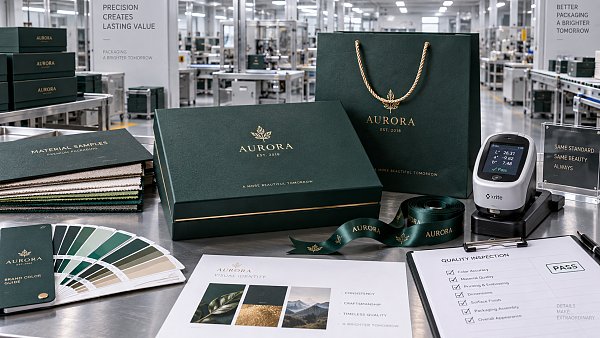
Whether the audit is in person or remote, focus less on polished presentation boards and more on the movement of work through the facility. Observe how incoming paper, board, fabric, adhesives, hardware, and printed components are identified. Look for separation between approved, pending, and rejected materials. Check whether approved color standards, dielines, and production instructions are accessible at the workstation rather than stored only in a sales office.
Also examine the finishing and assembly areas closely. Fine details are where premium packaging either holds together or falls apart: clean corners on wrapped rigid boxes, centered inserts, consistent ribbon lengths, smooth glue application, undamaged edges, and dust-free surfaces. If significant handwork is involved, ask how operators are trained and how the supplier maintains consistency across shifts and peak seasons.
Turn Aesthetic Approval into a Real Quality-Control System
Premium packaging can be rejected for details that might be acceptable in mass-market retail. A logo may technically be present but positioned slightly off-center. The correct Pantone reference may have been used, yet the finished surface may appear different under warm boutique lighting. A rigid box may pass a basic visual check but reveal poor wrapping alignment once displayed beside a prior production batch.
For this reason, quality control should be evaluated in three layers: standards, inspection, and escalation.
1. Standards: establish a controlled “golden sample”
Every approved format should have a retained physical standard, supported by signed artwork, material callouts, finish specifications, tolerances, and clear photographs of critical details. For color-sensitive projects, define the lighting conditions and measurement approach used for approval. For complex gift packaging, document the correct assembly sequence and the way the product should sit inside the pack.
The supplier should have a process for version control. Brand updates happen: a logo is refined, a new paper is approved, a sustainability requirement changes, or a seasonal colorway is introduced. Without disciplined revision management, older artwork or obsolete components can reappear unexpectedly in later orders.
2. Inspection: ask where checks happen, not merely whether they exist
End-of-line inspection alone is rarely enough. Effective control begins with incoming materials, continues during printing and finishing, and includes final random inspection before shipment. Ask suppliers to describe their sampling plans and the defects they classify as critical, major, or minor. Their definitions should align with your brand’s tolerance for visible flaws.
Useful questions include:
- How is color checked between initial press approval and the production run?
- How are foil registration, embossing depth, and logo placement verified?
- What tests are used for handles, closures, inserts, and load-bearing bags?
- How do you inspect for glue marks, scratches, odor, edge damage, and surface contamination?
- What records accompany a shipment when a buyer requests pre-shipment inspection evidence?
3. Escalation: test how the supplier handles an imperfect batch
Every manufacturer encounters variation. The meaningful difference is how early it is identified and how transparently it is communicated. Ask for an anonymized example of a nonconformance process: how the issue was contained, whether root cause was identified, what corrective action followed, and how recurrence was prevented.
Procurement teams should be wary of suppliers who promise zero defects without describing controls. A more credible partner acknowledges production realities while demonstrating a rigorous method for protecting the approved standard.
Material Expertise Should Support Both Luxury and Practical Use
The material decision is more complex than choosing between paper, fabric, or board. Each choice affects appearance, durability, transport behavior, cost stability, environmental claims, and the customer’s tactile impression.
Consider a matte black shopping bag. It may look restrained and sophisticated in a concept presentation, but it can show scratches, fingerprints, and pressure marks in busy retail environments. A soft-touch laminate can elevate the feel while complicating recyclability or creating scuff sensitivity. Natural, uncoated paper may support a more responsible material story but requires careful print and color management. None of these choices is inherently right or wrong; they need to match the intended experience and operating conditions.
Ask suppliers to provide material samples that have been handled, packed, transported, and exposed to realistic retail use—not only pristine swatches. Where relevant, request testing for rub resistance, compression, humidity response, odor, migration risk, and product-contact suitability. This is especially important for fragrance, cosmetics, food gifts, delicate accessories, and jewelry presentation packaging.
Environmental positioning deserves the same discipline. Terms such as “eco-friendly,” “recyclable,” and “plastic-free” can be misleading when adhesives, laminates, magnets, metalized films, or mixed-material components are involved. A supplier should explain the composition of the finished pack, not merely the origin of one visible material. They should also be able to provide the documentation required to support claims in your sales regions.
Check Whether Scale Will Dilute the Premium Result
A supplier may deliver 500 beautiful boxes for a launch event and struggle to maintain the same finish across 100,000 units for a multi-market rollout. Scale is not only a matter of machine capacity. It involves labor planning, material allocation, mold and tooling control, quality staffing, warehouse management, and communication between production sites.
Discuss your expected annual demand, seasonal peaks, launch calendar, and possible replenishment pattern early. If your business has volatile demand, ask how the supplier handles forecast changes. Can they reserve key materials? What lead time applies to repeat orders versus new developments? Is there a minimum order quantity that would force the brand to overstock packaging that may later be revised?
For global brands, consistency across regions needs particular attention. A single-source model can offer tighter control but may increase geographic risk. A multi-site or regional supply model can shorten delivery routes but requires careful harmonization of machinery, materials, approved samples, and inspection criteria. Do not assume that identical artwork guarantees identical packaging from different plants.
Request a continuity plan for foreseeable disruptions: material shortages, port congestion, equipment downtime, regulatory changes, and sudden demand spikes. The goal is not to eliminate every risk. It is to understand who makes decisions, how quickly alternatives are qualified, and whether substitutions can occur only after formal brand approval.
Compare Total Landed Risk, Not the Unit Price Alone
Luxury packaging procurement often becomes difficult when finance sees a lower unit quote while brand teams see a risk to presentation. Both views are valid, but neither is sufficient by itself. The useful comparison is total landed risk: the full commercial impact of buying, storing, inspecting, shipping, and potentially replacing packaging.
A lower-cost quote may use thinner board, less robust handles, less stable finishes, or a production plan that leaves little room for rework. Conversely, an expensive solution may add decorative elements that do not improve customer perception or retail performance. Ask suppliers to quote transparently, separating tooling, development, materials, finishing, assembly, packing, freight assumptions, and any services related to inspection or storage.
Then evaluate the commercial implications of defect exposure. What happens if a shipment fails inspection? Who bears the cost of rework, air freight, disposal, or replacement? What credit terms, liability limits, and dispute procedures apply? A well-written supplier agreement cannot prevent errors, but it can prevent a preventable problem from becoming a crisis during a store opening or holiday launch.
A Practical Supplier Scorecard for Procurement Teams
When several suppliers appear capable, a weighted scorecard helps separate polished sales claims from decision-relevant evidence. The precise weighting will vary by category, but the following areas usually deserve consideration:
Score each category against evidence collected through samples, site visits, technical discussions, reference checks where appropriate, and a controlled pilot order. A supplier should not win solely because they are the lowest bidder or because their first sample is the most visually dramatic.
Use a Pilot Order to Reveal What Presentations Cannot
Before committing to a broad rollout, place a pilot order that is large enough to expose real production conditions. Inspect units from different cartons, production times, and, where possible, different operators or shifts. Simulate the journey: warehouse handling, shipment, store delivery, assembly, customer use, and disposal or recycling.
Collect feedback from the people who experience the packaging beyond the boardroom: visual merchandising teams, store associates, fulfillment staff, and regional logistics partners. They may identify issues that a brand approval meeting misses, such as bags that are awkward to stack, tissue paper that tears during packing, boxes that take too long to assemble, or inserts that shift in transit.
Global Commercial Trade’s sourcing perspective across luxury accessories, hospitality, specialty retail, and commercial environments reinforces a simple principle: premium experiences depend on disciplined details. The strongest packaging programs bring creative, procurement, operations, and compliance teams into the evaluation early, rather than asking packaging to solve conflicting priorities at the final stage.
The Final Question: Can This Supplier Protect the Brand When Conditions Change?
The most dependable luxury retail packaging supplier is not just a maker of boxes, bags, and wrapping. They are a controlled extension of the brand’s physical identity. They understand which details carry emotional value, which technical features protect the product, and which operational disciplines keep the result consistent when demand grows or circumstances shift.
Before selecting a partner, look beyond the showroom sample. Confirm how standards are translated to the production floor, how variation is measured, how materials are managed, and how problems are resolved. If a supplier can answer those questions with clarity—and validate the answers through a pilot order—you are far more likely to preserve the quiet confidence that premium packaging is meant to communicate.
Search News
Hot Articles
- Jewelry Packaging & DisplayHow to Evaluate a Luxury Retail Packaging Supplier for Premium Brand ConsistencySep 20, 2026
- Commercial KitchenHow to Select a Spiral Dough Mixer for Bakery Batch Size and Dough HydrationSep 19, 2026
- Outdoor RidesWhat Drives Animatronic Dinosaur Manufacturer Prices for Theme Park Projects?Sep 18, 2026
Popular Tags
Need ExpertConsultation?
Connect with our specialized leisureengineering team for procurementstrategies.
Recommended News
 Sep 20, 2026How to Evaluate a Luxury Retail Packaging Supplier for Premium Brand ConsistencyLuxury retail packaging supplier evaluation guide: protect premium brand consistency with proven quality control, material expertise, scalable production, and supply reliability.● Luxury Retail Analyst
 Sep 13, 2026How U.S. Retailers Can Choose Jewelry Displays for Better Security and SalesJewelry displays USA retailers can use to balance security, product visibility, and sales performance. Explore practical selection tips for cases, lighting, materials, and suppliers.● Luxury Retail Analyst
 Aug 18, 2026How to Choose Retail Display Fixtures for Boutiques by Layout, Product Mix, and Brand StyleRetail display fixtures for boutiques should match layout, product mix, and brand style. Learn how to choose flexible, durable displays that improve flow, elevate presentation, and support sales.● Luxury Retail Analyst
 Jul 23, 2026Acrylic Jewelry Display Stands Price Guide: What Affects Cost and Bulk Buying Value?Acrylic jewelry display stands price explained: compare thickness, finish, customization, and bulk order value to cut sourcing risk and choose better retail displays.● Luxury Retail Analyst
 Jul 13, 2026France and Belgium Extend EPR to Jewelry Display PackagingFrance and Belgium extend EPR to jewelry display packaging from Oct 1, 2026. Learn how registration, recycling fees, and customs risks may impact exporters and sellers.● Luxury Retail Analyst
 Jul 08, 2026EU PPWR EPR Rules Take Effect for Jewelry PackagingEU PPWR EPR rules take effect for jewelry packaging on July 8, 2026. Learn key compliance risks, reporting duties, and how exporters can protect EU market access.● Luxury Retail Analyst
 Jul 07, 2026EU EN 71-3:2026 Tightens Lead Limit to 0.05%EU EN 71-3:2026 Tightens Lead Limit to 0.05%—learn how the new 500 ppm rule affects exports, metal components, compliance documents, and EU shipment readiness.● Luxury Retail Analyst
 Jul 05, 2026EN 71-3:2026 Tightens Heavy Metal Limits for Jewelry PackagingEN 71-3:2026 tightens heavy metal limits for jewelry packaging in the EU. Learn what exporters, importers, and suppliers must do before October 1, 2026 to stay compliant.● Luxury Retail Analyst
 Jun 29, 2026EU EPR Rule Takes Effect July 1 for Jewelry PackagingEU EPR Rule Takes Effect July 1 for Jewelry Packaging—learn how PPWR-linked registration, annual packaging reporting, and EU compliance checks may impact exporters, sellers, and supply chains.● Luxury Retail Analyst
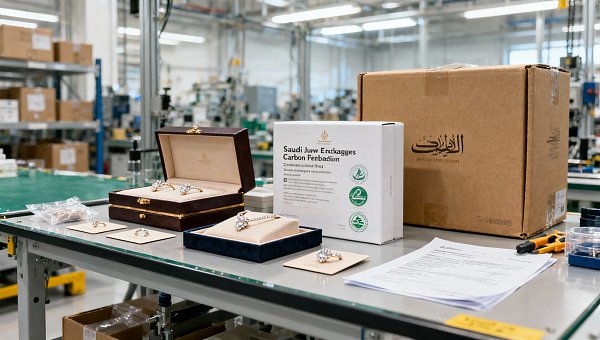
 Jun 28, 2026Saudi Carbon Label Rule Hits Jewelry Packaging by Q3 2026Jewelry Packaging faces Saudi carbon label rules by Q3 2026. Learn SASO compliance deadlines, LCA certification steps, labeling impact, and how exporters can avoid shipment delays.● Luxury Retail Analyst
 Jun 27, 2026SASO Sets Carbon Label Rule for Jewelry PackagingSASO Sets Carbon Label Rule for Jewelry Packaging: learn how Saudi Arabia’s new carbon footprint and LCA requirement will impact exporters, packaging suppliers, and delivery timelines before the 2026 deadline.● Luxury Retail Analyst
 Apr 27, 2026Luxury Jewelry for Commercial Spaces ExplainedLuxury jewelry for commercial spaces explained: compare custom jewelry design, luxury jewelry wholesale, and reliable luxury jewelry manufacturer solutions for hotels, retail, and B2B buyers.● Luxury Retail Analyst
 Apr 18, 2026Luxury jewelry packaging: When minimalist boxes backfire on shelf appealTrampoline park, indoor playground & adventure playground packaging demands? Discover why luxury jewelry boxes fail—and how to fix shelf appeal across arcade games, musical instruments & office supplies.● Luxury Retail Analyst
 Apr 17, 2026Why luxury jewelry display cases matter more than you thinkLuxury jewelry display cases elevate trampoline parks, indoor playgrounds, arcade games & adventure playgrounds—boosting brand value, safety, and engagement.● Luxury Retail Analyst
 Apr 16, 2026Supply chain solutions for jewelry packaging: How lead time variance breaks seasonal launchesSupply chain solutions for jewelry packaging: Cut lead time variance, ensure on-time seasonal launches for designer eyewear, OEM manufacturing & luxury goods.● Luxury Retail Analyst
 Apr 16, 2026Custom jewelry packaging that enhances perceived valueCustom jewelry packaging for luxury accessories, timepieces & orchestral instruments—engineered for institutional buyers seeking premium unboxing, compliance & ROI.● Luxury Retail Analyst
 Apr 15, 2026Jewelry display cases that meet museum-grade UV and humidity controlsCommercial furniture meets museum-grade precision: UV-stable, humidity-controlled jewelry display cases for amusement equipment, sensory playgrounds, hotel tables & educational supplies.● Luxury Retail Analyst
 Apr 14, 2026Luxury jewelry packaging that survives transit—but not retail handlingLuxury jewelry, office supplies & musical instruments—discover transit-strong, retail-ready packaging that excels for trampoline parks, indoor playgrounds, arcade games and adventure playgrounds.● Luxury Retail Analyst
 Apr 14, 2026Luxury jewelry display cases that prevent tarnish without humidity controlLuxury jewelry display cases prevent tarnish without humidity control—ideal for office supplies, musical instruments, arcade games & adventure playgrounds.● Luxury Retail Analyst
 Apr 10, 2026Jewelry packaging & display suppliers rarely share shelf-life test data for eco-materialsDiscover verified shelf-life data for eco-packaging—trusted by OEM jewelry, ODM watches & designer eyewear brands. Get supply chain solutions that deliver transparency, not just promises.● Luxury Retail Analyst
 Apr 11, 2026Commercial kitchen suppliers offer modular design — but jewelry packaging doesn’t. Why?Unlock modular packaging for ODM watches, OEM jewelry & designer eyewear—agile supply chain solutions, premium accessories, commercial procurement made flexible.● Luxury Retail Analyst
 Mar 30, 2026Jewelry packaging & display units designed for retail are cracking under warehouse stacking pressureOEM jewelry displays failing under warehouse stacking? Discover stacking-ready solutions for hotel cabinets, playground components, live sound equipment & commercial procurement.● Luxury Retail Analyst
 Mar 28, 2026Custom jewelry packaging ordered with foil stamping often arrives with misaligned logos — and replacements take 3 weeksIndoor playground & adventure playground suppliers: Fix foil stamping misalignment in safety signage, luxury timepieces, DJ equipment—get verified ≤±0.2mm precision now.● Luxury Retail Analyst
") Mar 28, 2026Why luxury jewelry packaging fails under real retail lighting (not studio shots)Discover why trampoline park signage, luxury jewelry packaging, arcade games, and musical instruments—including string, wind & keyboard instruments—fail under real retail lighting. Expert insights for procurement pros.● Luxury Retail Analyst
Mar 28, 2026Why luxury jewelry packaging fails under real retail lighting (not studio shots)Discover why trampoline park signage, luxury jewelry packaging, arcade games, and musical instruments—including string, wind & keyboard instruments—fail under real retail lighting. Expert insights for procurement pros.● Luxury Retail Analyst