How U.S. Retailers Can Choose Jewelry Displays for Better Security and Sales
A jewelry display purchase can affect two outcomes that retailers often evaluate separately: inventory protection and selling performance. In practice, the same fixture influences both. A case that is difficult for staff to open may slow assisted selling; an open display that makes merchandise easy to touch may create unacceptable exposure; an elegant cabinet with poor lighting can flatten the perceived value of the product inside it.
For U.S. retailers, choosing jewelry displays should begin with the store’s selling model and risk profile, not with a catalog finish or a standard fixture size. A mall-based fine-jewelry store, a multi-brand fashion boutique, a department-store counter, and a jewelry retailer operating by appointment all need different tradeoffs. The strongest display program is usually one that assigns different levels of security, accessibility, and presentation to different merchandise categories rather than trying to make every showcase do the same job.
Start With the Merchandise and the Selling Moment
Before comparing materials or requesting quotations, procurement teams should map the merchandise that each display will hold. Product value matters, but it is not the only variable. A small collection of high-value diamond rings needs a different setup from a large assortment of lower-ticket sterling silver pieces, even if both occupy the same amount of floor space.
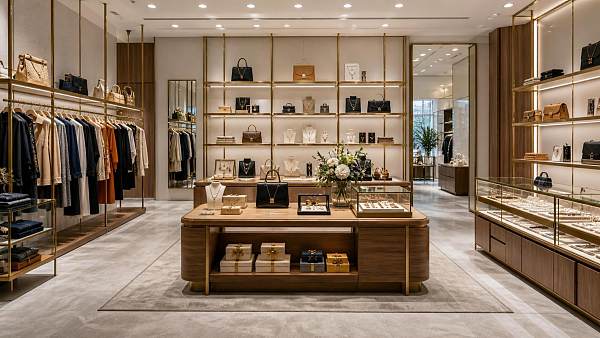
Consider how a customer is expected to shop. Fine jewelry is commonly sold through assisted interaction: a sales associate retrieves pieces, presents them on a tray or pad, and returns them to a secure case. In that setting, the display’s role is to create a clear viewing environment while controlling access. Fashion jewelry and gift-oriented accessories may require more browsing freedom, with customers comparing pieces directly from wall racks, towers, or tabletop fixtures. Security cannot disappear in that model, but it must be distributed through merchandising density, fixture placement, staff sightlines, and replenishment routines.
A useful first step is to classify merchandise into practical display groups:
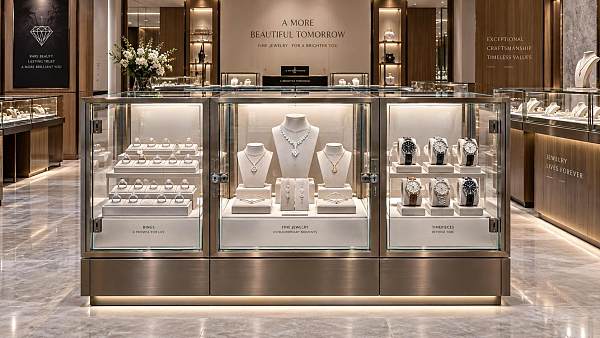
- High-value, compact items: rings, loose stones, high-carat gold, and premium watches generally belong in lockable cases with controlled staff access.
- Mid-value assisted-sale items: necklaces, bracelets, and branded collections may need secure cabinetry but can be displayed in larger sets to support comparison.
- Lower-value self-service items: selected fashion pieces, accessories, and impulse-purchase products can use open fixtures where inventory loss is manageable and stock control is disciplined.
- Fragile or presentation-sensitive items: pieces with delicate settings, soft finishes, or elaborate packaging may need display supports that reduce handling and prevent tangling or surface damage.
This classification prevents a common procurement mistake: purchasing a visually consistent fixture package that forces valuable merchandise into an unsuitable selling environment. A store can still look coherent when its cases, wall units, and open displays use a shared material palette, lighting temperature, and hardware language.
Security Is a System, Not a Lock Specification
Retail buyers sometimes focus heavily on whether a jewelry case has locks, tempered glass, or a metal frame. Those features matter, yet they do not by themselves determine whether the display is secure. A locking case can still be vulnerable if its keys are poorly controlled, staff cannot maintain a clear line of sight, doors obstruct traffic during service, or the fixture can be moved or forced from its installed position.
Security should be assessed at three levels: the fixture itself, the store environment, and the daily operating routine.
Assess the fixture’s physical resistance
For enclosed jewelry cases, buyers should examine the construction behind the visible finish. The questions are practical: How are glass panels retained? Are doors aligned tightly enough to resist prying? Is the lock mechanism accessible for servicing? Are hinges exposed or protected? Can the rear access panels be removed easily? Does the base provide sufficient stability for the case dimensions and merchandise load?
Glass selection also deserves more than a cursory review. Clear, low-iron glass may improve product visibility, but the appropriate glass construction should reflect the location, operating model, and security plan. Retailers should ask suppliers to specify glass type, thickness, edge treatment, and the way panels are mounted. Broad descriptions such as “security glass” are not enough for a purchasing decision.
Cases intended for higher-risk inventory should also be evaluated as installed units. Anchoring methods, floor conditions, wall attachment where relevant, and access to power or data cabling can affect both stability and tamper resistance. A display that performs well in a showroom may behave differently once placed on uneven flooring, near a storefront entrance, or within a high-traffic aisle.
Design for controlled staff access
Many losses and service problems stem from access management rather than from a visibly damaged case. Procurement specifications should establish how doors open, who can access each section, whether keys are interchangeable, and how replacement locks or duplicate keys are handled. A large case with multiple doors can improve selling efficiency when associates serve different customers, but it can also create more access points to manage.
Sliding doors, hinged doors, lift-top cases, and rear-service cabinets each create different workflow conditions. A rear-service case may provide strong customer-side protection, yet it needs enough clearance behind it for associates to move safely and retrieve products without blocking one another. Front-opening or lift-top formats can work in compact layouts, though they must be assessed for how they affect customer proximity and staff visibility.
The best choice is rarely the most restrictive option. If opening a case requires awkward movements, extra steps, or repeated trips to a key location, staff may create informal shortcuts. A sound display specification supports the way the store is actually staffed during busy periods.
Place displays within a broader loss-prevention layout
Display location can reduce exposure before any hardware feature is considered. High-value cases benefit from clear employee sightlines and should not be isolated by tall freestanding fixtures, heavy signage, or visual clutter. Entrance zones, fitting areas, and secondary corridors may require different merchandising densities than the main sales floor.
Open jewelry displays should be positioned where staff can naturally observe customer activity while performing normal selling tasks. Overloading them may look abundant but makes counting, recovery, and replenishment harder. Smaller, more controlled presentations often produce a cleaner visual result and simplify inventory routines.
Presentation Must Help Customers Compare and Commit
Jewelry displays are not neutral containers. Their proportions, interior finish, lighting, and organization influence whether a shopper can distinguish metal color, stone detail, scale, and craftsmanship. When those cues are obscured, customers may assume products are less refined than they are or hesitate to ask for assistance.
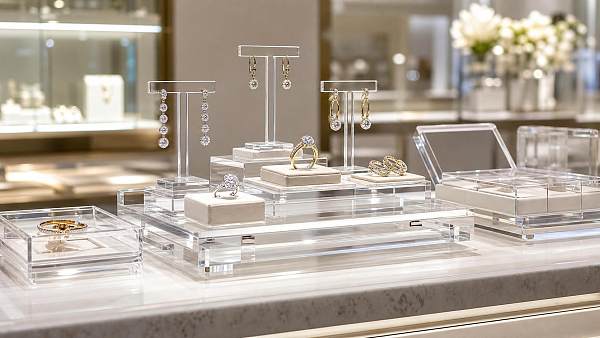
The display should support the specific decision a shopper needs to make. Ring cases need clear sightlines to individual pieces and enough separation that settings do not visually merge. Necklace displays need ways to show length, drape, and pendant orientation without tangling. Bracelet and watch fixtures need supports that hold their intended shape. Earring presentations should make pair matching easy at a glance while leaving enough space for the product to read as jewelry rather than as dense inventory.
Interior color selection should follow the merchandise assortment. Neutral surfaces can work across a broad collection, but the chosen tone should not distort the appearance of white metals, yellow gold, gemstones, or pearl. Highly textured backdrops may create visual interest in small doses, yet they can compete with detailed pieces. Before a full rollout, retailers should review actual samples under the proposed display lighting rather than approving finishes from a swatch alone.
Lighting is equally consequential. Brightness alone does not make jewelry more compelling. Uneven lighting can leave portions of a case dull, while poorly aimed fixtures may create glare on glass and prevent customers from seeing details. Light sources that generate excess heat can also create concerns for sensitive materials, adhesives, packaging, or long-term fixture finishes. Buyers should ask how interior lighting will be serviced, whether components can be replaced without dismantling the case, and how wiring is concealed.
For jewelry displays USA retail teams should also think about the difference between an attractive fixture and a workable visual-merchandising platform. Adjustable shelving, replaceable risers, removable pads, and modular tray systems can extend the useful life of a display as assortments change. A fixed interior may appear tailored on opening day but become restrictive when a retailer adds watch collections, bridal inventory, seasonal color stories, or new packaging formats.
Match Materials to Store Conditions, Not Just Brand Aesthetics
Wood veneer, lacquered panels, metal, glass, acrylic, engineered stone, and upholstered inserts can all have a place in jewelry retail. The purchasing question is whether the material will retain its intended appearance under the store’s real conditions: repeated cleaning, frequent merchandise changes, customer contact, climate variation, moving fixtures, and daily opening and closing.
High-gloss surfaces may emphasize a premium identity but reveal fingerprints and scratches quickly. Dark interiors can make some products appear dramatic while reducing visibility for others. Upholstered pads can soften the presentation of fine jewelry, but fabric selection should account for lint, wear, and the effort required to keep displays looking clean. Metal trims and handles should be reviewed for finish durability, edge quality, and compatibility with the store’s cleaning products.
Durability should be considered through maintenance access. Can a scratched display pad be replaced independently? Can lighting components be serviced from inside the case? Are glass panels standardized enough to replace without a full fixture rebuild? Will the supplier provide matching components after the initial installation? These questions often have more commercial value than selecting a marginally more decorative surface.
Do Not Treat Compliance as a Generic Supplier Claim
U.S. retailers may have obligations tied to store construction, local building requirements, accessibility, electrical installation, fire safety, and workplace conditions. The precise requirements depend on location, property type, fixture design, and the scope of the project. A fixture that is acceptable in one setting may need modifications in another.
Procurement teams should therefore define the site requirements early and make them part of the supplier conversation. This is especially important for illuminated cases, custom millwork, wall-mounted units, and large freestanding fixtures. Electrical components, cable routing, ventilation around heat-producing elements, and installation details should be documented clearly. Where a project requires specified testing, listing, or documentation, that requirement should appear in the purchase specification rather than being assumed from a supplier’s general statement of compliance.
Accessibility also affects layout decisions. Case height, circulation space, queue areas, and the position of service counters should be considered with the entire customer journey in view. A display plan can appear efficient on a drawing yet create difficult movement patterns once staff, customers, seating, and door swings occupy the same space.
Evaluate Suppliers on Execution Capability
A display supplier is being selected for more than furniture manufacturing. The supplier must translate merchandising intent into repeatable construction, manage material consistency, coordinate logistics, and resolve defects without derailing a store opening. This becomes more important in multi-location programs, where small variations in finish, dimensions, lighting, or hardware are visible across the estate.
Retailers should request detailed drawings, finish samples, hardware specifications, and a clear description of what is included in the delivered scope. Installation responsibilities deserve particular attention. A quotation that appears competitive may exclude site measurement, anchoring, electrical coordination, protective packaging removal, waste handling, final leveling, or post-installation adjustments.
For custom programs, approve a prototype or representative unit before authorizing full production where the project scale justifies it. The review should use actual merchandise and should include staff who will operate the cases. This is the point to assess door movement, lock operation, interior visibility, drawer clearance, lighting reflections, finish quality, and access to serviceable components. A rendering can establish design direction; it cannot fully reveal how a ring tray feels during a busy customer interaction.
Lead time should be reviewed as a sequence rather than a single promise. Design approval, sample approval, material procurement, fabrication, quality inspection, freight, site readiness, and installation all affect the opening schedule. Buyers should identify which decisions must be made early and which components have limited substitution options. Custom glass, specialty finishes, imported hardware, and integrated lighting can all add coordination risk when changes occur late.
Build a Display Brief Before Requesting Prices
The most productive request for quotation is not a list of case dimensions alone. It gives suppliers enough context to propose a workable solution and makes competing bids easier to compare. At minimum, the brief should identify merchandise categories and approximate value exposure, floor plans and site conditions, desired selling model, required fixture types, lighting expectations, finish direction, installation scope, maintenance needs, and delivery milestones.
It should also state where flexibility is acceptable. Retailers may be open to alternative interior materials or modular tray configurations while requiring fixed dimensions at a storefront wall. Separating non-negotiable requirements from preferences helps prevent suppliers from pricing entirely different solutions under the same description.
Price remains important, but the lowest initial quotation can be misleading when it omits service access, replacement parts, installation coordination, or the fixture strength required for sustained use. A more useful comparison considers total operational cost: how well the display protects inventory, how quickly staff can sell from it, how often it needs repair, and whether it can adapt as merchandise changes.
Retailers choosing jewelry displays are making a durable decision about how value is presented and controlled on the sales floor. The right program does not rely on decorative design or security hardware alone. It gives staff an efficient way to sell, lets customers see products clearly, and applies stronger protection where the inventory and store environment demand it.
Search News
Hot Articles
- Musical InstrumentsMusic China 2026 Opens Tomorrow, With 800-Plus Events Connecting TradeOct 28, 2026
- Outdoor RidesChoosing an Electric Trackless Train Supplier: Safety, Warranty, and Spare PartsOct 28, 2026
- Fashion & Gem JewelryLuxury Retail Merchandising: What Sets It Apart From Mass-Market Retail?Oct 27, 2026
Popular Tags
Need ExpertConsultation?
Connect with our specialized leisureengineering team for procurementstrategies.
Recommended News
 Sep 20, 2026How to Evaluate a Luxury Retail Packaging Supplier for Premium Brand ConsistencyLuxury retail packaging supplier evaluation guide: protect premium brand consistency with proven quality control, material expertise, scalable production, and supply reliability.● Luxury Retail Analyst
 Sep 13, 2026How U.S. Retailers Can Choose Jewelry Displays for Better Security and SalesJewelry displays USA retailers can use to balance security, product visibility, and sales performance. Explore practical selection tips for cases, lighting, materials, and suppliers.● Luxury Retail Analyst
 Aug 18, 2026How to Choose Retail Display Fixtures for Boutiques by Layout, Product Mix, and Brand StyleRetail display fixtures for boutiques should match layout, product mix, and brand style. Learn how to choose flexible, durable displays that improve flow, elevate presentation, and support sales.● Luxury Retail Analyst
 Jul 23, 2026Acrylic Jewelry Display Stands Price Guide: What Affects Cost and Bulk Buying Value?Acrylic jewelry display stands price explained: compare thickness, finish, customization, and bulk order value to cut sourcing risk and choose better retail displays.● Luxury Retail Analyst
 Jul 13, 2026France and Belgium Extend EPR to Jewelry Display PackagingFrance and Belgium extend EPR to jewelry display packaging from Oct 1, 2026. Learn how registration, recycling fees, and customs risks may impact exporters and sellers.● Luxury Retail Analyst
 Jul 08, 2026EU PPWR EPR Rules Take Effect for Jewelry PackagingEU PPWR EPR rules take effect for jewelry packaging on July 8, 2026. Learn key compliance risks, reporting duties, and how exporters can protect EU market access.● Luxury Retail Analyst
 Jul 07, 2026EU EN 71-3:2026 Tightens Lead Limit to 0.05%EU EN 71-3:2026 Tightens Lead Limit to 0.05%—learn how the new 500 ppm rule affects exports, metal components, compliance documents, and EU shipment readiness.● Luxury Retail Analyst
 Jul 05, 2026EN 71-3:2026 Tightens Heavy Metal Limits for Jewelry PackagingEN 71-3:2026 tightens heavy metal limits for jewelry packaging in the EU. Learn what exporters, importers, and suppliers must do before October 1, 2026 to stay compliant.● Luxury Retail Analyst
 Jun 29, 2026EU EPR Rule Takes Effect July 1 for Jewelry PackagingEU EPR Rule Takes Effect July 1 for Jewelry Packaging—learn how PPWR-linked registration, annual packaging reporting, and EU compliance checks may impact exporters, sellers, and supply chains.● Luxury Retail Analyst
 Jun 28, 2026Saudi Carbon Label Rule Hits Jewelry Packaging by Q3 2026Jewelry Packaging faces Saudi carbon label rules by Q3 2026. Learn SASO compliance deadlines, LCA certification steps, labeling impact, and how exporters can avoid shipment delays.● Luxury Retail Analyst
 Jun 27, 2026SASO Sets Carbon Label Rule for Jewelry PackagingSASO Sets Carbon Label Rule for Jewelry Packaging: learn how Saudi Arabia’s new carbon footprint and LCA requirement will impact exporters, packaging suppliers, and delivery timelines before the 2026 deadline.● Luxury Retail Analyst
 Apr 27, 2026Luxury Jewelry for Commercial Spaces ExplainedLuxury jewelry for commercial spaces explained: compare custom jewelry design, luxury jewelry wholesale, and reliable luxury jewelry manufacturer solutions for hotels, retail, and B2B buyers.● Luxury Retail Analyst
 Apr 18, 2026Luxury jewelry packaging: When minimalist boxes backfire on shelf appealTrampoline park, indoor playground & adventure playground packaging demands? Discover why luxury jewelry boxes fail—and how to fix shelf appeal across arcade games, musical instruments & office supplies.● Luxury Retail Analyst
 Apr 17, 2026Why luxury jewelry display cases matter more than you thinkLuxury jewelry display cases elevate trampoline parks, indoor playgrounds, arcade games & adventure playgrounds—boosting brand value, safety, and engagement.● Luxury Retail Analyst
 Apr 16, 2026Supply chain solutions for jewelry packaging: How lead time variance breaks seasonal launchesSupply chain solutions for jewelry packaging: Cut lead time variance, ensure on-time seasonal launches for designer eyewear, OEM manufacturing & luxury goods.● Luxury Retail Analyst
 Apr 16, 2026Custom jewelry packaging that enhances perceived valueCustom jewelry packaging for luxury accessories, timepieces & orchestral instruments—engineered for institutional buyers seeking premium unboxing, compliance & ROI.● Luxury Retail Analyst
 Apr 15, 2026Jewelry display cases that meet museum-grade UV and humidity controlsCommercial furniture meets museum-grade precision: UV-stable, humidity-controlled jewelry display cases for amusement equipment, sensory playgrounds, hotel tables & educational supplies.● Luxury Retail Analyst
 Apr 14, 2026Luxury jewelry packaging that survives transit—but not retail handlingLuxury jewelry, office supplies & musical instruments—discover transit-strong, retail-ready packaging that excels for trampoline parks, indoor playgrounds, arcade games and adventure playgrounds.● Luxury Retail Analyst
 Apr 14, 2026Luxury jewelry display cases that prevent tarnish without humidity controlLuxury jewelry display cases prevent tarnish without humidity control—ideal for office supplies, musical instruments, arcade games & adventure playgrounds.● Luxury Retail Analyst
 Apr 10, 2026Jewelry packaging & display suppliers rarely share shelf-life test data for eco-materialsDiscover verified shelf-life data for eco-packaging—trusted by OEM jewelry, ODM watches & designer eyewear brands. Get supply chain solutions that deliver transparency, not just promises.● Luxury Retail Analyst
 Apr 11, 2026Commercial kitchen suppliers offer modular design — but jewelry packaging doesn’t. Why?Unlock modular packaging for ODM watches, OEM jewelry & designer eyewear—agile supply chain solutions, premium accessories, commercial procurement made flexible.● Luxury Retail Analyst
 Mar 30, 2026Jewelry packaging & display units designed for retail are cracking under warehouse stacking pressureOEM jewelry displays failing under warehouse stacking? Discover stacking-ready solutions for hotel cabinets, playground components, live sound equipment & commercial procurement.● Luxury Retail Analyst
 Mar 28, 2026Custom jewelry packaging ordered with foil stamping often arrives with misaligned logos — and replacements take 3 weeksIndoor playground & adventure playground suppliers: Fix foil stamping misalignment in safety signage, luxury timepieces, DJ equipment—get verified ≤±0.2mm precision now.● Luxury Retail Analyst
") Mar 28, 2026Why luxury jewelry packaging fails under real retail lighting (not studio shots)Discover why trampoline park signage, luxury jewelry packaging, arcade games, and musical instruments—including string, wind & keyboard instruments—fail under real retail lighting. Expert insights for procurement pros.● Luxury Retail Analyst
Mar 28, 2026Why luxury jewelry packaging fails under real retail lighting (not studio shots)Discover why trampoline park signage, luxury jewelry packaging, arcade games, and musical instruments—including string, wind & keyboard instruments—fail under real retail lighting. Expert insights for procurement pros.● Luxury Retail Analyst