Acrylic Jewelry Display Stands Price Guide: What Affects Cost and Bulk Buying Value?
Acrylic Jewelry Display Stands Price Guide: What Should You Really Compare?
Understanding acrylic jewelry display stands price starts with one practical point: display cost is never only about the lowest unit quote.
In retail, hotel boutiques, museum shops, and branded counters, the stand influences both product perception and replacement frequency.
That is why buyers usually compare presentation quality, durability, branding impact, and shipping efficiency together.
More commonly, the final acrylic jewelry display stands price changes because of thickness, polishing, shape complexity, logo treatment, packaging, and order volume.
For commercial sourcing, this matters even more when projects span luxury accessories, hospitality retail, or multi-location rollouts.
Across sectors covered by Global Commercial Trade, the better question is not “What is the cheapest stand?”
It is “Which specification gives the best bulk buying value without weakening the customer-facing finish?”
What is a normal acrylic jewelry display stands price range?
There is no single market price, but there are usable ranges.
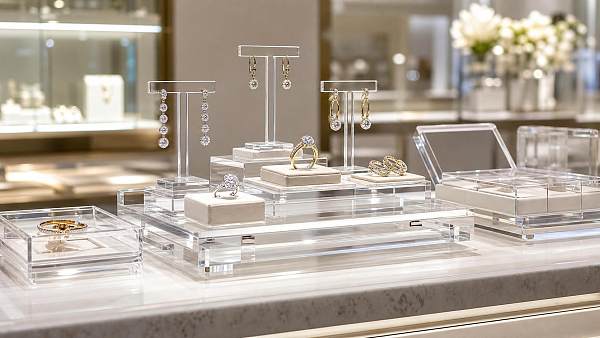
Simple earring blocks, ring risers, or bracelet holders in standard clear acrylic often start at low single-digit factory pricing.
Mid-range countertop sets with thicker sheets, cleaner edges, and stable bases usually move into a higher bracket.
Custom acrylic jewelry display stands price rises quickly when the project adds colored material, silk-screen logos, complex bending, magnetic parts, or premium packaging.
For flagship or luxury retail, bespoke units can cost several times more than stock designs.
That increase is not always wasteful.
If the display is part of a branded launch, visual consistency may justify a higher spend.
A quick comparison table helps separate price bands from likely specifications.
In practice, acrylic jewelry display stands price should be reviewed against lifespan and visual role, not only against the invoice line.
Why do similar-looking stands have very different prices?
This is one of the most common sourcing questions, and the answer usually sits in the details buyers do not see in listing photos.
Acrylic thickness is a major factor.
A 3 mm stand and a 5 mm stand can look close online, yet behave very differently under commercial use.
Edge treatment also matters.
Diamond polishing, flame polishing, or hand finishing add labor and improve clarity.
Then comes fabrication complexity.
Straight-cut blocks cost less than bent, layered, slotted, or interlocking structures.
Branding pushes the acrylic jewelry display stands price further when printing needs color accuracy or scratch resistance.
Protective film, individual wrapping, barcode labeling, and export cartons also change the quote.
A useful way to judge differences is to request a specification breakdown instead of a single lump-sum number.
- Material grade: virgin acrylic and recycled blends can price differently.
- Surface quality: clearer panels often signal tighter production control.
- Construction method: glued joints and heat bending have different labor inputs.
- Packing method: compact nested packing can lower landed cost.
When price gaps seem unusually large, the hidden difference is often in material quality or finishing consistency.
How much does customization add to acrylic jewelry display stands price?
Customization can add a little or a lot, depending on what is being changed.
A simple logo print may have a moderate effect.
A new shape, custom color, fitted insert, or branded presentation box usually has a stronger impact.
The reason is straightforward.
Custom work often introduces setup charges, sampling time, production waste, and stricter quality checks.
Even when the unit itself looks small, the support process behind it can be expensive.
Still, custom acrylic jewelry display stands price may create real value in premium channels.
Luxury accessory displays, hotel retail corners, and giftable in-store sets often need consistent brand language.
In those cases, customization is part of the commercial experience rather than an optional decoration.
A sensible approach is to separate custom elements into three tiers.
That framework keeps discussions focused on value, not only on decoration requests.
Does bulk ordering always lower the price enough to justify it?
Usually yes, but not automatically.
Bulk orders often reduce the acrylic jewelry display stands price because setup cost spreads across more units.
Material purchasing becomes more efficient, and production scheduling gets easier for the supplier.
However, bulk value depends on three things: storage, replenishment speed, and design stability.
If the display design may change within six months, very large volumes can create dead stock.
If import freight is volatile, a split shipment may outperform one oversized order.
This is especially relevant for cross-border sourcing where landed cost matters as much as ex-factory price.
A better evaluation method is to compare total use cost.
- Unit price at each MOQ level
- Packaging density per carton
- Damage rate during transit
- Expected replacement cycle in stores
- Cost of holding extra inventory
In many commercial projects, the best bulk buying value comes from medium-volume repeatable orders, not the absolute largest first order.
Where do buyers misread acrylic jewelry display stands price?
The biggest mistake is treating all acrylic stands as equivalent if dimensions look similar.
In actual use, weak joints, cloudy edges, and unstable bases quickly become visible.
That leads to breakage, visual inconsistency, and extra replacement spending.
Another common issue is ignoring compliance and material safety where the display enters premium retail or hospitality settings.
Low quotes can also exclude protective packaging, sample approval, or logo color control.
Then the “cheaper” offer becomes expensive after revisions.
To reduce risk, ask for these checks before confirming an order.
- A measured drawing with thickness and tolerance
- Close-up photos or a pre-production sample
- Packaging specification and drop protection details
- Clarification on logo process and color consistency
- Confirmation of lead time for repeat orders
This type of disciplined review aligns with the sourcing standards expected in data-backed commercial procurement environments such as GCT’s coverage model.
So how should you judge the best buying option now?
Acrylic jewelry display stands price makes sense only when matched to use case, replacement cycle, and brand presentation goals.
For short-term promotions, stock designs with light branding may deliver the best return.
For permanent counters or luxury accessory programs, thicker material and more refined finishing often pay back through lower replacement and better presentation.
The most reliable next step is to build a comparison sheet before requesting final quotes.
List the required size, material thickness, finish, logo method, packaging level, MOQ, delivery schedule, and target lifespan.
Then compare acrylic jewelry display stands price on a landed-cost basis, not just by ex-factory numbers.
That process creates a clearer sourcing decision and reduces expensive surprises after approval.
If the project spans multiple locations or premium retail formats, it is worth validating samples under real merchandising conditions before scaling the order.
A well-judged display stand is a small item, but it has an outsized effect on visual trust, product positioning, and long-term commercial value.
Search News
Hot Articles
- Outdoor RidesIAAPA Launches Insurance Solution for North American Attractions IndustryOct 21, 2026
- Watch OEM & SmartwatchesWatch Movement Parts: How to Check Compatibility With a Specific CaliberOct 21, 2026
- Outdoor RidesEnergylandia Announces Rokan, Set to Be Europe’s Tallest and Longest B&M Wing CoasterOct 20, 2026
Popular Tags
Need ExpertConsultation?
Connect with our specialized leisureengineering team for procurementstrategies.
Recommended News
 Sep 20, 2026How to Evaluate a Luxury Retail Packaging Supplier for Premium Brand ConsistencyLuxury retail packaging supplier evaluation guide: protect premium brand consistency with proven quality control, material expertise, scalable production, and supply reliability.● Luxury Retail Analyst
 Sep 13, 2026How U.S. Retailers Can Choose Jewelry Displays for Better Security and SalesJewelry displays USA retailers can use to balance security, product visibility, and sales performance. Explore practical selection tips for cases, lighting, materials, and suppliers.● Luxury Retail Analyst
 Aug 18, 2026How to Choose Retail Display Fixtures for Boutiques by Layout, Product Mix, and Brand StyleRetail display fixtures for boutiques should match layout, product mix, and brand style. Learn how to choose flexible, durable displays that improve flow, elevate presentation, and support sales.● Luxury Retail Analyst
 Jul 23, 2026Acrylic Jewelry Display Stands Price Guide: What Affects Cost and Bulk Buying Value?Acrylic jewelry display stands price explained: compare thickness, finish, customization, and bulk order value to cut sourcing risk and choose better retail displays.● Luxury Retail Analyst
 Jul 13, 2026France and Belgium Extend EPR to Jewelry Display PackagingFrance and Belgium extend EPR to jewelry display packaging from Oct 1, 2026. Learn how registration, recycling fees, and customs risks may impact exporters and sellers.● Luxury Retail Analyst
 Jul 08, 2026EU PPWR EPR Rules Take Effect for Jewelry PackagingEU PPWR EPR rules take effect for jewelry packaging on July 8, 2026. Learn key compliance risks, reporting duties, and how exporters can protect EU market access.● Luxury Retail Analyst
 Jul 07, 2026EU EN 71-3:2026 Tightens Lead Limit to 0.05%EU EN 71-3:2026 Tightens Lead Limit to 0.05%—learn how the new 500 ppm rule affects exports, metal components, compliance documents, and EU shipment readiness.● Luxury Retail Analyst
 Jul 05, 2026EN 71-3:2026 Tightens Heavy Metal Limits for Jewelry PackagingEN 71-3:2026 tightens heavy metal limits for jewelry packaging in the EU. Learn what exporters, importers, and suppliers must do before October 1, 2026 to stay compliant.● Luxury Retail Analyst
 Jun 29, 2026EU EPR Rule Takes Effect July 1 for Jewelry PackagingEU EPR Rule Takes Effect July 1 for Jewelry Packaging—learn how PPWR-linked registration, annual packaging reporting, and EU compliance checks may impact exporters, sellers, and supply chains.● Luxury Retail Analyst
 Jun 28, 2026Saudi Carbon Label Rule Hits Jewelry Packaging by Q3 2026Jewelry Packaging faces Saudi carbon label rules by Q3 2026. Learn SASO compliance deadlines, LCA certification steps, labeling impact, and how exporters can avoid shipment delays.● Luxury Retail Analyst
 Jun 27, 2026SASO Sets Carbon Label Rule for Jewelry PackagingSASO Sets Carbon Label Rule for Jewelry Packaging: learn how Saudi Arabia’s new carbon footprint and LCA requirement will impact exporters, packaging suppliers, and delivery timelines before the 2026 deadline.● Luxury Retail Analyst
 Apr 27, 2026Luxury Jewelry for Commercial Spaces ExplainedLuxury jewelry for commercial spaces explained: compare custom jewelry design, luxury jewelry wholesale, and reliable luxury jewelry manufacturer solutions for hotels, retail, and B2B buyers.● Luxury Retail Analyst
 Apr 18, 2026Luxury jewelry packaging: When minimalist boxes backfire on shelf appealTrampoline park, indoor playground & adventure playground packaging demands? Discover why luxury jewelry boxes fail—and how to fix shelf appeal across arcade games, musical instruments & office supplies.● Luxury Retail Analyst
 Apr 17, 2026Why luxury jewelry display cases matter more than you thinkLuxury jewelry display cases elevate trampoline parks, indoor playgrounds, arcade games & adventure playgrounds—boosting brand value, safety, and engagement.● Luxury Retail Analyst
 Apr 16, 2026Supply chain solutions for jewelry packaging: How lead time variance breaks seasonal launchesSupply chain solutions for jewelry packaging: Cut lead time variance, ensure on-time seasonal launches for designer eyewear, OEM manufacturing & luxury goods.● Luxury Retail Analyst
 Apr 16, 2026Custom jewelry packaging that enhances perceived valueCustom jewelry packaging for luxury accessories, timepieces & orchestral instruments—engineered for institutional buyers seeking premium unboxing, compliance & ROI.● Luxury Retail Analyst
 Apr 15, 2026Jewelry display cases that meet museum-grade UV and humidity controlsCommercial furniture meets museum-grade precision: UV-stable, humidity-controlled jewelry display cases for amusement equipment, sensory playgrounds, hotel tables & educational supplies.● Luxury Retail Analyst
 Apr 14, 2026Luxury jewelry packaging that survives transit—but not retail handlingLuxury jewelry, office supplies & musical instruments—discover transit-strong, retail-ready packaging that excels for trampoline parks, indoor playgrounds, arcade games and adventure playgrounds.● Luxury Retail Analyst
 Apr 14, 2026Luxury jewelry display cases that prevent tarnish without humidity controlLuxury jewelry display cases prevent tarnish without humidity control—ideal for office supplies, musical instruments, arcade games & adventure playgrounds.● Luxury Retail Analyst
 Apr 10, 2026Jewelry packaging & display suppliers rarely share shelf-life test data for eco-materialsDiscover verified shelf-life data for eco-packaging—trusted by OEM jewelry, ODM watches & designer eyewear brands. Get supply chain solutions that deliver transparency, not just promises.● Luxury Retail Analyst
 Apr 11, 2026Commercial kitchen suppliers offer modular design — but jewelry packaging doesn’t. Why?Unlock modular packaging for ODM watches, OEM jewelry & designer eyewear—agile supply chain solutions, premium accessories, commercial procurement made flexible.● Luxury Retail Analyst
 Mar 30, 2026Jewelry packaging & display units designed for retail are cracking under warehouse stacking pressureOEM jewelry displays failing under warehouse stacking? Discover stacking-ready solutions for hotel cabinets, playground components, live sound equipment & commercial procurement.● Luxury Retail Analyst
 Mar 28, 2026Custom jewelry packaging ordered with foil stamping often arrives with misaligned logos — and replacements take 3 weeksIndoor playground & adventure playground suppliers: Fix foil stamping misalignment in safety signage, luxury timepieces, DJ equipment—get verified ≤±0.2mm precision now.● Luxury Retail Analyst
") Mar 28, 2026Why luxury jewelry packaging fails under real retail lighting (not studio shots)Discover why trampoline park signage, luxury jewelry packaging, arcade games, and musical instruments—including string, wind & keyboard instruments—fail under real retail lighting. Expert insights for procurement pros.● Luxury Retail Analyst
Mar 28, 2026Why luxury jewelry packaging fails under real retail lighting (not studio shots)Discover why trampoline park signage, luxury jewelry packaging, arcade games, and musical instruments—including string, wind & keyboard instruments—fail under real retail lighting. Expert insights for procurement pros.● Luxury Retail Analyst