How to Choose a Charcoal Commercial Grill for Capacity, Heat Control, and Menu Fit
Choosing a charcoal commercial grill is rarely a simple equipment purchase. It shapes production speed, flavor consistency, labor flow, and fuel cost at the same time. In hospitality, live-fire dining, premium catering, and experience-led foodservice, the wrong specification can slow service or narrow the menu. The better decision comes from matching capacity, heat control, and menu fit with compliance, build quality, and supplier credibility.
Why charcoal grilling remains commercially relevant
Gas and electric systems offer convenience, but charcoal still holds a strong place in commercial kitchens where flame character matters. That includes steak concepts, open-kitchen restaurants, resort dining, outdoor venues, and premium event catering.
The appeal is not only about smoke. A charcoal commercial grill can produce a firmer sear, more varied heat zones, and a visual cooking experience that supports premium positioning. In many venues, that sensory value affects guest perception as much as the food itself.
This is one reason sourcing decisions now sit closer to wider commercial strategy. Platforms such as Global Commercial Trade (GCT) reflect that shift by treating equipment selection as a mix of operational, compliance, and brand experience requirements.
Start with output, not grill size alone
A larger grill does not automatically improve service. What matters is usable cooking area during peak periods, not the headline dimensions on a product sheet.
Begin with the menu mix and expected order pattern. A venue serving mostly steaks and chops needs a different layout from one handling skewers, seafood, vegetables, and small plates in rotation.
Peak covers, average ticket composition, and firing rhythm should guide the specification. If the kitchen often batches proteins ahead of rush periods, recovery time after loading becomes more important than maximum grill width.
Useful capacity questions
- How many portions must be cooked simultaneously at peak?
- How much of the grate remains truly high heat during service?
- How quickly can the unit recover after cold product is loaded?
- Does the grill support holding, resting, or indirect finishing zones?
- Can staff manage the fire without disrupting line speed?
In practice, an undersized charcoal commercial grill creates congestion quickly. An oversized unit can waste fuel, occupy valuable footprint, and introduce heat management complexity that the kitchen does not need.
Heat control is where commercial value is won or lost
Heat control separates a professional charcoal commercial grill from a basic live-fire cooker. Commercial performance depends on how precisely staff can create, maintain, and adjust cooking zones during a full service.
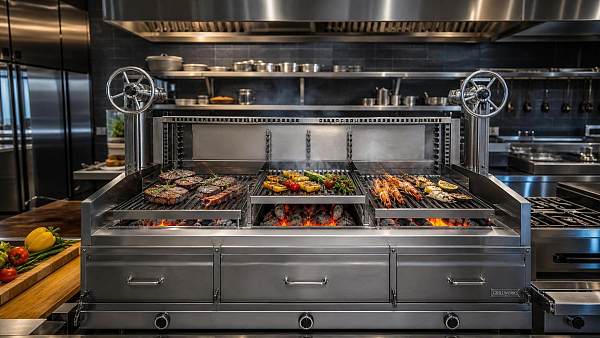
Look closely at grate adjustment systems, charcoal tray elevation, airflow design, and ash handling. These features influence whether the grill can support repeatable cooking rather than constant firefighting.
Adjustable grates are especially useful when the menu includes proteins with different thicknesses. Fine control over distance from the fire helps balance caramelization and internal doneness without excessive flare-ups.
Air intake and exhaust behavior also matter. Poor airflow leads to unstable temperatures, uneven burn patterns, and avoidable fuel consumption. Over time, that affects both plate consistency and operating cost.
Features worth comparing side by side
Menu fit should drive specification choices
A charcoal commercial grill should be selected around what it must cook repeatedly, not what it could cook occasionally. Menu fit is the most practical filter because it connects equipment choice with revenue items.
For thick steaks and bone-in cuts, stable high heat and grate strength are priorities. For seafood and vegetables, gentler zones and precise height adjustment become more valuable. For mixed menus, flexibility usually matters more than raw firepower.
Skewer-heavy operations may need narrow spacing and easier turning access. Open-fire show kitchens may place more weight on visual design, front presentation, and smoke capture integration.
That is why menu mapping is useful before supplier comparison. Identify core items, service volumes, finish requirements, and desired flavor profile. Then test whether the grill design supports that mix without excessive workarounds.
Typical menu-to-grill considerations
- Steakhouse menus benefit from strong searing capacity and robust heat retention.
- Seafood concepts often need responsive control to avoid overcooking.
- Catering formats need faster cleanup and flexible loading patterns.
- Resort or outdoor venues may prioritize weather resistance and visual presence.
- Multi-cuisine kitchens usually need several usable temperature zones.
Build quality, fuel efficiency, and lifecycle cost
Initial price should never be the only comparison point. A charcoal commercial grill with poor steel quality, weak welds, or unstable mechanisms may cost less upfront and more over its service life.
Material grade matters because charcoal cooking creates intense thermal stress. Stainless steel thickness, refractory components, and frame rigidity influence durability, temperature retention, and maintenance intervals.
Fuel efficiency deserves equal attention. Better insulation, controlled airflow, and an effective charcoal bed design can reduce consumption meaningfully over time. In high-volume operations, that difference becomes financially visible quite quickly.
Cleaning time is another cost factor often missed during sourcing. Ash removal, grease management, and access to interior surfaces affect labor hours, hygiene routines, and turnaround between services.
Compliance, ventilation, and supplier verification
Live-fire equipment introduces safety and installation questions that cannot be treated as afterthoughts. Ventilation compatibility, fire regulations, local emissions rules, and material certifications should be checked early.
Imported equipment must also be reviewed for documentation quality. Drawings, test reports, user manuals, spare parts lists, and after-sales support often reveal more than marketing claims do.
This is where a sourcing platform with sector-specific intelligence becomes useful. GCT’s emphasis on hospitality equipment, compliance rigor, and supplier reliability reflects what global projects increasingly require: proof, not just promise.
A supplier should be able to explain lead times, customization limits, replacement parts availability, and previous commercial installations. If those answers stay vague, the risk usually sits downstream in commissioning or maintenance.
Documents worth requesting before final selection
- Technical drawings with exact dimensions and utility needs
- Material specifications and certification records
- Cleaning, maintenance, and operating instructions
- Spare parts schedule and warranty terms
- References from comparable hospitality or foodservice projects
A practical evaluation framework
When several models appear similar, structured comparison prevents expensive guesswork. A practical scorecard should combine operational and sourcing criteria rather than focusing only on cooking surface size.
A charcoal commercial grill should earn its place operationally and commercially. If a model looks impressive but fails under one of these areas, it usually creates friction later.
Where to focus next
The strongest sourcing decisions start with a short internal brief. Define menu priorities, peak load, installation constraints, preferred charcoal format, ventilation conditions, and expected cleaning routine.
From there, compare each charcoal commercial grill against the same operational criteria. Ask for technical proof, not generic assurances. Review build details, recovery performance, maintenance access, and support capability with equal weight.
In sectors where guest experience and kitchen discipline both matter, the right charcoal commercial grill is not simply the hottest or largest option. It is the one that aligns live-fire character with dependable service, compliant installation, and long-term commercial logic.
Search News
Hot Articles
- Stationery & UniformsChoosing a Wholesale Chef Coat Supplier: MOQs, Samples, and Lead TimesOct 19, 2026
- Indoor PlaygroundTurnkey Playground Installation: What's Included and What Costs Extra?Oct 18, 2026
- Musical InstrumentsProfessional String Instruments: How to Evaluate Tone, Response, and ProjectionOct 17, 2026
Popular Tags
Need ExpertConsultation?
Connect with our specialized leisureengineering team for procurementstrategies.
Recommended News
 Oct 06, 2026What Is Driving Demand for Commercial Hospitality Projects Across the GCC?Commercial hospitality GCC demand is rising through destination-led tourism, mixed-use development, and premium operational standards. Explore the procurement strategies shaping resilient projects.● Hospitality Sourcing Dir
 Sep 24, 2026Conveyor Pizza Oven Price: What Buyers Should Budget for Capacity and FeaturesConveyor pizza oven price guide: compare capacity, features, installation costs, and quote factors to choose the right commercial oven for your operation.● Hospitality Sourcing Dir
 Sep 23, 2026How Restaurant Buyers Can Source Hospitality Supplies Without OverorderingHospitality supplies for restaurants: learn practical sourcing strategies to cut excess inventory, protect cash flow, improve supplier reliability, and keep every service running smoothly.● Hospitality Sourcing Dir
 Sep 22, 2026Commercial Kitchen Design Price: Budgeting by Layout, Equipment, and MEP ScopeCommercial kitchen design price explained: budget smarter for layout, equipment, MEP scope, compliance, installation, and long-term operational performance.● Hospitality Sourcing Dir
 Sep 19, 2026How to Select a Spiral Dough Mixer for Bakery Batch Size and Dough HydrationSpiral dough mixer bakery guide: match batch size, flour load, and hydration to select reliable torque, temperature control, and consistent dough results.● Hospitality Sourcing Dir
 Sep 14, 2026How Restaurants Can Choose Disposable Wooden Cutlery for Takeout and CateringDisposable wooden cutlery fork spoon knife guide for restaurants: compare strength, finish, packaging, food-contact needs, and catering performance.● Hospitality Sourcing Dir
 Sep 12, 2026How to Size a Restaurant Walk-In Cooler for Peak Inventory and Kitchen LayoutRestaurant walk in coolers sized for peak inventory and kitchen workflow help improve food safety, staff efficiency, storage access, and long-term operational performance.● Hospitality Sourcing Dir
 Sep 10, 2026How to Choose a CE Hot Dog Roller for Safe, High-Volume Food Service?Choose a CE hot dog roller with confidence: compare compliance documents, heating consistency, cleaning design, capacity, and total cost for safe, high-volume food service.● Hospitality Sourcing Dir
 Sep 04, 2026How to Evaluate a Commercial Food Warmer Manufacturer for Bulk Catering ProjectsCommercial food warmer manufacturer evaluation guide for bulk catering projects: compare thermal performance, compliance, customization, costs, and after-sales support.● Hospitality Sourcing Dir
 Aug 30, 2026How Can Buyers Verify Supplier Qualifications Before a Bulk Order?How to confirm supplier qualifications before placing a bulk order: verify legal identity, factory capability, certificates, samples, quality controls, and payment safeguards.● Hospitality Sourcing Dir
 Aug 28, 2026Commercial Kitchen Design Standards: A Planning Checklist for Code-Compliant LayoutsCommercial kitchen design standards: use this practical checklist to plan safer, code-compliant layouts, streamline approvals, and avoid costly rework.● Hospitality Sourcing Dir
 Aug 06, 2026How to Choose Flake Ice Makers for Seafood Displays, Bars, and Food Prep?Flake ice makers buying guide: compare output, hygiene, storage, energy use, and reliability to choose the best solution for seafood displays, bars, and food prep.● Hospitality Sourcing Dir
 Aug 03, 2026Commercial Kitchen Design Price: What Drives Cost in a New Build Project?Commercial kitchen design price explained: discover what drives cost in a new build, from layout and equipment to ventilation, compliance, and hidden budget risks.● Hospitality Sourcing Dir
 Jul 30, 2026How to Choose a Countertop Commercial Pizza Oven for Capacity, Speed, and Space?Countertop commercial pizza oven buying guide: learn how to match capacity, bake speed, and kitchen space for consistent output, lower costs, and smarter purchasing decisions.● Hospitality Sourcing Dir
 Jul 22, 2026How to Evaluate a Cotton Candy Machine Supplier for Quality, Lead Time, and MOQCotton candy machine supplier selection starts with quality, lead time, and MOQ. Learn how to compare suppliers, reduce sourcing risk, and choose a partner that supports reliable growth.● Hospitality Sourcing Dir
 Jul 21, 2026How to Choose a Charcoal Commercial Grill for Capacity, Heat Control, and Menu FitCharcoal commercial grill buying guide: learn how to match capacity, heat control, and menu fit to boost consistency, service speed, and ROI in commercial kitchens.● Hospitality Sourcing Dir
 Jul 10, 2026FDA Import Alert Adds NSF/ANSI 50-2026 for Commercial Kitchen EquipmentFDA Import Alert now highlights NSF/ANSI 50-2026 for commercial kitchen equipment. Learn how dishwashers, ice machines, and steam cabinets can avoid U.S. port detention.● Hospitality Sourcing Dir
 Jul 05, 2026How to Select Energy Efficient Display Cabinets for Food Retail and HospitalityEnergy efficient display cabinets can cut operating costs while improving food safety, visibility, and service efficiency. Learn how to choose the right model for retail and hospitality.● Hospitality Sourcing Dir
 Jul 04, 2026CPSC Flags New UL 2595 Label Rule for Commercial Ice MakersCPSC flags a new UL 2595 label rule for commercial ice makers entering the U.S. after Aug. 1, 2026. Learn who is affected, key compliance steps, and how to avoid port delays and recall risk.● Hospitality Sourcing Dir
 Jun 29, 2026How to Choose Thermal Receipt Printers for Retail and Restaurant CountersThermal receipt printers for retail and restaurant counters: learn how to compare speed, durability, connectivity, and total operating cost to choose a model that supports smoother service.● Hospitality Sourcing Dir
 Jun 28, 2026Stainless Steel Kitchen Ventilation Systems: Key Specifications for Commercial ProjectsStainless steel kitchen ventilation systems: compare material grades, airflow capture, hygiene, fire safety, and installation specs for commercial projects before you buy.● Hospitality Sourcing Dir
 Jun 27, 2026Commercial Shawarma Machines: What to Check Before Buying for High-Volume ServiceShawarma machines commercial buying guide: learn how to compare capacity, heat control, durability, compliance, and lifecycle cost before choosing equipment for high-volume service.● Hospitality Sourcing Dir
 Jun 26, 2026Restaurant POS Systems: How to Compare Features, Costs, and ScalabilityRestaurant POS systems: compare features, costs, and scalability to find the best fit for your restaurant and boost long-term efficiency.● Hospitality Sourcing Dir
 Jun 25, 2026Kitchen Ventilation Systems Design: How to Size Hoods, Airflow, and Make-Up AirKitchen ventilation systems design explained clearly: learn how to size hoods, set exhaust airflow, and balance make-up air for safer, more efficient commercial kitchens.● Hospitality Sourcing Dir