Choosing a Wholesale Chef Coat Supplier: MOQs, Samples, and Lead Times
A wholesale chef coat supplier is a good fit when its order minimums match your staffing needs, its samples demonstrate acceptable performance under your laundry conditions, and its delivery commitments leave time for inspection before uniforms enter service. A lower unit price has limited value if it requires excess stock, creates gaps in the size range, or depends on a production schedule that starts later than expected.
For hospitality procurement teams, the first decision is whether to buy an existing coat, customize a stocked style, or commission a separate production run. Each route changes the minimum order quantity, approval process, and replenishment options. Compare suppliers against the same route and specification before treating their quotations as competing offers.
Start with the order you can actually use
Build the requirement around employees, departments, and laundry rotation. A headcount alone does not establish the order quantity: staff may need several coats to cover shifts while garments are being washed. Opening stock may also need to accommodate new hires, fit exchanges, and replacement garments. Keep those allowances visible so they do not become an unexplained surplus.
Break the requirement down by style, color, and size before requesting prices. A hotel buying one coat for its main kitchen and a different style for guest-facing culinary staff may have two separate purchasing requirements, even when both garments come from the same supplier. Embroidery variations across properties can create further divisions.
This is where an attractive minimum order quantity can become misleading. A supplier may quote a minimum for the total order while applying separate minimums to each style, fabric color, size group, or logo. Ask for every minimum that applies to the proposed assortment.
Check what the MOQ commits you to
Ask the supplier to price your actual size breakdown, including the smallest and largest sizes required. Establish whether sizes can be mixed freely, whether fixed packs apply, and whether extended sizes carry separate charges or production conditions. A low order minimum provides little flexibility if the pack composition leaves you short of the sizes your team wears.
For custom production, ask which part of the specification creates the minimum. A fabric purchase, a special dye color, a pattern change, and an embroidery setup have different cost implications. If a custom color is driving an excessive commitment, an available fabric with the required performance may offer a more practical route. If branding is the only change, decorating an existing coat may avoid a separate garment production run.
Consider the second order alongside the first. Can the supplier replenish individual sizes? Will the same fabric and pattern remain available? Does a repeat order face the original minimum? A supplier that suits an opening rollout may be expensive to use for small replacement orders.
A higher unit price can therefore be commercially reasonable when it buys useful flexibility. Compare the cost of the quantity you must purchase with the cost of the quantity you expect to issue. Excess garments tie up money and can become unusable after a uniform redesign, staffing change, or supplier discontinuation.
Use samples to settle fit and laundry questions before approval
A sample should answer a defined purchasing question. A showroom coat can demonstrate general construction and appearance, but it may not represent the fabric, sizing, or decoration proposed for your order. Ask what each sample represents and record any differences from the quoted specification.
A useful approval process separates basic product evaluation from final production approval. First, assess fabric, construction, and fit. Then review the specified coat with the intended embroidery, trims, and other changes. For a custom order, establish whether the final sample uses production materials and methods; any substitutions should be identified before approval.
Request sample charges, shipping costs, and any credit against the bulk order in writing. Also establish whether a failed sample can be revised, what revisions cost, and how they affect the schedule. These terms matter when procurement needs more than one approval round.
Evaluate the coat in the working environment
Fabric weight and fiber composition help describe a garment, but they do not establish whether it will suit your kitchen. Fit, ventilation, sleeve design, and fabric feel all affect wearability. Have representative wearers assess the coat while reaching, bending, and working at a counter. Check shoulder movement, closure security, sleeve clearance, and pocket access.
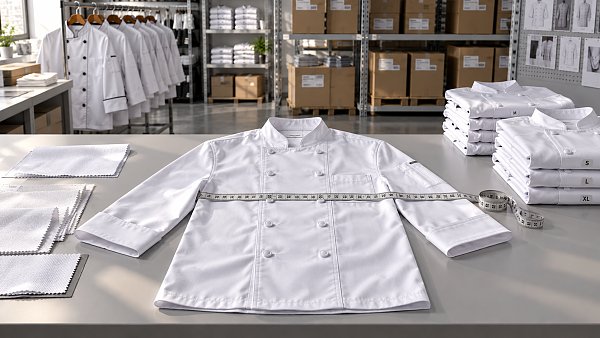
Use a size set where the order spans a broad workforce. Approving one medium coat does not demonstrate that the smallest and largest sizes will fit acceptably. Obtain the supplier’s garment measurement chart, clarify how measurements are taken, and agree acceptable tolerances. Staff should select sizes using the relevant chart and fit samples rather than assuming that familiar size labels will transfer between brands.
Laundry compatibility deserves its own approval. Share the intended washing, drying, and finishing process with the supplier, particularly where an external laundry handles the garments. Have that laundry assess the samples under the proposed service conditions. A coat suitable for one care process may not be suitable for another.
- Record garment measurements before and after laundering to assess dimensional change.
- Inspect seams, closures, fabric appearance, and any puckering after the agreed trial.
- Check whether the fabric remains acceptably opaque and comfortable.
- Review embroidery for distortion, loose threads, uncomfortable backing, and changes in appearance.
- Assess whether the coat can be finished to the presentation standard required by the property.
Define acceptance criteria before reviewing results. “Good quality” gives the buyer and supplier little basis for resolving a disagreement. Measurement tolerances, an approved logo position, agreed construction details, and a retained reference sample make the requirement more concrete. Where formal testing is necessary, specify the relevant method and acceptance level with a qualified testing provider.
Keep a dated approval record identifying the sample, specification version, and permitted deviations. Ask the supplier to retain a matching reference. Approval should apply to the agreed garment; changes to fabric, trims, or construction should return for review.
Translate the quoted lead time into a usable delivery date
A quoted lead time is incomplete until the supplier defines its starting point and endpoint. It might begin after the deposit, final size breakdown, artwork approval, fabric availability, or approval of a production sample. It might end when production finishes, when goods leave the factory, or when they reach the buyer.
Request a dated schedule built around your required receipt date. Identify the dependencies that must be completed before production can begin. A statement such as “delivery after approval” leaves too much uncertainty if sample preparation and revisions have no agreed schedule.
The schedule should distinguish the main stages:
- Sample preparation, transit, wear assessment, and laundry evaluation.
- Artwork approval and any revised sample or embroidery approval.
- Material allocation, production scheduling, sewing, and decoration.
- Final inspection, packing, and release for shipment.
- Transport, customs clearance where applicable, and delivery to the receiving location.
- Receiving inspection, size allocation, and distribution to staff or properties.
Ask what supports the proposed dates. For a stocked style, confirm that the required sizes are available and how they will be reserved. For a production order, establish whether fabric has been allocated and whether the schedule includes decoration. A garment listed as available may still need additional time before a branded order can ship.
Work backward from the date staff must wear the coats. Delivery on the day before opening leaves little room to resolve shortages, incorrect embroidery, or fit exchanges. The receiving allowance should reflect the consequences of a problem and the practicality of obtaining replacements.
For a fixed opening date, consider whether a staged order reduces exposure. An approved stocked coat might cover initial operations while a custom order follows. This requires agreement on appearance, employee allocation, and the extra cost; it should be planned before a delay makes the decision urgent.
Document how schedule changes will be communicated and handled. Ask when the supplier must report a missed milestone, whether partial shipments are possible, and who pays additional freight when an agreed delivery commitment is missed for reasons covered by the contract. The value of these terms depends on their clarity and enforceability.
Compare the cost of accepted garments ready for issue
Normalize quotations before comparing totals. Suppliers should price the same fabric specification, size breakdown, decoration, packing requirements, delivery location, and commercial terms. An undecorated factory price cannot be compared directly with a delivered quotation that includes embroidery and inspection.
Build the comparison from the full order cost: garments, size surcharges, samples, artwork or setup fees, decoration, inspection, freight, applicable duties and taxes, and receiving costs. Identify which charges recur on repeat orders. For imported goods, clarify responsibility for transport, customs arrangements, and charges under the agreed trade terms.
Keep uncertain costs visible. Possible airfreight, replacement shipments, and additional sample rounds should not disappear into a low headline price. Where these outcomes could change the supplier decision, compare a normal delivery scenario with a delayed or revised order.
Use the number of accepted garments available for issue as the practical basis for cost comparison. A compulsory size pack may leave unused stock; defects may reduce the quantity ready for staff; shortages may force a small, expensive follow-up purchase. These effects can outweigh a modest difference in unit price.
Also examine the remedy for defects. Establish the inspection window, evidence required for a claim, and whether the supplier offers replacement, repair, or credit. Clarify who pays associated transport and what remedy applies after decoration. A credit may settle the invoice while leaving the kitchen without enough coats.
Durability belongs in the cost discussion, but precise cost-per-wear claims require evidence about service life in your operation. Use sample and laundry results to assess suitability, then track replacement reasons after rollout. That record gives future purchasing decisions a firmer basis than an unsupported lifespan promise.
Make the award depend on evidence at each stage
The strongest supplier choice is the one that can support the required assortment, pass the agreed sample review, and commit to a workable delivery schedule at an acceptable total cost. Price can then distinguish suppliers that have demonstrated those capabilities.
Before committing to bulk production, bring the approved specification, size quantities, reference sample, price breakdown, milestone dates, and defect remedies into the purchase documentation. Align payment milestones with the agreed commercial terms and available evidence of progress. If inspection is part of acceptance, arrange its timing before shipment becomes urgent.
A narrowly stocked standard range may be the right choice for a buyer with frequent small replenishments. A custom production supplier may suit a stable program with predictable volume and enough time for development. The purchasing route should follow the operating requirement.
Leave the final supplier discussion focused on the next order as well as the first: how a single missing size will be supplied, how specification changes will be communicated, and what happens if the chosen coat is discontinued. Those answers determine whether an affordable rollout remains manageable once the uniforms are in daily use.
Search News
Hot Articles
- Stationery & UniformsChoosing a Wholesale Chef Coat Supplier: MOQs, Samples, and Lead TimesOct 19, 2026
- Indoor PlaygroundTurnkey Playground Installation: What's Included and What Costs Extra?Oct 18, 2026
- Musical InstrumentsProfessional String Instruments: How to Evaluate Tone, Response, and ProjectionOct 17, 2026
Popular Tags
Need ExpertConsultation?
Connect with our specialized leisureengineering team for procurementstrategies.
Recommended News
 Oct 19, 2026Choosing a Wholesale Chef Coat Supplier: MOQs, Samples, and Lead TimesChoose a wholesale chef coats supplier with confidence. Compare MOQs, test samples, and verify lead times to avoid excess stock, control costs, and keep your kitchen team ready.● Institutional Buyer
 Sep 21, 2026How Schools Can Cut Printing Costs When Buying Ink Cartridges in BulkSchool ink cartridges wholesale made smarter: cut printing costs with fleet planning, cost-per-page comparisons, reliable suppliers, and inventory controls.● Institutional Buyer
 Sep 17, 2026How to Source Wholesale Packing Tape Without Compromising Carton Seal StrengthWholesale packing tape sourcing guide: compare adhesive, backing, carton conditions, and real-world trials to reduce costs while maintaining reliable carton seal strength.● Institutional Buyer
 Sep 05, 2026How to Buy Geometry Sets in Bulk for Schools: A Practical Procurement ChecklistGeometry sets bulk buying guide for schools: compare safety, quality, compliance, packaging, supplier reliability, and total cost for smarter procurement.● Institutional Buyer
 Aug 31, 2026Microscope Slides Market Outlook: Demand Drivers, Segments, and Sourcing RisksExplore the microscope slides market: key demand drivers, product segments, quality risks, and sourcing strategies for reliable laboratory supply.● Institutional Buyer
 Aug 30, 2026Microscope Slides HS Code: How Importers Classify Laboratory Glass Slides CorrectlyMicroscope slides HS code guide: learn how to classify laboratory glass slides accurately, verify materials, avoid customs delays, and improve import compliance.● Institutional Buyer
 Aug 29, 2026How to Choose Graduation Tassels With Year Charms for Large School OrdersGraduation tassels with year charm: learn how to specify colors, materials, packaging, proofs, and delivery timelines for accurate large school orders.● Institutional Buyer
 Aug 11, 2026How to Choose Alphabet Educational Posters for Different Classroom Age GroupsAlphabet educational posters should match how each age group learns. Discover how to choose safer, clearer, curriculum-ready designs for preschool to primary classrooms.● Institutional Buyer
 Aug 05, 2026How to Evaluate a Marching Band Uniform Manufacturer for Quality and On-Time DeliveryMarching band uniform manufacturer selection starts with delivery risk. Learn how to compare quality, sizing, compliance, and capacity for reliable, on-time orders.● Institutional Buyer
 Jul 20, 2026How to Evaluate a Stationery Distributor for Bulk Office and School Supply PurchasingStationery distributor selection affects cost, delivery, and compliance. Learn how to evaluate suppliers for bulk office and school supply purchasing with confidence.● Institutional Buyer
 Jul 18, 2026How to Choose Custom Hotel Uniforms: Fabric, Branding, Comfort, and DurabilityCustom hotel uniforms guide: learn how to choose the right fabric, branding, comfort, and durability to improve staff performance, strengthen hotel image, and reduce long-term costs.● Institutional Buyer
 Jul 15, 2026How to Choose a Clear Pencil Cases Manufacturer for School and Retail OrdersClear pencil cases manufacturer selection made simple: learn how to compare quality, compliance, customization, pricing, and lead times for school and retail orders.● Institutional Buyer
 Jul 14, 2026How to Evaluate a Hole Punches Wholesale Supplier for Quality, MOQ, and Lead TimeHole punches wholesale supplier selection starts with quality, MOQ, and lead time. Learn practical checks, warning signs, and sourcing tips to reduce risk and buy smarter.● Institutional Buyer
 Jul 13, 2026Wholesale Erasers and Sharpeners: How to Compare Materials, Packaging, and MOQWholesale erasers and sharpeners buying guide: compare materials, packaging, and MOQ to cut risk, improve quality, and choose suppliers with better value.● Institutional Buyer
 Jul 10, 2026Custom Housekeeping Uniforms: What Fabrics and Features Hold Up in Daily Hotel Use?Custom housekeeping uniforms that last: discover the best fabrics, stretch, stain resistance, and hotel-ready features to cut replacement costs and keep staff polished daily.● Institutional Buyer
 Jul 08, 2026Fast Warm Up Laminator Buying Guide: Speed, Film Thickness, and Use Case ExplainedFast warm up laminator buying guide covering warm-up speed, film thickness, and real use cases. Compare specs, avoid buying mistakes, and choose the right model with confidence.● Institutional Buyer
 Jul 08, 2026How to Choose School Supplies for Campuses by Grade Level, Budget, and Daily UseSchool supplies for campuses made simple: learn how to choose by grade level, budget, durability, and daily use to reduce waste, improve sourcing, and support every classroom.● Institutional Buyer
 Jul 05, 2026How to Choose Branded Office Stationery for Corporate Use and Budget ControlBranded office stationery buying guide: learn how to balance quality, customization, supplier comparison, and budget control for consistent branding and smarter corporate sourcing.● Institutional Buyer
 Jul 01, 2026Paper Guillotines Buying Guide: Manual vs Electric, Cut Size, and Safety FeaturesPaper guillotines buying guide covering manual vs electric models, cut size, and safety features. Compare costs, productivity, and key specs to choose the right machine.● Institutional Buyer
 Jun 29, 2026Bingo Cages and Balls: Sizes, Materials, and What Affects Game VisibilityBingo cages and balls guide: compare sizes, materials, contrast, and durability to improve visibility, fairness, and long-term value in commercial and event play.● Institutional Buyer
 Jun 25, 2026School Uniforms in Europe: Materials, Sizing, and Compliance Points for Bulk OrdersSchool uniforms Europe sourcing guide: compare materials, sizing accuracy, and EU compliance points for bulk orders to reduce risk, improve durability, and choose suppliers with confidence.● Institutional Buyer
 Jun 23, 2026Wholesale Playing Cards Casino Buying Guide: Paper Stock, Finish, Security, and MOQWholesale playing cards casino buying guide covering paper stock, finish, security features, and MOQ. Compare suppliers smarter, reduce sourcing risk, and choose casino-grade decks with confidence.● Institutional Buyer
 Jun 22, 2026Eco Friendly Office Stationery: What to Check Before Buying for Daily Business UseEco friendly office stationery buying guide for businesses: learn how to check materials, certifications, durability, supplier reliability, and total cost before choosing daily office supplies.● Institutional Buyer
 Jun 21, 2026How to Choose Custom Promotional Pens for Trade Shows, Schools, and Corporate GiveawaysCustom promotional pens: learn how to choose the right styles for trade shows, schools, and corporate giveaways with tips on quality, branding, durability, and sourcing.● Institutional Buyer