Wholesale Playing Cards Casino Buying Guide: Paper Stock, Finish, Security, and MOQ
Wholesale Playing Cards Casino Buying Guide: what matters before you compare quotes?
Sourcing wholesale playing cards casino products is rarely a simple price exercise. Card feel, shuffling consistency, print precision, and supply stability all affect the final decision.
In commercial environments, poor card quality creates visible problems fast. Edges split early, finishes become sticky, and inconsistent cutting can interfere with gameplay.
That is why many buyers now evaluate casino cards like any other premium commercial asset. They look at material standards, compliance confidence, branding needs, and replenishment risk together.
From a broader sourcing perspective, this fits the kind of disciplined buying logic often seen across hospitality, leisure, and specialty retail categories covered by GCT.
The practical question is not just where to buy wholesale playing cards casino stock. It is how to choose a supplier that can hold quality, cost, and lead time at the same time.
What separates casino-grade playing cards from standard promotional decks?
The biggest difference is performance under repeated handling. Casino-grade decks are built for controlled dealing, smooth spreading, and predictable durability during intensive use.
Standard promotional cards may look acceptable at first glance. In practice, they often use lower-density board, softer edges, and less stable coatings.
For wholesale playing cards casino orders, three baseline traits usually define commercial suitability.
- Consistent thickness and stiffness across all decks
- Accurate color registration and centered cutting
- Surface finish that supports repeated shuffling without excessive slip
A useful way to think about it is this: casino cards are operating supplies, not souvenir items. The deck must perform reliably, not just print attractively.
This distinction matters even more in leisure venues, integrated resorts, cruise entertainment spaces, and gaming-themed hospitality projects where brand perception depends on touch quality.
Paper stock or plastic-coated board: which option usually makes more sense?
This is often the first technical question, and it deserves careful comparison. The right answer depends on usage frequency, replacement cycle, and desired table feel.
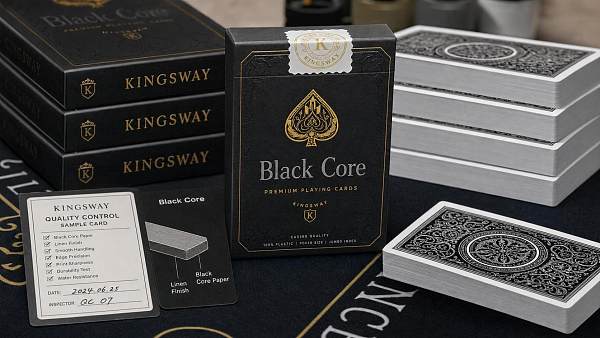
Many wholesale playing cards casino programs still prefer premium black-core paper stock. It offers a classic snap, controlled flexibility, and a familiar handling experience.
Plastic-coated paper can improve moisture resistance and extend working life. However, the coating quality matters more than the label itself.
Lower-grade coatings sometimes crack, become glossy too quickly, or change the friction level after repeated use. That creates inconsistency from batch to batch.
In actual buying decisions, sample testing is more reliable than spec sheets alone. Flex, edge rebound, and finger glide reveal differences very quickly.
How should finish, texture, and cut quality be evaluated?
Many sourcing problems come from underestimating the finish. Buyers focus on artwork and stock weight, then discover that the deck handles poorly on the table.
A suitable finish should balance slide and control. If the surface is too slick, cards can misalign. If it is too dry, shuffling becomes laborious.
Embossing pattern also changes performance. Fine linen textures often improve airflow between cards, while smoother finishes may favor a more polished visual appearance.
Cut quality deserves equal attention. Uneven corners, rough edges, or poor centering are not cosmetic issues alone. They can affect dealing comfort and visual consistency.
A practical sample review checklist usually includes the following points.
- Spread test across felt or smooth table surfaces
- Shuffle feel after repeated cycles
- Corner uniformity under close visual inspection
- Ink rub resistance on face and back areas
- Warping response after short exposure to humidity
When reviewing wholesale playing cards casino samples, it helps to compare decks from two or three suppliers side by side under the same lighting and handling conditions.
Which security features are worth paying for, and which are often unnecessary?
Security requirements vary widely. Some projects need basic deck control only, while others need stronger anti-counterfeit and traceability measures.
For most wholesale playing cards casino orders, the common options include UV marks, serial numbering, barcode tracking, tamper-evident seals, and custom tuck box identifiers.
UV printing is useful when discreet validation matters. Serial numbers help with batch control and dispute resolution. Tamper seals support chain-of-custody checks during storage and issue.
More complex security layers are not always necessary. If the operational setting uses frequent deck replacement and tight internal controls, overengineering may only raise cost.
The better question is not whether a feature sounds advanced. It is whether that feature solves a real control problem in the intended environment.
What does MOQ really tell you about a supplier?
MOQ is often treated as a negotiating point, but it also reveals manufacturing structure. A very low MOQ can be convenient, though it may signal limited customization efficiency.
A high MOQ is not automatically negative either. It may reflect custom plate setup, dedicated paper sourcing, security printing steps, or stricter packaging control.
For wholesale playing cards casino procurement, MOQ should be reviewed together with four related factors.
- Unit price at target volume
- Sampling and preproduction approval time
- Repeat order consistency
- Packaging and freight efficiency
In many cases, the best commercial result comes from a phased order structure. An initial validated run reduces risk, then repeat orders improve pricing once specifications are locked.
That approach aligns with a broader B2B sourcing principle seen across GCT-covered sectors: stable standards usually create better lifetime value than aggressive first-order discounts.
Where do buyers usually make mistakes with wholesale playing cards casino sourcing?
The most common mistake is approving artwork but not approving performance criteria. A visually strong sample can still fail during actual use.
Another frequent issue is asking for custom features without defining tolerance limits. Color variation, corner radius, and finish consistency should be documented before mass production.
Lead time misunderstandings also create avoidable pressure. Security printing, custom tuck boxes, and export packaging can add more time than expected.
It is also risky to compare quotes without normalizing specifications. One supplier may price black-core stock with UV security, while another quotes standard board with no traceability features.
A clean comparison sheet helps prevent that confusion.
- Confirm stock composition and thickness tolerance
- Define finish type and handling expectation
- List every security element separately
- Specify deck count, packaging style, and carton details
- Request repeat-order consistency terms if possible
How should the final decision be made?
The final choice should come from a balanced scorecard, not a single quote. Material performance, finish stability, security fit, MOQ logic, and replenishment reliability all deserve weight.
A useful next step is to shortlist two or three suppliers, request matched samples, and evaluate them against the same handling and packaging checklist.
For wholesale playing cards casino sourcing, the strongest result usually comes from clear specifications established before price negotiation, not after it.
If the application includes hospitality, entertainment, or branded leisure environments, it also helps to review how the deck supports the broader guest experience, not just operational cost.
In simple terms, reliable buying starts with defining the table feel, lifespan, security level, and reorder plan you actually need. Once those points are clear, supplier comparison becomes much easier.
That is the most practical way to reduce sourcing risk, control total cost, and secure casino-grade cards that perform consistently over time.
Search News
Hot Articles
- Stationery & UniformsHow Schools Can Cut Printing Costs When Buying Ink Cartridges in BulkSep 21, 2026
- Jewelry Packaging & DisplayHow to Evaluate a Luxury Retail Packaging Supplier for Premium Brand ConsistencySep 20, 2026
- Commercial KitchenHow to Select a Spiral Dough Mixer for Bakery Batch Size and Dough HydrationSep 19, 2026
Popular Tags
Need ExpertConsultation?
Connect with our specialized leisureengineering team for procurementstrategies.
Recommended News
 Sep 21, 2026How Schools Can Cut Printing Costs When Buying Ink Cartridges in BulkSchool ink cartridges wholesale made smarter: cut printing costs with fleet planning, cost-per-page comparisons, reliable suppliers, and inventory controls.● Institutional Buyer
 Sep 17, 2026How to Source Wholesale Packing Tape Without Compromising Carton Seal StrengthWholesale packing tape sourcing guide: compare adhesive, backing, carton conditions, and real-world trials to reduce costs while maintaining reliable carton seal strength.● Institutional Buyer
 Sep 05, 2026How to Buy Geometry Sets in Bulk for Schools: A Practical Procurement ChecklistGeometry sets bulk buying guide for schools: compare safety, quality, compliance, packaging, supplier reliability, and total cost for smarter procurement.● Institutional Buyer
 Aug 31, 2026Microscope Slides Market Outlook: Demand Drivers, Segments, and Sourcing RisksExplore the microscope slides market: key demand drivers, product segments, quality risks, and sourcing strategies for reliable laboratory supply.● Institutional Buyer
 Aug 30, 2026Microscope Slides HS Code: How Importers Classify Laboratory Glass Slides CorrectlyMicroscope slides HS code guide: learn how to classify laboratory glass slides accurately, verify materials, avoid customs delays, and improve import compliance.● Institutional Buyer
 Aug 29, 2026How to Choose Graduation Tassels With Year Charms for Large School OrdersGraduation tassels with year charm: learn how to specify colors, materials, packaging, proofs, and delivery timelines for accurate large school orders.● Institutional Buyer
 Aug 11, 2026How to Choose Alphabet Educational Posters for Different Classroom Age GroupsAlphabet educational posters should match how each age group learns. Discover how to choose safer, clearer, curriculum-ready designs for preschool to primary classrooms.● Institutional Buyer
 Aug 05, 2026How to Evaluate a Marching Band Uniform Manufacturer for Quality and On-Time DeliveryMarching band uniform manufacturer selection starts with delivery risk. Learn how to compare quality, sizing, compliance, and capacity for reliable, on-time orders.● Institutional Buyer
 Jul 20, 2026How to Evaluate a Stationery Distributor for Bulk Office and School Supply PurchasingStationery distributor selection affects cost, delivery, and compliance. Learn how to evaluate suppliers for bulk office and school supply purchasing with confidence.● Institutional Buyer
 Jul 18, 2026How to Choose Custom Hotel Uniforms: Fabric, Branding, Comfort, and DurabilityCustom hotel uniforms guide: learn how to choose the right fabric, branding, comfort, and durability to improve staff performance, strengthen hotel image, and reduce long-term costs.● Institutional Buyer
 Jul 15, 2026How to Choose a Clear Pencil Cases Manufacturer for School and Retail OrdersClear pencil cases manufacturer selection made simple: learn how to compare quality, compliance, customization, pricing, and lead times for school and retail orders.● Institutional Buyer
 Jul 14, 2026How to Evaluate a Hole Punches Wholesale Supplier for Quality, MOQ, and Lead TimeHole punches wholesale supplier selection starts with quality, MOQ, and lead time. Learn practical checks, warning signs, and sourcing tips to reduce risk and buy smarter.● Institutional Buyer
 Jul 13, 2026Wholesale Erasers and Sharpeners: How to Compare Materials, Packaging, and MOQWholesale erasers and sharpeners buying guide: compare materials, packaging, and MOQ to cut risk, improve quality, and choose suppliers with better value.● Institutional Buyer
 Jul 10, 2026Custom Housekeeping Uniforms: What Fabrics and Features Hold Up in Daily Hotel Use?Custom housekeeping uniforms that last: discover the best fabrics, stretch, stain resistance, and hotel-ready features to cut replacement costs and keep staff polished daily.● Institutional Buyer
 Jul 08, 2026Fast Warm Up Laminator Buying Guide: Speed, Film Thickness, and Use Case ExplainedFast warm up laminator buying guide covering warm-up speed, film thickness, and real use cases. Compare specs, avoid buying mistakes, and choose the right model with confidence.● Institutional Buyer
 Jul 08, 2026How to Choose School Supplies for Campuses by Grade Level, Budget, and Daily UseSchool supplies for campuses made simple: learn how to choose by grade level, budget, durability, and daily use to reduce waste, improve sourcing, and support every classroom.● Institutional Buyer
 Jul 05, 2026How to Choose Branded Office Stationery for Corporate Use and Budget ControlBranded office stationery buying guide: learn how to balance quality, customization, supplier comparison, and budget control for consistent branding and smarter corporate sourcing.● Institutional Buyer
 Jul 01, 2026Paper Guillotines Buying Guide: Manual vs Electric, Cut Size, and Safety FeaturesPaper guillotines buying guide covering manual vs electric models, cut size, and safety features. Compare costs, productivity, and key specs to choose the right machine.● Institutional Buyer
 Jun 29, 2026Bingo Cages and Balls: Sizes, Materials, and What Affects Game VisibilityBingo cages and balls guide: compare sizes, materials, contrast, and durability to improve visibility, fairness, and long-term value in commercial and event play.● Institutional Buyer
 Jun 25, 2026School Uniforms in Europe: Materials, Sizing, and Compliance Points for Bulk OrdersSchool uniforms Europe sourcing guide: compare materials, sizing accuracy, and EU compliance points for bulk orders to reduce risk, improve durability, and choose suppliers with confidence.● Institutional Buyer
 Jun 23, 2026Wholesale Playing Cards Casino Buying Guide: Paper Stock, Finish, Security, and MOQWholesale playing cards casino buying guide covering paper stock, finish, security features, and MOQ. Compare suppliers smarter, reduce sourcing risk, and choose casino-grade decks with confidence.● Institutional Buyer
 Jun 22, 2026Eco Friendly Office Stationery: What to Check Before Buying for Daily Business UseEco friendly office stationery buying guide for businesses: learn how to check materials, certifications, durability, supplier reliability, and total cost before choosing daily office supplies.● Institutional Buyer
 Jun 21, 2026How to Choose Custom Promotional Pens for Trade Shows, Schools, and Corporate GiveawaysCustom promotional pens: learn how to choose the right styles for trade shows, schools, and corporate giveaways with tips on quality, branding, durability, and sourcing.● Institutional Buyer
 Jun 16, 2026Microscope Slides Wholesale Buying Guide: Glass Types, Sizes, and MOQ FactorsMicroscope slides wholesale buying guide covering glass types, standard sizes, MOQ factors, and quality risks—compare smarter, reduce waste, and choose reliable bulk supply.● Institutional Buyer