Fast Warm Up Laminator Buying Guide: Speed, Film Thickness, and Use Case Explained
Fast Warm Up Laminator Buying Guide: Speed, Film Thickness, and Use Case Explained
Choosing a fast warm up laminator is not only about startup speed.
The better decision comes from matching speed, film range, and workload.
That balance affects finish quality, operator efficiency, and equipment stability over time.
In real purchasing work, a model that heats quickly but handles limited film options may create downstream limits.
A slower machine may also fail when peak demand requires fast turnaround.
This guide breaks down how to evaluate a fast warm up laminator in a practical way.
Why Fast Warm Up Matters Beyond Convenience
Warm-up time directly shapes workflow efficiency.
In schools, offices, copy centers, and print rooms, jobs often arrive in short bursts.
A fast warm up laminator reduces idle waiting between tasks.
That matters more when operators handle mixed media throughout the day.
From a technical perspective, fast warm-up should not be viewed in isolation.
The key question is whether the machine reaches stable operating temperature quickly and consistently.
A machine that heats fast but fluctuates under load can cause silvering, bubbles, or edge lift.
So the real target is stable readiness, not a headline number alone.
How to Read Warm-Up Speed Specifications
Manufacturers usually promote warm-up time in minutes.
For a fast warm up laminator, common claims range from 30 seconds to 3 minutes.
However, quoted figures may reflect ideal lab conditions.
Ambient temperature, standby cycles, and film thickness can all change actual startup time.
When comparing models, look for these details:
- Time to first usable output, not only heater activation
- Recovery speed between consecutive jobs
- Temperature stability at maximum rated width
- Performance when switching from thin to thick pouches
- Auto standby and reheat behavior
This is where many buying decisions improve.
A truly useful fast warm up laminator keeps speed after the first document, not only before it.
Film Thickness: The Specification That Changes Everything
Film thickness has a major impact on machine suitability.
It affects rigidity, protection level, heat demand, and output finish.
Many buyers focus on warm-up time first, then discover the machine cannot support their target pouch range.
That creates avoidable replacement cost or workflow compromise.
Entry-level units often support thinner pouches.
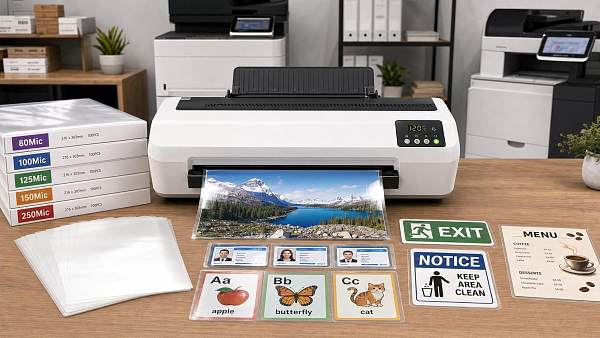
Higher-spec machines usually handle wider ranges, such as 3 mil to 10 mil, or more in specialty cases.
A fast warm up laminator with broad film compatibility gives more flexibility across departments.
If the application mix changes often, film range may matter more than raw startup speed.
Match the Fast Warm Up Laminator to the Real Use Case
Use case should guide every specification review.
A fast warm up laminator for a front office is different from one used in a print support room.
The following patterns help narrow the shortlist.
Low-Volume Administrative Use
For occasional certificates, notices, or desk materials, startup speed is highly visible.
Compact size, simple controls, and jam release matter just as much.
Here, a fast warm up laminator with 3 mil to 5 mil support is often enough.
School and Training Environments
Educational settings need repeatability across different operators.
Frequent use, mixed document types, and moderate durability needs are common.
A fast warm up laminator with stable heating and 5 mil capability usually fits better.
Commercial or Shared-Service Use
This environment punishes weak duty cycles.
Recovery time, throughput, roller design, and thermal consistency become critical.
A fast warm up laminator here should support thicker film and sustained daily volume.
Retail Display and Signage Support
Signage teams often need thicker, more rigid laminated pieces.
A machine that warms quickly but struggles with 7 mil or 10 mil pouches adds risk.
In this case, film support and finish quality outrank small differences in startup time.
Key Technical Factors That Separate Strong Models
Once speed and film range are clear, deeper specifications should drive the final comparison.
- Roller count: More rollers usually improve pressure consistency and finish quality.
- Laminating speed: Measured in inches or millimeters per minute, it affects actual throughput.
- Maximum width: Check compatibility with letter, A4, menu, badge, or display formats.
- Jam release: Essential for reducing downtime and protecting documents.
- Temperature control: Adjustable settings matter when film types vary.
- Duty cycle: Continuous operation tolerance indicates suitability for shared or commercial use.
- Energy management: Sleep mode and quick recovery help in intermittent workflows.
A fast warm up laminator with weak roller pressure may still produce disappointing results.
That is why technical screening should always connect output quality with stated specifications.
Common Buying Risks and How to Avoid Them
Several buying mistakes appear again and again.
Most come from relying on one visible feature instead of total fit.
- Choosing by warm-up claim alone. Verify output consistency after repeated jobs.
- Ignoring film thickness limits. Check present and future media needs.
- Underestimating workload. Daily volume often exposes hidden weaknesses.
- Overbuying industrial features. Extra capacity has a cost and may not improve value.
- Skipping operator usability. Poor controls increase training time and errors.
A careful evaluation matrix usually solves these issues early.
The better approach is to score each fast warm up laminator against workload, film needs, quality risk, and expected service life.
A Practical Shortlist Framework
To compare models efficiently, use a simple decision structure.
This framework helps keep the review grounded in actual purchasing outcomes.
It also makes supplier comparison cleaner when several fast warm up laminator options appear similar on paper.
Final Decision: What the Best Choice Usually Looks Like
The best fast warm up laminator is rarely the one with the shortest advertised startup number.
The better choice reaches stable temperature quickly, supports the right film thickness, and performs reliably in the intended environment.
For light office use, simplicity and quick readiness may lead the decision.
For schools and commercial teams, wider film support and stronger duty performance often matter more.
That is the practical lens for evaluating any fast warm up laminator.
Start with workload, confirm film requirements, then verify speed under real conditions. That sequence usually leads to the right shortlist and a better long-term purchase.
Search News
Hot Articles
- Commercial KitchenWhat Is Driving Demand for Commercial Hospitality Projects Across the GCC?Oct 06, 2026
- Hotel Room AmenitiesHow to Select Hotel Hair Dryers That Balance Guest Safety, Durability, and CostOct 05, 2026
- Restaurant FurnitureFast-Casual Restaurant Interiors: Design Choices That Improve Speed and Guest FlowOct 04, 2026
Popular Tags
Need ExpertConsultation?
Connect with our specialized leisureengineering team for procurementstrategies.
Recommended News
 Sep 21, 2026How Schools Can Cut Printing Costs When Buying Ink Cartridges in BulkSchool ink cartridges wholesale made smarter: cut printing costs with fleet planning, cost-per-page comparisons, reliable suppliers, and inventory controls.● Institutional Buyer
 Sep 17, 2026How to Source Wholesale Packing Tape Without Compromising Carton Seal StrengthWholesale packing tape sourcing guide: compare adhesive, backing, carton conditions, and real-world trials to reduce costs while maintaining reliable carton seal strength.● Institutional Buyer
 Sep 05, 2026How to Buy Geometry Sets in Bulk for Schools: A Practical Procurement ChecklistGeometry sets bulk buying guide for schools: compare safety, quality, compliance, packaging, supplier reliability, and total cost for smarter procurement.● Institutional Buyer
 Aug 31, 2026Microscope Slides Market Outlook: Demand Drivers, Segments, and Sourcing RisksExplore the microscope slides market: key demand drivers, product segments, quality risks, and sourcing strategies for reliable laboratory supply.● Institutional Buyer
 Aug 30, 2026Microscope Slides HS Code: How Importers Classify Laboratory Glass Slides CorrectlyMicroscope slides HS code guide: learn how to classify laboratory glass slides accurately, verify materials, avoid customs delays, and improve import compliance.● Institutional Buyer
 Aug 29, 2026How to Choose Graduation Tassels With Year Charms for Large School OrdersGraduation tassels with year charm: learn how to specify colors, materials, packaging, proofs, and delivery timelines for accurate large school orders.● Institutional Buyer
 Aug 11, 2026How to Choose Alphabet Educational Posters for Different Classroom Age GroupsAlphabet educational posters should match how each age group learns. Discover how to choose safer, clearer, curriculum-ready designs for preschool to primary classrooms.● Institutional Buyer
 Aug 05, 2026How to Evaluate a Marching Band Uniform Manufacturer for Quality and On-Time DeliveryMarching band uniform manufacturer selection starts with delivery risk. Learn how to compare quality, sizing, compliance, and capacity for reliable, on-time orders.● Institutional Buyer
 Jul 20, 2026How to Evaluate a Stationery Distributor for Bulk Office and School Supply PurchasingStationery distributor selection affects cost, delivery, and compliance. Learn how to evaluate suppliers for bulk office and school supply purchasing with confidence.● Institutional Buyer
 Jul 18, 2026How to Choose Custom Hotel Uniforms: Fabric, Branding, Comfort, and DurabilityCustom hotel uniforms guide: learn how to choose the right fabric, branding, comfort, and durability to improve staff performance, strengthen hotel image, and reduce long-term costs.● Institutional Buyer
 Jul 15, 2026How to Choose a Clear Pencil Cases Manufacturer for School and Retail OrdersClear pencil cases manufacturer selection made simple: learn how to compare quality, compliance, customization, pricing, and lead times for school and retail orders.● Institutional Buyer
 Jul 14, 2026How to Evaluate a Hole Punches Wholesale Supplier for Quality, MOQ, and Lead TimeHole punches wholesale supplier selection starts with quality, MOQ, and lead time. Learn practical checks, warning signs, and sourcing tips to reduce risk and buy smarter.● Institutional Buyer
 Jul 13, 2026Wholesale Erasers and Sharpeners: How to Compare Materials, Packaging, and MOQWholesale erasers and sharpeners buying guide: compare materials, packaging, and MOQ to cut risk, improve quality, and choose suppliers with better value.● Institutional Buyer
 Jul 10, 2026Custom Housekeeping Uniforms: What Fabrics and Features Hold Up in Daily Hotel Use?Custom housekeeping uniforms that last: discover the best fabrics, stretch, stain resistance, and hotel-ready features to cut replacement costs and keep staff polished daily.● Institutional Buyer
 Jul 08, 2026Fast Warm Up Laminator Buying Guide: Speed, Film Thickness, and Use Case ExplainedFast warm up laminator buying guide covering warm-up speed, film thickness, and real use cases. Compare specs, avoid buying mistakes, and choose the right model with confidence.● Institutional Buyer
 Jul 08, 2026How to Choose School Supplies for Campuses by Grade Level, Budget, and Daily UseSchool supplies for campuses made simple: learn how to choose by grade level, budget, durability, and daily use to reduce waste, improve sourcing, and support every classroom.● Institutional Buyer
 Jul 05, 2026How to Choose Branded Office Stationery for Corporate Use and Budget ControlBranded office stationery buying guide: learn how to balance quality, customization, supplier comparison, and budget control for consistent branding and smarter corporate sourcing.● Institutional Buyer
 Jul 01, 2026Paper Guillotines Buying Guide: Manual vs Electric, Cut Size, and Safety FeaturesPaper guillotines buying guide covering manual vs electric models, cut size, and safety features. Compare costs, productivity, and key specs to choose the right machine.● Institutional Buyer
 Jun 29, 2026Bingo Cages and Balls: Sizes, Materials, and What Affects Game VisibilityBingo cages and balls guide: compare sizes, materials, contrast, and durability to improve visibility, fairness, and long-term value in commercial and event play.● Institutional Buyer
 Jun 25, 2026School Uniforms in Europe: Materials, Sizing, and Compliance Points for Bulk OrdersSchool uniforms Europe sourcing guide: compare materials, sizing accuracy, and EU compliance points for bulk orders to reduce risk, improve durability, and choose suppliers with confidence.● Institutional Buyer
 Jun 23, 2026Wholesale Playing Cards Casino Buying Guide: Paper Stock, Finish, Security, and MOQWholesale playing cards casino buying guide covering paper stock, finish, security features, and MOQ. Compare suppliers smarter, reduce sourcing risk, and choose casino-grade decks with confidence.● Institutional Buyer
 Jun 22, 2026Eco Friendly Office Stationery: What to Check Before Buying for Daily Business UseEco friendly office stationery buying guide for businesses: learn how to check materials, certifications, durability, supplier reliability, and total cost before choosing daily office supplies.● Institutional Buyer
 Jun 21, 2026How to Choose Custom Promotional Pens for Trade Shows, Schools, and Corporate GiveawaysCustom promotional pens: learn how to choose the right styles for trade shows, schools, and corporate giveaways with tips on quality, branding, durability, and sourcing.● Institutional Buyer
 Jun 16, 2026Microscope Slides Wholesale Buying Guide: Glass Types, Sizes, and MOQ FactorsMicroscope slides wholesale buying guide covering glass types, standard sizes, MOQ factors, and quality risks—compare smarter, reduce waste, and choose reliable bulk supply.● Institutional Buyer