Eco Friendly Office Stationery: What to Check Before Buying for Daily Business Use
Eco Friendly Office Stationery: What to Check Before Buying for Daily Business Use
Choosing eco friendly office stationery for daily business use is no longer just about image.
It now affects cost control, compliance, product safety, and supplier reliability.
In practical sourcing, small items create large volumes, repeated orders, and hidden waste.
That is why eco friendly office stationery should be reviewed with the same discipline as other business supplies.
A smart buying decision balances sustainability, usability, pricing stability, and dependable supply.
The checks below help reduce risk while supporting long-term procurement goals.
Start With Real Usage, Not Just Green Claims
The first mistake is buying eco friendly office stationery based only on packaging language.
Daily business use demands products that perform consistently under normal office pressure.
Pens must write smoothly, folders must resist tearing, and notebooks must handle frequent handling.
If performance drops, employees stop using the product, and sustainability goals lose credibility.
A better starting point is usage mapping.
List high-volume items, user frequency, replacement cycles, and department-specific requirements.
This makes it easier to separate essential daily supplies from occasional-use items.
From there, eco friendly office stationery can be evaluated against real operational needs.
Questions to ask at this stage
- Which items are ordered every month or every quarter?
- Which products are shared across all departments?
- Which items create the most packaging waste?
- Which supplies often trigger user complaints or replacement requests?
Check Materials and Recycled Content Carefully
Material composition is one of the most important checks before buying eco friendly office stationery.
Not every recycled product delivers the same environmental value or the same product quality.
Some items use post-consumer recycled fiber, while others use production scrap only.
That difference matters when comparing sustainability claims.
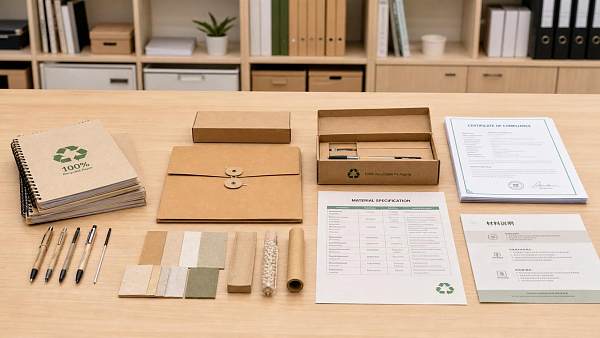
For paper products, ask for recycled percentage, fiber source, brightness level, and bleaching process.
For plastic items, check whether the material is recyclable, refillable, or partially bio-based.
For wood-based products, confirm certified sourcing and coating safety.
In short, eco friendly office stationery should be measurable, not just marketable.
What strong material data usually includes
- Recycled content percentage by weight
- Virgin versus recycled raw material ratio
- Refillable or reusable product structure
- Material declarations from the supplier
Verify Certifications, Safety, and Compliance
A reliable eco friendly office stationery program should stand on compliance, not assumption.
This is especially important for cross-border sourcing and institutional procurement.
Products may look similar, but documentation quality often separates low-risk supply from future problems.
Recent buying patterns show stronger attention to chemical safety and environmental reporting.
For paper, wood, and packaging, certifications such as FSC can support sourcing credibility.
For inks, adhesives, markers, and plastics, request relevant safety and substance compliance records.
This may include REACH, RoHS, or other market-specific declarations.
The goal is simple: eco friendly office stationery must be safe for users and acceptable for target markets.
Key documents worth requesting
- Material specification sheets
- Test reports for restricted substances
- Chain-of-custody or sourcing certifications
- Factory audit summaries when available
Review Durability and Total Cost, Not Unit Price Alone
A low unit price can make eco friendly office stationery look attractive at first.
But daily business use exposes weak clips, poor binding, leaking ink, and warped paper quickly.
When replacement rates rise, the real cost increases through repurchasing, complaints, and interrupted work.
That is why total cost of ownership matters more than list price.
Look at expected lifespan, refill options, packaging efficiency, and return rates.
In many cases, a durable refillable pen performs better than cheap disposable alternatives.
The same logic applies to files, desktop organizers, and labeling products.
A simple evaluation table
Assess Supplier Consistency and Supply Chain Visibility
Even the best eco friendly office stationery fails as a sourcing choice if supply is unstable.
For recurring business orders, consistency is often more valuable than promotional pricing.
A dependable supplier should provide clear lead times, batch traceability, and replacement procedures.
This becomes even more important when standardizing supplies across multiple offices or regions.
In actual business operations, small stationery shortages can still disrupt onboarding, meetings, and internal administration.
So ask how raw materials are sourced, how quality is controlled, and how substitutions are handled.
Strong eco friendly office stationery sourcing depends on a stable chain, not only a sustainable label.
Useful supplier review points
- Can the supplier support repeat orders with the same specification?
- Do they offer samples from current production, not old stock?
- How quickly do they respond to quality issues?
- Are sustainability claims supported by documented evidence?
Look at Packaging, Logistics, and Storage Impact
Packaging often gets less attention than the product itself.
Still, it strongly affects the real value of eco friendly office stationery.
Overpacked items increase disposal effort, shipping volume, and warehouse inefficiency.
For high-frequency office supplies, those extra layers add up fast.
Ask whether cartons are optimized for business distribution, inner packs are recyclable, and labels support inventory control.
Also confirm storage conditions, especially for adhesives, markers, and specialty paper products.
A greener product should not create avoidable waste after it reaches your facility.
Pilot Before Standardizing Across the Business
One of the most practical ways to validate eco friendly office stationery is to run a pilot order.
This reduces risk before large-scale rollout.
Test a limited product set in real departments for several weeks.
Track user feedback, replacement needs, packaging waste, and order accuracy.
This stage often reveals details that spec sheets do not show.
For example, recycled paper may print well but jam certain machines.
A pen may meet sustainability goals but fail user comfort expectations.
A short pilot gives decision-makers clearer evidence and fewer surprises later.
Make Eco Friendly Office Stationery Part of a Buying Framework
The best results come when eco friendly office stationery is built into a repeatable sourcing framework.
That framework should cover performance, compliance, cost, packaging, and supplier reliability.
It should also reflect broader business goals around waste reduction and responsible procurement.
For organizations comparing multiple vendors, a weighted scorecard keeps decisions objective.
This is where structured sourcing intelligence adds value.
At GCT, category-focused market insight helps commercial buyers compare suppliers with more confidence.
That matters when selecting eco friendly office stationery for long-term business use, not short-term campaigns.
A careful review today can lower waste, improve consistency, and protect future purchasing performance.
The practical next step is simple.
Create a shortlist, request documentation, test samples, and compare total value instead of headline price.
That is how eco friendly office stationery becomes a smart business standard, not just a good intention.
Search News
Hot Articles
- Commercial KitchenCommercial Kitchen Design Price: Budgeting by Layout, Equipment, and MEP ScopeSep 22, 2026
- Stationery & UniformsHow Schools Can Cut Printing Costs When Buying Ink Cartridges in BulkSep 21, 2026
- Jewelry Packaging & DisplayHow to Evaluate a Luxury Retail Packaging Supplier for Premium Brand ConsistencySep 20, 2026
Popular Tags
Need ExpertConsultation?
Connect with our specialized leisureengineering team for procurementstrategies.
Recommended News
 Sep 21, 2026How Schools Can Cut Printing Costs When Buying Ink Cartridges in BulkSchool ink cartridges wholesale made smarter: cut printing costs with fleet planning, cost-per-page comparisons, reliable suppliers, and inventory controls.● Institutional Buyer
 Sep 17, 2026How to Source Wholesale Packing Tape Without Compromising Carton Seal StrengthWholesale packing tape sourcing guide: compare adhesive, backing, carton conditions, and real-world trials to reduce costs while maintaining reliable carton seal strength.● Institutional Buyer
 Sep 05, 2026How to Buy Geometry Sets in Bulk for Schools: A Practical Procurement ChecklistGeometry sets bulk buying guide for schools: compare safety, quality, compliance, packaging, supplier reliability, and total cost for smarter procurement.● Institutional Buyer
 Aug 31, 2026Microscope Slides Market Outlook: Demand Drivers, Segments, and Sourcing RisksExplore the microscope slides market: key demand drivers, product segments, quality risks, and sourcing strategies for reliable laboratory supply.● Institutional Buyer
 Aug 30, 2026Microscope Slides HS Code: How Importers Classify Laboratory Glass Slides CorrectlyMicroscope slides HS code guide: learn how to classify laboratory glass slides accurately, verify materials, avoid customs delays, and improve import compliance.● Institutional Buyer
 Aug 29, 2026How to Choose Graduation Tassels With Year Charms for Large School OrdersGraduation tassels with year charm: learn how to specify colors, materials, packaging, proofs, and delivery timelines for accurate large school orders.● Institutional Buyer
 Aug 11, 2026How to Choose Alphabet Educational Posters for Different Classroom Age GroupsAlphabet educational posters should match how each age group learns. Discover how to choose safer, clearer, curriculum-ready designs for preschool to primary classrooms.● Institutional Buyer
 Aug 05, 2026How to Evaluate a Marching Band Uniform Manufacturer for Quality and On-Time DeliveryMarching band uniform manufacturer selection starts with delivery risk. Learn how to compare quality, sizing, compliance, and capacity for reliable, on-time orders.● Institutional Buyer
 Jul 20, 2026How to Evaluate a Stationery Distributor for Bulk Office and School Supply PurchasingStationery distributor selection affects cost, delivery, and compliance. Learn how to evaluate suppliers for bulk office and school supply purchasing with confidence.● Institutional Buyer
 Jul 18, 2026How to Choose Custom Hotel Uniforms: Fabric, Branding, Comfort, and DurabilityCustom hotel uniforms guide: learn how to choose the right fabric, branding, comfort, and durability to improve staff performance, strengthen hotel image, and reduce long-term costs.● Institutional Buyer
 Jul 15, 2026How to Choose a Clear Pencil Cases Manufacturer for School and Retail OrdersClear pencil cases manufacturer selection made simple: learn how to compare quality, compliance, customization, pricing, and lead times for school and retail orders.● Institutional Buyer
 Jul 14, 2026How to Evaluate a Hole Punches Wholesale Supplier for Quality, MOQ, and Lead TimeHole punches wholesale supplier selection starts with quality, MOQ, and lead time. Learn practical checks, warning signs, and sourcing tips to reduce risk and buy smarter.● Institutional Buyer
 Jul 13, 2026Wholesale Erasers and Sharpeners: How to Compare Materials, Packaging, and MOQWholesale erasers and sharpeners buying guide: compare materials, packaging, and MOQ to cut risk, improve quality, and choose suppliers with better value.● Institutional Buyer
 Jul 10, 2026Custom Housekeeping Uniforms: What Fabrics and Features Hold Up in Daily Hotel Use?Custom housekeeping uniforms that last: discover the best fabrics, stretch, stain resistance, and hotel-ready features to cut replacement costs and keep staff polished daily.● Institutional Buyer
 Jul 08, 2026Fast Warm Up Laminator Buying Guide: Speed, Film Thickness, and Use Case ExplainedFast warm up laminator buying guide covering warm-up speed, film thickness, and real use cases. Compare specs, avoid buying mistakes, and choose the right model with confidence.● Institutional Buyer
 Jul 08, 2026How to Choose School Supplies for Campuses by Grade Level, Budget, and Daily UseSchool supplies for campuses made simple: learn how to choose by grade level, budget, durability, and daily use to reduce waste, improve sourcing, and support every classroom.● Institutional Buyer
 Jul 05, 2026How to Choose Branded Office Stationery for Corporate Use and Budget ControlBranded office stationery buying guide: learn how to balance quality, customization, supplier comparison, and budget control for consistent branding and smarter corporate sourcing.● Institutional Buyer
 Jul 01, 2026Paper Guillotines Buying Guide: Manual vs Electric, Cut Size, and Safety FeaturesPaper guillotines buying guide covering manual vs electric models, cut size, and safety features. Compare costs, productivity, and key specs to choose the right machine.● Institutional Buyer
 Jun 29, 2026Bingo Cages and Balls: Sizes, Materials, and What Affects Game VisibilityBingo cages and balls guide: compare sizes, materials, contrast, and durability to improve visibility, fairness, and long-term value in commercial and event play.● Institutional Buyer
 Jun 25, 2026School Uniforms in Europe: Materials, Sizing, and Compliance Points for Bulk OrdersSchool uniforms Europe sourcing guide: compare materials, sizing accuracy, and EU compliance points for bulk orders to reduce risk, improve durability, and choose suppliers with confidence.● Institutional Buyer
 Jun 23, 2026Wholesale Playing Cards Casino Buying Guide: Paper Stock, Finish, Security, and MOQWholesale playing cards casino buying guide covering paper stock, finish, security features, and MOQ. Compare suppliers smarter, reduce sourcing risk, and choose casino-grade decks with confidence.● Institutional Buyer
 Jun 22, 2026Eco Friendly Office Stationery: What to Check Before Buying for Daily Business UseEco friendly office stationery buying guide for businesses: learn how to check materials, certifications, durability, supplier reliability, and total cost before choosing daily office supplies.● Institutional Buyer
 Jun 21, 2026How to Choose Custom Promotional Pens for Trade Shows, Schools, and Corporate GiveawaysCustom promotional pens: learn how to choose the right styles for trade shows, schools, and corporate giveaways with tips on quality, branding, durability, and sourcing.● Institutional Buyer
 Jun 16, 2026Microscope Slides Wholesale Buying Guide: Glass Types, Sizes, and MOQ FactorsMicroscope slides wholesale buying guide covering glass types, standard sizes, MOQ factors, and quality risks—compare smarter, reduce waste, and choose reliable bulk supply.● Institutional Buyer