How to Evaluate a Marching Band Uniform Manufacturer for Quality and On-Time Delivery
Start with the delivery risk, not the design mockup
Procurement teams usually get pulled into color charts, trim details, and logo placement early. That matters, but it is rarely the part that causes the most damage. The real failure point with a marching band uniform manufacturer is usually the gap between what was promised in sampling and what can actually be produced, packed, and delivered on schedule.
If the uniforms are for a fixed performance season, parade date, school opening, competition calendar, or touring schedule, late delivery is not a minor inconvenience. It can force rushed approvals, expensive air freight, partial shipment workarounds, or emergency local alterations. So when you evaluate suppliers, start by asking a simple question: can this factory repeatedly deliver customized garments at the quality level you need, within your calendar, without relying on luck?
That shift in mindset changes the whole selection process.
Check whether they really manufacture, or mainly coordinate
Some suppliers present themselves as manufacturers but actually operate more like trading companies or project coordinators. That is not automatically a problem, but it changes your risk profile. A coordinator can be useful when they have strong vendor control. It becomes a problem when no one clearly owns fabric sourcing, cutting, embroidery, finishing, or final inspection.
Ask for a process map covering the major production steps. You are not looking for a sales brochure. You want to know:
- Which steps are done in-house
- Which steps are subcontracted
- Who controls incoming material inspection
- Where final measurement and appearance checks happen
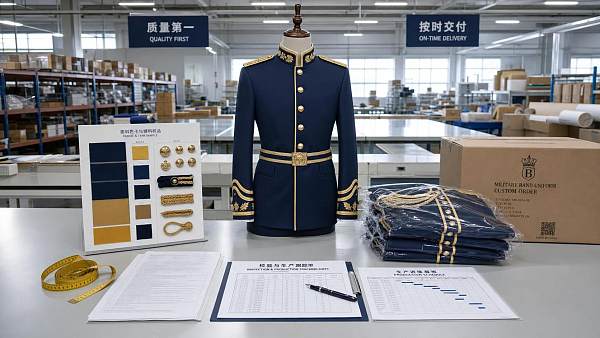
A marching band uniform manufacturer handling tailored jackets, pants, bibbers, shakos, capes, sashes, or decorative trims may use outside partners for specialty embellishments. That is normal. What you need to see is control. If the answer stays vague, expect surprises later.
Review samples like a buyer, not like a costume judge
A good-looking sample can still be a poor production candidate. In this category, visual impact often hides construction weaknesses. When reviewing a sample, go beyond the front view on a hanger.
Look at seam consistency, lining attachment, edge finishing, reinforcement at stress points, zipper quality, hook and closure alignment, embroidery backing, and how trims are secured. If decorative braids or shoulder details are only lightly attached, they may not survive rehearsal use, transport, or repeated cleaning.
Also check whether the sample reflects a real production method or a one-off showroom piece. A supplier that cannot explain how the same finish will be maintained across a full size run is giving you a design sample, not a manufacturing sample.
Get specific about fabric performance
Band uniforms are worn under heat, lights, movement, and sometimes outdoor weather. The fabric choice affects appearance, comfort, durability, and maintenance cost. General phrases like “premium polyester blend” or “high-quality woven fabric” are not enough for supplier comparison.
Ask the supplier to identify the exact material composition for the main body fabric, lining, and key trim components. Then review whether those materials fit the use case. A parade uniform, an indoor competition uniform, and a school-use uniform with frequent cleaning do not place the same demands on weight, breathability, stiffness, and wrinkle resistance.
A practical checkpoint list looks like this:
You do not need to turn this into a lab exercise, but you do need material clarity before approving bulk production.
Treat sizing control as a production issue, not just a fitting issue
Custom uniform programs fall apart when sizing data is handled casually. A manufacturer may produce attractive garments and still create chaos if their measurement intake, pattern grading, or size labeling process is weak.
Ask how they collect and manage measurements. Are they working from standard size charts, individual measurements, or a hybrid model? Who converts those measurements into production specs? What tolerance is applied to finished garments? If you are buying for a school, institution, or performance group with a wide age and body-size range, this becomes even more important.
One of the most expensive mistakes is approving a factory that is good at sewing but weak at data handling. The result is not one bad piece. It is an entire shipment with fit distribution problems that only show up when uniforms are assigned to wearers.
Ask how they manage change after approval
In uniform buying, changes happen late. A school revises colors. A logo file changes. A roster shifts. A director asks for sleeve length adjustments after seeing the wear test. The right supplier is not the one claiming nothing ever changes. It is the one with a disciplined change-control process.
You want to know how revision requests are documented, who approves them, and what happens to lead time when changes affect fabric booking, trim procurement, or cutting status. If a supplier cannot show a clean method for version control, you risk mixed production standards in the same order.
Test their delivery promise against capacity, not confidence
A lot of suppliers will say they can meet your timeline. Fewer can explain how. Ask for the expected production schedule from order confirmation to shipment readiness, broken into actual stages: material sourcing, sample approval, bulk cutting, sewing, decoration, inspection, packing, and dispatch.
Then pressure-test it. If your order includes multiple styles, custom colors, embroidery, headwear, or accessories, where is the bottleneck? If this is peak season, what else is running in the line? If one raw material is delayed, what is the recovery plan?
The point is not to trap the supplier. It is to see whether the schedule is operationally grounded. A reliable manufacturer usually talks in dependencies. An unreliable one talks in promises.
Look for evidence of repeatability
One successful sample run does not tell you much about bulk consistency. Procurement decisions should lean heavily on repeatability: the ability to produce the same color, shape, trim placement, and finish across dozens or hundreds of units.
A few useful questions cut through the noise:
- How do they control approved color standards between batches?
- Do they keep sealed samples or approval references for reorders?
- How is placement of decorative elements standardized?
- What is inspected piece by piece, and what is checked by sampling during production?
This matters even more if you expect future replenishment or phased delivery. A supplier that cannot support repeat orders without visual drift becomes costly over time.
Do not skip compliance and labeling review
The exact compliance requirements depend on your target market, buyer type, product construction, and import destination. That means you should not ask a generic question like “Are your uniforms compliant?” Ask for the actual documents tied to your transaction.
At minimum, review product labeling details, fiber content declarations where required, care label format, country-of-origin marking, and any buyer-specific restricted substance or safety requirements if they apply to the fabrics, prints, coatings, or accessories used in the uniform set. If headwear, metallic parts, cords, or specialty finishes are included, those components should be identified clearly in the bill of materials and sample approval records.
The key is traceability. You need a supplier that can connect what was quoted, what was approved, and what was shipped.
Watch how they communicate when details get messy
For custom apparel procurement, communication quality is often a better predictor of outcome than presentation quality. A supplier that responds quickly but vaguely can waste more time than one that answers more slowly with complete, usable detail.
Pay attention during quoting and sampling. Do they summarize decisions clearly? Do they flag missing inputs before production? Do they restate artwork, sizing logic, and trim choices in a way your internal team can verify? A dependable manufacturer reduces ambiguity. A weak one lets confusion travel downstream until it becomes a cost issue.
Compare quotes line by line, not just by unit price
A cheaper quote can hide expensive gaps. The fair comparison is not unit price against unit price. It is scope against scope.
Review what is included in the quote: pattern development, sample rounds, name labeling, measurements handling, accessories, spare pieces, replacement terms for defects, export packing, and shipment split options if needed. One supplier may look more expensive simply because they priced the real job while another priced a simplified version of it.
This is where many procurement teams make a preventable mistake. They negotiate aggressively on price before locking the technical scope. Then every missing detail reappears later as a delay, surcharge, or quality dispute.
Use a short approval path before placing the full order
Before committing to full production, make the supplier pass a controlled approval sequence. For most buyers, that means approved artwork, material confirmation, measurement method, pre-production sample or final sample approval, and a written production timeline tied to those approvals.
Keep it short enough to move, but detailed enough to prevent argument later. If your team has multiple stakeholders, align them before the supplier enters bulk production. Internal indecision is one of the easiest ways to turn a manageable lead time into a missed event date.
Make the final decision based on controllable risk
The best marching band uniform manufacturer is not always the one with the most striking sample or the lowest quote. It is the one that gives you the fewest uncontrolled variables between approval and delivery.
A practical decision order works well here: confirm manufacturing control, validate sample construction, lock fabric and trim specs, verify sizing workflow, review change handling, test the production schedule, and only then compare final commercial terms. That sequence keeps you focused on the risks that actually derail uniform programs.
If two suppliers look similar on price and appearance, choose the one that documents better, answers more precisely, and shows a more believable path to on-time shipment. In this category, that is usually the supplier that performs better when the order becomes real.
Search News
Hot Articles
- Commercial KitchenHow to Select a Spiral Dough Mixer for Bakery Batch Size and Dough HydrationSep 19, 2026
- Outdoor RidesWhat Drives Animatronic Dinosaur Manufacturer Prices for Theme Park Projects?Sep 18, 2026
- Stationery & UniformsHow to Source Wholesale Packing Tape Without Compromising Carton Seal StrengthSep 17, 2026
Popular Tags
Need ExpertConsultation?
Connect with our specialized leisureengineering team for procurementstrategies.
Recommended News
 Sep 17, 2026How to Source Wholesale Packing Tape Without Compromising Carton Seal StrengthWholesale packing tape sourcing guide: compare adhesive, backing, carton conditions, and real-world trials to reduce costs while maintaining reliable carton seal strength.● Institutional Buyer
 Sep 05, 2026How to Buy Geometry Sets in Bulk for Schools: A Practical Procurement ChecklistGeometry sets bulk buying guide for schools: compare safety, quality, compliance, packaging, supplier reliability, and total cost for smarter procurement.● Institutional Buyer
 Aug 31, 2026Microscope Slides Market Outlook: Demand Drivers, Segments, and Sourcing RisksExplore the microscope slides market: key demand drivers, product segments, quality risks, and sourcing strategies for reliable laboratory supply.● Institutional Buyer
 Aug 30, 2026Microscope Slides HS Code: How Importers Classify Laboratory Glass Slides CorrectlyMicroscope slides HS code guide: learn how to classify laboratory glass slides accurately, verify materials, avoid customs delays, and improve import compliance.● Institutional Buyer
 Aug 29, 2026How to Choose Graduation Tassels With Year Charms for Large School OrdersGraduation tassels with year charm: learn how to specify colors, materials, packaging, proofs, and delivery timelines for accurate large school orders.● Institutional Buyer
 Aug 11, 2026How to Choose Alphabet Educational Posters for Different Classroom Age GroupsAlphabet educational posters should match how each age group learns. Discover how to choose safer, clearer, curriculum-ready designs for preschool to primary classrooms.● Institutional Buyer
 Aug 05, 2026How to Evaluate a Marching Band Uniform Manufacturer for Quality and On-Time DeliveryMarching band uniform manufacturer selection starts with delivery risk. Learn how to compare quality, sizing, compliance, and capacity for reliable, on-time orders.● Institutional Buyer
 Jul 20, 2026How to Evaluate a Stationery Distributor for Bulk Office and School Supply PurchasingStationery distributor selection affects cost, delivery, and compliance. Learn how to evaluate suppliers for bulk office and school supply purchasing with confidence.● Institutional Buyer
 Jul 18, 2026How to Choose Custom Hotel Uniforms: Fabric, Branding, Comfort, and DurabilityCustom hotel uniforms guide: learn how to choose the right fabric, branding, comfort, and durability to improve staff performance, strengthen hotel image, and reduce long-term costs.● Institutional Buyer
 Jul 15, 2026How to Choose a Clear Pencil Cases Manufacturer for School and Retail OrdersClear pencil cases manufacturer selection made simple: learn how to compare quality, compliance, customization, pricing, and lead times for school and retail orders.● Institutional Buyer
 Jul 14, 2026How to Evaluate a Hole Punches Wholesale Supplier for Quality, MOQ, and Lead TimeHole punches wholesale supplier selection starts with quality, MOQ, and lead time. Learn practical checks, warning signs, and sourcing tips to reduce risk and buy smarter.● Institutional Buyer
 Jul 13, 2026Wholesale Erasers and Sharpeners: How to Compare Materials, Packaging, and MOQWholesale erasers and sharpeners buying guide: compare materials, packaging, and MOQ to cut risk, improve quality, and choose suppliers with better value.● Institutional Buyer
 Jul 10, 2026Custom Housekeeping Uniforms: What Fabrics and Features Hold Up in Daily Hotel Use?Custom housekeeping uniforms that last: discover the best fabrics, stretch, stain resistance, and hotel-ready features to cut replacement costs and keep staff polished daily.● Institutional Buyer
 Jul 08, 2026Fast Warm Up Laminator Buying Guide: Speed, Film Thickness, and Use Case ExplainedFast warm up laminator buying guide covering warm-up speed, film thickness, and real use cases. Compare specs, avoid buying mistakes, and choose the right model with confidence.● Institutional Buyer
 Jul 08, 2026How to Choose School Supplies for Campuses by Grade Level, Budget, and Daily UseSchool supplies for campuses made simple: learn how to choose by grade level, budget, durability, and daily use to reduce waste, improve sourcing, and support every classroom.● Institutional Buyer
 Jul 05, 2026How to Choose Branded Office Stationery for Corporate Use and Budget ControlBranded office stationery buying guide: learn how to balance quality, customization, supplier comparison, and budget control for consistent branding and smarter corporate sourcing.● Institutional Buyer
 Jul 01, 2026Paper Guillotines Buying Guide: Manual vs Electric, Cut Size, and Safety FeaturesPaper guillotines buying guide covering manual vs electric models, cut size, and safety features. Compare costs, productivity, and key specs to choose the right machine.● Institutional Buyer
 Jun 29, 2026Bingo Cages and Balls: Sizes, Materials, and What Affects Game VisibilityBingo cages and balls guide: compare sizes, materials, contrast, and durability to improve visibility, fairness, and long-term value in commercial and event play.● Institutional Buyer
 Jun 25, 2026School Uniforms in Europe: Materials, Sizing, and Compliance Points for Bulk OrdersSchool uniforms Europe sourcing guide: compare materials, sizing accuracy, and EU compliance points for bulk orders to reduce risk, improve durability, and choose suppliers with confidence.● Institutional Buyer
 Jun 23, 2026Wholesale Playing Cards Casino Buying Guide: Paper Stock, Finish, Security, and MOQWholesale playing cards casino buying guide covering paper stock, finish, security features, and MOQ. Compare suppliers smarter, reduce sourcing risk, and choose casino-grade decks with confidence.● Institutional Buyer
 Jun 22, 2026Eco Friendly Office Stationery: What to Check Before Buying for Daily Business UseEco friendly office stationery buying guide for businesses: learn how to check materials, certifications, durability, supplier reliability, and total cost before choosing daily office supplies.● Institutional Buyer
 Jun 21, 2026How to Choose Custom Promotional Pens for Trade Shows, Schools, and Corporate GiveawaysCustom promotional pens: learn how to choose the right styles for trade shows, schools, and corporate giveaways with tips on quality, branding, durability, and sourcing.● Institutional Buyer
 Jun 16, 2026Microscope Slides Wholesale Buying Guide: Glass Types, Sizes, and MOQ FactorsMicroscope slides wholesale buying guide covering glass types, standard sizes, MOQ factors, and quality risks—compare smarter, reduce waste, and choose reliable bulk supply.● Institutional Buyer
 Jun 12, 2026How to Choose Wholesale Playing Cards for Casino Use: Materials, Finish, and MOQWholesale playing cards casino buyers: compare materials, finish, print quality, security features, and MOQ to reduce cost, improve durability, and choose a supplier casinos can trust.● Institutional Buyer