How to Choose Graduation Tassels With Year Charms for Large School Orders
Two weeks before commencement, a school may discover that its tassel order is not as straightforward as it appeared on the purchase request. The graduation year is wrong on one charm proof, the school color looks different from the sample card, or the delivery window leaves no time to sort thousands of units by campus. These are small components, but they are highly visible on ceremony day. A mismatched tassel can affect cap-and-gown distribution, photography, student satisfaction, and the overall presentation of the graduating class.
The difficulty increases when several schools, programs, or campuses are covered by one order. A single institution may need different degree colors, multiple graduation dates, and a shared year charm design. In that situation, buying graduation tassels with year charm is not simply a matter of choosing the lowest unit price. The more useful approach is to define the finished item, validate the details that can go wrong in production, and build enough time into the order for approval and receiving checks.
Start with the ceremony, not the catalog
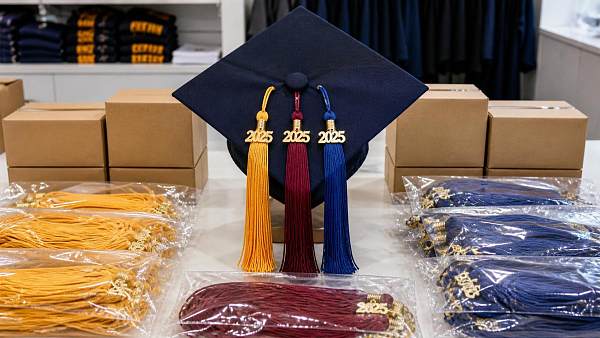
A catalog image usually shows a tassel hanging neatly from a graduation cap. It does not show the operational questions behind a large order: Will every unit fit the cap button used by the gown supplier? Does the charm face forward when worn? Are master cartons labeled by color and school location? Can staff identify the correct tassels quickly during distribution?
Before requesting quotations, map the actual ceremony use. Note whether the school will distribute caps and tassels together, provide them separately, or include them in student regalia packages. This affects packaging requirements and the level of sorting needed. If tassels will be handed out at several campuses, a bulk-packed shipment may save money at the factory but create unnecessary labor at the receiving end.
It also helps to distinguish between a common ceremony tassel and a program-specific item. Some institutions use one school color for all graduates, while others assign colors by academic department, degree level, honor status, or affiliated college. These choices should be established before supplier comparison. A quote based on “assorted colors” is not comparable to one that includes exact quantities by color, individually packed units, and separate labels for each destination.
The details that often create avoidable problems
Year charms appear simple, but their accuracy and finish deserve the same attention as the tassel itself. The year must be confirmed in writing and shown clearly on an approved artwork or product proof. A typed reference in an email is useful, but it should not replace a visual confirmation of the charm face, number style, hole placement, finish color, and orientation.
One common mistake is assuming that a charm marked with a year is interchangeable from one season to the next. Leftover stock can create confusion if it is stored near current inventory. For large school orders, separate prior-year items physically and identify the current-year version by color code, internal item number, or carton label. This is particularly important when the same school uses the same tassel colors every year.
Another source of trouble is the relationship between the charm and the hanging loop. If the attachment ring is too light, too open, or poorly finished, the charm may twist, sit unevenly, or detach under handling. Ask the supplier to describe the attachment method rather than relying only on a front-facing photograph. A close-up sample is useful because it shows whether the ring, connector, and charm edge feel appropriate for repeated handling during packaging and the ceremony.
Color should be treated as a separate approval point. Terms such as navy, royal blue, burgundy, or gold can vary between suppliers and even between production materials. If school branding is important, provide a physical color reference when possible, or request a sample set before final production. Screen images and compressed catalog photos are not dependable color standards. The same caution applies to metallic cord and metallic charm finishes, which can appear brighter or duller depending on lighting.
Compare construction before comparing unit cost
Graduation tassels are commonly made from rayon-like fibers, polyester-based fibers, or other synthetic yarn constructions. The practical difference is not just appearance. It can affect sheen, softness, strand separation, color consistency, static, and how the tassel performs after shipping.
A more lustrous tassel may create a formal look under stage lighting, but buyers should still inspect strand density and finishing. Sparse strands can look less substantial when the tassel is hanging freely. Very tightly packed strands may look better in a sample bag yet flatten during transit if packaging is compressed. Ask whether tassels are shipped hanging, laid flat, bundled, or individually bagged, then decide whether the expected presentation matches the school’s distribution process.
Polyester construction may be selected where color stability and handling durability matter more than a traditional silky appearance. Rayon-style materials may be preferred where a softer, more formal drape is desired. Neither choice is automatically better. The correct material is the one that meets the visual standard, available lead time, and handling needs of the order.
The charm material also affects the final impression. Lightweight molded plastic charms can be appropriate for cost-sensitive programs and are generally easy to produce in larger volumes. Metal-look or metal charms may offer a more substantial feel, but they can introduce questions about finish variation, edge smoothness, weight, and attachment strength. If the tassel is intended as a keepsake, the charm may deserve a larger share of the budget. If it is mainly part of coordinated regalia, a simpler option may be sufficient.
Turn an informal request into a usable specification
Large orders become difficult when the request is written as “graduation tassels, school colors, current year.” That wording leaves too much open to interpretation. A better specification does not need to be complicated, but it should allow two suppliers to quote the same requirement.
Include the total quantity and a breakdown by tassel color. State the required graduation year exactly as it should appear on the charm. Describe whether all units use one charm or whether different programs need separate versions. Add the tassel length requirement, the material preference if one exists, and any limitations on charm material or finish. If the school expects an emblem, initials, or custom shape, provide clean artwork and identify the owner responsible for final proof approval.
Packaging deserves its own line item. Specify whether each tassel needs individual protection, whether bundles must contain a fixed quantity, and whether cartons must be marked by department, campus, or event date. Include the ship-to locations rather than assuming all stock will arrive at a central warehouse. A supplier can only plan split shipments or carton allocation if the requirement is documented early.
For graduation tassels with year charm, the specification should also state whether the charm is supplied assembled on the tassel. This sounds obvious, but some orders may be quoted with loose charms, separately packed accessories, or different assembly methods. A lower price can reflect a different configuration rather than a genuine cost advantage.
Use samples to answer the questions paper cannot answer
Written specifications control many variables, yet physical review remains valuable for products worn in a public ceremony. A sample lets staff assess the things that are hard to describe: whether the tassel hangs straight, whether the color has the right character beside the gown fabric, whether the charm has sharp edges, and whether the loop attaches smoothly to the cap button.
When reviewing a sample, place it on the actual cap if available. Look at it against the gown color and under indoor lighting similar to the venue. Handle the charm and connector several times rather than judging it only in a still position. Check whether the year remains legible from a normal viewing distance. If several colors are required, review all colorways rather than approving one color and assuming the rest will match the intended standard.
For custom charms, distinguish between an artwork proof and a production sample. The proof confirms layout, spelling, date, and shape. The production sample reveals material, finish, scale, and assembly. Both can be necessary when the order includes a school-specific design. Approval should be controlled by a small group with clear authority; otherwise, late comments from multiple departments can delay production or create conflicting instructions.
Build the delivery plan backward from distribution day
The ceremony date is not the real delivery deadline. The operational deadline is the date by which staff need completed, counted, and sorted tassels ready for issue. Between arrival and distribution, there may be receiving, quality checks, storage, campus transfers, package assembly, and replacement handling. If the order arrives only days before graduation, even a minor discrepancy can become disruptive.
Work backward from the first student distribution date, not the stage ceremony. Reserve time for proof approval, sample review if required, production, transit, customs procedures where applicable, and inspection. Custom year charms may add steps compared with stock tassels, especially if artwork, a special mold, or a nonstandard finish is involved. Do not assume that a supplier’s stated production time begins before artwork and payment terms are settled; confirm the actual production-release point.
Quantity planning should include an internal decision about extras. Large institutions often need replacements for damaged packages, transfer students, late additions, or distribution mistakes. The appropriate overage depends on the school’s historical pattern, the ability to reorder quickly, and whether the tassel is a standard item or a unique custom version. It is better to decide the extra quantity deliberately than to discover after delivery that there is no practical route for replenishment.
Reading quotations without losing the real cost
The lowest quoted price may exclude details that matter in practice. When comparing suppliers, ask whether the quote includes year charm assembly, color sorting, individual packaging, proof charges, sample charges, carton marking, shipping, and any destination-related costs. If these items are not separated, it becomes difficult to compare offers fairly.
Also compare minimum order quantities by color and by charm design. A supplier may offer an attractive price at the total order volume while applying limits to each color variant. For a school with many departments and small color allocations, this can change the practical order cost. The same issue applies to custom charm tooling or setup: it may be a one-time charge, a recurring charge, or already built into the piece price. Ask for the quotation assumptions in writing.
Payment terms affect risk as well as cash flow. For a custom order, clarify the point at which the design becomes locked, what changes can still be made, and how approval records are retained. If a supplier provides a final production proof, make sure the approved version is attached to the purchase record. This gives receiving staff a reference if the delivered item does not match the agreed configuration.
Receiving inspection should focus on the failures that matter
When cartons arrive, do not wait until distribution day to open them. Start by matching carton labels and counts to the purchase order. Then inspect a practical sample from each color, charm version, and carton group. Confirm the year first; it is the most visible nonrecoverable detail. Check tassel color, length, charm attachment, finish consistency, and packaging allocation.
If items are separated by campus or program, verify that the carton contents match the external label. A correct total quantity is not enough if one location receives too many gold tassels and another receives too few. Record discrepancies with clear photos and carton identifiers, then contact the supplier promptly. Early notice gives more options for correction, replacement, or local redistribution.
Store approved tassels in a clean, dry area and keep current-year stock clearly separated from previous ceremony materials. Avoid placing heavy cartons on packages if tassels are individually presented in a way that can flatten or crease. A short receiving process may feel like extra work, but it is usually easier than resolving errors while students are waiting in line.
A practical buying position
Reliable graduation tassels with year charm are purchased through clarity rather than guesswork. Define the ceremony use, approve the actual charm year and construction, compare materials on appearance and handling needs, and make packaging part of the specification. Then set the delivery date early enough for sorting and inspection, not merely for arrival.
For a standard school order, a proven tassel format with a clearly approved year charm and disciplined color allocation is often the most manageable choice. For programs that need stronger institutional presentation, invest more attention in sample review, charm finish, and packaging control. In either case, the goal is the same: every graduate receives a tassel that looks intentional, matches the event, and is ready when the ceremony team needs it.
Search News
Hot Articles
- Office Furniture & EquipChoosing Commercial Air Conditioners for Offices: Capacity, Zoning, and NoiseOct 13, 2026
- Fashion & Gem JewelryHow to Choose Designer Eyewear That Fits Your Store’s Customer ProfileOct 12, 2026
- Musical InstrumentsA Practical Guide to Identifying Wooden Orchestral Instruments by Family and ToneOct 10, 2026
Popular Tags
Need ExpertConsultation?
Connect with our specialized leisureengineering team for procurementstrategies.
Recommended News
 Sep 21, 2026How Schools Can Cut Printing Costs When Buying Ink Cartridges in BulkSchool ink cartridges wholesale made smarter: cut printing costs with fleet planning, cost-per-page comparisons, reliable suppliers, and inventory controls.● Institutional Buyer
 Sep 17, 2026How to Source Wholesale Packing Tape Without Compromising Carton Seal StrengthWholesale packing tape sourcing guide: compare adhesive, backing, carton conditions, and real-world trials to reduce costs while maintaining reliable carton seal strength.● Institutional Buyer
 Sep 05, 2026How to Buy Geometry Sets in Bulk for Schools: A Practical Procurement ChecklistGeometry sets bulk buying guide for schools: compare safety, quality, compliance, packaging, supplier reliability, and total cost for smarter procurement.● Institutional Buyer
 Aug 31, 2026Microscope Slides Market Outlook: Demand Drivers, Segments, and Sourcing RisksExplore the microscope slides market: key demand drivers, product segments, quality risks, and sourcing strategies for reliable laboratory supply.● Institutional Buyer
 Aug 30, 2026Microscope Slides HS Code: How Importers Classify Laboratory Glass Slides CorrectlyMicroscope slides HS code guide: learn how to classify laboratory glass slides accurately, verify materials, avoid customs delays, and improve import compliance.● Institutional Buyer
 Aug 29, 2026How to Choose Graduation Tassels With Year Charms for Large School OrdersGraduation tassels with year charm: learn how to specify colors, materials, packaging, proofs, and delivery timelines for accurate large school orders.● Institutional Buyer
 Aug 11, 2026How to Choose Alphabet Educational Posters for Different Classroom Age GroupsAlphabet educational posters should match how each age group learns. Discover how to choose safer, clearer, curriculum-ready designs for preschool to primary classrooms.● Institutional Buyer
 Aug 05, 2026How to Evaluate a Marching Band Uniform Manufacturer for Quality and On-Time DeliveryMarching band uniform manufacturer selection starts with delivery risk. Learn how to compare quality, sizing, compliance, and capacity for reliable, on-time orders.● Institutional Buyer
 Jul 20, 2026How to Evaluate a Stationery Distributor for Bulk Office and School Supply PurchasingStationery distributor selection affects cost, delivery, and compliance. Learn how to evaluate suppliers for bulk office and school supply purchasing with confidence.● Institutional Buyer
 Jul 18, 2026How to Choose Custom Hotel Uniforms: Fabric, Branding, Comfort, and DurabilityCustom hotel uniforms guide: learn how to choose the right fabric, branding, comfort, and durability to improve staff performance, strengthen hotel image, and reduce long-term costs.● Institutional Buyer
 Jul 15, 2026How to Choose a Clear Pencil Cases Manufacturer for School and Retail OrdersClear pencil cases manufacturer selection made simple: learn how to compare quality, compliance, customization, pricing, and lead times for school and retail orders.● Institutional Buyer
 Jul 14, 2026How to Evaluate a Hole Punches Wholesale Supplier for Quality, MOQ, and Lead TimeHole punches wholesale supplier selection starts with quality, MOQ, and lead time. Learn practical checks, warning signs, and sourcing tips to reduce risk and buy smarter.● Institutional Buyer
 Jul 13, 2026Wholesale Erasers and Sharpeners: How to Compare Materials, Packaging, and MOQWholesale erasers and sharpeners buying guide: compare materials, packaging, and MOQ to cut risk, improve quality, and choose suppliers with better value.● Institutional Buyer
 Jul 10, 2026Custom Housekeeping Uniforms: What Fabrics and Features Hold Up in Daily Hotel Use?Custom housekeeping uniforms that last: discover the best fabrics, stretch, stain resistance, and hotel-ready features to cut replacement costs and keep staff polished daily.● Institutional Buyer
 Jul 08, 2026Fast Warm Up Laminator Buying Guide: Speed, Film Thickness, and Use Case ExplainedFast warm up laminator buying guide covering warm-up speed, film thickness, and real use cases. Compare specs, avoid buying mistakes, and choose the right model with confidence.● Institutional Buyer
 Jul 08, 2026How to Choose School Supplies for Campuses by Grade Level, Budget, and Daily UseSchool supplies for campuses made simple: learn how to choose by grade level, budget, durability, and daily use to reduce waste, improve sourcing, and support every classroom.● Institutional Buyer
 Jul 05, 2026How to Choose Branded Office Stationery for Corporate Use and Budget ControlBranded office stationery buying guide: learn how to balance quality, customization, supplier comparison, and budget control for consistent branding and smarter corporate sourcing.● Institutional Buyer
 Jul 01, 2026Paper Guillotines Buying Guide: Manual vs Electric, Cut Size, and Safety FeaturesPaper guillotines buying guide covering manual vs electric models, cut size, and safety features. Compare costs, productivity, and key specs to choose the right machine.● Institutional Buyer
 Jun 29, 2026Bingo Cages and Balls: Sizes, Materials, and What Affects Game VisibilityBingo cages and balls guide: compare sizes, materials, contrast, and durability to improve visibility, fairness, and long-term value in commercial and event play.● Institutional Buyer
 Jun 25, 2026School Uniforms in Europe: Materials, Sizing, and Compliance Points for Bulk OrdersSchool uniforms Europe sourcing guide: compare materials, sizing accuracy, and EU compliance points for bulk orders to reduce risk, improve durability, and choose suppliers with confidence.● Institutional Buyer
 Jun 23, 2026Wholesale Playing Cards Casino Buying Guide: Paper Stock, Finish, Security, and MOQWholesale playing cards casino buying guide covering paper stock, finish, security features, and MOQ. Compare suppliers smarter, reduce sourcing risk, and choose casino-grade decks with confidence.● Institutional Buyer
 Jun 22, 2026Eco Friendly Office Stationery: What to Check Before Buying for Daily Business UseEco friendly office stationery buying guide for businesses: learn how to check materials, certifications, durability, supplier reliability, and total cost before choosing daily office supplies.● Institutional Buyer
 Jun 21, 2026How to Choose Custom Promotional Pens for Trade Shows, Schools, and Corporate GiveawaysCustom promotional pens: learn how to choose the right styles for trade shows, schools, and corporate giveaways with tips on quality, branding, durability, and sourcing.● Institutional Buyer
 Jun 16, 2026Microscope Slides Wholesale Buying Guide: Glass Types, Sizes, and MOQ FactorsMicroscope slides wholesale buying guide covering glass types, standard sizes, MOQ factors, and quality risks—compare smarter, reduce waste, and choose reliable bulk supply.● Institutional Buyer