Wholesale Erasers and Sharpeners: How to Compare Materials, Packaging, and MOQ
Wholesale Erasers and Sharpeners: How to Compare Materials, Packaging, and MOQ
Choosing wholesale erasers and sharpeners is not just about unit price. The better decision comes from comparing material safety, packaging efficiency, and MOQ flexibility together.
That matters even more when supply plans serve schools, offices, bookstores, gift channels, or promotional programs. A low quote can become expensive once breakage, compliance issues, or slow inventory movement appear.
In practical sourcing, wholesale erasers and sharpeners sit in a high-volume, price-sensitive category. Small specification changes can affect freight cost, shelf appeal, user safety, and reorder timing.
This guide breaks the comparison into three buying levers: materials, packaging, and MOQ. It also shows how to balance cost with performance, especially when supplier options look similar on paper.
Start with Material Quality, Not Price Alone
For wholesale erasers and sharpeners, material choice decides product performance first. It also influences safety records, complaint rates, and whether the item fits school or office procurement standards.
How to Compare Eraser Materials
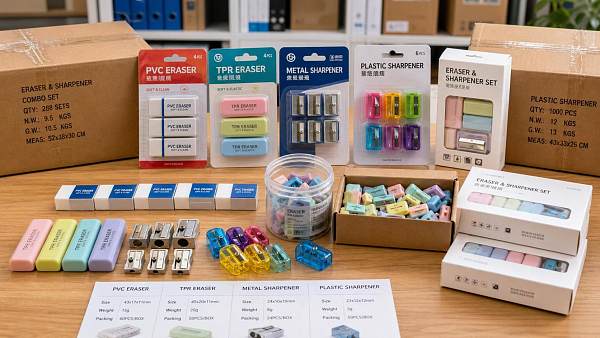
Most erasers use PVC, TPR, or rubber blends. Each option brings a different balance of erasing performance, odor, dust generation, softness, and compliance positioning.
- PVC erasers are common, low-cost, and easy to shape in bulk production.
- TPR erasers often feel softer and can support cleaner branding for school markets.
- Natural rubber options may suit premium lines, but pricing and consistency need closer review.
A useful question is not only what the eraser is made from. The better question is how well it removes graphite without tearing paper or leaving heavy residue.
Ask suppliers for samples across several pencil grades. HB performance alone can hide weaknesses that appear with softer leads or lower-grade paper.
How to Compare Sharpener Materials
For sharpeners, the key materials are the body, blade, and screw assembly. This is where many wholesale erasers and sharpeners programs separate into budget, standard, and premium tiers.
- Plastic bodies reduce weight and cost, especially for school distribution.
- Aluminum or magnesium bodies improve durability and often feel more premium.
- Carbon steel blades can be cost-effective, but corrosion resistance must be checked.
- Stainless blades support longer shelf stability in humid storage conditions.
The blade angle matters as much as blade material. A cheap sharpener with a stable blade setup may outperform a more expensive model with inconsistent assembly.
In real procurement work, failure usually appears as broken pencil tips, loose screws, or blades that dull too quickly. Those issues create hidden replacement cost.
Safety and Compliance Checks
If wholesale erasers and sharpeners are sold into education channels, safety documentation should be part of the first quotation review. Leaving compliance until later usually slows approvals.
Typical checks may include EN71, ASTM-related requirements, CPSIA relevance, phthalate limits, heavy metal testing, and material declarations. Exact requirements depend on destination market and use case.
It is also worth checking odor level, edge finishing, and cap safety where applicable. These details affect user acceptance more than many buyers expect.
Use Packaging to Control Cost and Channel Fit
Packaging is often treated as a secondary decision. For wholesale erasers and sharpeners, that approach misses a major source of cost variation and channel performance.
The right pack format should support transportation efficiency, retail presentation, and warehouse handling. It should also match whether the item is sold individually, in sets, or in institutional cartons.
Common Packaging Formats
- Bulk inner boxes for schools, offices, and project supply contracts.
- Blister packs for retail visibility and hanging display.
- OPP bags for simple, low-cost promotional assortments.
- Printed paper boxes for gift sets, kits, or private-label ranges.
Bulk packaging usually gives the best landed cost. However, retail-ready formats can reduce local labor cost and improve sell-through where shelf competition is strong.
Packaging Questions That Change the Real Cost
Two offers may show the same unit price, yet the total cost can differ after carton efficiency is measured. That is where wholesale erasers and sharpeners sourcing becomes more technical.
- Check units per inner box and master carton.
- Review carton dimensions, not only carton quantity.
- Confirm whether barcodes, labels, and warnings are included.
- Ask if private-label packaging requires new tooling or plate charges.
- Verify drop resistance for sharpeners with blades or shavings containers.
For mixed SKU programs, packaging consistency matters too. Standardized carton sizes make warehouse planning easier and reduce picking errors.
Private Label and Branding Considerations
Many wholesale erasers and sharpeners orders include custom logos, school branding, or retail identity. Customization can improve margin, but it often changes lead time and MOQ.
Printed sleeves, embossed marks, and custom color matching all have different cost impacts. The practical move is to separate must-have branding from nice-to-have decoration.
That also helps during supplier comparison. One vendor may look cheaper only because the quote excludes packaging artwork setup or compliance labeling.
Treat MOQ as a Risk Tool, Not Just a Factory Rule
MOQ is one of the most misunderstood parts of wholesale erasers and sharpeners sourcing. It is not only a production threshold. It is a risk-sharing mechanism between buyer and manufacturer.
A low MOQ sounds attractive, but it can come with higher unit pricing, fewer material options, or limited packaging flexibility. A high MOQ may unlock better economics, but increase inventory pressure.
When Higher MOQ Makes Sense
- Demand is stable across school seasons or office replenishment cycles.
- The item is a standard SKU with long selling life.
- Custom packaging cost spreads better over larger volume.
- Container utilization improves enough to reduce freight cost per unit.
When Lower MOQ Is the Better Decision
- A new private-label line is still being tested.
- Demand visibility is weak across regions or channels.
- Product design changes are likely within one buying cycle.
- Cash flow priorities favor faster turnover over maximum discount.
In current sourcing conditions, MOQ flexibility is often a sign of supplier maturity. Factories with better planning systems can sometimes offer mixed colors, mixed packs, or phased deliveries.
That flexibility can be more valuable than a small unit price reduction. It lowers dead stock risk and supports cleaner replenishment decisions.
Build a Comparison Model That Reflects Total Value
A useful quote sheet for wholesale erasers and sharpeners should go beyond FOB price. It should rank suppliers across performance, compliance, packaging fit, and order flexibility.
This kind of scorecard makes negotiations clearer. It also helps internal teams justify why the cheapest offer may not be the strongest sourcing decision.
Common Buying Mistakes in Wholesale Erasers and Sharpeners
Several repeat mistakes appear in this category. Most are avoidable when comparison criteria are set before quotation collection.
- Approving samples without checking mass-production consistency.
- Comparing unit prices without freight and packaging impact.
- Ignoring blade quality because the sharpener body looks acceptable.
- Choosing custom packs before demand is proven.
- Accepting MOQ terms that exceed realistic turnover speed.
From recent market behavior, the clearer signal is caution around over-customization. Buyers are increasingly favoring scalable specifications with selective branding, especially for mixed-channel distribution.
A Practical Sourcing Checklist
Before confirming any wholesale erasers and sharpeners order, run through a short operational checklist. It keeps the decision grounded in execution, not only quotation comparison.
- Define the target channel: school, office, retail, promotional, or mixed.
- Set minimum material and compliance requirements before sampling.
- Compare packaging by freight efficiency and shelf use, not appearance alone.
- Model MOQ against turnover, storage capacity, and cash flow.
- Request a final landed-cost view, including packaging add-ons and labeling.
- Approve a golden sample tied to production specifications.
The strongest wholesale erasers and sharpeners purchase is rarely the one with the lowest opening price. It is the one that fits the channel, passes compliance smoothly, moves efficiently, and reorders with fewer surprises.
When materials, packaging, and MOQ are reviewed together, sourcing becomes more predictable. That is what protects margin, supports service levels, and keeps a basic stationery category commercially sound.
Search News
Hot Articles
- Fashion & Gem JewelryHow to Choose Designer Eyewear That Fits Your Store’s Customer ProfileOct 12, 2026
- Musical InstrumentsA Practical Guide to Identifying Wooden Orchestral Instruments by Family and ToneOct 10, 2026
- Indoor PlaygroundHow to Choose Animatronic Haunted House Props for High-Throughput AttractionsOct 08, 2026
Popular Tags
Need ExpertConsultation?
Connect with our specialized leisureengineering team for procurementstrategies.
Recommended News
 Sep 21, 2026How Schools Can Cut Printing Costs When Buying Ink Cartridges in BulkSchool ink cartridges wholesale made smarter: cut printing costs with fleet planning, cost-per-page comparisons, reliable suppliers, and inventory controls.● Institutional Buyer
 Sep 17, 2026How to Source Wholesale Packing Tape Without Compromising Carton Seal StrengthWholesale packing tape sourcing guide: compare adhesive, backing, carton conditions, and real-world trials to reduce costs while maintaining reliable carton seal strength.● Institutional Buyer
 Sep 05, 2026How to Buy Geometry Sets in Bulk for Schools: A Practical Procurement ChecklistGeometry sets bulk buying guide for schools: compare safety, quality, compliance, packaging, supplier reliability, and total cost for smarter procurement.● Institutional Buyer
 Aug 31, 2026Microscope Slides Market Outlook: Demand Drivers, Segments, and Sourcing RisksExplore the microscope slides market: key demand drivers, product segments, quality risks, and sourcing strategies for reliable laboratory supply.● Institutional Buyer
 Aug 30, 2026Microscope Slides HS Code: How Importers Classify Laboratory Glass Slides CorrectlyMicroscope slides HS code guide: learn how to classify laboratory glass slides accurately, verify materials, avoid customs delays, and improve import compliance.● Institutional Buyer
 Aug 29, 2026How to Choose Graduation Tassels With Year Charms for Large School OrdersGraduation tassels with year charm: learn how to specify colors, materials, packaging, proofs, and delivery timelines for accurate large school orders.● Institutional Buyer
 Aug 11, 2026How to Choose Alphabet Educational Posters for Different Classroom Age GroupsAlphabet educational posters should match how each age group learns. Discover how to choose safer, clearer, curriculum-ready designs for preschool to primary classrooms.● Institutional Buyer
 Aug 05, 2026How to Evaluate a Marching Band Uniform Manufacturer for Quality and On-Time DeliveryMarching band uniform manufacturer selection starts with delivery risk. Learn how to compare quality, sizing, compliance, and capacity for reliable, on-time orders.● Institutional Buyer
 Jul 20, 2026How to Evaluate a Stationery Distributor for Bulk Office and School Supply PurchasingStationery distributor selection affects cost, delivery, and compliance. Learn how to evaluate suppliers for bulk office and school supply purchasing with confidence.● Institutional Buyer
 Jul 18, 2026How to Choose Custom Hotel Uniforms: Fabric, Branding, Comfort, and DurabilityCustom hotel uniforms guide: learn how to choose the right fabric, branding, comfort, and durability to improve staff performance, strengthen hotel image, and reduce long-term costs.● Institutional Buyer
 Jul 15, 2026How to Choose a Clear Pencil Cases Manufacturer for School and Retail OrdersClear pencil cases manufacturer selection made simple: learn how to compare quality, compliance, customization, pricing, and lead times for school and retail orders.● Institutional Buyer
 Jul 14, 2026How to Evaluate a Hole Punches Wholesale Supplier for Quality, MOQ, and Lead TimeHole punches wholesale supplier selection starts with quality, MOQ, and lead time. Learn practical checks, warning signs, and sourcing tips to reduce risk and buy smarter.● Institutional Buyer
 Jul 13, 2026Wholesale Erasers and Sharpeners: How to Compare Materials, Packaging, and MOQWholesale erasers and sharpeners buying guide: compare materials, packaging, and MOQ to cut risk, improve quality, and choose suppliers with better value.● Institutional Buyer
 Jul 10, 2026Custom Housekeeping Uniforms: What Fabrics and Features Hold Up in Daily Hotel Use?Custom housekeeping uniforms that last: discover the best fabrics, stretch, stain resistance, and hotel-ready features to cut replacement costs and keep staff polished daily.● Institutional Buyer
 Jul 08, 2026Fast Warm Up Laminator Buying Guide: Speed, Film Thickness, and Use Case ExplainedFast warm up laminator buying guide covering warm-up speed, film thickness, and real use cases. Compare specs, avoid buying mistakes, and choose the right model with confidence.● Institutional Buyer
 Jul 08, 2026How to Choose School Supplies for Campuses by Grade Level, Budget, and Daily UseSchool supplies for campuses made simple: learn how to choose by grade level, budget, durability, and daily use to reduce waste, improve sourcing, and support every classroom.● Institutional Buyer
 Jul 05, 2026How to Choose Branded Office Stationery for Corporate Use and Budget ControlBranded office stationery buying guide: learn how to balance quality, customization, supplier comparison, and budget control for consistent branding and smarter corporate sourcing.● Institutional Buyer
 Jul 01, 2026Paper Guillotines Buying Guide: Manual vs Electric, Cut Size, and Safety FeaturesPaper guillotines buying guide covering manual vs electric models, cut size, and safety features. Compare costs, productivity, and key specs to choose the right machine.● Institutional Buyer
 Jun 29, 2026Bingo Cages and Balls: Sizes, Materials, and What Affects Game VisibilityBingo cages and balls guide: compare sizes, materials, contrast, and durability to improve visibility, fairness, and long-term value in commercial and event play.● Institutional Buyer
 Jun 25, 2026School Uniforms in Europe: Materials, Sizing, and Compliance Points for Bulk OrdersSchool uniforms Europe sourcing guide: compare materials, sizing accuracy, and EU compliance points for bulk orders to reduce risk, improve durability, and choose suppliers with confidence.● Institutional Buyer
 Jun 23, 2026Wholesale Playing Cards Casino Buying Guide: Paper Stock, Finish, Security, and MOQWholesale playing cards casino buying guide covering paper stock, finish, security features, and MOQ. Compare suppliers smarter, reduce sourcing risk, and choose casino-grade decks with confidence.● Institutional Buyer
 Jun 22, 2026Eco Friendly Office Stationery: What to Check Before Buying for Daily Business UseEco friendly office stationery buying guide for businesses: learn how to check materials, certifications, durability, supplier reliability, and total cost before choosing daily office supplies.● Institutional Buyer
 Jun 21, 2026How to Choose Custom Promotional Pens for Trade Shows, Schools, and Corporate GiveawaysCustom promotional pens: learn how to choose the right styles for trade shows, schools, and corporate giveaways with tips on quality, branding, durability, and sourcing.● Institutional Buyer
 Jun 16, 2026Microscope Slides Wholesale Buying Guide: Glass Types, Sizes, and MOQ FactorsMicroscope slides wholesale buying guide covering glass types, standard sizes, MOQ factors, and quality risks—compare smarter, reduce waste, and choose reliable bulk supply.● Institutional Buyer