Geometry Sets Wholesale: How to Compare Materials, Packaging, and MOQ
For institutional and retail sourcing, geometry sets wholesale decisions are not only about the lowest unit price.
They require balanced judgment across material durability, student safety, packaging efficiency, ruler accuracy, and supplier flexibility.
Small differences in plastic quality, case design, and MOQ terms can affect long-term value and customer satisfaction.
This guide explains how to compare geometry sets wholesale offers across real purchasing scenarios with practical evaluation criteria.
Geometry Sets Wholesale Starts With the Use Scenario
A geometry set used in a classroom differs from one sold through a stationery chain.
The same product category may need different plastic thickness, printing precision, packaging style, and replenishment rhythm.
Before comparing geometry sets wholesale prices, define where the product will be used and how it will be handled.
High-volume school programs often prioritize safety, uniform specifications, and stable delivery schedules.
Retail distribution may require shelf-ready packaging, barcode labeling, attractive colors, and lower breakage during transport.
Promotional projects usually care about branding space, cost control, and short production cycles.
Export-focused orders must also consider compliance documents, carton strength, and customs-friendly packaging information.
School Supply Programs Need Safe and Consistent Geometry Sets
School distribution is one of the most demanding scenarios for geometry sets wholesale sourcing.
Products are handled daily, stored in bags, dropped on floors, and used by different age groups.
The main judgment points are material safety, smooth edges, clear measurement markings, and consistent product composition.
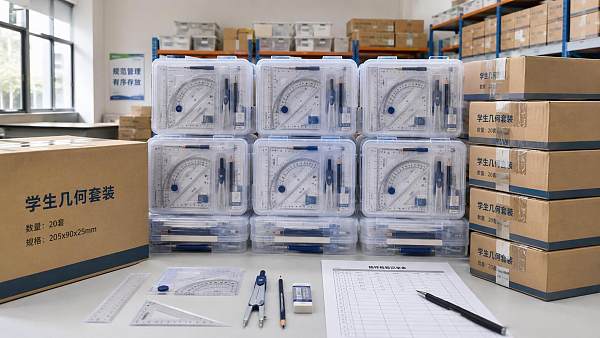
Common items include a ruler, two set squares, a protractor, a compass, pencil, sharpener, and eraser.
For younger users, sharp compass points should be protected with caps or safer packaging inserts.
Transparent polystyrene is popular because it supports easy reading and affordable bulk production.
However, polypropylene may offer better flexibility and reduced cracking in rough daily use.
When comparing geometry sets wholesale suppliers, request drop-test details and edge finishing samples.
Key checks for classroom distribution
- Non-toxic plastic and ink declarations.
- Smooth ruler edges and protected compass tips.
- Accurate scale printing with durable markings.
- Stable packing quantity per carton.
- Repeatable color and component configuration.
Retail Shelves Require Packaging That Sells and Protects
Retail sales place heavier emphasis on visual presentation and shelf efficiency.
For this scenario, geometry sets wholesale decisions should include packaging structure, print quality, barcode placement, and display compatibility.
A plastic case looks durable and reusable, but it may increase shipping volume and unit cost.
A blister card presents the contents clearly, yet it requires stronger sealing and careful anti-scratch protection.
A paper box reduces plastic use and supports premium graphics, but inner positioning must prevent ruler movement.
Retail geometry sets wholesale projects should also check how products hang, stack, and scan at checkout.
Poor barcode placement can create operational friction, even when the product itself meets specifications.
Color consistency also matters, especially when multiple SKUs appear together on the same display wall.
Retail packaging comparison
Distributor Orders Depend on MOQ, Lead Time, and SKU Control
Distribution channels often manage multiple markets, customer levels, and seasonal demand peaks.
In this scenario, geometry sets wholesale sourcing should focus on MOQ flexibility and replenishment reliability.
A low unit price may not help if the MOQ forces excess inventory across slow-moving designs.
Ask whether suppliers support mixed colors, mixed packaging, or shared cartons within one production batch.
This can reduce inventory pressure while maintaining variety for different resale channels.
For geometry sets wholesale programs, clarify MOQ by component, packaging, color, and printed logo.
Some suppliers advertise low MOQ, but custom packaging may require much higher print quantities.
Lead time should also be separated into sampling, tooling, mass production, inspection, and shipping stages.
MOQ questions that prevent hidden costs
- What is the MOQ for standard geometry sets wholesale items?
- Does color customization change the minimum quantity?
- Is custom packaging counted separately from product MOQ?
- Can multiple designs share one shipment?
- What buffer stock is available for urgent replenishment?
Promotional and Brand Programs Need Customization Without Overengineering
Promotional geometry sets often serve campaigns, education events, museum shops, or branded learning kits.
The product must look customized, but the cost structure still needs practical control.
For this scenario, geometry sets wholesale evaluation should separate visible branding from costly structural changes.
Logo printing on a case or paper insert is usually easier than changing every tool color.
A custom instruction card can improve perceived value without redesigning the full set.
When timing is tight, choose existing molds and adjust packaging artwork instead.
This keeps geometry sets wholesale production faster and reduces approval risks before shipment.
Confirm logo durability if the branding appears directly on rulers, cases, or compass bodies.
Material Choices Affect Breakage, Clarity, and Perceived Value
Material comparison is central to geometry sets wholesale quality control.
The most common options include PS, PP, ABS, metal parts, and hybrid material combinations.
PS offers good transparency and clean scale visibility, making it common in standard school sets.
PP is more flexible and less brittle, although printed markings may need stronger ink adhesion.
ABS is stronger for cases or compass parts, but it can raise product cost.
Metal compasses may provide better stability, while plastic compasses reduce cost and weight.
In geometry sets wholesale negotiations, avoid judging material only by appearance.
Request bending samples, scratch checks, print rub tests, and real packed carton samples.
Material decision guide
Accuracy and Safety Are More Important Than Decorative Features
A geometry set has little value if the markings are inaccurate or fade quickly.
For geometry sets wholesale inspection, check ruler length, protractor degree alignment, and set square angle accuracy.
Measurement errors may be small, but they create complaints in education and examination settings.
Scale printing should remain readable after repeated handling and pencil case friction.
Safety checks should include edge smoothness, compass point protection, and secure assembly of small parts.
For export orders, request applicable test reports based on destination market requirements.
Relevant references may include EN71, ASTM standards, REACH, or CPSIA depending on market scope.
Reliable geometry sets wholesale suppliers should explain which reports match the exact product configuration.
Scenario Differences Should Drive the Final Specification
The best specification is not always the most expensive one.
It is the one that matches handling intensity, price positioning, packaging channel, and compliance requirements.
Common Misjudgments in Geometry Sets Wholesale Sourcing
Many sourcing problems come from comparing quotations without matching product details.
A cheaper set may use thinner plastic, weaker cartons, smaller components, or lower-grade printing.
Another common mistake is approving a perfect sample without checking mass production consistency.
Samples may be hand-selected, while bulk goods reveal mold wear, color variation, or rough edges.
Packaging is also often underestimated in geometry sets wholesale projects.
Weak inner placement can cause scratching, loose components, and poor shelf appearance after transport.
MOQ terms are another hidden risk when custom artwork, color matching, or private labeling is involved.
Always confirm whether quoted prices include packaging design, testing, barcode labels, and export cartons.
Practical Supplier Evaluation Before Confirming an Order
A structured evaluation reduces uncertainty and makes geometry sets wholesale comparison more transparent.
Start with a specification sheet covering components, dimensions, material, packaging, artwork, and carton details.
Then request samples from shortlisted suppliers using the same requirement document.
Compare samples under normal use conditions, not only by visual inspection.
- Check scale readability under classroom lighting.
- Bend rulers gently to test brittleness.
- Open and close cases repeatedly.
- Rub printed markings with dry and slightly damp cloth.
- Review carton strength and pallet loading efficiency.
For larger geometry sets wholesale orders, consider pre-shipment inspection with AQL sampling.
Inspection criteria should include quantity, appearance, dimensions, functionality, packaging, labeling, and safety-related points.
Next Steps for a Better Geometry Sets Wholesale Decision
A strong sourcing decision starts with matching product specifications to the real use scenario.
Define the target channel, required components, packaging format, compliance expectations, and acceptable MOQ range.
Then compare geometry sets wholesale quotations with identical assumptions, not broad catalog descriptions.
Ask suppliers for material proof, packaging samples, production lead time, and customization limits before negotiation.
This approach helps separate low-price offers from truly dependable geometry sets wholesale solutions.
For complex commercial sourcing, GCT supports data-backed comparison across office and educational supply categories.
Use structured specifications, verified supplier information, and scenario-based evaluation to source with greater confidence.
Search News
Hot Articles
- Pro Stage AudioDesigning Theater Sound Systems for Clear Dialogue and Even Audience CoverageOct 15, 2026
- Musical InstrumentsHow Do You Choose Music Education Equipment for a New Campus?Oct 15, 2026
- Arcade & VR MachinesChoosing a Racing Simulator Cockpit for an FEC: Durability and Guest FitOct 14, 2026
Popular Tags
Need ExpertConsultation?
Connect with our specialized leisureengineering team for procurementstrategies.
Recommended News
 Sep 21, 2026How Schools Can Cut Printing Costs When Buying Ink Cartridges in BulkSchool ink cartridges wholesale made smarter: cut printing costs with fleet planning, cost-per-page comparisons, reliable suppliers, and inventory controls.● Institutional Buyer
 Sep 17, 2026How to Source Wholesale Packing Tape Without Compromising Carton Seal StrengthWholesale packing tape sourcing guide: compare adhesive, backing, carton conditions, and real-world trials to reduce costs while maintaining reliable carton seal strength.● Institutional Buyer
 Sep 05, 2026How to Buy Geometry Sets in Bulk for Schools: A Practical Procurement ChecklistGeometry sets bulk buying guide for schools: compare safety, quality, compliance, packaging, supplier reliability, and total cost for smarter procurement.● Institutional Buyer
 Aug 31, 2026Microscope Slides Market Outlook: Demand Drivers, Segments, and Sourcing RisksExplore the microscope slides market: key demand drivers, product segments, quality risks, and sourcing strategies for reliable laboratory supply.● Institutional Buyer
 Aug 30, 2026Microscope Slides HS Code: How Importers Classify Laboratory Glass Slides CorrectlyMicroscope slides HS code guide: learn how to classify laboratory glass slides accurately, verify materials, avoid customs delays, and improve import compliance.● Institutional Buyer
 Aug 29, 2026How to Choose Graduation Tassels With Year Charms for Large School OrdersGraduation tassels with year charm: learn how to specify colors, materials, packaging, proofs, and delivery timelines for accurate large school orders.● Institutional Buyer
 Aug 11, 2026How to Choose Alphabet Educational Posters for Different Classroom Age GroupsAlphabet educational posters should match how each age group learns. Discover how to choose safer, clearer, curriculum-ready designs for preschool to primary classrooms.● Institutional Buyer
 Aug 05, 2026How to Evaluate a Marching Band Uniform Manufacturer for Quality and On-Time DeliveryMarching band uniform manufacturer selection starts with delivery risk. Learn how to compare quality, sizing, compliance, and capacity for reliable, on-time orders.● Institutional Buyer
 Jul 20, 2026How to Evaluate a Stationery Distributor for Bulk Office and School Supply PurchasingStationery distributor selection affects cost, delivery, and compliance. Learn how to evaluate suppliers for bulk office and school supply purchasing with confidence.● Institutional Buyer
 Jul 18, 2026How to Choose Custom Hotel Uniforms: Fabric, Branding, Comfort, and DurabilityCustom hotel uniforms guide: learn how to choose the right fabric, branding, comfort, and durability to improve staff performance, strengthen hotel image, and reduce long-term costs.● Institutional Buyer
 Jul 15, 2026How to Choose a Clear Pencil Cases Manufacturer for School and Retail OrdersClear pencil cases manufacturer selection made simple: learn how to compare quality, compliance, customization, pricing, and lead times for school and retail orders.● Institutional Buyer
 Jul 14, 2026How to Evaluate a Hole Punches Wholesale Supplier for Quality, MOQ, and Lead TimeHole punches wholesale supplier selection starts with quality, MOQ, and lead time. Learn practical checks, warning signs, and sourcing tips to reduce risk and buy smarter.● Institutional Buyer
 Jul 13, 2026Wholesale Erasers and Sharpeners: How to Compare Materials, Packaging, and MOQWholesale erasers and sharpeners buying guide: compare materials, packaging, and MOQ to cut risk, improve quality, and choose suppliers with better value.● Institutional Buyer
 Jul 10, 2026Custom Housekeeping Uniforms: What Fabrics and Features Hold Up in Daily Hotel Use?Custom housekeeping uniforms that last: discover the best fabrics, stretch, stain resistance, and hotel-ready features to cut replacement costs and keep staff polished daily.● Institutional Buyer
 Jul 08, 2026Fast Warm Up Laminator Buying Guide: Speed, Film Thickness, and Use Case ExplainedFast warm up laminator buying guide covering warm-up speed, film thickness, and real use cases. Compare specs, avoid buying mistakes, and choose the right model with confidence.● Institutional Buyer
 Jul 08, 2026How to Choose School Supplies for Campuses by Grade Level, Budget, and Daily UseSchool supplies for campuses made simple: learn how to choose by grade level, budget, durability, and daily use to reduce waste, improve sourcing, and support every classroom.● Institutional Buyer
 Jul 05, 2026How to Choose Branded Office Stationery for Corporate Use and Budget ControlBranded office stationery buying guide: learn how to balance quality, customization, supplier comparison, and budget control for consistent branding and smarter corporate sourcing.● Institutional Buyer
 Jul 01, 2026Paper Guillotines Buying Guide: Manual vs Electric, Cut Size, and Safety FeaturesPaper guillotines buying guide covering manual vs electric models, cut size, and safety features. Compare costs, productivity, and key specs to choose the right machine.● Institutional Buyer
 Jun 29, 2026Bingo Cages and Balls: Sizes, Materials, and What Affects Game VisibilityBingo cages and balls guide: compare sizes, materials, contrast, and durability to improve visibility, fairness, and long-term value in commercial and event play.● Institutional Buyer
 Jun 25, 2026School Uniforms in Europe: Materials, Sizing, and Compliance Points for Bulk OrdersSchool uniforms Europe sourcing guide: compare materials, sizing accuracy, and EU compliance points for bulk orders to reduce risk, improve durability, and choose suppliers with confidence.● Institutional Buyer
 Jun 23, 2026Wholesale Playing Cards Casino Buying Guide: Paper Stock, Finish, Security, and MOQWholesale playing cards casino buying guide covering paper stock, finish, security features, and MOQ. Compare suppliers smarter, reduce sourcing risk, and choose casino-grade decks with confidence.● Institutional Buyer
 Jun 22, 2026Eco Friendly Office Stationery: What to Check Before Buying for Daily Business UseEco friendly office stationery buying guide for businesses: learn how to check materials, certifications, durability, supplier reliability, and total cost before choosing daily office supplies.● Institutional Buyer
 Jun 21, 2026How to Choose Custom Promotional Pens for Trade Shows, Schools, and Corporate GiveawaysCustom promotional pens: learn how to choose the right styles for trade shows, schools, and corporate giveaways with tips on quality, branding, durability, and sourcing.● Institutional Buyer
 Jun 16, 2026Microscope Slides Wholesale Buying Guide: Glass Types, Sizes, and MOQ FactorsMicroscope slides wholesale buying guide covering glass types, standard sizes, MOQ factors, and quality risks—compare smarter, reduce waste, and choose reliable bulk supply.● Institutional Buyer