Designing Theater Sound Systems for Clear Dialogue and Even Audience Coverage
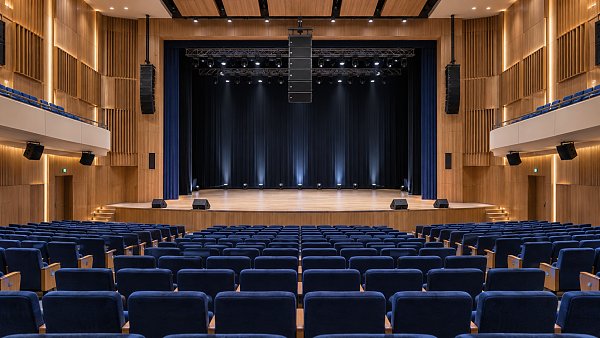
Clear dialogue depends on how much useful speech reaches each listener compared with background noise and reflected sound. A powerful loudspeaker can make a theater louder while leaving words difficult to understand. Effective stage sound for theaters starts with room acoustics and audience geometry, then uses loudspeaker placement, microphone technique, and system tuning to deliver consistent results.
The design should answer three practical questions: Can listeners understand quiet dialogue? Does the tonal balance remain reasonably consistent across the seating area? Does the sound feel connected to the performers? Those questions provide a stronger basis for equipment selection than amplifier power or loudspeaker quantity alone.
Define what the system must deliver before choosing equipment
A theater used mainly for spoken drama needs a different balance of capabilities from one hosting musicals, amplified concerts, and film screenings. Dialogue requires intelligibility and convincing localization. Musicals also need enough capacity for overlapping vocals and instruments without audible strain. Playback-heavy productions may require extended bass and separate routing for sound effects.
Write the performance brief around actual operating conditions. Include the seating configurations, stage layouts, orchestra arrangements, and production types the venue expects to support. Retractable seating, thrust stages, and movable scenery can change coverage and microphone conditions substantially. A design based only on the building’s default layout may fail during routine use.
Turn broad expectations into acceptance criteria before requesting proposals:
- Dialogue intelligibility: Define an agreed speech intelligibility measurement method, together with listening checks using representative voices and microphones.
- Audience consistency: Specify acceptable sound level variation and tonal balance across designated seating zones.
- Operating capacity: Establish normal performance levels and the headroom needed for louder passages.
- Noise conditions: Include ventilation, lighting equipment, and other services that will operate during performances.
- Stage connection: Require listening checks that assess whether amplified speech remains perceptually linked to the acting area.
Numerical targets should reflect the room and its intended use. Speech Transmission Index, or STI, can help assess how clearly a system conveys speech, but a single average score can conceal weak seating areas. The brief should identify measurement locations and operating conditions so competing proposals address the same requirement.
Resolve room problems that loudspeakers cannot fix
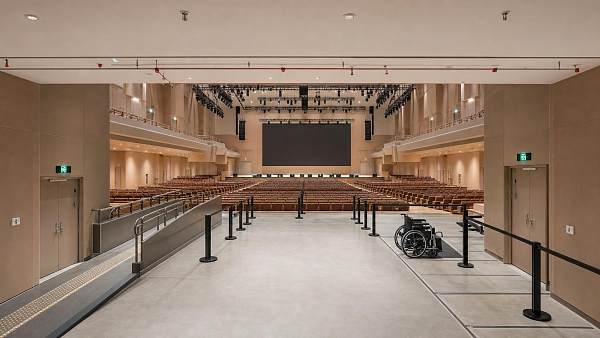
Long reverberation and strong late reflections can blur consecutive syllables. Raising the system level also raises the reflected sound, so additional volume may bring little improvement. Hard rear walls, balcony fronts, and large reflective surfaces deserve particular attention when they send delayed sound back toward the audience or stage.
Acoustic treatment should respond to the problem’s location and frequency range. Thin decorative material may soften some high-frequency reflections while leaving lower-frequency buildup largely unchanged. Treatment also needs to preserve the room’s intended character: a venue supporting unamplified music may need a different acoustic balance from a theater devoted to reinforced speech.
Background noise can defeat an otherwise capable system. Air movement, mechanical vibration, equipment fans, and noise entering through doors compete with quiet dialogue. Address these sources during building coordination, when changes to ducts, plant isolation, or door assemblies are easier to implement.
Assess the room in conditions representative of use. An empty auditorium behaves differently from an occupied one, and scenery can introduce reflective surfaces or block sound paths. Coverage modelling and acoustic assessment should state their assumptions about seating, occupancy, curtains, and stage configuration.
Choose a loudspeaker arrangement that fits the seating geometry
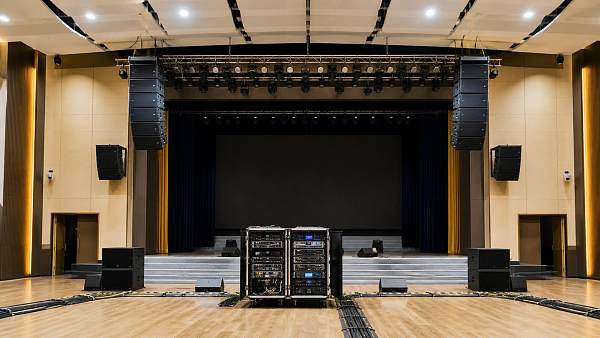
The main loudspeakers should direct sound toward listeners while limiting unnecessary energy on walls, ceilings, and open microphones. Their mounting position matters as much as the cabinet specification. A suitable loudspeaker placed behind an architectural obstruction or aimed across a balcony edge cannot deliver its intended coverage.
A central speech system can provide a stable image near the stage center when sightlines and room geometry permit. Left and right systems offer flexibility for music and effects, but routing identical dialogue through both can create uneven interference where their outputs overlap. Some seats may also receive much more sound from one side, pulling the apparent voice away from the performer.
Separate speech and music routing can help. A venue may use a central source for dialogue while retaining left and right channels for musical content, with fills assigned according to their seating areas. This arrangement still needs careful coordination; adding another loudspeaker does not automatically improve clarity.
Line arrays are not an automatic upgrade for every theater. Their behavior depends on array size, configuration, and frequency. A compact auditorium may receive more predictable coverage from well-positioned point-source cabinets. Compare proposals through coverage predictions based on feasible mounting locations, rather than product categories alone.
Treat front rows and balcony areas as distinct coverage tasks
Front-row listeners may sit below the main loudspeakers’ useful coverage or hear voices coming from high above the stage. Small front fills can restore speech detail and improve the connection to the performance. Their level should support the main system without creating an obvious separate source.
Under-balcony seats often need dedicated fills because the balcony blocks the direct path from the main system. Increasing the mains to reach those seats can make exposed areas excessively loud. Local reinforcement delivers sound where it is missing, provided its coverage stays within the intended zone.
Delay settings help fills work with the main system. Where both are audible, the relationship between their arrival times affects clarity and perceived direction. Matching arrivals is a useful starting point, but final settings should also account for stage localization. Loudspeaker processing introduces latency, so physical distance alone does not provide the complete answer.
Upper balconies require their own assessment. A main system that covers the stalls well may miss the rear balcony or strike its front surface strongly. Check vertical coverage, sightlines, and transitions between zones. Listen at boundary seats, where competing sources can produce a hollow tone or an audible second arrival even when each zone sounds acceptable on its own.
Design microphone and stage monitoring choices together
The audience system can only reproduce the signal it receives. A microphone positioned far from the performer captures more room sound and competing noise. Increasing its gain then raises those unwanted signals along with the voice and reduces the available margin before feedback.
Close microphone placement generally improves isolation, but theater use introduces movement, costumes, concealment, and changing vocal direction. Headset microphones can maintain a relatively consistent distance from the mouth. Concealed lavalier microphones may satisfy visual requirements while needing more careful placement to manage clothing noise and tonal changes. The appropriate choice depends on the production’s visual and operational needs.
Stage monitors also affect dialogue clarity. High monitor levels can spill into vocal microphones and increase the sound reaching the auditorium directly from the stage. Plan monitor locations, coverage, and performer requirements alongside the audience system. In-ear monitoring may reduce acoustic spill for suitable performers, but it introduces fitting, wireless coordination, and operational requirements.
Wireless microphone planning should include locally permitted frequencies, coordination with other wireless equipment, antenna placement, and realistic movement tests. Battery handling, spare transmitters, and clear channel identification matter during a performance. These operational provisions belong in the procurement scope, rather than being left for the first rehearsal.
Coordinate installation and procurement around the complete system
Confirm loudspeaker locations before architectural finishes and structural provisions are finalized. Rigging needs engineered support, suitable hardware, and maintenance access. Cable paths, electrical distribution, equipment ventilation, and access to connectors should be coordinated with the building services. A concealed cabinet still needs a sound path that preserves its coverage.
Budget decisions should protect the parts of the design that determine performance. Removing an under-balcony fill or substituting a cabinet with different coverage can change the listening result substantially. An equipment substitution should therefore trigger a design review, including mounting, processing, amplifier compatibility, and updated coverage predictions.
A useful supplier proposal explains how the system meets the brief. Request loudspeaker locations and aiming information, coverage plots with stated assumptions, signal-flow diagrams, equipment schedules, rigging responsibilities, commissioning scope, and handover requirements. Model names and total wattage provide too little information for a meaningful comparison.
For sourcing through Global Commercial Trade (GCT), its pro audio focus is relevant to identifying potential suppliers and comparing commercial capabilities. The project specification should remain the basis for selection. Evaluate documentation quality, replacement availability, technical support, and the supplier’s ability to deliver the complete installation package.
Keep responsibility for overall performance explicit. If one party supplies equipment, another installs it, and a third tunes it, the contract should identify who owns design coordination and acceptance. Otherwise, a coverage problem can remain unresolved while each party points to another part of the system.
Commission across the audience area and rehearse real operating conditions
Commissioning should begin with installation checks: signal routing, polarity, loudspeaker orientation, amplifier settings, network operation, and processing configuration. Tuning around an installation error can conceal the fault temporarily while creating problems elsewhere.
Use measurements to establish level, timing, and frequency-response behavior across representative seats. Equalization can improve tonal balance, but it cannot reliably repair a deep cancellation caused by geometry or restore coverage behind an obstruction. Resolve placement, aiming, and overlap issues before applying extensive corrective equalization.
Listening checks should use speech and production material that expose the intended challenges. Include quiet dialogue, changing microphone positions, overlapping vocals, and music beneath speech. Test with ventilation running and the stage configured for use. A system demonstration using only loud recorded music does not establish whether an audience can follow a restrained spoken scene.
Walk the front rows, side seats, rear stalls, balcony edges, and under-balcony areas. Record unresolved issues by location and symptom: missing consonants, excessive bass, unstable vocal image, or a noticeable fill speaker. This gives the commissioning team specific problems to correct and creates a clear basis for retesting.
Complete handover with documented settings, labelled routing, configuration backups, operator training, and agreed presets for common venue layouts. The final acceptance session should demonstrate the performance brief under representative conditions. It should also leave the operating team able to reproduce that result when the room configuration or production changes.
Search News
Hot Articles
- Pro Stage AudioDesigning Theater Sound Systems for Clear Dialogue and Even Audience CoverageOct 15, 2026
- Musical InstrumentsHow Do You Choose Music Education Equipment for a New Campus?Oct 15, 2026
- Arcade & VR MachinesChoosing a Racing Simulator Cockpit for an FEC: Durability and Guest FitOct 14, 2026
Popular Tags
Need ExpertConsultation?
Connect with our specialized leisureengineering team for procurementstrategies.
Recommended News
 Oct 15, 2026Designing Theater Sound Systems for Clear Dialogue and Even Audience CoverageOptimize stage sound for theaters with practical tips on acoustics, speaker placement, and tuning. Discover how to deliver clear dialogue and consistent coverage across audience seating.● Pro Audio Engineer
 Sep 30, 2026How to Choose an Aluminum Projector Ceiling Mount for Load, Drop, and Ceiling TypeChoose an aluminum projector ceiling mount with confidence. Learn how load capacity, drop length, ceiling structure, safety retention, and service access shape a reliable commercial AV installation.● Pro Audio Engineer
 Sep 26, 2026How to Choose Dynamic Microphones for Vocals in Live Stage SettingsDynamic microphones for vocals: learn how to match polar patterns, feedback control, durability, and clarity to live stage needs for reliable, professional sound.● Pro Audio Engineer
 Sep 07, 2026How to Choose Wall Mount Speakers for Clear Audio in Commercial SpacesWall mount speakers for commercial spaces: learn how to optimize coverage, SPL, directivity, installation, and system design for clear, reliable audio.● Pro Audio Engineer
 Sep 03, 2026How to Choose Locking Speakon Speaker Cables for Reliable Live Sound ConnectionsLocking Speakon speaker cables: learn how to select the right gauge, connector pinout, strain relief, and durable construction for reliable live sound connections.● Pro Audio Engineer
 Sep 08, 2026Is It Worth Upgrading a Stage Sound System Mid-Project?Is it worth upgrading stage sound systems mid-project? Discover how to assess performance gaps, costs, compatibility, and long-term venue value.● Pro Audio Engineer
 Sep 04, 2026Can AV Systems Be Retrofitted Into Older Commercial Buildings?Can AV integration be retrofitted into older commercial buildings? Discover practical strategies for reliable, code-aware AV upgrades with minimal disruption.● Pro Audio Engineer
 Jul 17, 2026How to Choose a Crossover Networks Supplier: Key Specs, Quality Checks, and OEM FactorsFind the right crossover networks supplier with this practical guide to key specs, quality checks, OEM factors, and supply chain risks for better audio performance and sourcing confidence.● Pro Audio Engineer
 Jul 16, 2026How to Evaluate ODM Services for Pro Audio: Design, Certification, and Production CapabilitiesODM services for pro audio: learn how to assess design depth, certification readiness, and production strength to choose a reliable partner and launch better audio products with less risk.● Pro Audio Engineer
 Jul 15, 2026JETRO Flags Modular, Low-Power Shift in Pro Stage AudioPro Stage Audio buyers in Japan are shifting fast: JETRO flags modular amplifiers, IP65 line arrays, low standby power, and JIS compliance as key to channel entry.● Pro Audio Engineer
 Jul 15, 2026Paper Speaker Cones Explained: How Cone Weight and Stiffness Affect SoundPaper speaker cones explained: discover how cone weight and stiffness shape sensitivity, clarity, breakup control, and real-world speaker performance for smarter audio sourcing.● Pro Audio Engineer
 Jul 15, 2026Performance Venues Compliance Checklist: Fire Safety, Accessibility, and Crowd RulesPerformance venues compliance checklist covering fire safety, accessibility, and crowd rules. Learn how to reduce delays, improve approvals, and open safer, more resilient venues.● Pro Audio Engineer
 Jul 14, 2026Japan Adds EMC Immunity Test for Stage AmplifiersJapan Adds EMC Immunity Test for Stage Amplifiers: learn how Japan’s 2026 JIS update affects EMC testing, JIS marking, certification timing, and market access for exporters.● Pro Audio Engineer
 Jul 13, 2026CISCE 2026 Adds Pro Stage Audio ZoneCISCE 2026 Adds Pro Stage Audio Zone as free overseas pre-registration opens. Explore key updates for pro audio suppliers, distributors, and system integrators before the Shanghai expo.● Pro Audio Engineer
 Jul 12, 2026Japan Tightens Pro Stage Audio Efficiency Limits Under JIS C 8105-2026Japan Tightens Pro Stage Audio Efficiency Limits Under JIS C 8105-2026: learn how new PSE compliance rules reshape market access, product eligibility, and shipment planning in Japan.● Pro Audio Engineer
 Jul 12, 2026How to Choose Low Profile Ceiling Speakers for Hotels, Offices, and Retrofit ProjectsLow profile ceiling speakers for hotels, offices, and retrofit projects: learn how to compare depth, coverage, compliance, and installation factors to choose the right fit.● Pro Audio Engineer
 Jul 11, 2026Japan Tightens JIS C 8105-2026 for Pro AudioJapan Tightens JIS C 8105-2026 for Pro Audio: learn how stricter standby power, PSE diamond mark rules, and the 2026 deadline impact exports, compliance, and market access.● Pro Audio Engineer
 Jul 10, 2026JETRO Q2 Outlook Signals Higher Stage Audio DemandJETRO Q2 Outlook signals higher stage audio demand in Japan, with 37% procurement growth and stricter PSE Annex D compliance. See what importers, manufacturers, and rental channels must act on now.● Pro Audio Engineer
 Jul 10, 2026How to Choose Wall Mount Speakers for Restaurants by Layout, Coverage, and SPLWall mount speakers for restaurants should match layout, coverage, and SPL. Learn how to choose the right setup for even sound, guest comfort, and reliable performance.● Pro Audio Engineer
 Jul 09, 2026JIS T 9001:2026 Adds Mandatory AI Noise LabelsJIS T 9001:2026 adds mandatory AI noise labels for pro audio gear from October 2026. Learn how it impacts compliance, testing, exports, and product launches.● Pro Audio Engineer
 Jul 06, 2026Improving Sound Reinforcement Speech Clarity: Key Causes of Muddiness and How to Fix ThemSound reinforcement speech clarity starts with identifying reverberation, coverage, noise, and timing issues. Discover practical fixes that make announcements clearer and commercial spaces perform better.● Pro Audio Engineer
 Jul 05, 2026Saudi Rule Adds Arabic UI Requirement for Pro Audio ImportsSaudi Rule Adds Arabic UI Requirement for Pro Audio Imports: learn how SASO’s new Arabic UI mandate affects digital amplifiers, DSP processors, and network audio interfaces before Sept. 1, 2026.● Pro Audio Engineer
 Jul 02, 2026How to Choose Audio Mixing Consoles for Live Venues: Channels, Buses, and I/O ExplainedAudio mixing consoles explained for live venues: learn how to choose the right channels, buses, and I/O to improve workflow, support growth, and avoid costly mistakes.● Pro Audio Engineer
 Jul 01, 2026UL 62368-3:2026 Adds EMC Rules for Pro Stage AudioUL 62368-3:2026 adds EMC rules for Pro Stage Audio, requiring Level 4 immunity and manual labeling by Oct 1, 2026. See what exporters, makers, and buyers must do now.● Pro Audio Engineer