How to Choose Wall Mount Speakers for Clear Audio in Commercial Spaces
Clear commercial audio is rarely achieved by selecting the loudest wall mount speakers in a catalogue. The decisive question is whether the installed system can deliver sufficient speech intelligibility and usable program level at every listening position without creating excessive level, reflections, feedback, or uneven coverage elsewhere in the room.
That distinction changes the evaluation process. A compact speaker with a modest power rating may work well in a quiet classroom or hotel corridor, while a higher-output model with tightly controlled directivity may be necessary in a reverberant lobby, retail entrance, or leisure venue. Wattage, enclosure size, and unit price matter, but they are secondary to coverage geometry, acoustic conditions, system architecture, and installation constraints.
Start with the acoustic task, not the speaker specification sheet
“Clear audio” has different technical meanings depending on what the system must reproduce. In a guestroom corridor, the priority may be intelligible paging at low background noise. In a retail store, the system may need consistent background music plus promotional announcements. A classroom requires speech clarity across seated listeners, while a restaurant or activity venue may need speech to remain understandable above conversation, music, and operational noise.
The first decision is therefore the required use case:
- Background music: prioritizes even coverage, unobtrusive level, and acceptable tonal consistency from zone to zone.
- Foreground music: requires greater output headroom, broader bandwidth, and lower audible distortion at elevated levels.
- Paging and voice announcements: depends primarily on intelligibility, directivity, and control of reverberation rather than bass extension.
- Voice alarm or emergency communication: introduces additional requirements for supervised circuits, fire performance, applicable codes, and system-level compliance.
A speaker selected for low-level ambient music should not automatically be assumed suitable for emergency messaging. Likewise, a model designed for speech paging may not provide the bandwidth or headroom expected for music-led hospitality spaces. Combining these functions on one device is possible in some projects, but only after confirming the acoustic target and the governing life-safety requirements.
Use coverage pattern to determine quantity and placement
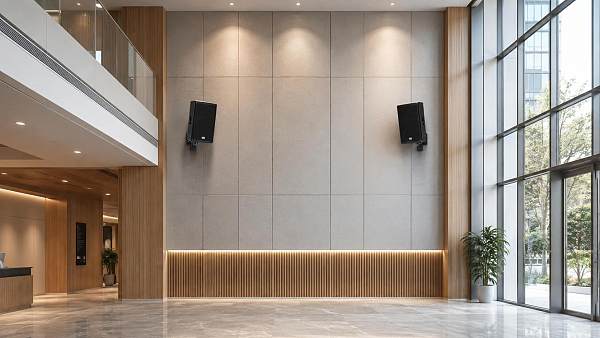
Wall-mounted loudspeakers are directional devices. Their nominal dispersion angle—often stated as horizontal by vertical coverage at a specified frequency—has a direct effect on spacing, aiming, and sound consistency. A broad-dispersion cabinet may cover a larger area at mid frequencies, but it can also send more energy toward hard side walls, ceilings, glazing, and other reflective surfaces. That additional reflected energy can reduce clarity, especially for speech.
Published coverage data also need to be read carefully. A specification such as 90° × 60° is meaningful only when the manufacturer identifies the reference frequency or provides polar plots across the usable band. Dispersion becomes narrower as frequency rises for many conventional two-way enclosures. A single angle without frequency context is not enough to model speech coverage reliably.
For rectangular spaces, placement should be based on listener-plane coverage rather than wall-to-wall distance. Define the nominal listener height, the mounting height, and the intended aiming angle. Then verify where the main axis intersects the listening plane and how much level variation occurs at the edges of the covered area. In many installations, speakers aimed slightly downward toward the audience provide better direct-to-reverberant sound than cabinets mounted flat and firing across the room.
Avoid treating wide-angle models as a universal answer. In a narrow corridor, a wide horizontal pattern can spill sound into doorways, adjacent open areas, or parallel reflective surfaces. A more controlled pattern, deployed at closer intervals, can produce clearer results with less spill. Conversely, a narrow-dispersion unit used in a low-ceiling retail space may leave audible gaps between coverage zones.
Coverage overlap is necessary, but excessive overlap creates its own problems. When adjacent loudspeakers reproduce the same signal at similar levels with differing arrival times, comb filtering can affect tonal consistency and speech clarity. Distributed systems should be laid out so that one loudspeaker is clearly dominant at a listener position where practical, rather than relying on several equal-level sources arriving from different directions.
Evaluate maximum SPL from sensitivity, distance, and headroom
Rated power alone does not indicate how loud a wall mount speaker can be in a room. The relevant relationship includes sensitivity, amplifier power, distance, and the number of active sources. A simplified free-field estimate for one loudspeaker is:
SPL at distance ≈ sensitivity at 1 W/1 m + 10 log10(power in watts) − 20 log10(distance in metres)
This is only a starting point. Commercial rooms are not free fields: reflections, room absorption, installation boundaries, and multiple loudspeakers modify the result. Still, the calculation exposes a common selection error. A low-sensitivity unit driven at a high wattage may not outperform a more efficient loudspeaker driven at lower power, particularly at the far end of a coverage zone.
For speech systems, the target should not be a maximum SPL figure in isolation. The design must produce adequate signal-to-noise ratio at occupied locations while preserving headroom for message peaks. If the local ambient noise is high, raising speaker level can improve audibility only up to the point where the sound becomes intrusive, distorted, or acoustically confusing. In a heavily reverberant environment, more level may make announcements louder but not clearer.
Check the manufacturer’s continuous and peak power definitions. “Power handling” may refer to different test conditions, and figures are not always directly comparable across brands. Sensitivity, maximum calculated SPL, frequency response tolerance, and distortion data should be interpreted together. Where speech is critical, measured STI or STIPA performance at representative locations is more useful than a broad claim of “high clarity,” although room acoustics and system processing strongly influence the final result.
Match the speaker topology to the distribution system
Commercial wall mount speakers are commonly supplied in either low-impedance form, such as 4 Ω or 8 Ω, or with transformers for constant-voltage distribution, typically 70 V or 100 V depending on regional practice. The choice affects cabling, amplifier loading, zoning, and future expansion.
A 70 V or 100 V line system is often appropriate when many loudspeakers are distributed across a large building or multiple zones. Each speaker is connected in parallel and assigned a transformer tap. The tap determines the approximate power drawn from the line, making load planning relatively straightforward. It also allows long cable runs with reduced distribution loss compared with a low-impedance network of similar scale.
The amplifier should not be sized exactly to the arithmetic total of all selected transformer taps. Program material and paging signals have peaks, transformer tolerances exist, and expansion may be required. Sensible headroom is part of a stable design. The exact margin depends on system duty, signal processing, and the amplifier’s stated operating conditions, but a line amplifier operated continuously at its limit is a poor foundation for consistent sound.
Low-impedance systems can be advantageous where higher-fidelity music, greater dynamic range, or more detailed DSP control is required, particularly in smaller zones. Their constraints are different: cable resistance becomes more consequential, parallel loading must remain within amplifier limits, and each channel requires disciplined impedance calculations. Do not mix transformer-equipped speakers and direct low-impedance loudspeakers on the same amplifier output unless the system architecture explicitly supports it.
Transformer tap selection should be based on the required acoustic output, not simply set to the highest position. In a distributed music system, matching taps across comparable coverage areas supports level uniformity. Higher taps may be needed near entrances, noisier operational zones, or spaces with greater mounting distance. Inappropriate tapping is one reason a system may sound uneven even when every enclosure is functioning correctly.
Frequency response matters, but intelligibility depends on more than bandwidth
For speech-dominant applications, the frequencies carrying consonant detail are especially important. A speaker with strong low-frequency output but irregular upper-midrange performance may sound full yet still deliver poor announcement clarity. For music, a wider and smoother response may be desirable, but published frequency ranges should be examined for their tolerance. A claim of “60 Hz–20 kHz” means little without knowing whether the limits are measured at ±3 dB, ±10 dB, or another condition.
Small wall-mounted enclosures cannot be expected to provide deep bass at high output without compromise. In hospitality and retail applications, attempting to force compact speakers to reproduce excessive low-frequency energy can consume amplifier headroom, increase distortion, and excite room resonances. High-pass filtering, appropriately configured subwoofers where the program requires them, and DSP equalization can deliver better results than selecting a small speaker based on an optimistic low-frequency specification.
Equalization should correct measured system behaviour, not compensate for a poor physical layout. DSP can manage level, delay, filters, limiting, and zone tuning; it cannot remove strong late reflections caused by firing a speaker into a hard-glazed atrium or solve insufficient direct coverage at the rear of a room.
Assess the enclosure as part of the building environment
Commercial spaces impose mechanical and environmental demands that may not appear in an acoustic model. The enclosure, grille, connector compartment, bracket, and mounting interface all need review.
In kitchens, pool-adjacent areas, covered outdoor circulation routes, and humid leisure environments, determine the needed ingress protection using IEC 60529 IP ratings. An IP rating should be interpreted by its actual digits and installation condition; a speaker’s rating does not automatically make its cable entry, wall penetration, external junction box, or mounting hardware equally protected. Outdoor exposure also raises questions about UV resistance, corrosion, drainage, temperature range, and wind loading.
For indoor public spaces, confirm the physical fixing arrangement. The structural substrate may be concrete, masonry, steel framing, timber, or plasterboard over framing, each with different anchor and reinforcement requirements. Speaker net weight is not the only load consideration: bracket leverage, safety cables, vibration, accidental impact, and seismic provisions can matter depending on location and local rules.
A pivoting U-bracket offers flexible aiming but requires enough clearance to set the desired angle without placing the enclosure against the wall. A fixed bracket can be more compact but may force an acoustically poor firing direction. Verify whether safety retention hardware is supplied, whether it is rated for the intended installation, and whether routine access remains possible after commissioning.
Separate ordinary audio requirements from life-safety obligations
Where wall mount speakers form part of an emergency voice communication or voice alarm system, selection cannot stop at audio performance. Requirements depend on jurisdiction, building use, and the authority having jurisdiction. In Europe, EN 54-24 addresses loudspeakers used in voice alarm systems, while related system requirements may apply elsewhere. In the United States, applicable listings can include UL 1480 for speaker products, with additional requirements potentially relevant to fire alarm, plenum, or emergency communication installations.
These references should not be treated as interchangeable badges. A product compliant or listed for one market may not satisfy a project specification or local approval pathway in another. The correct review starts with the building code, fire strategy, system specification, and applicable local authority requirements. Confirm the exact model, installation orientation, circuit arrangement, supervision method, and accessories covered by the relevant approval documentation.
For non-emergency background audio, safety still applies. Electrical ratings, flame performance of cabling, connector protection, mounting security, and local electrical installation rules remain part of the engineering scope. A speaker’s declaration alone does not validate the complete installed system.
Commissioning reveals whether the selection was correct
A wall mount speaker system should be accepted through measured performance rather than by a brief walk-through at a single volume setting. Verify polarity, transformer tap settings, amplifier loading, zone routing, limiter thresholds, and fault reporting where used. Inspect aiming angles because small deviations can significantly alter high-frequency coverage.
At representative listener positions, check level consistency and speech intelligibility with the actual paging microphone, program source, DSP preset, and normal operational noise where feasible. A system tuned with pink noise or music alone may conceal problems in microphone gain structure, automatic ducking, message playback level, or feedback margin.
Documentation should preserve the final configuration: speaker locations and orientations, model numbers, tap settings or impedances, amplifier channel assignments, DSP files, cable routes, and measured commissioning results. This record is essential when tenant layouts change, a retail zone is reconfigured, or replacement speakers are needed years later.
The most reliable choice of wall mount speakers is therefore not a single model category. It is a coordinated decision in which directivity matches room geometry, output matches ambient conditions, distribution architecture matches the scale of the installation, and the enclosure is appropriate for its physical environment. When those conditions are verified before ordering, clear sound becomes an engineered outcome rather than an assumption based on wattage or appearance.
Search News
Hot Articles
- Outdoor RidesComcast Q3 Earnings: Universal Theme Park Revenue Falls 4.4% to $2.6 BillionOct 23, 2026
- Restaurant FurnitureHotel Bar Furniture Prices: What to Budget for Stools, Tables, and DeliveryOct 23, 2026
- Pro Stage AudioAudio Production for Streaming: How to Build a Dedicated Live Event MixOct 22, 2026
Popular Tags
Need ExpertConsultation?
Connect with our specialized leisureengineering team for procurementstrategies.
Recommended News
 Oct 22, 2026Audio Production for Streaming: How to Build a Dedicated Live Event MixMaster audio production for streaming with a dedicated live event mix. Learn routing, loudness control, and monitoring techniques to deliver clear, balanced sound your online audience will love.● Pro Audio Engineer
 Oct 15, 2026Designing Theater Sound Systems for Clear Dialogue and Even Audience CoverageOptimize stage sound for theaters with practical tips on acoustics, speaker placement, and tuning. Discover how to deliver clear dialogue and consistent coverage across audience seating.● Pro Audio Engineer
 Oct 22, 2026Which Professional Sound System Specs Matter Most for Live Venues?Discover what professional sound system specs matter most for live venues. Compare SPL, coverage, frequency response, and headroom to choose a PA that delivers clear, powerful sound.● Pro Audio Engineer
 Oct 20, 2026Should You Prioritize Stage Sound or Audience Coverage?Should I prioritize stage sound or audience coverage first? Discover how to balance clear audience audio, reliable monitoring, and smarter sound-system upgrades for your venue.● Pro Audio Engineer
 Oct 18, 2026How Much Does Studio Acoustic Treatment Cost per Square Meter?How much does studio acoustic treatment cost per square meter? Learn how to compare panel prices, installation fees, and complete budgets to choose the right treatment without overspending.● Pro Audio Engineer
 Oct 17, 2026How Do Line Array and Point Source Sound Systems Differ?What is the difference between line array and point source systems? Compare coverage, costs, and venue fit to find the right solution for clearer sound.● Pro Audio Engineer
 Oct 16, 2026Are Standard Acoustic Panels Enough for Performance Venues?Are standard acoustic panels enough for performance venues? Discover their limits, explore bass control and diffusion, and learn how to choose treatments that improve sound without wasting budget.● Pro Audio Engineer
 Sep 30, 2026How to Choose an Aluminum Projector Ceiling Mount for Load, Drop, and Ceiling TypeChoose an aluminum projector ceiling mount with confidence. Learn how load capacity, drop length, ceiling structure, safety retention, and service access shape a reliable commercial AV installation.● Pro Audio Engineer
 Sep 26, 2026How to Choose Dynamic Microphones for Vocals in Live Stage SettingsDynamic microphones for vocals: learn how to match polar patterns, feedback control, durability, and clarity to live stage needs for reliable, professional sound.● Pro Audio Engineer
 Sep 07, 2026How to Choose Wall Mount Speakers for Clear Audio in Commercial SpacesWall mount speakers for commercial spaces: learn how to optimize coverage, SPL, directivity, installation, and system design for clear, reliable audio.● Pro Audio Engineer
 Sep 03, 2026How to Choose Locking Speakon Speaker Cables for Reliable Live Sound ConnectionsLocking Speakon speaker cables: learn how to select the right gauge, connector pinout, strain relief, and durable construction for reliable live sound connections.● Pro Audio Engineer
 Sep 08, 2026Is It Worth Upgrading a Stage Sound System Mid-Project?Is it worth upgrading stage sound systems mid-project? Discover how to assess performance gaps, costs, compatibility, and long-term venue value.● Pro Audio Engineer
 Sep 04, 2026Can AV Systems Be Retrofitted Into Older Commercial Buildings?Can AV integration be retrofitted into older commercial buildings? Discover practical strategies for reliable, code-aware AV upgrades with minimal disruption.● Pro Audio Engineer
 Jul 17, 2026How to Choose a Crossover Networks Supplier: Key Specs, Quality Checks, and OEM FactorsFind the right crossover networks supplier with this practical guide to key specs, quality checks, OEM factors, and supply chain risks for better audio performance and sourcing confidence.● Pro Audio Engineer
 Jul 16, 2026How to Evaluate ODM Services for Pro Audio: Design, Certification, and Production CapabilitiesODM services for pro audio: learn how to assess design depth, certification readiness, and production strength to choose a reliable partner and launch better audio products with less risk.● Pro Audio Engineer
 Jul 15, 2026JETRO Flags Modular, Low-Power Shift in Pro Stage AudioPro Stage Audio buyers in Japan are shifting fast: JETRO flags modular amplifiers, IP65 line arrays, low standby power, and JIS compliance as key to channel entry.● Pro Audio Engineer
 Jul 15, 2026Paper Speaker Cones Explained: How Cone Weight and Stiffness Affect SoundPaper speaker cones explained: discover how cone weight and stiffness shape sensitivity, clarity, breakup control, and real-world speaker performance for smarter audio sourcing.● Pro Audio Engineer
 Jul 15, 2026Performance Venues Compliance Checklist: Fire Safety, Accessibility, and Crowd RulesPerformance venues compliance checklist covering fire safety, accessibility, and crowd rules. Learn how to reduce delays, improve approvals, and open safer, more resilient venues.● Pro Audio Engineer
 Jul 14, 2026Japan Adds EMC Immunity Test for Stage AmplifiersJapan Adds EMC Immunity Test for Stage Amplifiers: learn how Japan’s 2026 JIS update affects EMC testing, JIS marking, certification timing, and market access for exporters.● Pro Audio Engineer
 Jul 13, 2026CISCE 2026 Adds Pro Stage Audio ZoneCISCE 2026 Adds Pro Stage Audio Zone as free overseas pre-registration opens. Explore key updates for pro audio suppliers, distributors, and system integrators before the Shanghai expo.● Pro Audio Engineer
 Jul 12, 2026Japan Tightens Pro Stage Audio Efficiency Limits Under JIS C 8105-2026Japan Tightens Pro Stage Audio Efficiency Limits Under JIS C 8105-2026: learn how new PSE compliance rules reshape market access, product eligibility, and shipment planning in Japan.● Pro Audio Engineer
 Jul 12, 2026How to Choose Low Profile Ceiling Speakers for Hotels, Offices, and Retrofit ProjectsLow profile ceiling speakers for hotels, offices, and retrofit projects: learn how to compare depth, coverage, compliance, and installation factors to choose the right fit.● Pro Audio Engineer
 Jul 11, 2026Japan Tightens JIS C 8105-2026 for Pro AudioJapan Tightens JIS C 8105-2026 for Pro Audio: learn how stricter standby power, PSE diamond mark rules, and the 2026 deadline impact exports, compliance, and market access.● Pro Audio Engineer
 Jul 10, 2026JETRO Q2 Outlook Signals Higher Stage Audio DemandJETRO Q2 Outlook signals higher stage audio demand in Japan, with 37% procurement growth and stricter PSE Annex D compliance. See what importers, manufacturers, and rental channels must act on now.● Pro Audio Engineer