Hotel Bar Furniture Prices: What to Budget for Stools, Tables, and Delivery
A hotel bar furniture price is useful only when its scope is clear. A stool priced at the factory, a table delivered to a loading dock, and furniture assembled inside the bar represent different purchasing commitments. The practical budget is the cost of getting approved furniture into service—not simply the quantity multiplied by the unit price.
Keep furniture, logistics, installation, and contingency as separate budget lines. Establish the required construction and finish before comparing suppliers, then price the delivery route and site conditions. A cheaper stool can lose its advantage if it requires expensive assembly, occupies more shipping space, or cannot be repaired economically.
What to Allow for Stools and Tables
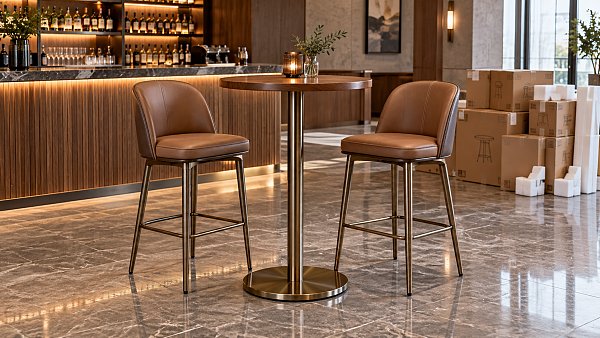
There is no reliable universal price for hotel bar furniture without a defined specification, order quantity, delivery location, and commercial basis. A standard metal stool and a custom upholstered swivel stool are not interchangeable purchases. Likewise, a quoted “bar table” may mean a complete table, a tabletop only, or a base without mounting hardware.
The figures below are illustrative budget allowances in USD, not verified market averages or supplier quotations. They show how to build an initial cost model before obtaining project-specific offers. They exclude freight, duties, taxes, installation, and bespoke development charges.
These bands are starting assumptions rather than price ceilings. Designer collections, specialist fabrication, destination-market distribution costs, and unusually demanding finishes can produce substantially different quotations. Replace each allowance with a comparable written offer before approving the purchasing budget.
For tables, request separate prices for the top, base, connecting plate, and assembly. For stools, establish whether upholstery, glides, footrest protection, and any swivel mechanism are included. This breakdown makes omissions visible and allows substitutions without reopening the entire quotation.
Stool Prices Depend on More Than Frame Material
A material description such as “steel frame” or “solid wood” explains little about suitability for a busy hotel bar. Joint design, bracing, finish preparation, upholstery construction, and replaceable wear parts determine whether two apparently similar stools offer comparable value.
Seat height is an early decision with expensive consequences. Specify the finished seat height against the actual counter underside, including support rails and other obstructions. A nominal bar-height label does not establish comfortable clearance. Check the proposed combination with a sample before approving production, particularly where thick seat cushions compress under use.
Footrests deserve equal attention. Their position affects comfort, while their connection and finish face repeated loading and shoe contact. A decorative finish that looks appropriate on the backrest may need additional protection on the footrest. Ask whether a worn component can be replaced without replacing the frame.
Upholstery comparisons should identify the covering manufacturer and reference, backing, foam specification, seams, and cleaning requirements. An abrasion-test result alone does not establish resistance to staining, cleaning chemicals, seam failure, or surface deterioration. The specified material must suit the hotel’s actual cleaning procedure.
Swivel and height-adjustment mechanisms introduce additional components, maintenance needs, and failure points. Where movement is not essential to the layout, a fixed stool can simplify maintenance. Where swivel seating improves access, obtain the mechanism specification, warranty coverage, and replacement cost rather than treating “swivel” as a sufficient description.
Request evidence of strength, durability, and stability testing appropriate to the product and destination. EN 16139 is one relevant reference for non-domestic seating, but the applicable requirements and test scope must be checked. A report should identify the tested model and configuration; a generic certificate for unrelated furniture does not establish equivalent performance.
A Table Price Must Cover a Compatible Top and Base
A tabletop and base can each meet their individual specifications yet perform poorly together. Top dimensions, weight, overhang, base footprint, column stiffness, and fixing details all affect stability. Bar-height tables require particular attention because forces applied at the top act through a taller structure.
Ask the supplier to confirm the proposed combination, including the largest approved top size and the attachment method. A heavier base is not, by itself, proof that the assembled table is stable. Adjustable glides can accommodate minor floor variation, but they cannot correct an unsuitable base or weak connection.
Compare surfaces against expected exposure. Laminate, veneer, solid timber, stone, and sintered surfaces have different implications for edges, impact damage, cleaning, weight, and repair. A lower-cost top with accessible replacement parts may be economical in a high-contact location; a premium finish may be justified where the design requirement is non-negotiable.
Confirm whether drilled holes, threaded inserts, mounting plates, and fasteners are supplied. Missing hardware can turn a straightforward installation into on-site fabrication, with additional labor and uncertainty over responsibility for the finished assembly.
Delivery Charges That Need Their Own Budget Lines
“Delivery included” is incomplete unless the quotation identifies the destination and service level. Delivery to a commercial receiving dock is different from unloading at a hotel without a dock, moving furniture through a service lift, assembling it, and removing packaging.
For international purchases, require the agreed Incoterms® rule, named place, and version. An EXW, FCA, FOB, or DDP price covers different obligations; FOB is intended for sea or inland waterway transport and should not be used as a generic synonym for export pricing. Even a DDP offer needs clarification on unloading and installation, which are not automatically included.
Budget separately for the charges that apply to the actual route:
- Packing and origin handling: export cartons, protective materials, crating, collection, and terminal handling where excluded.
- Main transport: sea, air, road, or rail freight, plus the stated scope of cargo insurance.
- Destination clearance: brokerage, duties, applicable taxes, inspections, and destination handling.
- Final-mile service: appointments, liftgate equipment, restricted access, unloading, and movement inside the property.
- Installation: assembly, leveling, placement, packaging removal, and any required floor protection.
- Schedule exceptions: storage, failed delivery, redelivery, waiting time, or delivery outside normal working hours.
Obtain packed dimensions, gross weight, package count, and total shipment volume before accepting a freight allowance. Fully assembled stools can consume considerable space; knock-down products can reduce shipping volume but move cost into assembly. Compare both options on a delivered-and-installed basis.
Do not apply a generic import-duty percentage to every furniture order. Classification, material, origin, destination, and applicable trade measures can change the amount payable. Confirm the calculation basis with the customs broker, and distinguish recoverable import tax from a non-recoverable project cost.
A Worked Budget: 40 Stools and 10 Tables
The following hypothetical example shows how the purchase total changes when delivery and installation are included. It assumes delivery within one customs territory, with no import duty. All figures are illustrative USD allowances, exclude tax, and are not live quotations.
The furniture subtotal is $17,500, while the planning budget is $24,860. The $7,360 difference is not a standard industry uplift: it results from the assumptions shown. A local stock order with easy access could need less; an imported custom order with storage and phased installation could need more.
The 10% contingency is also a modeling choice, not a rule. Set contingency against unresolved exposures. An approved sample, confirmed freight rate, surveyed delivery route, and fixed installation scope justify a different reserve from an order with incomplete specifications and an uncertain arrival date.
Make Supplier Proposals Comparable Before Negotiating
Issue one specification schedule showing quantities, dimensions, finishes, upholstery references, table construction, packing requirements, and delivery scope. Require suppliers to identify deviations explicitly. Otherwise, the lowest quotation may simply contain the most substitutions or exclusions.
Separate one-time charges from repeatable unit prices. Samples, tooling, custom finish development, and testing should not disappear into an unexplained total. State whether sample charges are credited against the production order and whether the approved sample remains the reference for acceptance.
Minimum order quantities can change the economics of a design. Splitting a modest order across several upholstery colors or frame finishes may create multiple production minimums. Ask for the cost of the specified mix and the saving from standardizing finishes; do not assume the unit price applies regardless of variation.
Compare schedules from the same starting point. “Production lead time” may begin only after deposit, drawing approval, and material confirmation. It does not necessarily include sampling, transit, customs clearance, or installation. The contractual milestone that matters is furniture ready for use by the required date.
Include inspection and damage procedures in the order. Define acceptance criteria, reporting deadlines, responsibility for replacement freight, and the remedy for shortages or finish discrepancies. A free replacement component has limited value if its arrival is delayed or installation costs remain with the hotel.
Where Paying More Can Protect the Budget
A higher initial price is defensible when it purchases a specific operational benefit: replaceable seat pads, available glides, documented testing, repairable finishes, or reliable spare components. A premium justified only by vague descriptions such as “hotel quality” is harder to evaluate.
Assess likely ownership costs without inventing a service-life forecast. Compare quoted replacement-part prices, repair labor, warranty exclusions, and replenishment terms. Confirm whether future orders can match the finish and whether small replacement quantities attract a surcharge.
The final approval should therefore rest on a defined furniture specification and a written delivered-and-installed scope. Keep taxes, contingency, and optional spares visible rather than hiding them in unit prices. That produces a budget that can survive delivery—and a supplier comparison based on what the bar will actually receive.
Search News
Hot Articles
- Outdoor RidesComcast Q3 Earnings: Universal Theme Park Revenue Falls 4.4% to $2.6 BillionOct 23, 2026
- Restaurant FurnitureHotel Bar Furniture Prices: What to Budget for Stools, Tables, and DeliveryOct 23, 2026
- Pro Stage AudioAudio Production for Streaming: How to Build a Dedicated Live Event MixOct 22, 2026
Popular Tags
Need ExpertConsultation?
Connect with our specialized leisureengineering team for procurementstrategies.
Recommended News
 Oct 23, 2026Hotel Bar Furniture Prices: What to Budget for Stools, Tables, and DeliveryCompare hotel bar furniture price allowances for stools and tables, plus delivery and installation costs. Build a realistic budget, spot hidden charges, and buy with confidence.● Hospitality Sourcing Dir
 Oct 16, 2026Buying Hotel Lobby Furniture Wholesale: MOQs, Freight Costs, and Lead TimesBuying hotel lobby furniture wholesale? Compare MOQs, freight costs, and lead times to avoid hidden fees, protect your opening date, and source smarter with this practical guide.● Hospitality Sourcing Dir
 Oct 04, 2026Fast-Casual Restaurant Interiors: Design Choices That Improve Speed and Guest FlowRestaurant interiors for fast casual brands: discover design choices that improve guest flow, speed service, streamline pickup, and elevate every visit.● Hospitality Sourcing Dir
 Aug 31, 2026Do Supplier Product Specifications Always Match Design Drawings?Do product specs from suppliers always match design drawings? Discover how to prevent costly mismatches with revision control, shop drawings, samples, tolerances, and inspections.● Hospitality Sourcing Dir
 Jul 25, 2026How to Plan Restaurant Commercial Space Design for Better Workflow and Guest ExperienceRestaurant commercial space design starts with workflow, not style. Learn how to improve kitchen flow, guest comfort, and service efficiency with smarter restaurant planning.● Hospitality Sourcing Dir
 Jul 14, 2026Low Maintenance Hotel Outdoor Furniture: Best Materials for Poolsides, Patios, and RooftopsLow maintenance hotel outdoor furniture guide: discover the best materials for poolsides, patios, and rooftops to cut upkeep, improve durability, and elevate guest appeal.● Hospitality Sourcing Dir
 Jul 13, 2026FDA Rule Tightens Coating Tests for Restaurant FurnitureFDA Rule Tightens Coating Tests for Restaurant Furniture: learn how the 2026 FDA migration testing update may impact exports, compliance timelines, suppliers, and U.S.-bound orders.● Hospitality Sourcing Dir
 Jun 13, 2026How to Choose Hotel Outdoor Furniture for Pools, Patios, and Resort TerracesHotel outdoor furniture buying guide for pools, patios, and resort terraces. Learn how to balance durability, comfort, safety, and style for smarter hospitality sourcing.● Hospitality Sourcing Dir
 Jun 01, 2026How to choose folding event tables that last?Folding event tables buying guide: compare materials, load ratings, storage, safety, and supplier checks to choose durable tables for venues, schools, catering, and events.● Hospitality Sourcing Dir
 May 08, 2026Poker Tables Wholesale: MDF or Solid Wood for Heavy Use?Poker tables wholesale guide: compare MDF vs solid wood for heavy-use casinos, hotels, and events. Learn which build delivers durability, lower maintenance, and better ROI.● Hospitality Sourcing Dir
 May 06, 2026Indoor bleachers seating: fixed or retractable for tighter spaces?Indoor bleachers seating for tight spaces: compare fixed vs. retractable options for schools and multipurpose venues, with insights on safety, flexibility, lifecycle value, and smarter project planning.● Hospitality Sourcing Dir
 May 06, 2026Outdoor stadium seating mistakes that raise maintenance costsOutdoor stadium seating mistakes can quietly raise maintenance costs. Learn how better material, drainage, fixing, and service planning cuts repairs and protects long-term venue value.● Hospitality Sourcing Dir
 May 04, 2026Wholesale LED Menu Boards: Brightness Is Not the Only MetricWholesale LED menu boards are about more than brightness. Discover how color consistency, viewing angle, power efficiency, and reliability impact long-term performance and smarter sourcing.● Hospitality Sourcing Dir
 May 04, 2026Digital Signage for Restaurants: What Drives Real Menu Sales?Digital signage for restaurants drives real menu sales through smarter content, screen placement, timing, and optimization. Learn what truly boosts upsells, AOV, and menu performance.● Hospitality Sourcing Dir
 May 03, 2026Hotel pool lounge chairs: materials that survive sun and chlorineHotel pool lounge chairs buying guide: compare aluminum, resin, sling, and hardware materials that resist sun, chlorine, and heavy use for longer life and lower maintenance.● Hospitality Sourcing Dir
 May 03, 2026Outdoor rattan dining sets: which weave lasts in commercial useOutdoor rattan dining sets: discover which commercial weave lasts longest. Compare flat vs half-round options for durability, cleaning efficiency, and lower lifecycle cost.● Hospitality Sourcing Dir
 May 03, 2026Commercial patio umbrellas need more than UV fabric outdoorsCommercial patio umbrellas need more than UV fabric. Discover how wind stability, corrosion resistance, frame strength, and maintenance impact safer, longer-lasting outdoor projects.● Hospitality Sourcing Dir
 May 02, 2026Folding event tables that stay stable on uneven banquet floorsFolding event tables that stay stable on uneven banquet floors help reduce wobble, speed setup, and improve guest experience. Discover key features buyers should compare.● Hospitality Sourcing Dir
 May 02, 2026Banquet chairs wholesale: stacking height can change storage costsBanquet chairs wholesale decisions should consider stacking height, because smarter storage, faster handling, and lower transport costs can significantly improve long-term venue profitability.● Hospitality Sourcing Dir
 May 02, 2026When wholesale melamine plates look premium and when they do notWholesale melamine plates can look refined or cheap. Learn how finish, weight, design, and supplier quality affect premium appeal before you source for hospitality or retail.● Hospitality Sourcing Dir
 May 01, 2026Restaurant Booth Seating That Saves Space Without Feeling TightRestaurant booth seating that saves space without feeling cramped—discover smart dimensions, durable specs, and layout tips to boost comfort, traffic flow, and revenue.● Hospitality Sourcing Dir
 May 01, 2026How to Choose Commercial Bar Stools for High-Traffic VenuesCommercial bar stools for high-traffic venues: learn how to compare durability, safety, comfort, maintenance, and supplier reliability to choose seating that lasts and performs.● Hospitality Sourcing Dir
 Apr 28, 2026Why Hotel Tables Often Fail at Edges, Bases, and Surface FinishHotel tables often fail at edges, bases, and surface finish. Compare hotel furniture, custom furniture, luxury furniture, hotel chairs, hotel beds, and hotel equipment before you buy.● Hospitality Sourcing Dir
 Apr 28, 2026Hotel Tables With Stone Tops or Wood Tops: Which Performs Better?Hotel tables with stone tops or wood tops? Compare ROI, durability, and style across hotel furniture, custom furniture, hotel chairs, and hotel beds to choose smarter.● Hospitality Sourcing Dir