Poker Tables Wholesale: MDF or Solid Wood for Heavy Use?
Choosing the right material is critical when sourcing poker tables wholesale for demanding commercial environments. For technical evaluators, the MDF versus solid wood debate goes far beyond cost—it affects structural stability, surface consistency, maintenance cycles, and long-term return on investment. This guide examines both options through a performance-focused lens to help buyers match table construction with heavy-use requirements.
Why material choice changes by use scenario
In poker tables wholesale projects, the right answer is rarely universal. A casino floor operating around the clock, a hotel entertainment lounge used mainly on weekends, a tournament organizer moving tables between venues, and a premium private club all stress furniture in different ways. Technical evaluators therefore need to judge material suitability by application, not by headline price or marketing claims.
MDF and solid wood each solve different problems. MDF typically offers dimensional consistency, smoother machining for repeat production, and better cost control for large-scale sourcing. Solid wood can deliver stronger premium perception, better edge durability in some constructions, and easier refinishing when damage is localized. However, neither material is automatically better for heavy use unless the operating environment, maintenance capability, appearance goals, and logistics demands are clearly defined.
For commercial buyers working through GCT-style sourcing logic, evaluation should focus on the full construction system: substrate, frame reinforcement, leg design, rail fastening, felt attachment method, edge protection, moisture control, and repairability. In heavy-use scenarios, these details matter more than simply asking whether the poker table is MDF or solid wood.
Where poker tables wholesale decisions usually happen
Technical assessments for poker tables wholesale commonly arise in the following business settings, each with a different material priority:
- Casino and gaming venues needing maximum uptime, repeatable quality, and easy maintenance planning.
- Hotels, resorts, and cruise environments balancing appearance, guest experience, and moderate-to-high use intensity.
- Event rental and tournament operations prioritizing transport durability, assembly efficiency, and replacement economics.
- Private clubs or VIP rooms seeking premium visual value and tactile quality.
- Educational or training settings where budget discipline and standardized function matter more than luxury finish.
Because the same table may be exposed to chip abrasion, player leaning loads, beverage spills, repeated relocation, fluctuating humidity, or strict interior design requirements, material selection must be scenario-led. This is especially true in wholesale sourcing, where one wrong material choice can multiply across dozens or hundreds of units.
MDF vs solid wood in heavy-use settings: a practical comparison
Before matching materials to business scenarios, it helps to compare their operational behavior in a structured way.
Scenario 1: Casino floors and nonstop gaming operations
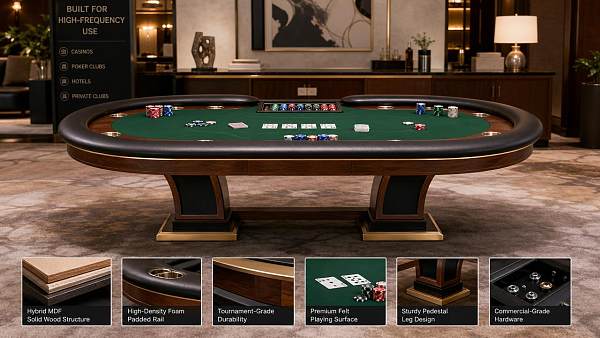
For casino environments, technical evaluators usually care most about uptime, standardized performance, and maintenance predictability. In these settings, poker tables wholesale orders often favor engineered construction that combines MDF tops with reinforced hardwood or metal support structures. The reason is simple: casinos need repeatable flatness, consistent rail geometry, and smooth integration with branded finishes across many units.
MDF performs well here when it is not used as a standalone structural solution. A high-density MDF playing surface can provide a stable substrate for speed cloth or felt, while subframes, aprons, and leg assemblies handle the major load-bearing stress. This hybrid approach reduces variation from one table to another and supports streamlined replacement parts programs.
Solid wood may still be specified for rails, trim, and visible perimeter sections where impact resistance and aesthetic quality matter. But fully solid wood tops are less common in heavy commercial gaming due to higher cost, natural movement, and more demanding material control. For 24/7 use, the best answer is often not MDF versus solid wood alone, but how they are combined within a robust commercial-grade system.
Scenario 2: Hotels, resorts, and mixed-use leisure spaces
In hospitality projects, poker tables wholesale decisions are shaped by brand atmosphere as much as by durability. A luxury resort lounge may need furniture that feels exclusive and visually warm, while a family entertainment zone may need practical surfaces that survive irregular but intensive guest handling. Usage intensity is often lower than a casino, yet exposure to spills, cleaning chemicals, and style expectations is higher.
For upscale hotel interiors, solid wood visible components can justify their cost because they support premium guest perception and align with high-end joinery. However, evaluators should still confirm moisture conditioning, finish hardness, and joinery type. Poorly selected solid wood can crack, shift, or show seasonal movement under air-conditioning cycles.
MDF-based tables with commercial-grade veneer or laminate are often the more practical choice for resort recreation rooms, cruise entertainment zones, and hotel gaming corners where visual consistency, easier bulk procurement, and budget discipline matter. In these settings, edge sealing and water resistance become critical checkpoints.
Scenario 3: Tournament organizers and event rental fleets
This is one of the most demanding scenarios for poker tables wholesale because transport adds a second layer of wear beyond gameplay. Tables are folded, stacked, loaded, unloaded, assembled, and broken down repeatedly. Here, the material question must include portability, fastening fatigue, and edge survival during movement.
MDF offers dimensional consistency and cost efficiency, which is attractive for fleet purchasing. Yet it can be vulnerable if corners are struck during logistics or if moisture reaches exposed core areas. Therefore, event-use MDF tables need reinforced edge banding, protected corners, durable leg mechanisms, and packaging designed for repeated shipping cycles.
Solid wood can tolerate some types of edge impact better, but it may increase weight and transport cost. For mobile operations, excess weight can slow crews, raise labor strain, and increase vehicle loading complexity. In many event scenarios, a lighter hybrid build or segmented structure outperforms both heavy solid wood and underprotected MDF. Technical evaluators should ask suppliers for cycle-test data on folding joints, mounting hardware, and transit packaging rather than focusing only on tabletop material.
Scenario 4: VIP clubs and image-driven premium spaces
In private clubs, executive lounges, and premium entertainment suites, decision criteria shift. Usage may be heavy in individual sessions but lower in overall annual volume. Here, the tactile experience, design authenticity, and visible craftsmanship often outweigh lowest-cost sourcing. Solid wood has an advantage because users notice grain depth, finish quality, rail feel, and joinery detail at close range.
That said, not every “solid wood” specification adds real value. If the table will be exposed to direct sunlight, unstable humidity, or frequent room layout changes, selective use of solid wood may be smarter than full solid construction. For poker tables wholesale in premium spaces, buyers often get the best result from solid wood rails and trim paired with stable engineered internal panels. This preserves visual prestige while reducing movement risk.
How to match material to your operating profile
A scenario-based decision framework helps technical teams avoid overbuying or underengineering.
Common misjudgments in poker tables wholesale sourcing
One frequent mistake is assuming solid wood always means stronger. In reality, structural performance depends on species, thickness, grain orientation, moisture content, joint design, and how loads are transferred into the base. A poorly designed solid wood table can fail earlier than a well-engineered MDF-core table.
Another mistake is treating MDF as suitable only for low-end projects. Commercial-grade MDF, when properly sealed and supported, can perform well in many demanding indoor environments. The issue is not whether MDF exists in the bill of materials, but whether vulnerable edges, fastener zones, and high-load spans have been engineered correctly.
Buyers also sometimes evaluate appearance samples without reviewing maintenance realities. A beautiful rail finish may scratch easily under rings, chip handling, or aggressive cleaning. For heavy-use applications, request abrasion data, coating specifications, and repair procedures. In poker tables wholesale contracts, technical clarity on service life is often more valuable than cosmetic perfection at delivery.
What technical evaluators should confirm before approving a supplier
- Core material density and thickness, not just the label “MDF” or “solid wood.”
- Frame reinforcement design, especially under player leaning loads and repeated movement.
- Moisture protection for edges, underside panels, and hardware interfaces.
- Rail attachment method and replacement practicality.
- Surface re-covering process for felt or speed cloth after wear.
- Packaging standards for export, warehousing, and site delivery.
- Consistency across batches for multi-site poker tables wholesale programs.
FAQ for scenario-based material selection
Is MDF good enough for heavy-use poker tables wholesale?
Yes, if the table is engineered for commercial use with reinforced framing, sealed edges, and durable mounting points. MDF alone is not the whole story; build quality determines success.
When is solid wood worth the extra cost?
Solid wood is most worthwhile in premium hospitality, VIP, or brand-led spaces where visible craftsmanship, tactile value, and refinishing potential directly support business goals.
Which option is better for moving tables frequently?
Neither material wins automatically. For frequent relocation, the better solution is a transport-oriented hybrid design with protected edges, strong hardware, and manageable weight.
Final recommendation for commercial buyers
For poker tables wholesale, the best heavy-use choice is usually scenario-specific rather than material-pure. MDF is often the smarter answer for standardized, scalable, cost-controlled indoor commercial programs, especially when paired with robust support structures. Solid wood is more compelling where luxury presentation, edge feel, and refinishing value matter enough to justify higher material and quality-control costs.
If you are evaluating suppliers, define your use case first: daily operating hours, movement frequency, humidity exposure, target visual grade, repair expectations, and replacement cycle. Then ask vendors to map their MDF, solid wood, or hybrid construction directly to that scenario. This is the most reliable way to source poker tables wholesale that perform well under real commercial pressure, not just in a showroom sample.
Search News
Hot Articles
- Commercial KitchenCommercial Kitchen Design Price: Budgeting by Layout, Equipment, and MEP ScopeSep 22, 2026
- Stationery & UniformsHow Schools Can Cut Printing Costs When Buying Ink Cartridges in BulkSep 21, 2026
- Jewelry Packaging & DisplayHow to Evaluate a Luxury Retail Packaging Supplier for Premium Brand ConsistencySep 20, 2026
Popular Tags
Need ExpertConsultation?
Connect with our specialized leisureengineering team for procurementstrategies.
Recommended News
 Aug 31, 2026Do Supplier Product Specifications Always Match Design Drawings?Do product specs from suppliers always match design drawings? Discover how to prevent costly mismatches with revision control, shop drawings, samples, tolerances, and inspections.● Hospitality Sourcing Dir
 Jul 25, 2026How to Plan Restaurant Commercial Space Design for Better Workflow and Guest ExperienceRestaurant commercial space design starts with workflow, not style. Learn how to improve kitchen flow, guest comfort, and service efficiency with smarter restaurant planning.● Hospitality Sourcing Dir
 Jul 14, 2026Low Maintenance Hotel Outdoor Furniture: Best Materials for Poolsides, Patios, and RooftopsLow maintenance hotel outdoor furniture guide: discover the best materials for poolsides, patios, and rooftops to cut upkeep, improve durability, and elevate guest appeal.● Hospitality Sourcing Dir
 Jul 13, 2026FDA Rule Tightens Coating Tests for Restaurant FurnitureFDA Rule Tightens Coating Tests for Restaurant Furniture: learn how the 2026 FDA migration testing update may impact exports, compliance timelines, suppliers, and U.S.-bound orders.● Hospitality Sourcing Dir
 Jun 13, 2026How to Choose Hotel Outdoor Furniture for Pools, Patios, and Resort TerracesHotel outdoor furniture buying guide for pools, patios, and resort terraces. Learn how to balance durability, comfort, safety, and style for smarter hospitality sourcing.● Hospitality Sourcing Dir
 Jun 01, 2026How to choose folding event tables that last?Folding event tables buying guide: compare materials, load ratings, storage, safety, and supplier checks to choose durable tables for venues, schools, catering, and events.● Hospitality Sourcing Dir
 May 08, 2026Poker Tables Wholesale: MDF or Solid Wood for Heavy Use?Poker tables wholesale guide: compare MDF vs solid wood for heavy-use casinos, hotels, and events. Learn which build delivers durability, lower maintenance, and better ROI.● Hospitality Sourcing Dir
 May 06, 2026Indoor bleachers seating: fixed or retractable for tighter spaces?Indoor bleachers seating for tight spaces: compare fixed vs. retractable options for schools and multipurpose venues, with insights on safety, flexibility, lifecycle value, and smarter project planning.● Hospitality Sourcing Dir
 May 06, 2026Outdoor stadium seating mistakes that raise maintenance costsOutdoor stadium seating mistakes can quietly raise maintenance costs. Learn how better material, drainage, fixing, and service planning cuts repairs and protects long-term venue value.● Hospitality Sourcing Dir
 May 04, 2026Wholesale LED Menu Boards: Brightness Is Not the Only MetricWholesale LED menu boards are about more than brightness. Discover how color consistency, viewing angle, power efficiency, and reliability impact long-term performance and smarter sourcing.● Hospitality Sourcing Dir
 May 04, 2026Digital Signage for Restaurants: What Drives Real Menu Sales?Digital signage for restaurants drives real menu sales through smarter content, screen placement, timing, and optimization. Learn what truly boosts upsells, AOV, and menu performance.● Hospitality Sourcing Dir
 May 03, 2026Hotel pool lounge chairs: materials that survive sun and chlorineHotel pool lounge chairs buying guide: compare aluminum, resin, sling, and hardware materials that resist sun, chlorine, and heavy use for longer life and lower maintenance.● Hospitality Sourcing Dir
 May 03, 2026Outdoor rattan dining sets: which weave lasts in commercial useOutdoor rattan dining sets: discover which commercial weave lasts longest. Compare flat vs half-round options for durability, cleaning efficiency, and lower lifecycle cost.● Hospitality Sourcing Dir
 May 03, 2026Commercial patio umbrellas need more than UV fabric outdoorsCommercial patio umbrellas need more than UV fabric. Discover how wind stability, corrosion resistance, frame strength, and maintenance impact safer, longer-lasting outdoor projects.● Hospitality Sourcing Dir
 May 02, 2026Folding event tables that stay stable on uneven banquet floorsFolding event tables that stay stable on uneven banquet floors help reduce wobble, speed setup, and improve guest experience. Discover key features buyers should compare.● Hospitality Sourcing Dir
 May 02, 2026Banquet chairs wholesale: stacking height can change storage costsBanquet chairs wholesale decisions should consider stacking height, because smarter storage, faster handling, and lower transport costs can significantly improve long-term venue profitability.● Hospitality Sourcing Dir
 May 02, 2026When wholesale melamine plates look premium and when they do notWholesale melamine plates can look refined or cheap. Learn how finish, weight, design, and supplier quality affect premium appeal before you source for hospitality or retail.● Hospitality Sourcing Dir
 May 01, 2026Restaurant Booth Seating That Saves Space Without Feeling TightRestaurant booth seating that saves space without feeling cramped—discover smart dimensions, durable specs, and layout tips to boost comfort, traffic flow, and revenue.● Hospitality Sourcing Dir
 May 01, 2026How to Choose Commercial Bar Stools for High-Traffic VenuesCommercial bar stools for high-traffic venues: learn how to compare durability, safety, comfort, maintenance, and supplier reliability to choose seating that lasts and performs.● Hospitality Sourcing Dir
 Apr 28, 2026Why Hotel Tables Often Fail at Edges, Bases, and Surface FinishHotel tables often fail at edges, bases, and surface finish. Compare hotel furniture, custom furniture, luxury furniture, hotel chairs, hotel beds, and hotel equipment before you buy.● Hospitality Sourcing Dir
 Apr 28, 2026Hotel Tables With Stone Tops or Wood Tops: Which Performs Better?Hotel tables with stone tops or wood tops? Compare ROI, durability, and style across hotel furniture, custom furniture, hotel chairs, and hotel beds to choose smarter.● Hospitality Sourcing Dir
 Apr 28, 2026The Best Hotel Chairs Balance Comfort, Stackability, and DurabilityHotel chairs that balance comfort, stackability, and durability. Explore hotel furniture, custom furniture, hotel tables, hotel beds, and luxury furniture solutions for hospitality buyers.● Hospitality Sourcing Dir
 Apr 28, 2026Hotel Chairs: What Causes Wobbling, Cracks, and Early Wear?Hotel chairs buying guide: learn what causes wobbling, cracks, and early wear, and how to compare hotel furniture, custom furniture, hotel tables, hotel beds, and luxury furniture for lasting value.● Hospitality Sourcing Dir
 Apr 21, 2026Hotel tables that stay stable on uneven flooringHotel tables that stay stable on uneven flooring: a practical guide for hospitality procurement covering hotel furniture, commercial furniture, luxury furniture, and specs that reduce wobble, risk, and maintenance.● Hospitality Sourcing Dir