How to Choose Hotel Outdoor Furniture for Pools, Patios, and Resort Terraces
Choosing hotel outdoor furniture for pools, patios, and resort terraces shapes far more than visual appeal. It affects guest comfort, operating costs, safety performance, and the long-term credibility of the property experience.
In hospitality projects, outdoor areas often carry the brand’s first and last impressions. A terrace lounge, pool deck, or open-air dining zone must look refined, withstand weather stress, and remain practical under heavy daily use.
That is why hotel outdoor furniture has become a strategic sourcing category rather than a decorative afterthought. For global buyers tracking commercial fit-out quality, the decision sits at the intersection of design, compliance, durability, and supplier reliability.
Why outdoor furniture selection now carries more weight
Hospitality investment has shifted toward experience-led spaces. Guests increasingly evaluate resorts through usable outdoor environments, not only room interiors or lobby finishes.
This shift changes procurement priorities. A chair or sun lounger is no longer just a movable asset. It becomes part of the guest journey, social media visibility, operational flow, and maintenance planning.
From an industry perspective, this is where platforms such as Global Commercial Trade matter. Data-backed sourcing intelligence helps connect design ambition with practical commercial standards, especially when buyers compare OEM capability, safety expectations, and lifecycle value across markets.
In other words, hotel outdoor furniture must perform as a commercial system. It has to support aesthetics, occupancy patterns, climate exposure, and replacement planning without creating hidden operational friction.
What hotel outdoor furniture really includes
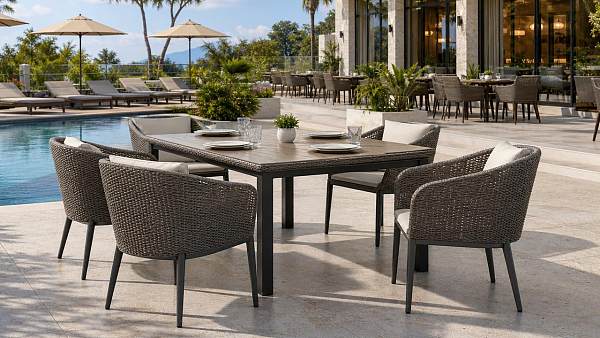
The category covers more than lounge chairs beside a pool. It usually includes dining sets, sunbeds, modular sofas, side tables, bar-height seating, daybeds, umbrellas, cabanas, and occasional accent pieces.
Each subcategory serves a different operational purpose. Poolside products focus on water resistance and quick drying. Patio seating often needs stronger versatility. Resort terrace furniture usually carries the highest design visibility.
The best hotel outdoor furniture selections are not uniform across the property. They are coordinated, but tailored to activity level, weather exposure, guest dwell time, and cleaning frequency.
Core commercial requirements
- Structural stability under repeated use and movement
- Resistance to UV, humidity, chlorine, salt air, and staining
- Easy cleaning without labor-intensive maintenance routines
- Design consistency with the property’s positioning
- Replaceable parts, stackability, or modular flexibility where needed
Materials determine performance more than appearance alone
Material selection is usually the first technical filter. A beautiful finish can quickly become a liability if it fades, corrodes, cracks, or traps moisture in a demanding environment.
Powder-coated aluminum remains popular because it is lightweight, corrosion-resistant, and easy to reposition. For many hotel outdoor furniture programs, it offers a practical balance between design flexibility and lifecycle durability.
Synthetic wicker works well in relaxed resort settings, but quality varies widely. Low-grade versions can become brittle or discolored after long UV exposure.
Teak brings warmth and prestige, especially on luxury terraces. Still, it needs a clear maintenance strategy. Without regular care, tone variation and surface weathering may conflict with the intended visual standard.
Outdoor fabrics deserve equal scrutiny. Quick-dry foam, solution-dyed textiles, and mildew-resistant stitching often matter more than cushion thickness alone.
Different zones require different decision criteria
A common sourcing mistake is treating every exterior area the same. Pools, patios, and terraces face different guest behaviors and environmental stress.
Pool areas
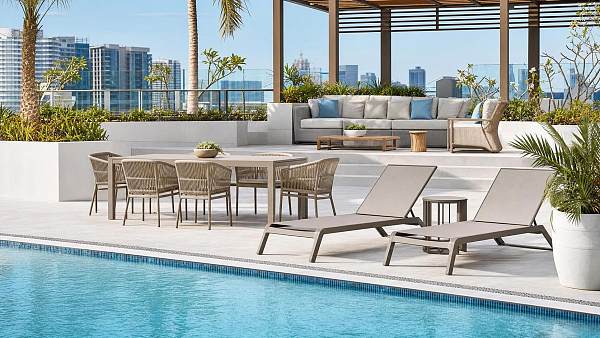
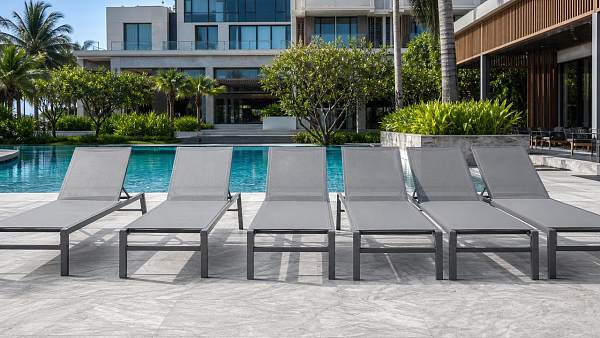
Poolside hotel outdoor furniture needs slip-aware construction, water-tolerant surfaces, and fabrics that dry quickly. Frames should resist chlorine, sunscreen residue, and frequent repositioning.
Stackable loungers can also reduce storage pressure during cleaning, storm preparation, or seasonal reconfiguration.
Patios
Patios often serve multiple roles across the day. Breakfast seating, afternoon lounging, and evening drinks may happen within the same footprint.
That makes flexibility important. Modular seating, mixed table sizes, and easy-to-move pieces usually support better use of space.
Resort terraces
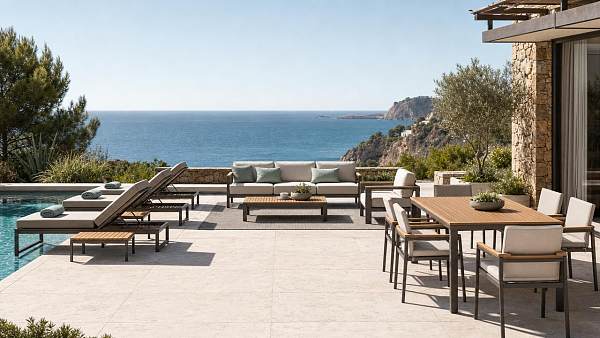
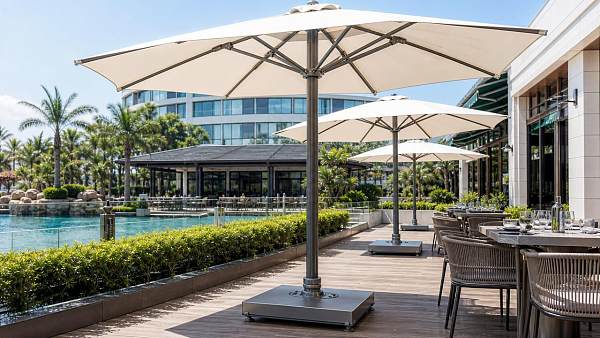
Terraces usually carry stronger visual expectations. Here, hotel outdoor furniture must match architecture, branding, and premium guest perception while still meeting commercial durability standards.
Wind exposure becomes especially important in elevated settings. Heavier bases, secure tabletops, and tested umbrella systems deserve close attention.
Comfort, safety, and maintenance should be evaluated together
Comfort cannot be separated from maintenance. Cushions that feel luxurious on day one may become impractical if they absorb moisture or require constant protective handling.
Safety also extends beyond obvious compliance. Rounded edges, stable bases, smooth finishing, and non-marking feet all matter in busy hospitality environments.
More importantly, maintenance should be measured in labor time, not only cleaning instructions. If hotel outdoor furniture needs special treatment every week, the real ownership cost rises quickly.
- Check whether cushions can be removed and stored efficiently
- Review cleaning chemicals recommended by the supplier
- Confirm replacement availability for glides, slings, and covers
- Inspect frame joints, weight capacity, and anti-tip behavior
Supplier evaluation is part of product evaluation
In commercial sourcing, the product sample tells only part of the story. The supplier’s process discipline often determines whether the final rollout remains consistent across rooms, zones, and future replenishment orders.
This is where an intelligence-led sourcing approach becomes valuable. GCT’s broader commercial perspective reflects a real market need: reliable vendors must demonstrate manufacturing stability, documentation quality, and the ability to meet international hospitality expectations.
For hotel outdoor furniture, useful supplier signals include material traceability, export experience, packaging protection, project references, and responsiveness during technical clarification.
Questions worth asking before approval
- Can finishes and fabrics be matched across phased deliveries?
- What testing supports UV, corrosion, and load performance claims?
- How are spare parts supplied after project handover?
- What is the lead time for custom dimensions or branding details?
- How is packaging designed for international transport risk?
Balancing design intent with total project value
Lowest price rarely means best value. Outdoor hospitality furniture should be reviewed through lifecycle cost, visual longevity, replacement frequency, and service disruption risk.
A lower-cost sun lounger that fails after two seasons may cost more than a stronger model with stable spare part support. The same logic applies to fading fabrics, unstable coatings, or weak fastening systems.
At the same time, over-specification can create waste. Not every patio requires luxury-grade teak, and not every resort terrace needs oversized modular seating.
The strongest hotel outdoor furniture strategy usually aligns finish level with guest visibility, environmental load, and expected usage intensity.
A practical path for the next decision
A clear selection process begins with zoning the property by exposure, traffic, and use pattern. After that, material requirements, design language, and maintenance expectations become easier to define.
It also helps to compare hotel outdoor furniture options against a simple decision matrix covering durability, comfort, safety, lead time, warranty support, and replacement planning.
For projects with international sourcing complexity, the next useful step is not rushing into product lists. It is building a sharper specification brief, validating supplier capability, and checking how each option performs in its actual outdoor context.
When that groundwork is done well, pools, patios, and resort terraces become easier to furnish with confidence, consistency, and long-term commercial sense.
Search News
Hot Articles
Popular Tags
Need ExpertConsultation?
Connect with our specialized leisureengineering team for procurementstrategies.
Recommended News
 Oct 23, 2026Hotel Bar Furniture Prices: What to Budget for Stools, Tables, and DeliveryCompare hotel bar furniture price allowances for stools and tables, plus delivery and installation costs. Build a realistic budget, spot hidden charges, and buy with confidence.● Hospitality Sourcing Dir
 Oct 16, 2026Buying Hotel Lobby Furniture Wholesale: MOQs, Freight Costs, and Lead TimesBuying hotel lobby furniture wholesale? Compare MOQs, freight costs, and lead times to avoid hidden fees, protect your opening date, and source smarter with this practical guide.● Hospitality Sourcing Dir
 Oct 04, 2026Fast-Casual Restaurant Interiors: Design Choices That Improve Speed and Guest FlowRestaurant interiors for fast casual brands: discover design choices that improve guest flow, speed service, streamline pickup, and elevate every visit.● Hospitality Sourcing Dir
 Aug 31, 2026Do Supplier Product Specifications Always Match Design Drawings?Do product specs from suppliers always match design drawings? Discover how to prevent costly mismatches with revision control, shop drawings, samples, tolerances, and inspections.● Hospitality Sourcing Dir
 Jul 25, 2026How to Plan Restaurant Commercial Space Design for Better Workflow and Guest ExperienceRestaurant commercial space design starts with workflow, not style. Learn how to improve kitchen flow, guest comfort, and service efficiency with smarter restaurant planning.● Hospitality Sourcing Dir
 Jul 14, 2026Low Maintenance Hotel Outdoor Furniture: Best Materials for Poolsides, Patios, and RooftopsLow maintenance hotel outdoor furniture guide: discover the best materials for poolsides, patios, and rooftops to cut upkeep, improve durability, and elevate guest appeal.● Hospitality Sourcing Dir
 Jul 13, 2026FDA Rule Tightens Coating Tests for Restaurant FurnitureFDA Rule Tightens Coating Tests for Restaurant Furniture: learn how the 2026 FDA migration testing update may impact exports, compliance timelines, suppliers, and U.S.-bound orders.● Hospitality Sourcing Dir
 Jun 13, 2026How to Choose Hotel Outdoor Furniture for Pools, Patios, and Resort TerracesHotel outdoor furniture buying guide for pools, patios, and resort terraces. Learn how to balance durability, comfort, safety, and style for smarter hospitality sourcing.● Hospitality Sourcing Dir
 Jun 01, 2026How to choose folding event tables that last?Folding event tables buying guide: compare materials, load ratings, storage, safety, and supplier checks to choose durable tables for venues, schools, catering, and events.● Hospitality Sourcing Dir
 May 08, 2026Poker Tables Wholesale: MDF or Solid Wood for Heavy Use?Poker tables wholesale guide: compare MDF vs solid wood for heavy-use casinos, hotels, and events. Learn which build delivers durability, lower maintenance, and better ROI.● Hospitality Sourcing Dir
 May 06, 2026Indoor bleachers seating: fixed or retractable for tighter spaces?Indoor bleachers seating for tight spaces: compare fixed vs. retractable options for schools and multipurpose venues, with insights on safety, flexibility, lifecycle value, and smarter project planning.● Hospitality Sourcing Dir
 May 06, 2026Outdoor stadium seating mistakes that raise maintenance costsOutdoor stadium seating mistakes can quietly raise maintenance costs. Learn how better material, drainage, fixing, and service planning cuts repairs and protects long-term venue value.● Hospitality Sourcing Dir
 May 04, 2026Wholesale LED Menu Boards: Brightness Is Not the Only MetricWholesale LED menu boards are about more than brightness. Discover how color consistency, viewing angle, power efficiency, and reliability impact long-term performance and smarter sourcing.● Hospitality Sourcing Dir
 May 04, 2026Digital Signage for Restaurants: What Drives Real Menu Sales?Digital signage for restaurants drives real menu sales through smarter content, screen placement, timing, and optimization. Learn what truly boosts upsells, AOV, and menu performance.● Hospitality Sourcing Dir
 May 03, 2026Hotel pool lounge chairs: materials that survive sun and chlorineHotel pool lounge chairs buying guide: compare aluminum, resin, sling, and hardware materials that resist sun, chlorine, and heavy use for longer life and lower maintenance.● Hospitality Sourcing Dir
 May 03, 2026Outdoor rattan dining sets: which weave lasts in commercial useOutdoor rattan dining sets: discover which commercial weave lasts longest. Compare flat vs half-round options for durability, cleaning efficiency, and lower lifecycle cost.● Hospitality Sourcing Dir
 May 03, 2026Commercial patio umbrellas need more than UV fabric outdoorsCommercial patio umbrellas need more than UV fabric. Discover how wind stability, corrosion resistance, frame strength, and maintenance impact safer, longer-lasting outdoor projects.● Hospitality Sourcing Dir
 May 02, 2026Folding event tables that stay stable on uneven banquet floorsFolding event tables that stay stable on uneven banquet floors help reduce wobble, speed setup, and improve guest experience. Discover key features buyers should compare.● Hospitality Sourcing Dir
 May 02, 2026Banquet chairs wholesale: stacking height can change storage costsBanquet chairs wholesale decisions should consider stacking height, because smarter storage, faster handling, and lower transport costs can significantly improve long-term venue profitability.● Hospitality Sourcing Dir
 May 02, 2026When wholesale melamine plates look premium and when they do notWholesale melamine plates can look refined or cheap. Learn how finish, weight, design, and supplier quality affect premium appeal before you source for hospitality or retail.● Hospitality Sourcing Dir
 May 01, 2026Restaurant Booth Seating That Saves Space Without Feeling TightRestaurant booth seating that saves space without feeling cramped—discover smart dimensions, durable specs, and layout tips to boost comfort, traffic flow, and revenue.● Hospitality Sourcing Dir
 May 01, 2026How to Choose Commercial Bar Stools for High-Traffic VenuesCommercial bar stools for high-traffic venues: learn how to compare durability, safety, comfort, maintenance, and supplier reliability to choose seating that lasts and performs.● Hospitality Sourcing Dir
 Apr 28, 2026Why Hotel Tables Often Fail at Edges, Bases, and Surface FinishHotel tables often fail at edges, bases, and surface finish. Compare hotel furniture, custom furniture, luxury furniture, hotel chairs, hotel beds, and hotel equipment before you buy.● Hospitality Sourcing Dir
 Apr 28, 2026Hotel Tables With Stone Tops or Wood Tops: Which Performs Better?Hotel tables with stone tops or wood tops? Compare ROI, durability, and style across hotel furniture, custom furniture, hotel chairs, and hotel beds to choose smarter.● Hospitality Sourcing Dir