How Do Line Array and Point Source Sound Systems Differ?
A conference room where the front rows hear clearly but the rear seats struggle needs better coverage, not necessarily more volume. So, what is the difference between line array and point source systems? A line array uses multiple coordinated loudspeaker elements to shape coverage, especially vertically; a point source system typically uses individual enclosures with defined dispersion patterns. Either can deliver clear sound when its coverage matches the audience area.
The practical choice depends on listening distances, room geometry, required sound level, and installation constraints. Line arrays often suit deep audience areas where controlled vertical coverage is valuable. Point source systems are frequently simpler for compact rooms, distributed installations, and spaces with limited mounting options. Choosing by appearance or cabinet count can leave a venue with uneven sound, unnecessary complexity, or excessive reflections.
Two different ways of covering an audience
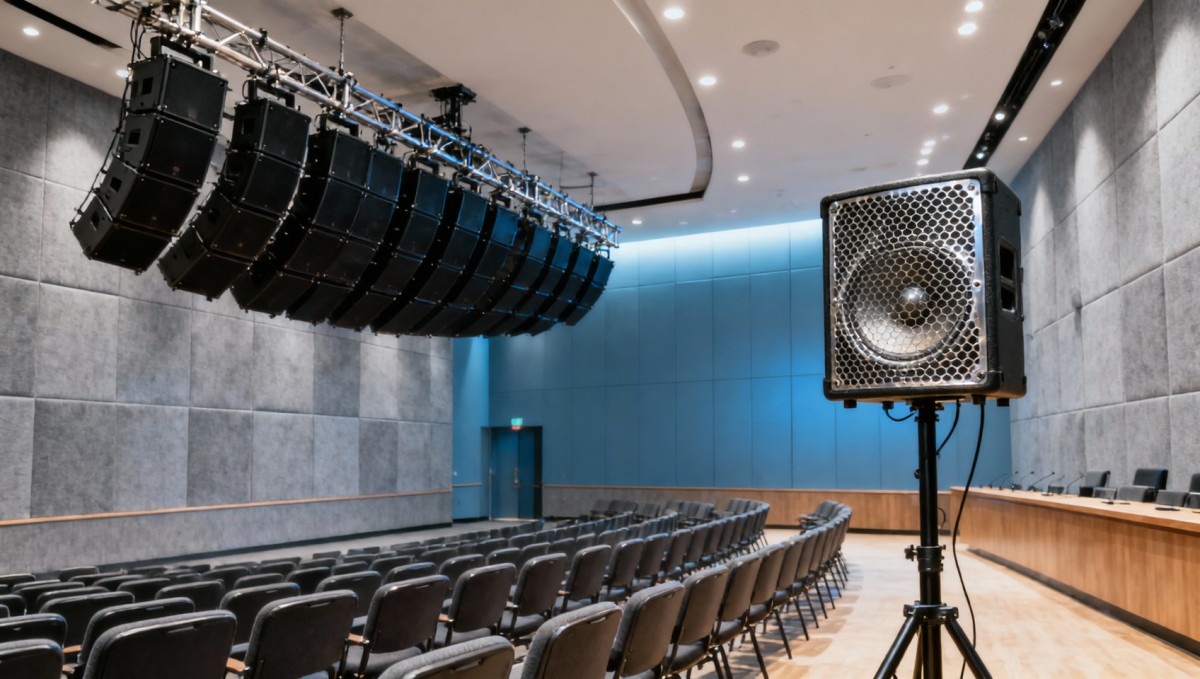
A point source loudspeaker behaves approximately as a single acoustic source over its intended operating range and listening distances. It may contain several drivers, such as a woofer and a compression driver, but they are integrated into one enclosure. Horns, waveguides, and cabinet design determine its coverage pattern. “Point source” does not mean that sound radiates equally in every direction.
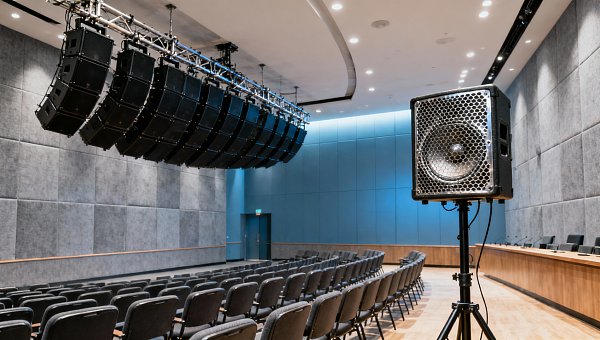
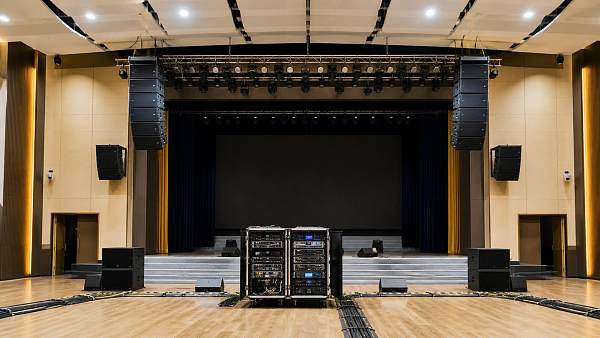
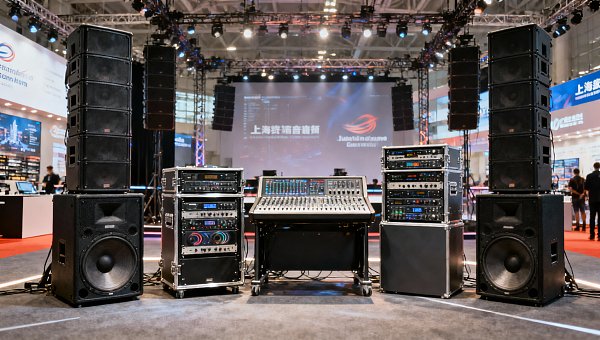
A line array normally consists of purpose-designed loudspeaker modules arranged vertically. Their spacing, waveguides, inter-cabinet angles, and processing help the modules work together across a specified frequency range. The resulting array can produce narrower vertical coverage than an individual enclosure while retaining useful horizontal coverage. Changing the array curvature helps direct different sections toward different audience distances.
Stacking ordinary loudspeakers does not automatically create a functioning line array. Without suitable acoustic design and spacing, adjacent cabinets can interfere with one another, producing peaks and cancellations that vary across the room. Similarly, a short array cannot provide the same low-frequency directivity as a much longer one simply because both are sold as line arrays.
Column loudspeakers complicate the terminology. Some use closely spaced small drivers and electronic beam steering; others use fixed physical arrangements. They may offer line-source behavior over part of their bandwidth, but their output, coverage, and deployment limits differ from large modular arrays. Evaluate the actual design rather than relying on the category name.
The differences that affect a working venue
These are tendencies, not performance rankings. A well-designed point source installation can outperform an undersized or poorly aimed line array. The comparison should be between complete proposed systems covering the same audience area at the same required level.
Distance behavior is not a universal shortcut
Point-source direct sound in a free field falls by approximately 6 dB for each doubling of distance. An ideal line source can show approximately 3 dB per doubling within its cylindrical-spreading region. Real loudspeaker arrays are finite, however, so their behavior changes with frequency, array length, and distance. They do not maintain a single attenuation rate throughout a venue.
A reverberant room complicates this further: reflected sound can keep measured levels high while speech clarity deteriorates. Do not select a system from a “3 dB versus 6 dB” claim alone. Request coverage predictions for the actual geometry, including front-to-back level variation and frequency-dependent behavior.
Directivity matters more than cabinet size
Sending less sound toward ceilings and rear walls can improve the ratio of direct to reflected sound at listeners. A suitably sized line array may provide useful vertical control, but it does not automatically solve reverberation. Its horizontal coverage can still illuminate side walls, and low-frequency control is limited by the array’s physical dimensions.
Point source enclosures also offer controlled patterns, sometimes with different horizontal and vertical coverage options. A narrow-pattern enclosure aimed accurately may be preferable to an array whose coverage does not fit the room. Neither design replaces acoustic treatment when excessive reverberation is the main problem.
Match the approach to the listening area
A shallow ballroom or multipurpose meeting room
When the audience is relatively close to the stage and the ceiling is low, appropriately aimed point source loudspeakers are often the more practical starting point. They can cover the seating without requiring an array that hangs too low or sits too close to listeners. Separate fills may address side seating or areas beneath obstructions.
Movable partitions change the decision. A room that regularly divides into smaller spaces may benefit from independently controlled loudspeaker zones rather than one large stage-oriented system. Confirm how routing, level control, and coverage will work in each partition configuration before choosing hardware.
A deep auditorium with a clear stage orientation
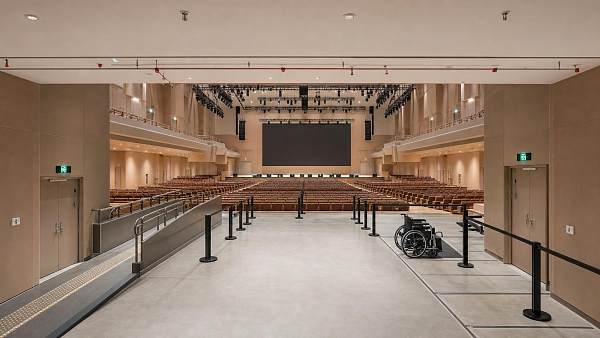
A line array becomes a stronger candidate when listeners occupy substantially different distances from the main loudspeakers. Its geometry can direct coverage toward the rear while limiting excessive energy near the stage. The design still needs enough array length, suitable elevation, and appropriate curvature to achieve that result.
Front fills may be necessary because the main array does not adequately cover seats immediately below or ahead of it. Balcony overhangs can require delayed fills even when the main system has ample output. Increasing array size cannot restore a blocked acoustic path.
A restaurant, exhibition area, or irregular commercial space
Distributed point source loudspeakers often suit spaces where people move between zones and there is no single listening direction. Placing smaller sources closer to listeners can reduce the level required from each speaker. This can be more useful than projecting sound from one end of a long, obstructed space.
Overlap needs attention. Adjacent speakers carrying the same signal can create interference, especially where listeners receive similarly strong arrivals at different times. Use deliberate zoning, aiming, level setting, and delay where appropriate rather than simply adding speakers wherever coverage seems weak.
A practical selection process before requesting quotations
- Map the audience, not just the floor area. Record seating depth, width, elevation changes, standing areas, balconies, and likely obstructions. Include the nearest and farthest listening positions.
- Define the program requirement. Speech-led meetings, background music, and high-energy live performances impose different demands on output, headroom, and low-frequency reproduction. State whether several uses must share one system.
- Confirm usable mounting positions. Record ceiling height, structural support locations, sightline restrictions, and access for maintenance. These constraints can eliminate an otherwise attractive loudspeaker arrangement.
- Assess the room’s acoustic limitations. Identify hard reflective surfaces, long reverberation, and background noise. Where intelligibility is critical, acoustic assessment should precede final equipment selection.
- Compare modeled alternatives. Ask for line array and point source proposals where both are feasible, using the same audience geometry and performance targets. Compare coverage, headroom, mounting demands, and total installed cost.
Prediction plots should show more than a single broadband level map. Examine relevant frequency bands, coverage outside the seating area, and difficult positions such as corners and under-balcony seats. Clarify whether simulations represent direct sound only or include room reflections; those outputs answer different questions.
Also ask how performance changes between room layouts. A design optimized for full seating may need different presets, zones, or level settings when only the front section is occupied. Those operating arrangements should be documented, not left to staff experimentation.
When the system sounds wrong, diagnose before replacing it
Loud at the front, weak at the back: First inspect aiming and coverage geometry. With a point source system, a delayed fill may be more effective than raising the main level. With a line array, check the specified hang height, cabinet angles, array length, and processing against the installed configuration. Do not change suspension angles without following the approved design and rigging procedure.
Speech is loud but difficult to understand: Investigate reverberation, background noise, excessive overlapping coverage, and competing arrivals from fills. Equalization can correct some tonal problems, but it cannot remove a long reverberant decay or repair poor loudspeaker placement.
Sound changes sharply between nearby seats: Check for interference between loudspeakers, inappropriate overlap, polarity errors, or strong reflections. Measurements at several positions help distinguish a system-wide tonal problem from a location-dependent cancellation. Boosting an equalizer at one affected seat can create excessive energy elsewhere.
Subwoofers require separate attention. Neither the main system’s line array label nor its point source label determines bass consistency. Subwoofer placement, crossover alignment, polarity, delay, and room modes can dominate low-frequency performance. Include the bass system in commissioning rather than evaluating only the main loudspeakers.
Compare complete packages, not enclosure prices
A purchasing comparison should include loudspeakers, amplifiers or powered-system infrastructure, signal processing, mounting hardware, cabling, installation labor, commissioning, and operator training. An apparently inexpensive enclosure can become costly if the proposed layout requires numerous fills, additional circuits, or difficult access equipment.
For a line array proposal, request the exact module count, rigging configuration, hang weight, predicted coverage, and required amplifier or processing presets. For a point source proposal, request each enclosure’s coverage pattern, aiming direction, mounting method, and role in the system. Both should identify fill-speaker delays and explain how zones will be controlled.
Suspended loudspeakers need documented load limits, compatible manufacturer-approved hardware, and confirmation that the supporting structure is suitable. A qualified rigging or structural professional should verify overhead installations. Ground-stacked arrays also need approved configurations and stability checks; avoiding suspension does not remove mechanical risk.
Acceptance testing should include representative listening positions, intelligibility where relevant, tonal consistency, usable headroom, and alignment between mains, fills, and subwoofers. Keep the final processing settings and installation drawings with the venue’s operating records. Select the design that demonstrates suitable coverage within the available mounting and operating conditions—not the one with the more impressive cabinet arrangement.
Search News
Hot Articles
- Musical InstrumentsProfessional String Instruments: How to Evaluate Tone, Response, and ProjectionOct 17, 2026
- Restaurant FurnitureBuying Hotel Lobby Furniture Wholesale: MOQs, Freight Costs, and Lead TimesOct 16, 2026
- Pro Stage AudioDesigning Theater Sound Systems for Clear Dialogue and Even Audience CoverageOct 15, 2026
Popular Tags
Need ExpertConsultation?
Connect with our specialized leisureengineering team for procurementstrategies.
Recommended News
 Oct 15, 2026Designing Theater Sound Systems for Clear Dialogue and Even Audience CoverageOptimize stage sound for theaters with practical tips on acoustics, speaker placement, and tuning. Discover how to deliver clear dialogue and consistent coverage across audience seating.● Pro Audio Engineer
 Oct 17, 2026How Do Line Array and Point Source Sound Systems Differ?What is the difference between line array and point source systems? Compare coverage, costs, and venue fit to find the right solution for clearer sound.● Pro Audio Engineer
 Oct 16, 2026Are Standard Acoustic Panels Enough for Performance Venues?Are standard acoustic panels enough for performance venues? Discover their limits, explore bass control and diffusion, and learn how to choose treatments that improve sound without wasting budget.● Pro Audio Engineer
 Sep 30, 2026How to Choose an Aluminum Projector Ceiling Mount for Load, Drop, and Ceiling TypeChoose an aluminum projector ceiling mount with confidence. Learn how load capacity, drop length, ceiling structure, safety retention, and service access shape a reliable commercial AV installation.● Pro Audio Engineer
 Sep 26, 2026How to Choose Dynamic Microphones for Vocals in Live Stage SettingsDynamic microphones for vocals: learn how to match polar patterns, feedback control, durability, and clarity to live stage needs for reliable, professional sound.● Pro Audio Engineer
 Sep 07, 2026How to Choose Wall Mount Speakers for Clear Audio in Commercial SpacesWall mount speakers for commercial spaces: learn how to optimize coverage, SPL, directivity, installation, and system design for clear, reliable audio.● Pro Audio Engineer
 Sep 03, 2026How to Choose Locking Speakon Speaker Cables for Reliable Live Sound ConnectionsLocking Speakon speaker cables: learn how to select the right gauge, connector pinout, strain relief, and durable construction for reliable live sound connections.● Pro Audio Engineer
 Sep 08, 2026Is It Worth Upgrading a Stage Sound System Mid-Project?Is it worth upgrading stage sound systems mid-project? Discover how to assess performance gaps, costs, compatibility, and long-term venue value.● Pro Audio Engineer
 Sep 04, 2026Can AV Systems Be Retrofitted Into Older Commercial Buildings?Can AV integration be retrofitted into older commercial buildings? Discover practical strategies for reliable, code-aware AV upgrades with minimal disruption.● Pro Audio Engineer
 Jul 17, 2026How to Choose a Crossover Networks Supplier: Key Specs, Quality Checks, and OEM FactorsFind the right crossover networks supplier with this practical guide to key specs, quality checks, OEM factors, and supply chain risks for better audio performance and sourcing confidence.● Pro Audio Engineer
 Jul 16, 2026How to Evaluate ODM Services for Pro Audio: Design, Certification, and Production CapabilitiesODM services for pro audio: learn how to assess design depth, certification readiness, and production strength to choose a reliable partner and launch better audio products with less risk.● Pro Audio Engineer
 Jul 15, 2026JETRO Flags Modular, Low-Power Shift in Pro Stage AudioPro Stage Audio buyers in Japan are shifting fast: JETRO flags modular amplifiers, IP65 line arrays, low standby power, and JIS compliance as key to channel entry.● Pro Audio Engineer
 Jul 15, 2026Paper Speaker Cones Explained: How Cone Weight and Stiffness Affect SoundPaper speaker cones explained: discover how cone weight and stiffness shape sensitivity, clarity, breakup control, and real-world speaker performance for smarter audio sourcing.● Pro Audio Engineer
 Jul 15, 2026Performance Venues Compliance Checklist: Fire Safety, Accessibility, and Crowd RulesPerformance venues compliance checklist covering fire safety, accessibility, and crowd rules. Learn how to reduce delays, improve approvals, and open safer, more resilient venues.● Pro Audio Engineer
 Jul 14, 2026Japan Adds EMC Immunity Test for Stage AmplifiersJapan Adds EMC Immunity Test for Stage Amplifiers: learn how Japan’s 2026 JIS update affects EMC testing, JIS marking, certification timing, and market access for exporters.● Pro Audio Engineer
 Jul 13, 2026CISCE 2026 Adds Pro Stage Audio ZoneCISCE 2026 Adds Pro Stage Audio Zone as free overseas pre-registration opens. Explore key updates for pro audio suppliers, distributors, and system integrators before the Shanghai expo.● Pro Audio Engineer
 Jul 12, 2026Japan Tightens Pro Stage Audio Efficiency Limits Under JIS C 8105-2026Japan Tightens Pro Stage Audio Efficiency Limits Under JIS C 8105-2026: learn how new PSE compliance rules reshape market access, product eligibility, and shipment planning in Japan.● Pro Audio Engineer
 Jul 12, 2026How to Choose Low Profile Ceiling Speakers for Hotels, Offices, and Retrofit ProjectsLow profile ceiling speakers for hotels, offices, and retrofit projects: learn how to compare depth, coverage, compliance, and installation factors to choose the right fit.● Pro Audio Engineer
 Jul 11, 2026Japan Tightens JIS C 8105-2026 for Pro AudioJapan Tightens JIS C 8105-2026 for Pro Audio: learn how stricter standby power, PSE diamond mark rules, and the 2026 deadline impact exports, compliance, and market access.● Pro Audio Engineer
 Jul 10, 2026JETRO Q2 Outlook Signals Higher Stage Audio DemandJETRO Q2 Outlook signals higher stage audio demand in Japan, with 37% procurement growth and stricter PSE Annex D compliance. See what importers, manufacturers, and rental channels must act on now.● Pro Audio Engineer
 Jul 10, 2026How to Choose Wall Mount Speakers for Restaurants by Layout, Coverage, and SPLWall mount speakers for restaurants should match layout, coverage, and SPL. Learn how to choose the right setup for even sound, guest comfort, and reliable performance.● Pro Audio Engineer
 Jul 09, 2026JIS T 9001:2026 Adds Mandatory AI Noise LabelsJIS T 9001:2026 adds mandatory AI noise labels for pro audio gear from October 2026. Learn how it impacts compliance, testing, exports, and product launches.● Pro Audio Engineer
 Jul 06, 2026Improving Sound Reinforcement Speech Clarity: Key Causes of Muddiness and How to Fix ThemSound reinforcement speech clarity starts with identifying reverberation, coverage, noise, and timing issues. Discover practical fixes that make announcements clearer and commercial spaces perform better.● Pro Audio Engineer
 Jul 05, 2026Saudi Rule Adds Arabic UI Requirement for Pro Audio ImportsSaudi Rule Adds Arabic UI Requirement for Pro Audio Imports: learn how SASO’s new Arabic UI mandate affects digital amplifiers, DSP processors, and network audio interfaces before Sept. 1, 2026.● Pro Audio Engineer