Are Standard Acoustic Panels Enough for Performance Venues?
Are Standard Acoustic Panels Enough for Performance Venues?
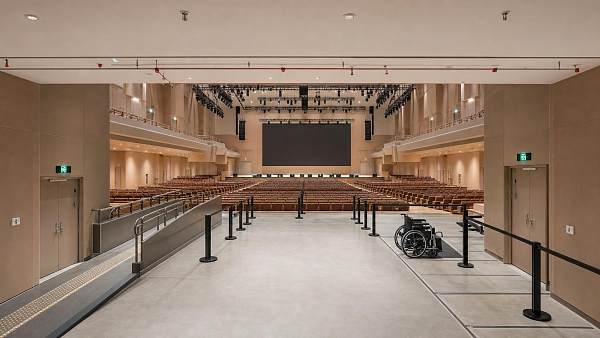
Standard acoustic panels can be enough for a small, speech-focused performance space with a straightforward reflection problem. They are rarely a complete solution for a concert hall, amplified music venue, or multipurpose theater. The distinction matters: a room can sound less echoey after treatment and still have uneven bass, poor coverage, or a stage where performers struggle to hear one another.
For venue owners, designers, and procurement teams, the useful question is not how many panels to buy. It is which acoustic problems need solving, what should remain acoustically live, and how performance requirements change between events. This guide explains how to make that judgment before committing to a specification.
Start with the performance, not the wall finish
“Standard acoustic panel” is a purchasing category, not a consistent acoustic specification. It may describe a fabric-wrapped porous absorber, a decorative felt panel, or a thin foam tile. These products can behave very differently, particularly at lower frequencies. Appearance and surface area alone tell you little about suitability.
Define how the room will actually operate. A black-box theater used mainly for dialogue needs intelligible speech without distracting reflections. An unamplified chamber music room also needs useful reflected energy, tonal balance, and support for musicians. A live club must manage amplified sound, including bass energy that shallow wall treatments may barely affect.
Multipurpose venues complicate the decision. A school auditorium may host assemblies, drama, amplified bands, and acoustic ensembles. Permanently treating it for the driest speech condition can leave music sounding thin. Treating it for musical reverberance can make spoken presentations difficult. Variable absorption, such as retractable acoustic banners or curtains, may help reconcile these uses, but its useful range needs assessment.
Write a short operating brief before requesting quotations. Include event types, seating arrangements, expected occupancy, sound-system use, and whether the stage layout changes. This gives an acoustician something meaningful to design around and stops suppliers from proposing essentially the same panel package for every room.
Diagnose what the audience and performers are hearing
Complaints often point toward a problem, but they are not a diagnosis. “The vocals are muddy” might reflect excessive reverberation, poor loudspeaker aiming, background noise, or several issues together. “There is too much bass” could mean a room resonance, inappropriate subwoofer placement, or an unbalanced system setting.
A clap test can expose flutter echo between reflective surfaces. It cannot establish whether a venue meets its performance requirements, especially at low frequencies. Walk the seating area during representative playback, listen on stage, and note whether the problem changes significantly between positions. Then use measurements to separate room behavior from sound-system behavior.
For an existing venue, the assessment should consider:
- Reverberation and decay across frequency bands, rather than a single broadband figure.
- Speech intelligibility where dialogue or announcements are important.
- Strong delayed reflections from rear walls, balconies, or other distant surfaces.
- Seat-to-seat variation, including low-frequency buildup and cancellations.
- Background noise from ventilation, equipment, and adjacent activities.
ISO 3382-1 provides measurement methods for room acoustic parameters in performance spaces. It does not supply one universal target for every theater or concert hall. Targets should follow the room volume, performance brief, and intended listening conditions. Occupancy matters too: an empty-room assessment needs to account for the acoustic effect of seating and audiences.
Where ordinary absorbers earn their place
Porous absorbers are useful when excessive mid- and high-frequency reflections are the main concern. Correctly selected and positioned, they can reduce flutter echo, shorten excessive decay, and control particular reflections that interfere with speech. In a modest rehearsal or presentation space, that may cover most of the treatment requirement.
Placement is more important than a visually balanced wall layout. A rear-wall reflection reaching the audience late may deserve treatment even when that wall is far from the stage. Ceiling treatment may be useful where wall area is limited. Conversely, removing a helpful early reflection can reduce perceived projection or make performers feel disconnected.
Do not specify panels by Noise Reduction Coefficient alone. NRC, reported through testing under ASTM C423, summarizes absorption at selected frequencies. It is convenient for product comparison, but it conceals the full frequency response and says nothing directly about where a panel should go. Two products with similar NRC values may perform differently in the frequency range causing trouble.
Request frequency-band absorption results and the tested mounting arrangement. Thickness, backing, air gap, and installation configuration all matter. A quotation based on a panel mounted with an air cavity should not be treated as equivalent to the same product installed directly against masonry.
The problems that need more than wall panels
Low-frequency control is often the dividing line. Thin porous panels generally absorb higher frequencies more effectively than deep bass. Adding more of them can make a venue less lively without resolving a persistent bass resonance. The result is a room that sounds dull and boomy at the same time.
Deeper porous treatment or appropriately designed resonant absorbers may be needed. These solutions require space, and tuned systems need a defined frequency problem. “Bass trap” is not a sufficient specification: ask what frequency range the design addresses and what evidence supports its performance.
Diffusion and reflection control serve different purposes from absorption. A diffuser redistributes reflected sound rather than simply removing it. Suitable reflective elements can help direct useful energy toward audiences or performers. Neither should be selected as decorative accessories; geometry, operating frequency range, and distance from listeners affect whether they are appropriate.
Stage acoustics deserve their own review. A heavily absorbed stage may make performers depend more on monitoring, while poorly directed reflections can make ensemble listening difficult. Reflectors, shells, and adjustable treatments may be appropriate, depending on the performance format and stage configuration.
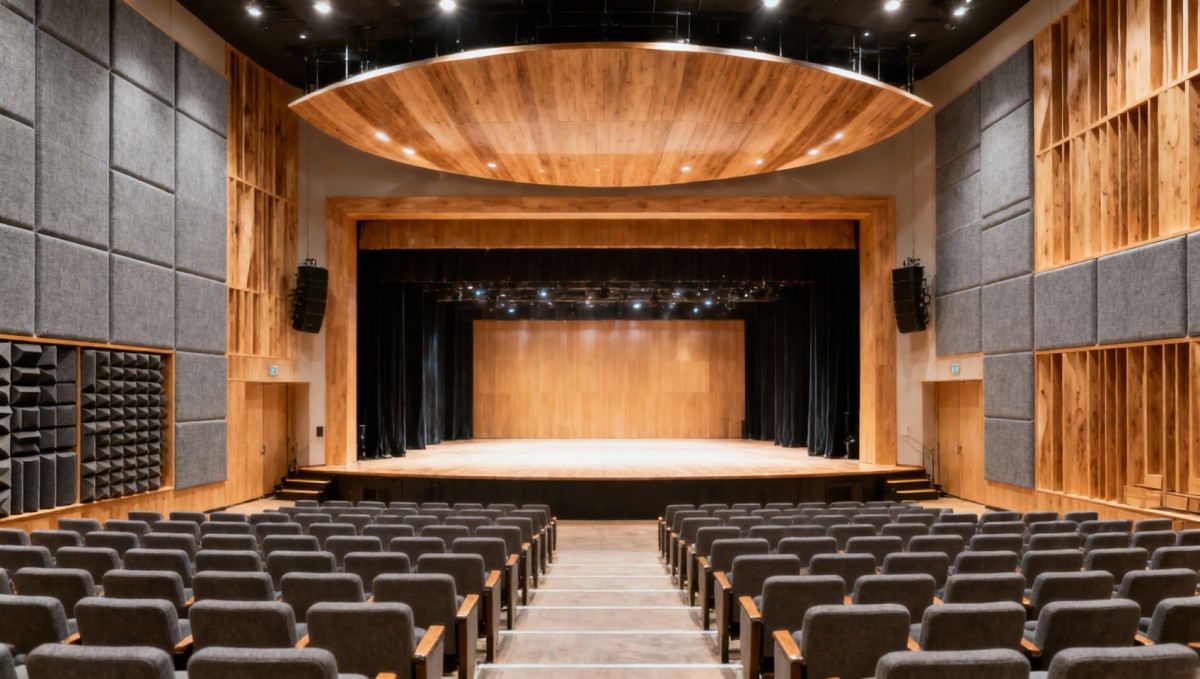
There is also a separate building problem: absorption is not sound isolation. Panels inside a room do not replace an isolation strategy for walls, doors, glazing, ventilation paths, and structural connections. If music disturbs adjoining hotel rooms or neighboring properties, investigate transmission routes. Buying more absorbers is not a dependable substitute.
Design the treatment and sound system together
In an amplified venue, acoustic treatment and loudspeaker design should not be separate projects that meet only during installation. Loudspeaker directivity, aiming, placement, delay alignment, and subwoofer configuration all influence how much energy reaches the audience and surrounding surfaces.
Consider a balcony front receiving substantial loudspeaker energy. Absorbing that surface might help, but revising the loudspeaker layout could reduce the problem at its source. Similarly, equalization cannot reliably remove a long room decay or repair every seat-dependent cancellation. Treatment cannot compensate for a fundamentally unsuitable coverage design either.
For budget-constrained projects, compare interventions by the problem they address. Targeted treatment and improved aiming may be more useful than extensive decorative coverage. In another room, the sound system may already be appropriate and deeper acoustic treatment may be unavoidable. Measurements and modeling help distinguish those situations before money is spent.
Turn the acoustic design into a buyable specification
The procurement challenge is preserving the design through substitutions, fabrication, and installation. A replacement panel may match the approved color and dimensions yet have a different core, facing, or mounting requirement. That is an acoustic substitution, not merely a finish change.
Commercial sourcing platforms such as Global Commercial Trade (GCT), which connects pro-audio and commercial-space sourcing interests, can help buyers organize supplier comparisons. However, supplier discovery should remain separate from project acceptance. A listing or attractive sample does not establish that the proposed assembly suits the venue.
Ask for documentation tied to the product actually being supplied:
- Acoustic evidence: test reports identifying the construction, facing, thickness, and mounting configuration.
- Safety information: fire-performance documentation applicable to the specified assembly and local requirements, plus secure fixing details for overhead installations.
- Installation constraints: required cavities, access provisions, allowable field modifications, and interfaces with lighting, sprinklers, and ventilation.
- Serviceability: cleaning methods, impact resistance where exposed, replacement availability, and access to concealed equipment.
Fire classifications are not automatically interchangeable across markets. Confirm what the local authority requires and whether the documentation covers the relevant facing, core, adhesive, and assembly. Custom finishes also need review: an acoustically restrictive covering can change the behavior of an otherwise suitable absorber.
Decide what “enough” means before installation
Standard panels are enough when the diagnosed problem falls within their capabilities and the completed installation meets agreed acoustic objectives. They are not enough simply because a supplier recommends a coverage percentage or the room sounds quieter during an informal visit.
Agree on acceptance criteria before ordering. Identify measurement positions, room configurations, occupancy assumptions, and relevant performance conditions. For amplified spaces, coordinate room verification with sound-system commissioning so that improvements—and remaining faults—can be attributed correctly.
Where practical, phase the work around a complete design rather than isolated purchases. Install the highest-priority measures, reassess, and retain the ability to adjust subsequent treatment. Before approving the panel order, ask one final question: does every specified element solve an identified problem without removing something the performance needs? If that answer is unclear, the specification is not ready.
Search News
Hot Articles
Popular Tags
Need ExpertConsultation?
Connect with our specialized leisureengineering team for procurementstrategies.
Recommended News
 Oct 15, 2026Designing Theater Sound Systems for Clear Dialogue and Even Audience CoverageOptimize stage sound for theaters with practical tips on acoustics, speaker placement, and tuning. Discover how to deliver clear dialogue and consistent coverage across audience seating.● Pro Audio Engineer
 Oct 16, 2026Are Standard Acoustic Panels Enough for Performance Venues?Are standard acoustic panels enough for performance venues? Discover their limits, explore bass control and diffusion, and learn how to choose treatments that improve sound without wasting budget.● Pro Audio Engineer
 Sep 30, 2026How to Choose an Aluminum Projector Ceiling Mount for Load, Drop, and Ceiling TypeChoose an aluminum projector ceiling mount with confidence. Learn how load capacity, drop length, ceiling structure, safety retention, and service access shape a reliable commercial AV installation.● Pro Audio Engineer
 Sep 26, 2026How to Choose Dynamic Microphones for Vocals in Live Stage SettingsDynamic microphones for vocals: learn how to match polar patterns, feedback control, durability, and clarity to live stage needs for reliable, professional sound.● Pro Audio Engineer
 Sep 07, 2026How to Choose Wall Mount Speakers for Clear Audio in Commercial SpacesWall mount speakers for commercial spaces: learn how to optimize coverage, SPL, directivity, installation, and system design for clear, reliable audio.● Pro Audio Engineer
 Sep 03, 2026How to Choose Locking Speakon Speaker Cables for Reliable Live Sound ConnectionsLocking Speakon speaker cables: learn how to select the right gauge, connector pinout, strain relief, and durable construction for reliable live sound connections.● Pro Audio Engineer
 Sep 08, 2026Is It Worth Upgrading a Stage Sound System Mid-Project?Is it worth upgrading stage sound systems mid-project? Discover how to assess performance gaps, costs, compatibility, and long-term venue value.● Pro Audio Engineer
 Sep 04, 2026Can AV Systems Be Retrofitted Into Older Commercial Buildings?Can AV integration be retrofitted into older commercial buildings? Discover practical strategies for reliable, code-aware AV upgrades with minimal disruption.● Pro Audio Engineer
 Jul 17, 2026How to Choose a Crossover Networks Supplier: Key Specs, Quality Checks, and OEM FactorsFind the right crossover networks supplier with this practical guide to key specs, quality checks, OEM factors, and supply chain risks for better audio performance and sourcing confidence.● Pro Audio Engineer
 Jul 16, 2026How to Evaluate ODM Services for Pro Audio: Design, Certification, and Production CapabilitiesODM services for pro audio: learn how to assess design depth, certification readiness, and production strength to choose a reliable partner and launch better audio products with less risk.● Pro Audio Engineer
 Jul 15, 2026JETRO Flags Modular, Low-Power Shift in Pro Stage AudioPro Stage Audio buyers in Japan are shifting fast: JETRO flags modular amplifiers, IP65 line arrays, low standby power, and JIS compliance as key to channel entry.● Pro Audio Engineer
 Jul 15, 2026Paper Speaker Cones Explained: How Cone Weight and Stiffness Affect SoundPaper speaker cones explained: discover how cone weight and stiffness shape sensitivity, clarity, breakup control, and real-world speaker performance for smarter audio sourcing.● Pro Audio Engineer
 Jul 15, 2026Performance Venues Compliance Checklist: Fire Safety, Accessibility, and Crowd RulesPerformance venues compliance checklist covering fire safety, accessibility, and crowd rules. Learn how to reduce delays, improve approvals, and open safer, more resilient venues.● Pro Audio Engineer
 Jul 14, 2026Japan Adds EMC Immunity Test for Stage AmplifiersJapan Adds EMC Immunity Test for Stage Amplifiers: learn how Japan’s 2026 JIS update affects EMC testing, JIS marking, certification timing, and market access for exporters.● Pro Audio Engineer
 Jul 13, 2026CISCE 2026 Adds Pro Stage Audio ZoneCISCE 2026 Adds Pro Stage Audio Zone as free overseas pre-registration opens. Explore key updates for pro audio suppliers, distributors, and system integrators before the Shanghai expo.● Pro Audio Engineer
 Jul 12, 2026Japan Tightens Pro Stage Audio Efficiency Limits Under JIS C 8105-2026Japan Tightens Pro Stage Audio Efficiency Limits Under JIS C 8105-2026: learn how new PSE compliance rules reshape market access, product eligibility, and shipment planning in Japan.● Pro Audio Engineer
 Jul 12, 2026How to Choose Low Profile Ceiling Speakers for Hotels, Offices, and Retrofit ProjectsLow profile ceiling speakers for hotels, offices, and retrofit projects: learn how to compare depth, coverage, compliance, and installation factors to choose the right fit.● Pro Audio Engineer
 Jul 11, 2026Japan Tightens JIS C 8105-2026 for Pro AudioJapan Tightens JIS C 8105-2026 for Pro Audio: learn how stricter standby power, PSE diamond mark rules, and the 2026 deadline impact exports, compliance, and market access.● Pro Audio Engineer
 Jul 10, 2026JETRO Q2 Outlook Signals Higher Stage Audio DemandJETRO Q2 Outlook signals higher stage audio demand in Japan, with 37% procurement growth and stricter PSE Annex D compliance. See what importers, manufacturers, and rental channels must act on now.● Pro Audio Engineer
 Jul 10, 2026How to Choose Wall Mount Speakers for Restaurants by Layout, Coverage, and SPLWall mount speakers for restaurants should match layout, coverage, and SPL. Learn how to choose the right setup for even sound, guest comfort, and reliable performance.● Pro Audio Engineer
 Jul 09, 2026JIS T 9001:2026 Adds Mandatory AI Noise LabelsJIS T 9001:2026 adds mandatory AI noise labels for pro audio gear from October 2026. Learn how it impacts compliance, testing, exports, and product launches.● Pro Audio Engineer
 Jul 06, 2026Improving Sound Reinforcement Speech Clarity: Key Causes of Muddiness and How to Fix ThemSound reinforcement speech clarity starts with identifying reverberation, coverage, noise, and timing issues. Discover practical fixes that make announcements clearer and commercial spaces perform better.● Pro Audio Engineer
 Jul 05, 2026Saudi Rule Adds Arabic UI Requirement for Pro Audio ImportsSaudi Rule Adds Arabic UI Requirement for Pro Audio Imports: learn how SASO’s new Arabic UI mandate affects digital amplifiers, DSP processors, and network audio interfaces before Sept. 1, 2026.● Pro Audio Engineer
 Jul 02, 2026How to Choose Audio Mixing Consoles for Live Venues: Channels, Buses, and I/O ExplainedAudio mixing consoles explained for live venues: learn how to choose the right channels, buses, and I/O to improve workflow, support growth, and avoid costly mistakes.● Pro Audio Engineer