How to Choose Low Profile Ceiling Speakers for Hotels, Offices, and Retrofit Projects
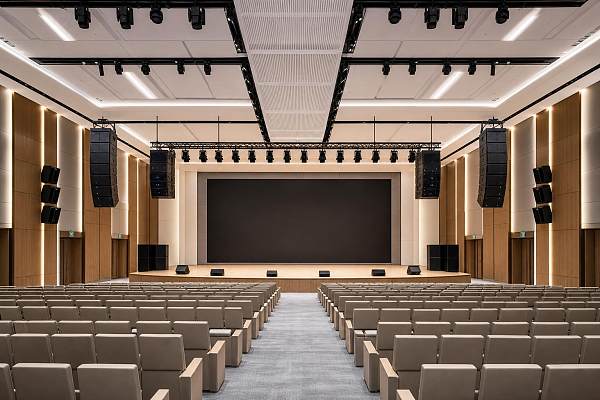
Choosing low profile ceiling speakers for hotels, offices, and retrofit projects is rarely a simple space-saving decision. In commercial environments, the speaker must disappear visually while still delivering clear coverage, reliable performance, and practical installation value across ceilings that are often already crowded with lighting, HVAC, and fire systems.
That balance matters more today because commercial spaces are judged by experience as much as function. In hospitality, education, and workplace projects, audio quality shapes comfort, privacy, brand perception, and day-to-day usability. A poor choice can create uneven sound, rework costs, and maintenance problems that outlast the fit-out phase.
From GCT’s cross-sector sourcing perspective, low profile ceiling speakers sit at the intersection of design, compliance, and supply chain discipline. They are small components, but they influence acoustic outcomes in spaces where aesthetics, safety standards, and long-term serviceability all carry business weight.
What low profile ceiling speakers really mean in commercial projects
Low profile ceiling speakers are in-ceiling audio units designed with reduced mounting depth. They are made for projects where plenum space is limited, ceiling voids are shallow, or existing building conditions make standard speaker housings difficult to install.
That reduced depth does not automatically define performance quality. Some models are engineered for background music only. Others support paging, speech reinforcement, or higher-output zones. The right interpretation depends on the room function, not on product thickness alone.
In practice, low profile ceiling speakers are chosen when the ceiling cannot be treated as an empty cavity. Retrofit offices, guestroom corridors, meeting suites, restaurants, and multi-use public areas are common examples.
Why the category is getting more attention
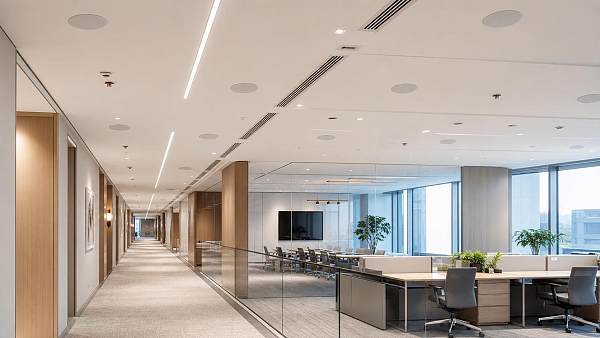
Commercial interiors are becoming more compact and more integrated. Slim lighting systems, sensors, sprinklers, cable trays, and acoustic treatments compete for the same overhead space. Speaker selection now affects coordination across several trades, not only the AV package.
There is also a shift toward cleaner architectural finishes. Hotels want discreet public-area audio. Offices prefer ceilings that support collaboration without visual clutter. Retrofit projects often need better sound without major ceiling reconstruction.
This is why low profile ceiling speakers are increasingly evaluated as a project coordination tool as much as an audio device. They can reduce clashes, simplify approvals, and preserve design intent when the construction schedule leaves little room for revision.
Different spaces ask for different priorities
A hotel lobby, an open office, and a retrofit classroom may all use low profile ceiling speakers, yet the success criteria are not the same. Sound character, SPL needs, zoning logic, and visual expectations change by use case.
The point is straightforward. A low profile ceiling speaker that works well in a quiet corridor may underperform in a collaborative office zone. Selection has to begin with room purpose and listening behavior.
The technical factors that matter most
Mounting depth and ceiling conditions
Start with the real ceiling build-up, not the drawing assumption. Measure void depth, identify obstructions, and confirm whether back cans, insulation, or fire barriers will reduce usable space.
Many low profile ceiling speakers look compact in catalog images but require extra depth for cable bend radius or transformer housing. That detail often determines whether installation stays simple or becomes a site issue.
Audio performance beyond the headline spec
Power rating alone does not tell the full story. For commercial use, frequency response, sensitivity, dispersion angle, and maximum SPL are more useful when assessing real coverage and clarity.
Speech-driven spaces need intelligibility first. Hospitality venues often need a smoother tonal balance at lower listening levels. In both cases, uniform coverage usually matters more than chasing peak loudness.
Transformer and system architecture
Check whether the project uses 70V or 100V distributed audio, low-impedance systems, or a hybrid layout. Low profile ceiling speakers should match the system architecture without requiring awkward workarounds.
Tap settings, loop-through wiring, and accessible connectors can save significant commissioning time. On larger sites, those small details affect labor cost and future service visits.
Certifications and risk control
Commercial projects often require documented compliance, not just product claims. Depending on jurisdiction and building type, that may include UL, CE, RoHS, plenum ratings, seismic restraints, or local fire-related requirements.
For international sourcing, consistency in documentation matters as much as the product itself. GCT’s broader sourcing lens is useful here because specification risk often appears during approvals, not during product discovery.
What separates a workable specification from a risky one
A common mistake is choosing low profile ceiling speakers too late, after the reflected ceiling plan is effectively fixed. That tends to compress acoustic review into a cosmetic decision and leaves little room to address spacing, zoning, or access.
A stronger specification usually includes the following checks:
- Verified ceiling depth in typical and worst-case locations.
- Target use by zone, such as BGM, paging, conferencing, or mixed use.
- Required coverage pattern and estimated speaker spacing.
- Finish options that align with the architectural palette.
- Compliance documents ready for consultant and authority review.
- Service access expectations over the product life cycle.
This kind of review reduces surprises later. It also improves supplier comparisons because the discussion moves from generic product claims to project-specific fit.
Retrofit projects need a different mindset
Retrofit work deserves separate attention because the ceiling condition is rarely ideal. Existing cutouts may not match current models. Legacy wiring may be undocumented. Hidden obstructions can change the plan after demolition begins.
In these cases, low profile ceiling speakers offer a real advantage, but only if the installation method is equally practical. Tool-free clamps, adaptable trim, clear templates, and forgiving connector access become highly relevant.
It is also worth checking whether the retrofit requires visual continuity with older fixtures. A slim speaker that sounds excellent may still be rejected if grille appearance disrupts the finished ceiling rhythm.
How sourcing strategy affects project outcomes
For commercial buyers, the speaker is only one part of the decision. Lead times, batch consistency, spare availability, technical support, and documentation quality affect whether the chosen product remains viable through procurement and handover.
This is where a sourcing platform such as GCT adds context. The value is not in promoting one model over another. It is in connecting specification decisions with broader signals such as manufacturing capability, reliability of supply, and relevance to hospitality or office fit-outs.
In a fragmented market, two low profile ceiling speakers can appear similar on paper while carrying very different execution risk. Consistent QA, credible project references, and complete technical files often make the difference.
A practical way to move forward
A useful next step is to build a short comparison matrix before product approval. Include ceiling depth, zone purpose, acoustic target, certification needs, finish requirements, and supply lead time. That framework exposes weak fits quickly.
If mock-ups are possible, test low profile ceiling speakers in at least one representative room. Listening in the actual ceiling environment reveals more than a brochure can, especially in speech-critical or design-sensitive spaces.
The best choice is usually the one that solves several constraints at once. It should fit the ceiling honestly, support the intended listening experience, satisfy compliance review, and remain dependable through installation and maintenance. That is the standard worth applying before any final shortlist is locked.
Search News
Hot Articles
- Musical InstrumentsA Practical Guide to Identifying Wooden Orchestral Instruments by Family and ToneOct 10, 2026
- Indoor PlaygroundHow to Choose Animatronic Haunted House Props for High-Throughput AttractionsOct 08, 2026
- Fashion & Gem JewelryThermal Diamond Testers: How They Work and When They Can Misidentify StonesOct 07, 2026
Popular Tags
Need ExpertConsultation?
Connect with our specialized leisureengineering team for procurementstrategies.
Recommended News
 Sep 30, 2026How to Choose an Aluminum Projector Ceiling Mount for Load, Drop, and Ceiling TypeChoose an aluminum projector ceiling mount with confidence. Learn how load capacity, drop length, ceiling structure, safety retention, and service access shape a reliable commercial AV installation.● Pro Audio Engineer
 Sep 26, 2026How to Choose Dynamic Microphones for Vocals in Live Stage SettingsDynamic microphones for vocals: learn how to match polar patterns, feedback control, durability, and clarity to live stage needs for reliable, professional sound.● Pro Audio Engineer
 Sep 07, 2026How to Choose Wall Mount Speakers for Clear Audio in Commercial SpacesWall mount speakers for commercial spaces: learn how to optimize coverage, SPL, directivity, installation, and system design for clear, reliable audio.● Pro Audio Engineer
 Sep 03, 2026How to Choose Locking Speakon Speaker Cables for Reliable Live Sound ConnectionsLocking Speakon speaker cables: learn how to select the right gauge, connector pinout, strain relief, and durable construction for reliable live sound connections.● Pro Audio Engineer
 Sep 08, 2026Is It Worth Upgrading a Stage Sound System Mid-Project?Is it worth upgrading stage sound systems mid-project? Discover how to assess performance gaps, costs, compatibility, and long-term venue value.● Pro Audio Engineer
 Sep 04, 2026Can AV Systems Be Retrofitted Into Older Commercial Buildings?Can AV integration be retrofitted into older commercial buildings? Discover practical strategies for reliable, code-aware AV upgrades with minimal disruption.● Pro Audio Engineer
 Jul 17, 2026How to Choose a Crossover Networks Supplier: Key Specs, Quality Checks, and OEM FactorsFind the right crossover networks supplier with this practical guide to key specs, quality checks, OEM factors, and supply chain risks for better audio performance and sourcing confidence.● Pro Audio Engineer
 Jul 16, 2026How to Evaluate ODM Services for Pro Audio: Design, Certification, and Production CapabilitiesODM services for pro audio: learn how to assess design depth, certification readiness, and production strength to choose a reliable partner and launch better audio products with less risk.● Pro Audio Engineer
 Jul 15, 2026JETRO Flags Modular, Low-Power Shift in Pro Stage AudioPro Stage Audio buyers in Japan are shifting fast: JETRO flags modular amplifiers, IP65 line arrays, low standby power, and JIS compliance as key to channel entry.● Pro Audio Engineer
 Jul 15, 2026Paper Speaker Cones Explained: How Cone Weight and Stiffness Affect SoundPaper speaker cones explained: discover how cone weight and stiffness shape sensitivity, clarity, breakup control, and real-world speaker performance for smarter audio sourcing.● Pro Audio Engineer
 Jul 15, 2026Performance Venues Compliance Checklist: Fire Safety, Accessibility, and Crowd RulesPerformance venues compliance checklist covering fire safety, accessibility, and crowd rules. Learn how to reduce delays, improve approvals, and open safer, more resilient venues.● Pro Audio Engineer
 Jul 14, 2026Japan Adds EMC Immunity Test for Stage AmplifiersJapan Adds EMC Immunity Test for Stage Amplifiers: learn how Japan’s 2026 JIS update affects EMC testing, JIS marking, certification timing, and market access for exporters.● Pro Audio Engineer
 Jul 13, 2026CISCE 2026 Adds Pro Stage Audio ZoneCISCE 2026 Adds Pro Stage Audio Zone as free overseas pre-registration opens. Explore key updates for pro audio suppliers, distributors, and system integrators before the Shanghai expo.● Pro Audio Engineer
 Jul 12, 2026Japan Tightens Pro Stage Audio Efficiency Limits Under JIS C 8105-2026Japan Tightens Pro Stage Audio Efficiency Limits Under JIS C 8105-2026: learn how new PSE compliance rules reshape market access, product eligibility, and shipment planning in Japan.● Pro Audio Engineer
 Jul 12, 2026How to Choose Low Profile Ceiling Speakers for Hotels, Offices, and Retrofit ProjectsLow profile ceiling speakers for hotels, offices, and retrofit projects: learn how to compare depth, coverage, compliance, and installation factors to choose the right fit.● Pro Audio Engineer
 Jul 11, 2026Japan Tightens JIS C 8105-2026 for Pro AudioJapan Tightens JIS C 8105-2026 for Pro Audio: learn how stricter standby power, PSE diamond mark rules, and the 2026 deadline impact exports, compliance, and market access.● Pro Audio Engineer
 Jul 10, 2026JETRO Q2 Outlook Signals Higher Stage Audio DemandJETRO Q2 Outlook signals higher stage audio demand in Japan, with 37% procurement growth and stricter PSE Annex D compliance. See what importers, manufacturers, and rental channels must act on now.● Pro Audio Engineer
 Jul 10, 2026How to Choose Wall Mount Speakers for Restaurants by Layout, Coverage, and SPLWall mount speakers for restaurants should match layout, coverage, and SPL. Learn how to choose the right setup for even sound, guest comfort, and reliable performance.● Pro Audio Engineer
 Jul 09, 2026JIS T 9001:2026 Adds Mandatory AI Noise LabelsJIS T 9001:2026 adds mandatory AI noise labels for pro audio gear from October 2026. Learn how it impacts compliance, testing, exports, and product launches.● Pro Audio Engineer
 Jul 06, 2026Improving Sound Reinforcement Speech Clarity: Key Causes of Muddiness and How to Fix ThemSound reinforcement speech clarity starts with identifying reverberation, coverage, noise, and timing issues. Discover practical fixes that make announcements clearer and commercial spaces perform better.● Pro Audio Engineer
 Jul 05, 2026Saudi Rule Adds Arabic UI Requirement for Pro Audio ImportsSaudi Rule Adds Arabic UI Requirement for Pro Audio Imports: learn how SASO’s new Arabic UI mandate affects digital amplifiers, DSP processors, and network audio interfaces before Sept. 1, 2026.● Pro Audio Engineer
 Jul 02, 2026How to Choose Audio Mixing Consoles for Live Venues: Channels, Buses, and I/O ExplainedAudio mixing consoles explained for live venues: learn how to choose the right channels, buses, and I/O to improve workflow, support growth, and avoid costly mistakes.● Pro Audio Engineer
 Jul 01, 2026UL 62368-3:2026 Adds EMC Rules for Pro Stage AudioUL 62368-3:2026 adds EMC rules for Pro Stage Audio, requiring Level 4 immunity and manual labeling by Oct 1, 2026. See what exporters, makers, and buyers must do now.● Pro Audio Engineer
 Jun 30, 2026Sound Reinforcement Design Basics: How to Plan Coverage, SPL, and Speaker PlacementSound reinforcement design starts with smarter coverage, target SPL, and speaker placement. Learn how to plan clearer, more reliable audio performance for commercial spaces.● Pro Audio Engineer