Should You Prioritize Stage Sound or Audience Coverage?
Should You Prioritize Stage Sound or Audience Coverage?
When planning a live sound system, one question can shape almost every equipment decision: should I prioritize stage sound or audience coverage first? Clear monitoring helps performers deliver, while well-designed audience coverage keeps vocals intelligible and listening levels reasonably consistent across the venue. Both matter, but they solve different problems—and spending equally on each does not necessarily produce a balanced system.
For most commercial venues, design audience coverage first, while protecting a minimum workable monitoring setup. The exception is an immediate stage problem that prevents performers from hearing essential cues or creates persistent feedback. Fix that constraint before adding more front-of-house capability. The useful distinction is between design priority and the next purchase: they are not always the same.
Start with what the room must deliver
A hotel ballroom hosting speeches needs a different balance from a club presenting amplified bands. An outdoor leisure venue with a wide standing audience has another set of demands. Before comparing loudspeakers, identify the program, audience footprint, stage layout, and operating conditions.
For speech-led events, intelligibility should lead the design. Listeners must understand words without the nearest seats becoming uncomfortable. For live music, the audience also needs suitable tonal balance and enough system headroom for peaks. Performers, meanwhile, need the particular signals that support timing, pitch, and confidence—not necessarily a complete copy of the audience mix.
Define where sound is required and where it is not. A dining area beside a hotel stage may need lower levels than the dance floor. A campus auditorium may have under-balcony seats that the main loudspeakers cannot reach cleanly. Treating these spaces as one uniform listening area often leads to excessive volume in one zone and poor clarity in another.
Also distinguish an acoustic problem from a coverage problem. If speech remains smeared throughout a reflective room, additional speakers or louder monitors may simply add more reflected energy. Placement, directivity, acoustic treatment, and operating level need consideration before a larger equipment order.
Diagnose the weak link before deciding what to buy
Run a short listening assessment with someone onstage and someone walking the audience area. Use familiar speech and music, then check with the actual microphones and representative performers whenever possible. Playback alone will not reveal how the system behaves with open microphones.
- Performers cannot hear vocals, but the audience mix is clear: investigate monitor routing, placement, available mixes, and stage volume.
- The front rows are loud while the rear struggles: investigate loudspeaker aiming, mounting height, throw distance, and whether properly integrated fills are needed.
- Vocals become unclear when the band starts: check masking from instruments and monitor spill before assuming the main system lacks power.
- Feedback arrives before useful vocal level: inspect microphone-to-speaker geometry, microphone technique, gain structure, and the offending monitor mix.
- Side seats hear a different balance: examine coverage angles and obstruction rather than turning up the entire system.
These observations establish the next intervention. They also prevent a common procurement mistake: buying higher-output loudspeakers to solve a problem caused by where the existing ones point.
Design audience coverage around geometry, not wattage
Start with a scaled room plan showing the stage, occupied seats, standing zones, ceiling height, and obstructions. Then consider loudspeaker locations that direct useful sound toward listeners while limiting unnecessary energy onto walls, ceilings, and the stage. There is no universally correct cabinet type; a compact point-source system may suit one room, while another requires a more distributed approach.
Published horizontal and vertical coverage angles are useful starting points, not guarantees of uniform sound at every frequency. Ask for polar data or prediction files where available, and examine how the proposed system covers the actual seating geometry. Maximum sound-pressure-level figures also require context: manufacturers may use different measurement methods, so headline numbers are not always directly comparable.
Deep rooms may benefit from delay loudspeakers; shallow, wide rooms may need careful side coverage. Front fills can serve seats below the main system’s effective coverage. But each added source creates another alignment task. Incorrect level, polarity, or delay can make overlapping areas less clear rather than more consistent.
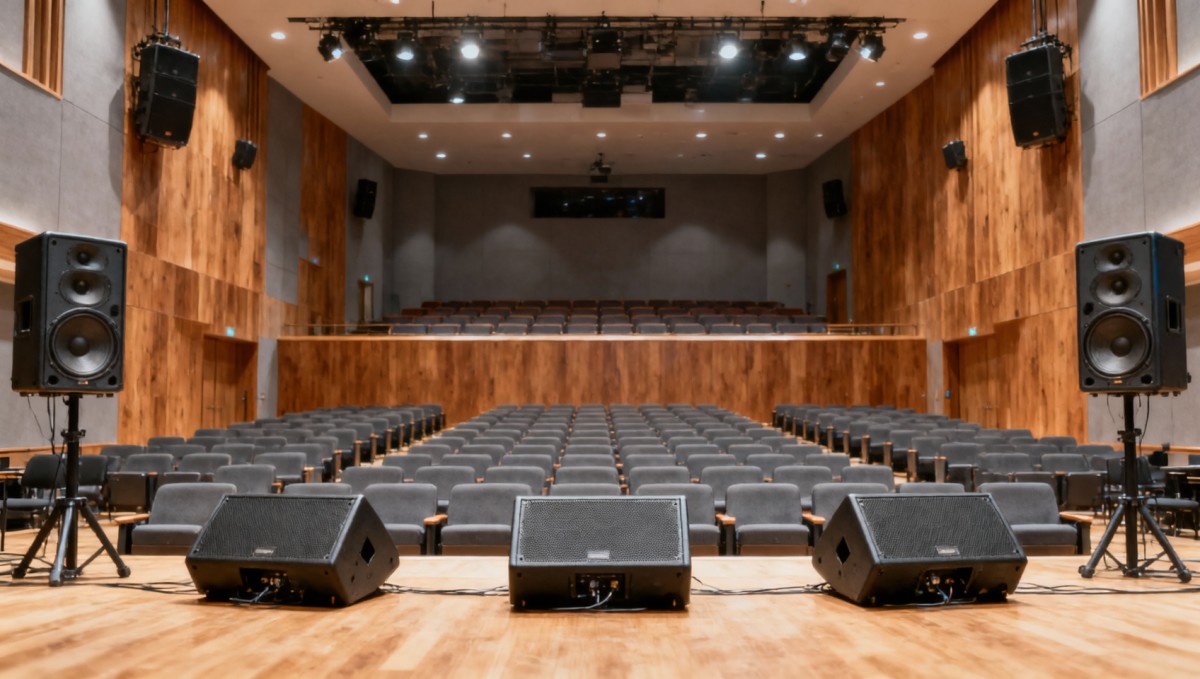
A useful system drawing should show main-speaker coverage, any fill zones, monitor positions, and microphone locations together. Keeping stage and audience diagrams separate can hide conflicts—for example, a main speaker aimed partly across the performance area.
If the design involves suspended equipment, structural suitability and approved rigging hardware require competent assessment. A convenient mounting position is not automatically a safe one. Confirm applicable local requirements before treating installation costs as optional.
Give performers what they need, not everything they request at once
Stage monitoring has a practical minimum: performers must hear the information necessary to do their jobs. A singer may need a clear vocal reference and selected accompaniment. A drummer may depend on bass, timing cues, or playback. A presenter might only need confidence that remote contributors or media playback are audible.
Start monitor mixes sparsely. Adding every instrument to every wedge consumes headroom and can make important signals harder to distinguish. When someone asks for “more vocal,” first establish whether the vocal is too quiet or whether competing instruments are too loud. Those problems have different remedies.
Wedge placement should account for the microphone’s polar pattern and the performer’s position. The best rejection direction is not identical for every microphone, and a placement that works with one model may be poor with another. Aim the monitor toward the performer’s ears, not simply toward their legs, and keep the layout consistent enough to avoid accidental microphone-to-speaker exposure.
In-ear monitoring can reduce wedge spill and provide individual mixes, but it is not a frictionless upgrade. It requires suitable mixer outputs, fitting, performer acceptance, and safe level management. Wireless systems also introduce frequency coordination and jurisdiction-specific spectrum rules. Wired in-ear systems may be practical for stationary performers, although cable routing still needs attention.
Do not assume in-ear monitors will quiet the stage if loud amplifiers and acoustic drums remain unchanged. They address one source of stage sound, not all of it.
When stage sound deserves the next investment
Consider a small amplified-music venue where the main system already reaches the occupied area reasonably well, but singers cannot hear themselves without pushing wedges into feedback. Here, improving monitor placement, adding independent mixes, or reducing amplifier volume may deliver more benefit than replacing the front-of-house speakers.
That is especially relevant where stage spill dominates the nearest audience positions. Loud wedges and backline become part of the room’s mix, often with a balance the front-of-house engineer cannot control. Reducing that spill can improve audience clarity without increasing the main system’s level.
The opposite applies to a speech-focused ballroom where presenters hear adequately but rear and side tables miss words. Expensive personal monitoring would not address the main failure. Coverage design, microphone practice, room treatment, or appropriately aligned distributed speakers deserve attention instead.
These are diagnostic scenarios, not universal prescriptions. The deciding question is whether the current stage setup limits performance, or whether the audience system fails to deliver that performance reliably.
Turn the decision into a sourcing brief
A useful supplier brief describes the problem and required operating conditions, rather than requesting “more powerful speakers.” Include room dimensions, audience zones, typical programs, microphone counts, monitor-mix requirements, installation restrictions, and who will operate the system.
For commercial buyers using Global Commercial Trade (GCT) to research pro-audio suppliers, this is where sourcing intelligence should support the technical decision. Compare the complete deliverable—not just the cabinet price. Relevant checks include documented coverage information, mixer compatibility, mounting accessories, service arrangements, replacement availability, and commissioning support.
Ask bidders to separate essential work from later upgrades. Essentials might include safe mounting, enough monitor sends, suitable signal processing, and commissioning. Additional wireless channels or expanded stage monitoring may be deferred if the current setup is workable. Conversely, a missing monitor mix should not remain unfunded simply because it is less visible than a new main speaker.
For imported equipment, verify electrical compatibility, relevant compliance documentation, and local service access for the intended destination. Avoid assuming that a product sold in one market automatically meets another market’s requirements.
Accept the system from both sides of the stage
Commissioning should include audience listening checks and an onstage rehearsal. Walk the front, rear, sides, and any obstructed zones. Check speech clarity, tonal consistency, and uncomfortable hotspots at representative operating levels. Then confirm that performers can hear essential cues with the intended microphones open.
Evaluate the combined system, not only mains and monitors in isolation. A clean playback demonstration does not prove that vocals will remain intelligible once wedges, amplifiers, and drums are active. Room occupancy can also change acoustic conditions, so leave scope for adjustments during real operation.
Record approved settings, label routing, and train the people who will actually run events. Otherwise, a well-designed system can quickly become an uncontrolled collection of level changes.
The practical rule is to plan around the audience experience, establish reliable stage monitoring, and spend next on the verified bottleneck. Before approving an upgrade, ask the supplier to demonstrate which listening or performance problem it solves—and at which positions. That answer is more useful than another power rating.
Search News
Hot Articles
- Outdoor RidesEnergylandia Announces Rokan, Set to Be Europe’s Tallest and Longest B&M Wing CoasterOct 20, 2026
- Musical InstrumentsChoosing a Classical Guitar Manufacturer in China: Quality Checks Before OrderingOct 20, 2026
- Stationery & UniformsChoosing a Wholesale Chef Coat Supplier: MOQs, Samples, and Lead TimesOct 19, 2026
Popular Tags
Need ExpertConsultation?
Connect with our specialized leisureengineering team for procurementstrategies.
Recommended News
 Oct 15, 2026Designing Theater Sound Systems for Clear Dialogue and Even Audience CoverageOptimize stage sound for theaters with practical tips on acoustics, speaker placement, and tuning. Discover how to deliver clear dialogue and consistent coverage across audience seating.● Pro Audio Engineer
 Oct 20, 2026Should You Prioritize Stage Sound or Audience Coverage?Should I prioritize stage sound or audience coverage first? Discover how to balance clear audience audio, reliable monitoring, and smarter sound-system upgrades for your venue.● Pro Audio Engineer
 Oct 18, 2026How Much Does Studio Acoustic Treatment Cost per Square Meter?How much does studio acoustic treatment cost per square meter? Learn how to compare panel prices, installation fees, and complete budgets to choose the right treatment without overspending.● Pro Audio Engineer
 Oct 17, 2026How Do Line Array and Point Source Sound Systems Differ?What is the difference between line array and point source systems? Compare coverage, costs, and venue fit to find the right solution for clearer sound.● Pro Audio Engineer
 Oct 16, 2026Are Standard Acoustic Panels Enough for Performance Venues?Are standard acoustic panels enough for performance venues? Discover their limits, explore bass control and diffusion, and learn how to choose treatments that improve sound without wasting budget.● Pro Audio Engineer
 Sep 30, 2026How to Choose an Aluminum Projector Ceiling Mount for Load, Drop, and Ceiling TypeChoose an aluminum projector ceiling mount with confidence. Learn how load capacity, drop length, ceiling structure, safety retention, and service access shape a reliable commercial AV installation.● Pro Audio Engineer
 Sep 26, 2026How to Choose Dynamic Microphones for Vocals in Live Stage SettingsDynamic microphones for vocals: learn how to match polar patterns, feedback control, durability, and clarity to live stage needs for reliable, professional sound.● Pro Audio Engineer
 Sep 07, 2026How to Choose Wall Mount Speakers for Clear Audio in Commercial SpacesWall mount speakers for commercial spaces: learn how to optimize coverage, SPL, directivity, installation, and system design for clear, reliable audio.● Pro Audio Engineer
 Sep 03, 2026How to Choose Locking Speakon Speaker Cables for Reliable Live Sound ConnectionsLocking Speakon speaker cables: learn how to select the right gauge, connector pinout, strain relief, and durable construction for reliable live sound connections.● Pro Audio Engineer
 Sep 08, 2026Is It Worth Upgrading a Stage Sound System Mid-Project?Is it worth upgrading stage sound systems mid-project? Discover how to assess performance gaps, costs, compatibility, and long-term venue value.● Pro Audio Engineer
 Sep 04, 2026Can AV Systems Be Retrofitted Into Older Commercial Buildings?Can AV integration be retrofitted into older commercial buildings? Discover practical strategies for reliable, code-aware AV upgrades with minimal disruption.● Pro Audio Engineer
 Jul 17, 2026How to Choose a Crossover Networks Supplier: Key Specs, Quality Checks, and OEM FactorsFind the right crossover networks supplier with this practical guide to key specs, quality checks, OEM factors, and supply chain risks for better audio performance and sourcing confidence.● Pro Audio Engineer
 Jul 16, 2026How to Evaluate ODM Services for Pro Audio: Design, Certification, and Production CapabilitiesODM services for pro audio: learn how to assess design depth, certification readiness, and production strength to choose a reliable partner and launch better audio products with less risk.● Pro Audio Engineer
 Jul 15, 2026JETRO Flags Modular, Low-Power Shift in Pro Stage AudioPro Stage Audio buyers in Japan are shifting fast: JETRO flags modular amplifiers, IP65 line arrays, low standby power, and JIS compliance as key to channel entry.● Pro Audio Engineer
 Jul 15, 2026Paper Speaker Cones Explained: How Cone Weight and Stiffness Affect SoundPaper speaker cones explained: discover how cone weight and stiffness shape sensitivity, clarity, breakup control, and real-world speaker performance for smarter audio sourcing.● Pro Audio Engineer
 Jul 15, 2026Performance Venues Compliance Checklist: Fire Safety, Accessibility, and Crowd RulesPerformance venues compliance checklist covering fire safety, accessibility, and crowd rules. Learn how to reduce delays, improve approvals, and open safer, more resilient venues.● Pro Audio Engineer
 Jul 14, 2026Japan Adds EMC Immunity Test for Stage AmplifiersJapan Adds EMC Immunity Test for Stage Amplifiers: learn how Japan’s 2026 JIS update affects EMC testing, JIS marking, certification timing, and market access for exporters.● Pro Audio Engineer
 Jul 13, 2026CISCE 2026 Adds Pro Stage Audio ZoneCISCE 2026 Adds Pro Stage Audio Zone as free overseas pre-registration opens. Explore key updates for pro audio suppliers, distributors, and system integrators before the Shanghai expo.● Pro Audio Engineer
 Jul 12, 2026Japan Tightens Pro Stage Audio Efficiency Limits Under JIS C 8105-2026Japan Tightens Pro Stage Audio Efficiency Limits Under JIS C 8105-2026: learn how new PSE compliance rules reshape market access, product eligibility, and shipment planning in Japan.● Pro Audio Engineer
 Jul 12, 2026How to Choose Low Profile Ceiling Speakers for Hotels, Offices, and Retrofit ProjectsLow profile ceiling speakers for hotels, offices, and retrofit projects: learn how to compare depth, coverage, compliance, and installation factors to choose the right fit.● Pro Audio Engineer
 Jul 11, 2026Japan Tightens JIS C 8105-2026 for Pro AudioJapan Tightens JIS C 8105-2026 for Pro Audio: learn how stricter standby power, PSE diamond mark rules, and the 2026 deadline impact exports, compliance, and market access.● Pro Audio Engineer
 Jul 10, 2026JETRO Q2 Outlook Signals Higher Stage Audio DemandJETRO Q2 Outlook signals higher stage audio demand in Japan, with 37% procurement growth and stricter PSE Annex D compliance. See what importers, manufacturers, and rental channels must act on now.● Pro Audio Engineer
 Jul 10, 2026How to Choose Wall Mount Speakers for Restaurants by Layout, Coverage, and SPLWall mount speakers for restaurants should match layout, coverage, and SPL. Learn how to choose the right setup for even sound, guest comfort, and reliable performance.● Pro Audio Engineer
 Jul 09, 2026JIS T 9001:2026 Adds Mandatory AI Noise LabelsJIS T 9001:2026 adds mandatory AI noise labels for pro audio gear from October 2026. Learn how it impacts compliance, testing, exports, and product launches.● Pro Audio Engineer